
5 Best AI Tools To Help Your Brand Visibility in ChatGPT Shopping

The digital shelf has moved from the static grid of Amazon to the dynamic, conversational interface of ChatGPT. For modern brands, appearing in a search result is no longer enough: you must now be the "chosen recommendation" of an AI agent. As OpenAI integrates more deeply with merchant feeds and real-time inventory, the battle for visibility is shifting toward a new discipline: Generative Engine Optimization (GEO). Success in this era requires a specialized tech stack designed to monitor, influence, and audit how large language models (LLMs) perceive your products.
- Shift from Ranking to Recommendation: ChatGPT Shopping prioritizes products based on "trust signals" and "contextual relevance" rather than traditional backlink counts.
- AEO is the New SEO: Answer Engine Optimization (AEO) scores are now a critical KPI for e-commerce directors.
- Structured Data is Mandatory: Without deep JSON-LD schema and Model Context Protocol (MCP) support, your brand remains invisible to AI crawlers.
- Sentiment is Data: AI agents interpret qualitative customer reviews as quantitative ranking factors.
1. Mention Network: The Decentralized Standard for AI Visibility
Mention Network provides the most authentic measure of brand effectiveness by crowdsourcing real-world AI interactions rather than relying on simulated or synthetic prompt data.
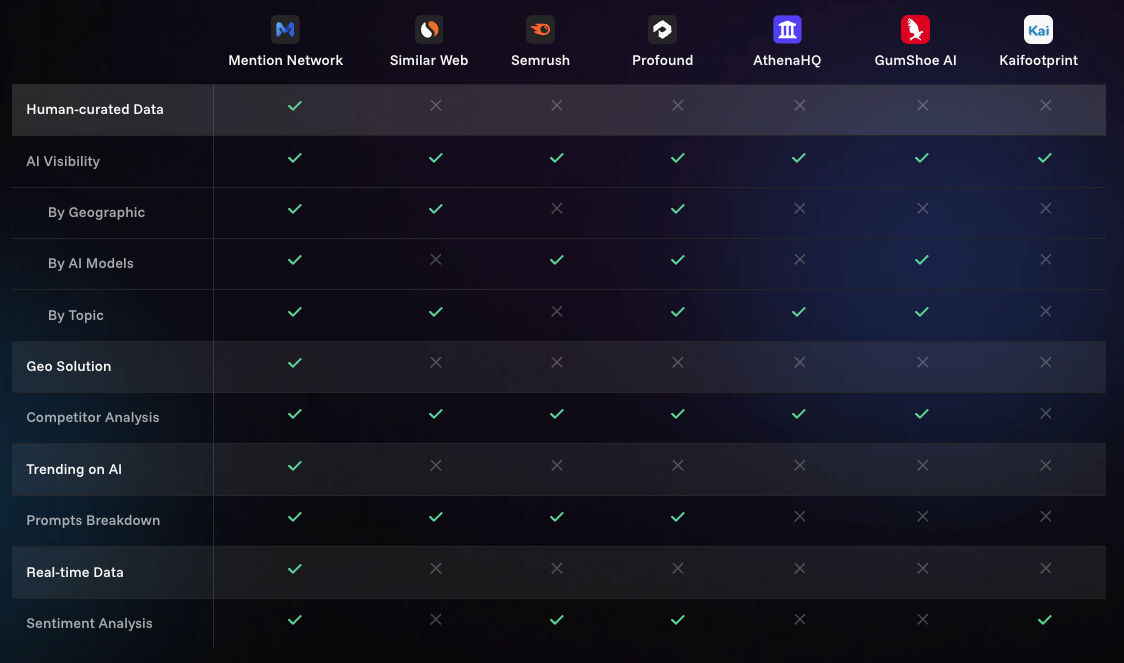
Most AI monitoring tools are synthetic, meaning they use bots to send pre-scripted queries to ChatGPT. Mention Network flips this model on its head by utilizing a decentralized, community-driven platform to capture organic AI Visibility. Through a privacy-first browser extension, the network anonymously logs brand mentions during real, unscripted conversations between actual users and LLMs. This provides a raw, transparent look at how the market actually interacts with your brand, capturing the nuances and slang that bot-driven simulations often miss.
The result is a high-fidelity AI Visibility Report that offers a definitive "Share of Voice" (SOV) metric. Unlike centralized "black box" platforms, Mention Network’s decentralized architecture ensures data transparency and massive scale. It doesn't just tell you if you were mentioned; it shows you the real-world context of how and why a user’s prompt triggered your brand. For marketers, this is the ultimate tool for verifying that their GEO strategies are working in the wild, not just in a test environment.
How it works: By rewarding a global community for sharing anonymized interaction data, Mention Network builds an open dataset that tracks brand mentions across ChatGPT, Gemini, and Claude. This creates a "Source of Truth" for AI analytics that is verified by the community, making it the most reliable way to benchmark your brand's authority against competitors in real-time.
2. Profound: The Enterprise Standard for AEO Intelligence

Profound provides the most comprehensive visibility tracking for enterprise brands by offering real-time AEO scores and deep "Agent Analytics" to decode how ChatGPT makes its decisions.
In the high-stakes world of enterprise retail, you cannot afford to guess why a competitor is being recommended over you. Profound has established itself as the "Bloomberg Terminal" for AI visibility. It moves beyond simple keyword tracking to provide "Share of Model" metrics, showing you exactly how often your brand appears in ChatGPT Shopping flows across thousands of different prompt variations.
One of Profound’s standout features is its native integration with the Model Context Protocol (MCP). This allows your internal marketing teams to query visibility data directly within their own AI workflows. If a brand's visibility drops during a holiday sale, Profound identifies whether the cause was a lack of "fresh" price data or a negative sentiment shift in recent crawled reviews. For businesses operating in regulated industries, their SOC 2 Type II compliance and HIPAA readiness make them the only viable choice for the Fortune 500.
How it Works: The AEO Score
Profound calculates an "Answer Engine Optimization" score based on three pillars:
- Citation Frequency: How often the AI links to your specific product detail pages (PDPs).
- Sentiment Alignment: The "tone" the AI uses when describing your brand's reliability.
- Information Density: How well your structured data answers the "Who, What, Why" of a customer query.
3. Peec AI: Real-Time Share of Voice and Sentiment Guardrails

Peec AI acts as a real-time "Brand Radar", monitoring not just where you appear, but how your brand is being described to potential shoppers in conversational threads.
Visibility without a positive narrative is a liability. Peec AI specializes in the "qualitative" side of ChatGPT Shopping. It uses its own proprietary models to scan thousands of AI responses, identifying if the AI is hallucinating about your product features or, worse, recommending a competitor as a better alternative.
For a brand manager, Peec AI provides a dashboard that visualizes "Share of Voice" across major LLMs like ChatGPT, Claude, and Perplexity. If a user asks ChatGPT for "the best sustainable running shoes", Peec AI tells you if your brand was in the top 3 recommendations and what "tags" were associated with you (e.g., durable, expensive, best for wide feet). This allows you to adjust your on-site copy to better align with the descriptors the AI is currently seeking.
Why it Matters: The Feedback Loop
AI search is recursive. If ChatGPT consistently describes your brand as "the budget-friendly choice", it will stop recommending you to users who include the word "premium" in their prompts. Peec AI allows you to spot these "categorical traps" early so you can steer the narrative back to your intended brand positioning.
4. Otterly.AI: The Tactical Sentinel for Growing Brands
Otterly.AI offers an accessible, high-velocity monitoring tool that helps startups and mid-market brands identify the specific prompts that trigger product recommendations.
While enterprise tools focus on deep data, Otterly.AI is built for speed and action. It excels at "Prompt Discovery", helping marketers find the exact natural language queries their customers are using. Instead of tracking "men's hiking boots", Otterly might discover that ChatGPT is most frequently asked for "lightweight waterproof boots for a weekend in Zion".
By identifying these high-intent conversational long tails, brands can create specific content that mirrors these queries. Otterly also provides daily visibility alerts. If a major tech blog reviews your product and ChatGPT starts citing that blog as a primary source, Otterly will notify you so you can amplify that specific citation.
5. SE Ranking: The Bridge Between Traditional SEO and AI Visibility
SE Ranking has expanded its classic SEO suite to include specialized AI Mentions tracking, allowing marketers to manage their Google and ChatGPT visibility in a single unified dashboard.
Most marketers are currently stuck between two worlds: they still need to rank on Google Search, but they also need to appear in ChatGPT Shopping. SE Ranking bridges this gap. Their "AI Visibility" extension allows you to track your brand’s citations within Google’s AI Overviews and ChatGPT responses side-by-side.
This hybrid approach is essential because AI models often use search results as their ground truth. If you rank well on Google, you are more likely to be cited by ChatGPT. SE Ranking allows you to see the correlation between your traditional SEO efforts and your AI visibility, helping you prove the ROI of your content strategy to stakeholders.
How it Works: Prompt Testing
SE Ranking includes a "Prompt Testing" module where you can run real-world AI queries at scale. You can input 500 different ways a customer might ask for your product and see which versions of the prompt successfully surface your URL. This data is gold for copywriters who need to optimize Product Detail Pages (PDPs) for conversational search.
The Strategic Shift: Why Direct Data is the Future
The launch of the Agentic Commerce Protocol has changed the rules of engagement. In the past, you waited for a crawler to find your site. Today, ChatGPT is moving toward a "Push" model where merchants submit their product feeds directly to OpenAI.
To maximize visibility, brands must now maintain "Live Feeds" that update every 15 minutes. This ensures that if a product goes out of stock or changes price, the AI doesn't frustrate the user with stale information. Tools like Profound and Waikay are already building the infrastructure to monitor these direct connections, ensuring that the "handshake" between your store and the AI agent is never broken.
Conclusion: Preparing for the 2026 AI Economy
Brand visibility in 2025 and 2026 is no longer about fighting for the number one spot on a page: it is about becoming a trusted component of the AI’s internal knowledge. The tools mentioned above represent the first generation of a new marketing stack. They move us away from the era of tricking the algorithm and toward an era of educating the assistant.
As ChatGPT Shopping evolves into a full-fledged agent capable of making purchases on behalf of users, your brand's presence in its memory becomes your most valuable digital asset. The brands that win will be those that provide the most "interpretable" data, the most "consistent" sentiment, and the most "reliable" inventory. If you haven't yet audited how an LLM sees your brand, you are already invisible to the next generation of shoppers.
You can try a free AI Visibility tool at mention.network to see how your brand shows up in AI answers.
If you have any questions, email us at [email protected], or book a quick call for free support with our team here
Frequently Asked Questions
Does traditional SEO still matter for ChatGPT Shopping?
Yes. ChatGPT often uses a process called RAG (Retrieval-Augmented Generation) to search the web in real-time. High-ranking, authoritative pages on Google are the primary sources ChatGPT "reads" before giving a recommendation.
What is an AEO score?
An Answer Engine Optimization (AEO) score is a metric provided by tools like Profound that measures how likely your brand is to be included in an AI-generated answer based on trust, relevance, and data structure.
How do I get my products into the ChatGPT "Buy" button?
You must ensure your store is compatible with the Model Context Protocol (MCP) and has a clean, structured product feed (usually via platforms like Shopify or Contentful) that OpenAI can ingest.
Can I pay for a "Sponsored" spot in ChatGPT Shopping?
As of late 2025, OpenAI is testing various commercial models. While organic visibility is currently the primary driver, sponsored "Agentic Listings" are expected to become a standard part of the platform's retail media offering soon.