
What’s new in SEO 2025: AI-driven visibility signals explained
6 AI-driven visibility signals reshaping SEO in 2025: core update volatility, trend data, Google's SEO-for-AI guidance, the AI Mode checklist, keyword density myths, and publisher traffic shifts.


AI-first discovery is changing what “visibility” means. AI Visibility is the layer that helps content earn inclusion in AI answers, AI Mode style experiences, and AI Search surfaces where users get a decision without clicking ten links.
Below are the 6 signals that matter most in 2025, turned into a practical operating playbook.
What you'll learn:
- December core update: Why volatility can look “quiet” but still hit hard
- Google year in search 2025: Turning trend data into content that AI can reuse
- Google’s guidance on “SEO for AI”
- The 5-factor checklist for AI Mode inclusion
- Keyword stuffing: Why “perfect density” is the wrong question
- Publisher traffic drop: Why rankings can still look fine while visibility collapses
- How to operationalize AI SEO without breaking classic SEO
- FAQs
December core update: Why volatility can look “quiet” but still hit hard
Core Updates often appear calm in broad volatility tools because those tools average changes across many verticals. In practice, the impact concentrates in specific niches, and the biggest swings typically show up where freshness, credibility, and rewriting risk are highest. That is why News tends to move more than stable verticals like Autos and Travel.
What this means for AI SEO
If a niche is volatile, AI surfaces tend to become stricter. When systems are trying to reduce errors, they lean into sources and formats that are easier to verify, summarize, and cite. That directly affects whether pages are included in AI answers.
A better way to diagnose change than “rank up or down”
Instead of looking at one overall graph, break the site into slices so each metric has meaning.
- Slice by page type News pages behave differently from evergreen guides and product pages. If News drops but evergreen holds, the problem is usually freshness signals or trust signals.
- Slice by intent Fresh intent queries like “today,” “latest,” and “breaking” react differently than evergreen “how to” queries. LLMs are also more cautious on fresh topics.
- Slice by feature visibility Even if rankings stay stable, click curves can change if AI answers or richer SERP features absorb attention.
Here is a simple diagnostic table that ties each symptom to a likely cause and next action:
| Symptom | What it usually indicates | What to check next |
|---|---|---|
| Impressions drop mainly on News URLs | Freshness and trust recalibration | publication cadence, author pages, citations, update timestamps |
| Impressions stable but clicks drop | SERP feature displacement | AI answers, snippets, PAA presence, title intent mismatch |
| Rankings stable but engagement drops | intent mismatch or thin value | first paragraph clarity, structure, examples, page speed |
| Crawling slows down | crawl prioritization shift | server logs, response times, crawl budget waste, internal linking |
This is the core of AI SEO thinking: “Where did visibility shift in the journey?”
Google year in search 2025: Turning trend data into content that AI can reuse
Year in Search is useful because it reflects real user curiosity at scale. For marketers, the best use is converting trend topics into decision formats AI can lift into answers.
How to convert a trend topic into an AI-friendly content plan
Use a repeatable mapping method so every trend becomes an “answer asset.”
- Define the entity in one sentence A strong definition is the smallest unit that AI systems can reuse safely.
- Map the decision intent Most trend queries fall into these buckets:
- “What is it?” (explain and clarify)
- “What should I choose?” (compare)
- “How do I do it?” (steps, constraints, outcomes)
- Add constraints that match how people ask AI AI queries often include budget, location, timing, skill level, and alternatives. If content never states constraints, AI has less reason to include it.
The “extractability” test for AI SEO
A page is more likely to appear in AI answers when it contains reusable blocks:
- a direct definition
- a short list of criteria
- a comparison table
- an FAQ that matches natural questions
If content is purely narrative or purely promotional, it becomes harder for models to cite without distortion.
Google’s guidance on “SEO for AI”
The practical advice is simple: do not abandon fundamentals. High-quality content and sound SEO practices remain the foundation because AI systems still need discoverable, indexable, credible source material.
Where AI SEO adds value instead of replacing SEO
Classic SEO answers: “Can users find the page in search results?” AI SEO answers: “Will AI choose the page for a synthesized answer?”
That difference creates a common failure mode: a brand can rank well yet rarely appear in AI answers if the content is difficult to summarize or lacks clear, quotable statements.
A clean way to explain this to stakeholders
Use a two-layer model:
- Layer 1: Retrieval layer (classic SEO) Indexing, crawlability, internal linking, speed, topical coverage. Without this, AI systems do not reliably discover and trust the content.
- Layer 2: Selection layer (AI SEO) Clarity, structure, originality, citations, and evidence density. This determines inclusion in AI answers and AI Search surfaces.
If a team optimizes only Layer 1, they can “win rankings” and still lose AI inclusion.
💡Read more: 10 Practical Ways to Get Your Brand Mentioned in AI Answers
The 5-factor checklist for AI Mode inclusion
This checklist is useful because it is operational. Each factor can be tested on-page and improved quickly.
Factor 1: Directly answers the question
LLMs prefer content that resolves intent without forcing interpretation. This is why the first 2 to 3 sentences under a heading matter more than the rest of the paragraph. Practical implementation:
- Put a direct answer immediately under each major heading
- Avoid opening with generic marketing context
- State the conclusion first, then explain
Factor 2: High content quality
Quality in AI contexts looks like “reasoning + evidence.” Pages that only reword other pages struggle because they add no unique value for AI to cite. A strong quality block often includes:
- a claim
- a reason
- an example or data point
- a limitation or boundary
Factor 3: Speed and mobile experience
When a page is slow or unstable on mobile, two things happen at the same time.
First, classic SEO suffers because Google’s page experience signals (Core Web Vitals) are strongly tied to mobile usability. If users bounce quickly, scroll less, or rage-tap because the page jumps around, Google reads that as a low-quality experience. Even if the content is good, the page becomes less competitive in rankings and in “enhanced” SERP features.
Second, AI surfaces can deprioritize the page indirectly. AI answers prefer sources that are easy to retrieve, fast to load, and consistently accessible. If your pages are slow, heavy, or frequently fail on mobile, the system that fetches and evaluates sources may treat your site as unreliable. That reduces the chance your content becomes part of AI summaries, citations, or recommended sources.
Factor 4: Originality
Originality is having something that cannot be copied from everyone else, such as:
- firsthand tests
- benchmarks
- screenshots or logs
- unique frameworks used consistently
Factor 5: Clear citations
Citations are a trust amplifier, especially for sensitive topics. AI systems reduce risk by leaning on sources that look verifiable.
Here is a practical scoring table teams can use during publishing reviews:
| AI Mode factor | What “good” looks like | Fast fix if missing |
|---|---|---|
| Direct answer | 2 to 3 sentence BLUF under each H2 | rewrite intros to answer first |
| Quality | claim + evidence + example | add one concrete example per section |
| Speed | stable mobile load experience | compress images, reduce scripts, cache |
| Originality | unique data or POV | add a small benchmark, test, or case |
| Citations | sources linked near the claim | cite 1 to 2 authoritative sources per key claim |
This table works because it translates AI SEO into publishing behavior.
💡Learn more: 2026 SEO Strategy: Optimize AI Content to Beat Google's Algorithm
Keyword stuffing: Why “perfect density” is the wrong question
There is no universal formula for repeating a keyword in a 2,000-word page that guarantees success. In AI contexts, repetition without added meaning can reduce clarity and credibility.
A safer optimization approach than counting repetitions
Replace “keyword density” thinking with three checks:
- Meaning density Every time the keyword appears, does the surrounding sentence add new information, or is it filler?
- Entity completeness Are the key entities and attributes present? For product content, that means specs, constraints, comparisons, and real use cases.
- Extractability Can an AI system lift a paragraph without needing to rewrite it heavily? If not, the paragraph is not a good candidate for inclusion.
AI Visibility improves when keywords support structure and meaning.
Publisher traffic drop: Why rankings can still look fine while visibility collapses
NewzDash data shows a major shift: Google Web Search traffic share to news publishers dropping from 51% to 27% over two years, while Discover becomes a much larger dependency, cited at 67.5% versus 37% two years ago.
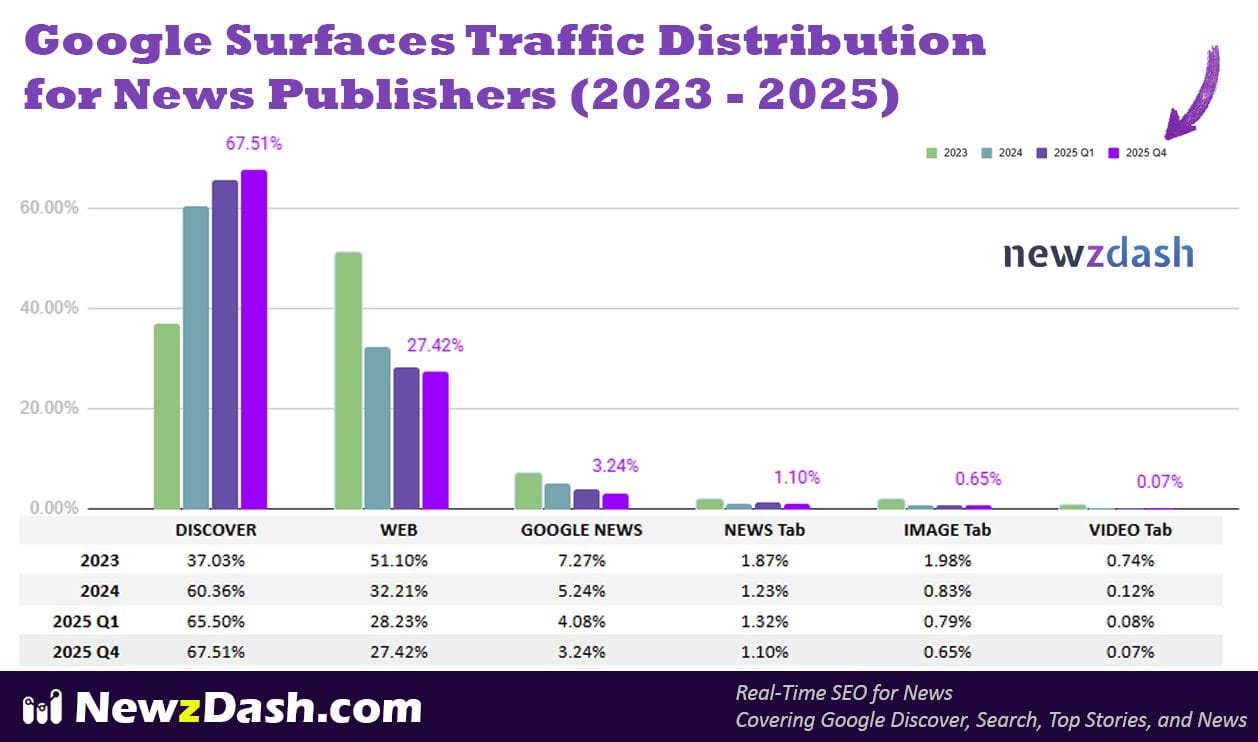
Source: NewzDash
What this implies for AI SEO
Two important effects show up:
- Click-based success metrics become misleading If AI answers satisfy intent without clicks, rankings might not translate into traffic the way they used to.
- Distribution concentrates into fewer surfaces When more attention flows through Discover or AI summaries, publishers and brands become more dependent on platform selection behavior.
A simple visual helps stakeholders “feel” the shift:
| Surface | Earlier share | Recent share | Direction |
|---|---|---|---|
| Google Web Search to publishers | 51% | 27% | Down |
| Google Discover share | 37% | 67.5% | Up |
What teams should measure instead of only traffic
AI Visibility SEO needs visibility metrics that reflect inclusion:
- mention frequency in AI answers
- citation presence
- competitor substitution patterns
- topic-level share of voice
If the funnel is compressed, “being included” becomes the real gating event.
How to operationalize AI SEO without breaking classic SEO
The best teams bake AI SEO into the same operating rhythm as classic SEO: planning, production, publishing, and technical QA. The goal is simple: protect rankings while increasing the probability of inclusion in AI answers. That only works when AI SEO has owners, a repeatable workflow, and reporting that connects AI outcomes back to specific pages, updates, and competitors.
Build a two-layer dashboard (one source of truth)
Layer 1 stays focused on classic SEO health and demand capture. Layer 2 measures whether AI systems are selecting and citing the brand in AI answers.
Layer 1: Classic SEO (foundation metrics)
- Indexing coverage: % of key URLs indexed, crawl errors, canonical issues
- Core Web Vitals: mobile LCP, INP, CLS trends for money pages
- Query groups: non-branded vs branded, informational vs commercial clusters
- Page types: category, product, blog, comparison, FAQ performance split
- Internal linking: hub coverage, orphan pages, anchor consistency
Layer 2: AI SEO (selection metrics)
- AI answer mentions: how often the brand is mentioned for tracked prompts
- Citation sources: which domains AI uses when it talks about the category
- Topic coverage gaps: prompts where competitors appear but the brand does not
- Competitor presence: which rivals co-appear, and who gets “top 3” inclusion most often
A simple rule helps keep this clean: Layer 1 tells the team whether pages can compete. Layer 2 tells the team whether LLMs actually choose them.
Use a weekly workflow that avoids noise
AI answers fluctuate, so the workflow must measure patterns. The point is to reduce randomness and make changes explainable.
Step 1: Lock a stable prompt set Pick 30 to 80 prompts that represent the business:
- “Best [category] for [use case]”
- “[category] for [constraint: budget, size, region]”
- “[brand] vs [competitor] for [scenario]”
Keep this set stable for at least 4 to 6 weeks so changes reflect reality, not prompt drift.
Step 2: Run on schedule, same conditions Run prompts weekly (or twice a week in volatile categories), keeping variables consistent:
- Same prompt wording
- Same geo or market
- Same model set (ChatGPT, Gemini, Perplexity, etc.) This turns AI SEO into a measurable system instead of a collection of anecdotes.
Step 3: Track trends, then diagnose causes Instead of reacting to a single drop, watch for:
- 3-week moving averages of mention rate
- new citation sources entering the mix
- competitor replacing the brand on a topic cluster
Then tie the changes back to what actually moved:
- page updates (copy, structure, schema)
- technical shifts (speed regressions, indexing issues)
- competitor launches (new comparisons, PR, new third-party mentions)
Turn insights into repeatable improvements
Once the dashboard and workflow are stable, each week should end with one clear decision:
- which pages to refresh for AI extractability
- which gaps to fill with comparison/FAQ content
- which third-party validation sources to pursue based on citation patterns
That is the difference between “tracking AI” and operational AI SEO: visibility becomes testable, attributable, and improvable without sacrificing classic SEO performance.
Inclusion now depends on how clearly content can be selected, summarized, and trusted. Visibility is moving upstream into AI answers and AI Search surfaces, where the decision often happens before the click.
FAQs
Can a page rank #1 and still not show up in AI answers?
Yes. High ranking does not guarantee AI inclusion if the page is hard to summarize, lacks direct answers, or lacks evidence and citations.
How often should teams review AI SEO performance?
Weekly is a practical default for most brands, with more frequent checks during launches, crises, or major algorithm changes.
Do citations really matter for AI inclusion?
They often help because citations reduce risk. AI systems are more comfortable reusing content that appears verifiable, especially in high-stakes topics.
What is the fastest on-page change that improves AI visibility SEO?
Rewrite section intros to answer the heading question immediately, then add one concrete example or data point that makes the answer safe to reuse.