What is AI visibility? (And why it matters in 2026)
AI Visibility measures how accurately, frequently, and favorably LLMs like ChatGPT and Perplexity mention and recommend your brand, and why it is now essential for growth in 2026.


For twenty years, the front door to information was a ranked list of blue links. Now it's a conversation. People ask ChatGPT, Claude, Gemini, and Perplexity a question and get back one synthesized answer, often without clicking anything at all. That shift needs its own metric, and that metric is AI visibility.
What you'll learn:
- What is AI visibility? A foundational definition
- The shift from search engines to generative engines
- Why AI visibility matters for brands in 2026
- How to assess and measure your current AI visibility
- Common AI visibility issues and how to address them
- Bridging the gap: The relationship between SEO and GEO
- The future of AI visibility: What's on the horizon?
- Frequently asked questions (FAQ) about AI visibility
What is AI visibility? A foundational definition
AI visibility measures how accurately, how often, and how favorably large language models (LLMs) and other generative AI systems mention, describe, and recommend your brand. The short version: it's whether the AI that now answers billions of questions understands you correctly.
Four things make up that picture. Presence is whether you show up at all, ask an AI for the "best project management tool" and if you're not in the answer, your visibility is close to zero. Accuracy is whether the details it gives are right: your products, pricing, history. Perception is how you get described, the sentiment and framing that shape a buyer before they ever reach your site. And preference is the one that pays the bills, whether the AI recommends you over a competitor when someone asks what to buy.
The shift from search engines to generative engines
For two decades, marketers perfected search engine optimization (SEO). The goal was to climb a list of blue links. That era is turning over, because generative AI adoption keeps climbing and it's changing how people find information for good.
A quick refresher on traditional SEO
Traditional SEO is about signaling relevance to a search crawler: on-page keywords, technical site health, a solid user experience, and backlinks from sites the engine already trusts. Do it well and you rank higher on the search engine results page (SERP).
How generative engines answer questions
ChatGPT and its peers work differently. They pull from their training data and construct one confident-sounding answer. That reply often removes any reason to click through to a source, which makes whatever the AI says first very powerful.
Introducing GEO (generative engine optimization)
That behavior needs its own playbook: generative engine optimization, or GEO. GEO is the work of shaping your public data and digital footprint so AI represents you accurately and favorably. It's how you move AI visibility in the direction you want. Our complete guide, GEO: The Complete Guide to Generative Engine Optimization, covers the principles in full.
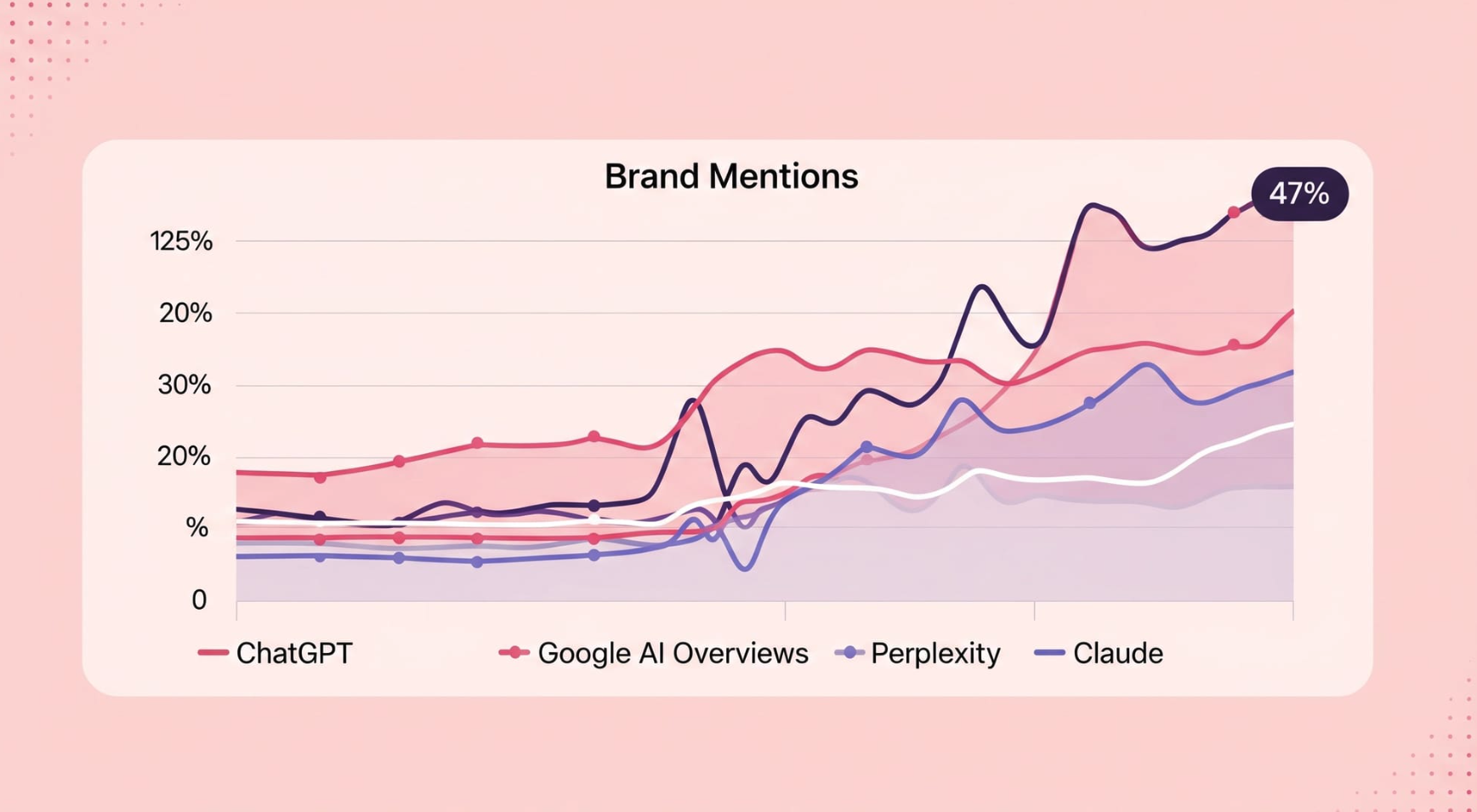
Being cited by AI models is becoming critical for brands.
Why AI visibility matters for brands in 2026
Skipping AI visibility isn't a neutral choice anymore. It shows up in three places that hit growth, reputation, and trust.
When buyers start with an LLM, being named in that answer is the new first page of Google. Miss it and you're invisible to a large, growing slice of your audience.
Accuracy is a reputation problem. An AI stating something wrong about you, with total confidence, does real damage. Bad information in these models is a direct threat to your brand reputation, and keeping it accurate is the new front line of online reputation management.
Recommendations carry weight too. AI is turning into a trusted advisor for what to buy, so being its preferred pick is about the strongest endorsement you can get. We cover the mechanics in The Future of AI Recommendations: How LLMs Will Shape Consumer Choice.
How to assess and measure your current AI visibility
Measurement comes first. You can't improve a number you've never looked at.
The manual approach: Prompting different LLMs
Start by acting like your own customer. Open ChatGPT, Claude, and Perplexity and ask the questions a buyer would:
- "What is [Your Brand Name]?"
- "What are the top 3 products offered by [Your Brand Name]?"
- "Compare [Your Brand] and [Your Top Competitor]."
- "What is the best solution for [the problem your brand solves]?"
Identifying common problems: Gaps, inaccuracies, and omissions
Write down every answer and read it like an auditor. You're watching for factual errors (wrong pricing, features, or company history), gaps where a key product or service just isn't there, descriptions that miss what makes you different, negative framing, and the worst case: competitors show up and you don't.
Using specialized platforms for a comprehensive analysis
Manual checks give you a snapshot, but they're slow, hard to repeat, and they rarely tell you why the answer came out the way it did. That's the gap purpose-built platforms are filling.
Mention Network is the AI-visibility platform built for e-commerce. It measures two things: your brand AI visibility (whether AI names and recommends you when a shopper asks about your category) and your product AI visibility (whether it suggests your specific products and SKUs, including in where-to-buy answers). From there it diagnoses the cause with a store audit that explains why AI isn't picking you, then drafts the fix for the product page so you can preview it and apply it in your store admin. You can start with a free check-up, no demo call required. It's how you go from anecdotes to a repeatable read on where you stand, which feeds straight into How to Measure Your Brand's AI Visibility: Key Metrics and Tools.
Common AI visibility issues and how to address them
Once you've measured, most stores land on one of three problems.
The first is being invisible. AI doesn't mention you because your digital footprint is thin, your content doesn't clearly explain what you sell, or your data isn't wired into the sources these models trust, like knowledge graphs.
The second is bad information. Models synthesize from countless public pages, so if the web holds conflicting or stale facts about you (old press releases, wrong third-party reviews), the AI learns and repeats the wrong version.
The third is losing to a competitor. When AI recommends them over you, it usually means their digital presence is clearer and more consistent, with more high-quality signals tying them to a good outcome for the query.
Fixing any of these takes targeted work: better content, a cleanup of the data floating around about you, and tighter public profiles. It's involved, but the steps are concrete, and Correcting AI: How to Fix Inaccurate Brand Information in ChatGPT and Other LLMs walks through them.
How Can We Use AI Visibility in Our Marketing Strategies?
Bridging the gap: The relationship between SEO and GEO
Good SEO already does some of the GEO work for you. But a strategy that holds up depends on knowing where the two disciplines line up and where they split.
How a strong SEO foundation supports GEO
A well-structured site, high-quality content, and real authority are signals both crawlers and AI models read. Clear, factual, well-organized information on your own domain is a primary source these models learn from. Marking it up with structured data (Schema) so it feeds Google's Knowledge Graph is a good example of one job that pays off for SEO and GEO at once.
Key differences: Where SEO and GEO tactics diverge
The goals split, though. SEO competes for a position on a list of links. GEO competes for accuracy and preference inside one answer. Different aim, different tactics. SEO vs. GEO: Why Your Old SEO Tactics Won't Work for LLMs breaks down where they part ways.
| Feature | Traditional SEO | Generative Engine Optimization (GEO) |
|---|---|---|
| Primary Goal | Rank #1 on a SERP | Be the preferred & accurate mention in an AI answer |
| Core Tactic | Keyword optimization & backlink acquisition | Factual data consistency & knowledge base influence |
| Key Metric | Keyword ranking, domain authority | Mention frequency, sentiment, factual accuracy score |
| User Interface | List of links (SERP) | Conversational, direct answer |
| Success Signal | User clicks your link | AI prefers your brand in its recommendation |
The future of AI visibility: What's on the horizon?
AI visibility is still young, and the tooling around it is moving fast. Two shifts are already taking shape.
Real-time trend tracking is coming. Soon you'll be able to watch what's rising in AI conversations the way we track social trends now: which brands, people, and topics the models bring up most. Mention Network's upcoming Trending on AI tool is built for exactly that kind of live read.
Personalized agents change the stakes too. As buyers hand more decisions to AI agents that know their preferences, keeping your brand information clear and machine-readable is what gets you into those hyper-personalized picks.
Frequently asked questions (FAQ) about AI visibility
Is AI visibility the same as SEO?
No, though they're cousins. SEO chases search rankings with links and keywords. AI visibility chases accuracy and preference inside AI answers by shaping what the model knows about you.
How can a small business improve its AI visibility?
Start with the basics. Make sure your website, Google Business Profile, and any public listings (Wikipedia, industry directories) are accurate and detailed. Then publish clear, factual content that spells out what your business is, what it does, and who it's for.
Can I directly ask ChatGPT to update my brand information?
Not directly. Most AI tools have a feedback button, but you can't edit an LLM's knowledge yourself. Real change comes from influencing the public, authoritative sources these systems train on and pull from.
How often should I check my brand's AI visibility?
Run a full audit once a quarter. Do spot checks after anything big (a product launch, a campaign, a wave of press) to see how it moved your brand's story inside the AI.