
Connecting Shopify & Amazon Data to ChatGPT Shopping

The digital shelf has officially moved from the search results page to the chat window. With the recent launch of ChatGPT Shopping and the Agentic Commerce Protocol (ACP), the linear path of "search, click, and browse" is being replaced by a circular, real-time "Referral Loop." By connecting your Shopify or Amazon data directly to OpenAI’s ecosystem, you are no longer just ranking for keywords, you are feeding an autonomous agent that can discover, recommend, and close a sale in a single dialogue. This integration represents the most significant shift in e-commerce infrastructure since the mobile revolution, turning your product catalog into a live, queryable brain for AI.
- The Referral Loop Defined: A continuous data cycle where real-time inventory and user feedback refine AI recommendations, creating a self-sustaining sales engine.
- Agentic Commerce Protocol (ACP): The open-source standard co-developed by OpenAI and Stripe that enables secure, in-chat "Instant Checkout."
- From Keywords to Intent: How LLMs prioritize structured metadata over traditional backlink authority to surface products.
- Real-Time Data Governance: The necessity of syncing Shopify and Amazon feeds to prevent AI "hallucinations" regarding stock or pricing.
- First-Mover Advantage: Why early adopters of AI-ready content will secure a 12 to 18-month lead in conversational search rankings.
Why the "Referral Loop" Matters
The Referral Loop is not a simple affiliate link, it is a technical ecosystem where your store data (input) meets AI reasoning (process) to generate a transaction (output), which then provides new behavioral data (feedback) to the AI. This loop ensures that the more the AI learns about your product’s performance and customer satisfaction, the more accurately it can "refer" your brand in future high-intent conversations.
The Death of the Click: How ChatGPT Shopping Reinvents the Funnel

ChatGPT Shopping collapses the traditional multi-step marketing funnel into a single, frictionless conversational event.
Traditionally, a customer journey involved multiple "handoffs" from a Google search to a blog post, then to a product page, and finally to a checkout screen. Every handoff is a point of potential friction where customers drop off. With the integration of Shopify and Amazon data, ChatGPT removes these barriers.
When a user asks, "What are the best eco-friendly running shoes for marathon training under $150?" the AI doesn't just provide a list of links. It parses your Shopify metadata, checks your live Amazon inventory, reads your recent customer reviews to verify "marathon durability," and presents a curated product card. The user can then click "Buy" and complete the purchase via Instant Checkout, powered by the Agentic Commerce Protocol. For founders and marketers, this means the "conversion" now happens where the "discovery" began.
Strategic Data Syncing: Turning Your Catalog into an AI Brain
To rank in ChatGPT Shopping, your product data must move from "human-readable" descriptions to "agent-optimized" structured metadata.
The AI does not "browse" your website like a human, it queries your data via APIs. If your Shopify or Amazon feed is messy, inconsistent, or lacks specific attributes, you are effectively invisible to the LLM.
Developers must ensure that Schema markup (specifically Product and Offer types) is flawlessly implemented. The "Referral Loop" depends on the AI's ability to trust your data. If the AI refers a product that is out of stock, the loop breaks, and your "trust score" within the model's retrieval system drops.
The Role of the Agentic Commerce Protocol (ACP)
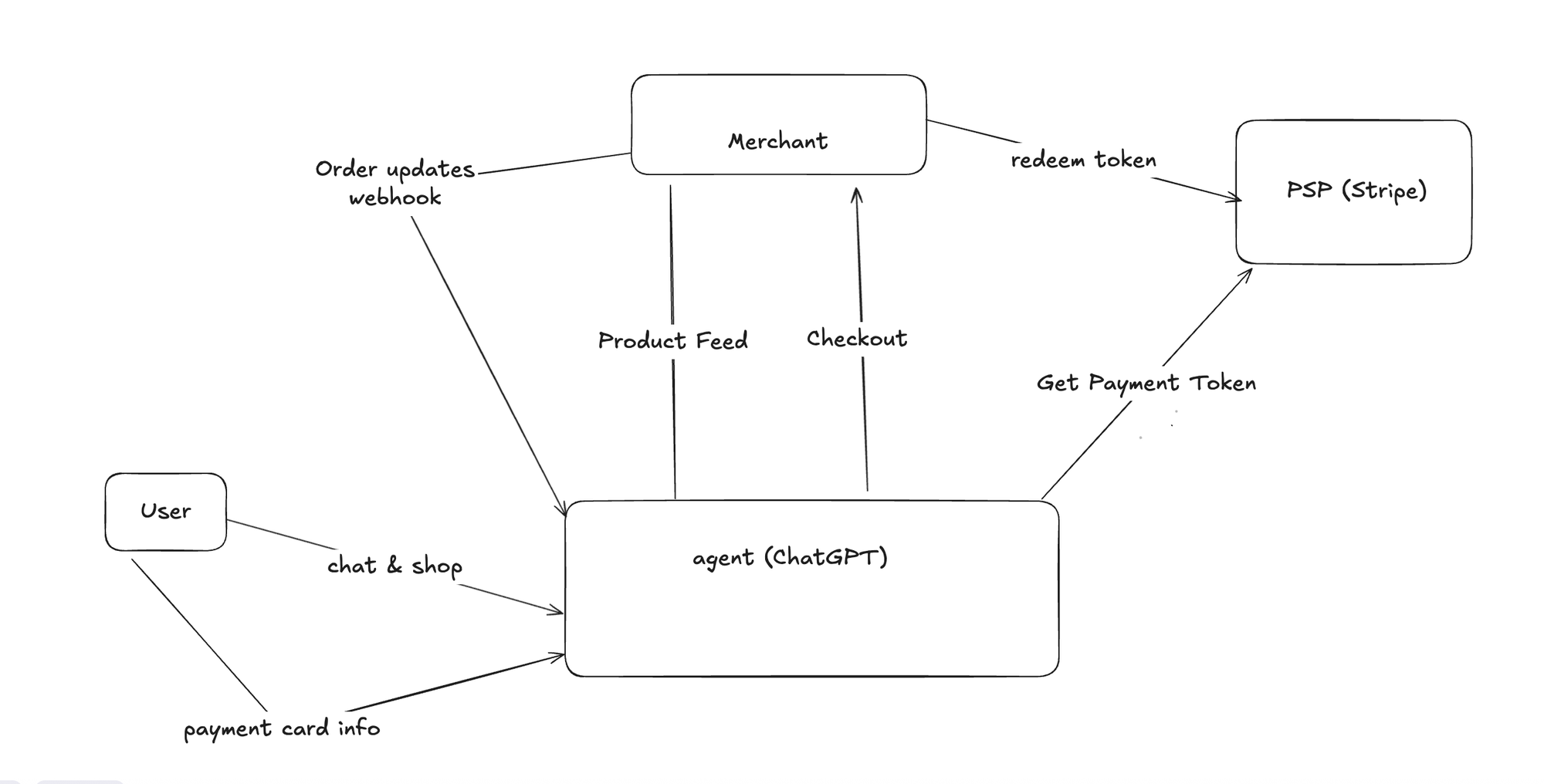
ACP is the technical bridge that allows ChatGPT to act as a secure proxy for your payment processor.
Open-sourced by OpenAI and Stripe in late 2025, the Agentic Commerce Protocol is the "handshake" between the AI agent and your Shopify or Amazon store. It allows the AI to pass a secure payment token and shipping details back to the merchant without the user ever leaving the chat interface.
For founders, this is a double-edged sword. While it dramatically increases conversion rates by removing friction, it also means the customer spends less time on your branded site. The brand experience must now be "baked into" the product data itself. Your "voice" is no longer your website's UI, it is the way your product is described and the clarity with which it solves a user's problem.
Managing the Loop: Feedback, Reviews, and AI Authority
The Referral Loop is powered by a feedback mechanism where AI-driven sales generate the very data that fuels the next recommendation.
In this new era, reviews are no longer just for "social proof" they are training data. When a customer buys a product through ChatGPT and later leaves a review saying, "These shoes were perfect for my wide feet," the AI incorporates that specific sentiment into its knowledge base.
The next time a user asks for "shoes for wide feet," your product moves to the top of the recommendation list. This is the heart of the Referral Loop:
- Discovery: AI finds your product via structured data.
- Transaction: AI completes the sale via ACP.
- Validation: Customer feedback confirms the product’s utility.
- Optimization: AI increases the product's "referral weight" for specific intents.
Future-Proofing for AI Search Citation
To stay relevant, brands must stop optimizing for "head terms" and start optimizing for "complex problem-solving."
As ChatGPT evolves into a "digital command center," it will favor brands that provide the most comprehensive "answers" to user needs. Investors are already looking at "AI-readiness" as a key metric for e-commerce valuations.
To win, you must:
- Audit your feeds: Ensure Shopify and Amazon data is perfectly synced.
- Adopt Conversational UX: Write product descriptions that answer "Who is this for?" and "What problem does it solve?"
- Monitor AI Mentions: Use tools to see how ChatGPT describes your brand compared to competitors.
Conclusion: The Conversational Pivot
The transition to ChatGPT Shopping is not merely an "additional sales channel", it is a fundamental restructuring of how value is exchanged on the internet. By leveraging the Referral Loop and connecting your Shopify or Amazon data to the Agentic Commerce Protocol, you are moving from a passive storefront to an active participant in the AI economy. The brands that will dominate 2026 and beyond are those that stop fighting for clicks and start building the data infrastructure that makes them the most "referable" solution in the room. The era of the search bar is ending, the era of the shopping partner has begun.
You can try a free AI Visibility tool at mention.network to see how your brand shows up in AI answers.
If you have any questions, email us at [email protected], or book a quick call for free support with our team here
Frequently Asked Questions (FAQ)
What is ChatGPT Shopping?
It is a native feature within ChatGPT that allows users to discover, compare, and purchase products directly in the chat interface using real-time data from merchants like Shopify and Amazon.
How do I get my Shopify products on ChatGPT?
You must ensure your product feeds are optimized with clean structured data (Schema.org) and connect your store to the Agentic Commerce Protocol, typically through a Shopify-OpenAI integration or Stripe-powered "Instant Checkout."
Does this replace traditional SEO?
No, but it shifts the focus. Traditional SEO still builds domain authority, but "AI SEO" (or GEO) focuses on structured metadata and natural language intent rather than just backlinks and keywords.
Is my customer data safe with the Agentic Commerce Protocol?
Yes. ACP is designed to pass encrypted payment tokens. The merchant remains the "merchant of record," meaning you still own the customer relationship, fulfillment, and support.
Will ChatGPT prioritize products with lower prices?
Not necessarily. While price is a factor, ChatGPT’s "Best Price" label is just one metric. It also weighs relevance, customer reviews, and how well the product description matches the specific intent of the user’s prompt.