
GEO vs SEO for Ecommerce: What's Different, What Still Matters in 2026
GEO and SEO answer different shopper questions in 2026. SEO still ranks your Shopify or WooCommerce store on Google. GEO decides whether ChatGPT, Gemini, and Perplexity name you when a shopper asks what to buy. Here's how the two fit together for merchants.

For a decade, the SEO job for an ecommerce store was easy to describe. You picked keywords, wrote category pages, built backlinks, tracked rankings, watched traffic. Every store I helped had the same rhythm: Semrush open in one tab, Search Console in another, Shopify Analytics in a third. If the graph on the right moved up, the month was good.
That rhythm still works for Google. It just doesn't cover the whole shopper anymore.
Sit next to a friend shopping for a running jacket in 2026. Half the time they open Google. The other half they open ChatGPT, ask "best rain jacket for trail running under $200", read three names, and click one. There's no page one in that flow. There's a single answer, and your store is in it or it isn't. That second surface is what people mean by GEO, and it's where most ecommerce brands have zero visibility right now.
This piece is my attempt to draw the line honestly. What SEO still does. What GEO adds. What ecommerce merchants specifically need to know. And what to do this week if you're a Shopify or WooCommerce brand trying to figure out the new stack. It is the ecommerce comparison satellite; the broad canonical guide is GEO: The complete guide to generative engine optimization.
How they stack up:
- Why GEO matters right now (the numbers)
- What GEO actually means (defined for merchants)
- GEO vs SEO: the actual differences
- What still matters from SEO (the concessions block)
- What's new in GEO (the AI-specific 40 percent)
- GEO for ecommerce specifically (Shopify and WooCommerce)
- Your GEO stack in 2026
- 5 things a merchant should do this week
Why GEO matters right now (the numbers)
Some data to anchor the shift, so you're not making decisions on vibes.
Adoption is real, not future-tense. OpenAI reported ChatGPT crossed 700 million weekly active users by mid-2026, up from around 100 million in early 2023. Perplexity crossed 15 million monthly users through 2025. Google shipped AI Overviews across 200+ countries by late 2025 and started defaulting AI Mode into buying-intent queries in Q2 2026. That is the demand-side shift, and it happened faster than most SEO analysts predicted three years ago.
Shopping is one of the fastest-growing AI use cases specifically. Research shared by OpenAI when it announced the Agentic Commerce Protocol in May 2026, documented in Exploding Topics' post-mortem on ACP, shows 77 percent of shoppers now use AI at some point in a purchase decision and 68.5 percent use it for product research. Those are ecommerce buyers, not enterprise SaaS teams.
Gartner predicted 25 percent of traditional search volume would shift to AI answers by 2026 in a widely cited 2023 forecast. Real numbers coming out of Q1 and Q2 2026 industry reports suggest closer to 30 to 40 percent of consumer product research now happens on AI first and Google second. The forecast was conservative.
Instant Checkout tried and failed, discovery took over. OpenAI killed the standalone Instant Checkout feature in March 2026 (six months live) and pivoted to a discovery-first model. Shopify shipped Agentic Storefronts the same quarter, and eligible Shopify stores now surface in ChatGPT with checkout redirecting back to the merchant. That is one fewer surface where AI keeps the buyer inside its own product, but the discovery layer is only growing.
Even the conservative scenario has ecommerce merchants leaving 25 to 30 percent of top-of-funnel visibility on the table if they only optimise for Google. The rest of this piece is what to do about it.
What GEO actually means (defined for merchants)
Generative engine optimization is the practice of getting your brand named, cited, or linked inside answers generated by AI engines. In merchant terms, GEO covers three things:
- Mentions. How often an AI engine names your brand in an answer, even without a link. "Try Allbirds, Rothy's, or Vessi" is a mention row for three brands.
- Citations. How often an AI engine links to your store, blog, or product page as a source under the answer. Perplexity is the clearest example, ChatGPT and Gemini also cite when they retrieve.
- Share of answers. For a set of prompts a real shopper would type, how often you show up compared to competitors. This is the closest thing GEO has to a ranking metric.
None of those show up in Google Search Console. None of them show up in Shopify Analytics. Your rank tracker won't see them either. And that's the gap.
The classic SEO job (get a URL to rank) is still real. GEO adds a new job: get the brand into the answer. The trick is that both jobs share a lot of the same inputs.
GEO vs SEO: the actual differences
Here's the comparison I use when explaining this to SEO teams pivoting to ecommerce AI visibility.
Dimension SEO GEO
Where you win Position on a Google SERP Named or cited inside an AI answer
Success unit Ranking + click Mention + citation + share of answers
Primary surface google.com ChatGPT, Gemini, Perplexity, Google AI
Query shape Head + long-tail keywords Full-sentence shopper prompts
Feedback loop Weekly rank check, monthly traffic Any time you scan, per engine, per prompt
Retrieval Google index + ranking model LLM training data + real-time retrieval
Freshness Crawl frequency, sitemap ping Retrieval recency, third-party mentions
Content that wins Ranked category and blog pages FAQ blocks, comparison content, review coverage
Off-site signal Backlinks Cross-web mentions on trusted sources
Measurement tool Semrush, Ahrefs, Search Console AI-visibility scanners (Mention Network et al.)
Read the table sideways and you'll see the pattern. GEO is SEO with a different surface, a different retrieval model, and a different measurement layer stacked on top of overlapping inputs.
What still matters from SEO (the concessions block)
Some things carry straight over. If your SEO shop is doing these well, most of GEO comes along for the ride.
Schema markup. Product schema, Offer, Review, aggregateRating, FAQPage, HowTo. AI engines pull these fields to decide which products to recommend and what to say about them. The Google schema documentation still applies word for word, and Shopify emits basic Product schema out of the box (theme-dependent) while WooCommerce needs a plugin like Rank Math or Yoast to be complete.
Content quality and E-E-A-T signals. Experience, expertise, authority, trust. Google codified these for SEO and AI engines apply the same lens. A category page written by someone who knows the category still beats a keyword-stuffed one, on both surfaces.
Freshness and crawlability. If an AI engine can't retrieve your page, it can't cite it. Robots.txt not blocking, sitemap.xml current, canonical tags correct. Same hygiene as always.
Cross-web mentions and backlinks. SEO called them backlinks. AI engines weight them as retrieval signals. A brand mentioned in twelve independent sources gets recommended with more confidence than one only mentioned on its own site. Rand Fishkin's SparkToro research tracks this shift closely and their read on how AI search actually works is one of the more honest ones going.
Review signals. Google reviews, Trustpilot, category-specific platforms. Feed the "shoppers who bought this said" slot in AI answers. Same input, new output surface.
If you already run good SEO, you're maybe 60 percent of the way to GEO without knowing it. The remaining 40 percent is the AI-specific stuff.
What's new in GEO (the AI-specific 40 percent)
This is where the discipline diverges from classic SEO in ways that matter for how you write and structure content.
Prompt-phrasing match. SEO taught us to write for head keywords and long-tail queries. GEO retrieves against the exact sentence a shopper types into ChatGPT. That's a different unit. "Best trail running jacket under 200" is a keyword. "What's a good rain jacket for trail running that won't cost more than $200 and works in winter?" is a prompt. Your FAQ blocks, product pages, and buying guides need to cover the full-sentence version.
llms.txt at store root. A convention file that lets AI engines know which pages you consider canonical for retrieval. Not universal yet, but zero downside and it's showing up as a signal in early crawler behavior. Fifteen minutes to add to a Shopify store, worth it.
Brand mentions weighted differently. In classic SEO, a mention without a link had almost no value. In GEO, a mention on a trusted third-party site (Reddit thread, Practical Ecommerce article, category subreddit) can be worth as much as a linked citation because language models pick up the association during retrieval. Digital PR still works, and it now covers a second job.
Comparison and buying-guide content, front-loaded. AI engines love comparison content because it maps cleanly to shopper intent. A post that names your product alongside three real competitors, honestly, and explains when to pick each one, gets cited more than a self-flattering brand page. Ecommerce brands used to hate this format. In 2026, it's your best ally.
Answer-first writing. SEO rewarded intro paragraphs that built up to the answer. GEO rewards the opposite: give the answer in the first sentence, then support it. The SearchEngineLand GEO library covers the copywriting shift in more depth than I can here.
Measurement moves from ranks to prompts. You stop asking "am I ranking for X keyword" and start asking "when a shopper types this exact prompt into ChatGPT, do I show up". That's a prompt-level scan, not a keyword tracker.
GEO for ecommerce specifically (Shopify and WooCommerce)
Ecommerce has a wrinkle general GEO advice usually skips: you have two things to make visible, not one.
Brand-level visibility. "Best sustainable sneaker brands under $150." An AI engine either names your brand in the list or it doesn't. This is closer to classic SEO domain authority translated to AI engines.
Product-level visibility. "What's a good petite blazer for a 5'2" woman under $200." An AI engine either names your specific SKU or it doesn't. This is a different game. Product-level GEO depends on product schema completeness, PDP copy that matches shopper phrasing, and reviews with specific detail.
Most SEO advice online covers brand-level only because that's what the classic domain-authority frame handles. For an ecommerce merchant, product-level GEO is the harder job and often the more valuable one, because that's where the actual purchase intent lives.
Shopify handles product schema well by default in most themes. WooCommerce needs a schema plugin. Both benefit from an FAQ block on the product page written in the shopper's exact question phrasing (not marketing copy). Both need reviews on the PDP with real text, not just star counts. Shopify's own SEO documentation still covers the technical basics you need, and BigCommerce's ecommerce SEO guide is a solid platform-neutral read for the fundamentals.
One more ecommerce-specific note. AI shopping is a channel now, and it's growing. ChatGPT's Instant Checkout was discontinued in March 2026 and replaced with a discovery-first model where Shopify handles the checkout redirect via Agentic Storefronts. Perplexity Shopping is live. Google AI Overviews are showing product cards for a growing set of buying queries. Every one of those surfaces is downstream of the GEO work you do this quarter.
Your GEO stack in 2026
The good news for anyone with an SEO stack already: you keep most of it. GEO adds one measurement layer on top and asks you to think about content a little differently. Here's what a realistic 2026 stack looks like for an ecommerce merchant, mapped layer by layer.
The 6-layer merchant stack
Layer SEO tools you keep GEO tools you add Shared inputs
Keyword and prompt research Semrush, Ahrefs, keyword.io Mention Network auto-generated prompt library (or hand-written spreadsheet) Shopper intent signals
Rank and answer monitoring Google Search Console, rank tracker Mention Network AI Visibility Check across ChatGPT, Gemini, Google AI Mode, Claude (or manual weekly runs) Both answer "am I visible"
Content optimisation Yoast, Rank Math, Screaming Frog Schema + FAQ blocks written in prompt phrasing (Mention Network flags gaps per SKU) Schema, headings, meta
Analytics GA4, Shopify Analytics GA4 with AI referrer segment + Mention Network per-engine + per-prompt breakdown Same GA4 property, new dimensions
Reviews Yotpo, Judge.me, Loox, Trustpilot Same tools (reviews feed AI answer citations, Mention Network measures the effect) Identical inputs
Off-site signal Backlinks (Ahrefs, Majestic, LinkFinder) Cross-web brand mentions (Mention Network tracks appearances in AI retrieval, digital PR still works upstream) Third-party mentions
Read across, and the stack is 70 percent overlap. You keep almost every tool. The one net-new addition is an AI-visibility scanner, and for Shopify merchants (WooCommerce is on the roadmap), Mention Network is the merchant-native option built for this layer. The AI Visibility Check installs as a Shopify app, reads your product catalogue, picks one product plus a location plus a language, and auto-generates 5 shopper-style discovery prompts (where to buy, best place to buy, authentic, cheapest, fastest shipping) that get run across the four engines. The other five rows are tools you almost certainly already run.
Now the layer-by-layer detail.
Keep from SEO (mostly unchanged)
- Keyword research tool. Semrush, Ahrefs, or a lighter option. Still where you find category head terms and product-level long-tail. Feed both SEO and GEO content plans.
- Google Search Console. First-party data on Google traffic. Still the source of truth for one of your two surfaces.
- Schema validator. Google's Rich Results Test remains the standard. AI engines read the same schema Google does.
- Site audit tool. Screaming Frog or the audit tab inside Semrush/Ahrefs. Crawlability affects both surfaces.
- Backlink tracker. Backlinks are still SEO fuel and now double as GEO retrieval signals.
Add for GEO (one new measurement layer)
- AI-visibility scanner. Runs prompts across ChatGPT, Gemini, Google AI Mode, and Claude on your behalf, reports which named your store and which named competitors, and ties results back to the specific product you scanned. This is where Mention Network fits: the AI Visibility Check installs as a Shopify app (WooCommerce is on the roadmap), reads your product catalogue, and per scan runs 5 auto-generated discovery intents (where to buy, best place to buy, authentic, cheapest, fastest shipping) across the 4 engines. The report shows Visibility Score, AI Coverage (x/4), Share of Voice against competing retailers, and a Market Position table with price and shipping deltas where the engine surfaced them.
- Prompt library. The GEO equivalent of a keyword list. 30 to 100 realistic shopper prompts per category, refreshed monthly. Some scanners generate these for you; you can also start with a hand-written spreadsheet.
- AI referrer segment in GA4. Add a segment that isolates traffic from
chatgpt.com,perplexity.ai,gemini.google.com,copilot.microsoft.comreferrers. Small setup, valuable trend view.
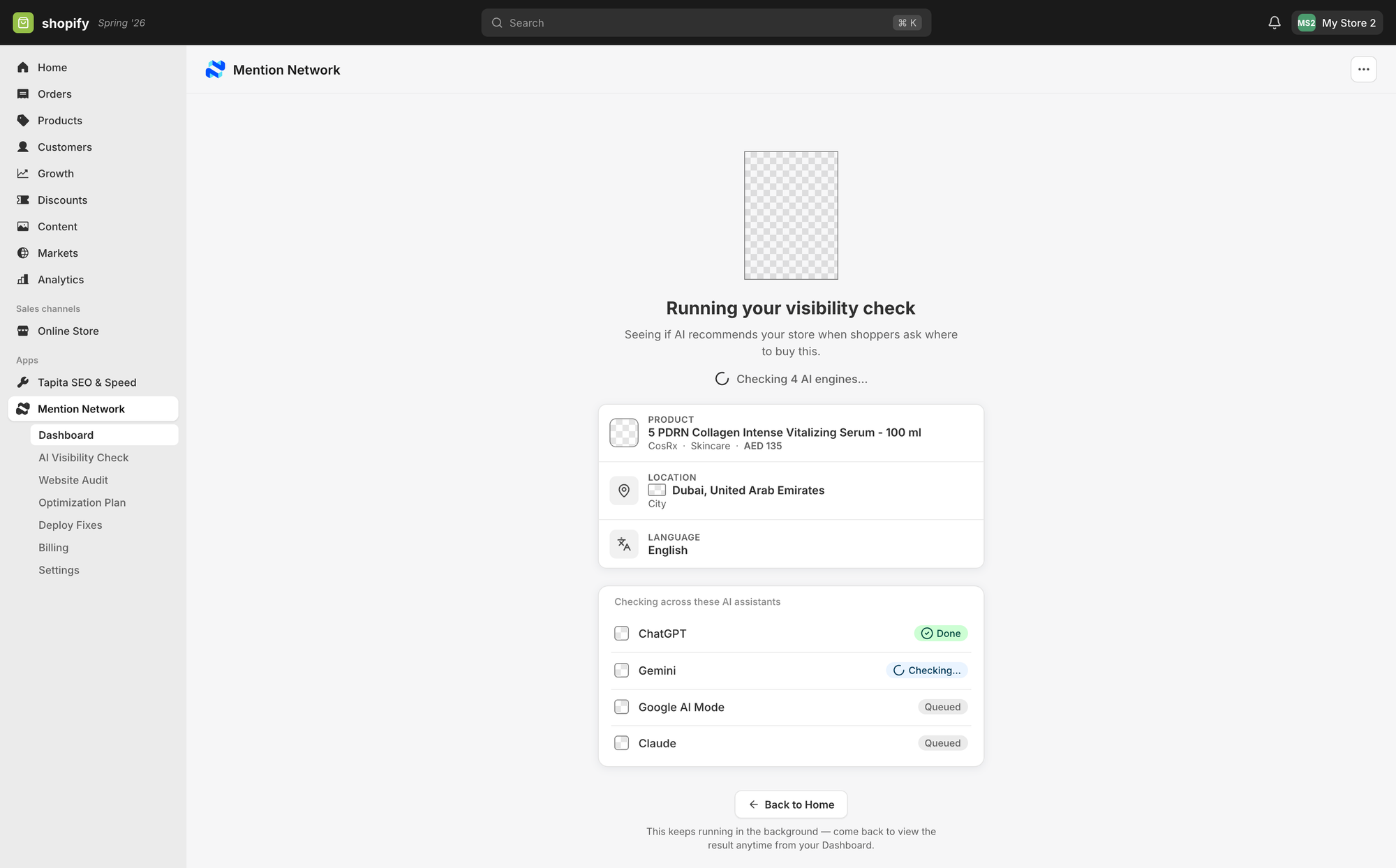
Per-engine scan running across ChatGPT, Gemini, Google AI Mode, and Claude. Each engine is a separate surface; a scanner runs all four in parallel and reports where your brand and specific SKUs land.
Keep from content and reviews (small tweaks)
- CMS and product pages. Unchanged foundation. Shopify or WooCommerce PDPs still hold the content.
- FAQ blocks. Rewrite in shopper phrasing pulled from your support inbox. Same tool, different copy pattern.
- Review platform. Yotpo, Judge.me, Loox, Trustpilot. Reviews now feed AI answer citations in addition to Google Rich Results. No new tool needed, more reason to invest in the one you have.
- Digital PR. Cross-web mentions matter more. Still email + relationships + a target list.
The full picture
The stack has one net-new tool (AI-visibility scanner) and a few new segments inside tools you already run. Everything else compounds across both surfaces.
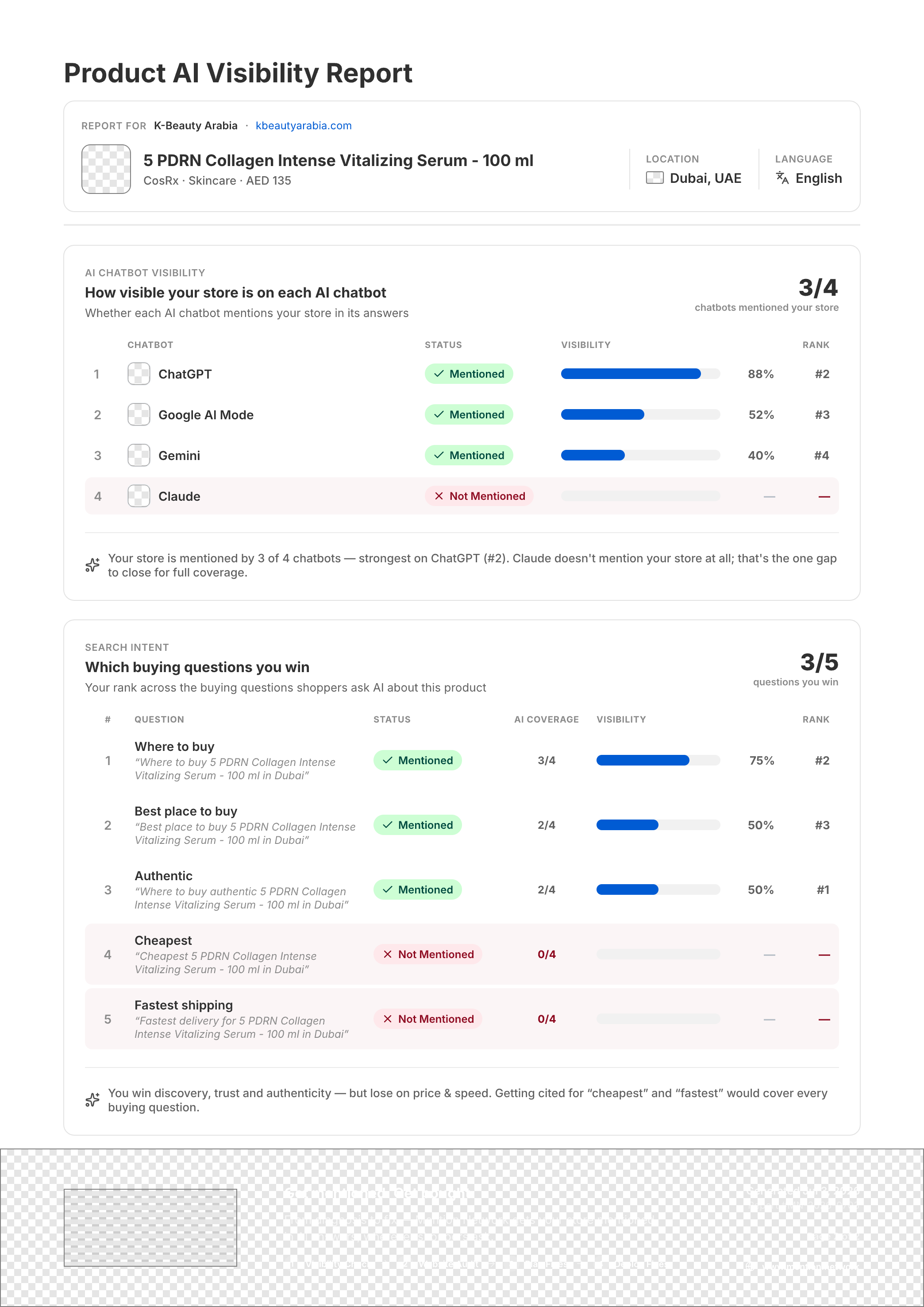
Per-engine visibility breakdown inside the Shopify admin. Brand rows show whether AI engines name your store when asked about your category. Product rows show whether specific SKUs surface in shopping answers. This is the missing measurement layer for GEO.
If you want to see whether AI engines are recommending your store today, the free tier at mention.network scans your first set of category prompts and shows the gap. Ten minutes to set up, no card required, and you get the honest answer instead of guessing.
5 things a merchant should do this week
If you take one thing away from this piece and want a small, concrete list to run against:
- Run one free AI-visibility scan. Pick your top 10 category prompts (the ones a shopper in your category would actually type into ChatGPT). Run them. Read the report. Note which engines named you and which named competitors.
- Fix product schema on your top 20 revenue SKUs. Product, Offer, aggregateRating. If you're on Shopify, check with Google's Rich Results Test. If you're on WooCommerce, install a schema plugin if you don't have one. This one fix moves both SEO and GEO.
- Rewrite three FAQ blocks in shopper phrasing. Pull real questions from your support inbox. Put them on the product page as an FAQ block with the exact wording. Not "Product care and materials", but "Can I wash this in the machine".
- Publish one honest comparison post. Your product versus two real competitors, with trade-offs. This is the highest-yield GEO content type in 2026 and most ecommerce brands still won't touch it because it feels vulnerable. That's why it works.
- Add llms.txt to your store root. Fifteen minutes. Small signal. No downside. The Backlinko technical SEO hub covers the classic robots and sitemap ground if you need a refresher on where llms.txt fits in the family.
That's a week's work and it'll show up in the next scan.
Wrapping up
SEO isn't going anywhere for ecommerce brands. Google is still the largest shopping traffic source for most merchants, and the tools you've been using for a decade still do their job. Semrush is a great SEO platform. Ahrefs is a great SEO platform. Search Console is free and still essential. Nothing on this list gets replaced.
What changed is that shoppers now split their buying research across two surfaces. The Google SERP is one. The AI answer is the other. Your brand needs to be visible on both, and the second surface has been running blind for most stores.
Think of GEO as your new rank tracking. Same discipline, different index, faster feedback. Keep the SEO tools you trust. Add an AI-visibility check next to them. The merchants who do both are the ones who'll end 2026 with growing traffic on Google and a growing share of AI answers everywhere else.
That's the whole shift. See you on both surfaces.