
Anatomy of a "Where to Buy" AI Answer: 4 Fields to Read
Every AI where-to-buy answer resolves to 4 fields: presence, rank, competitors, and price plus shipping. How to read them, and why one assistant is a sample size of one.

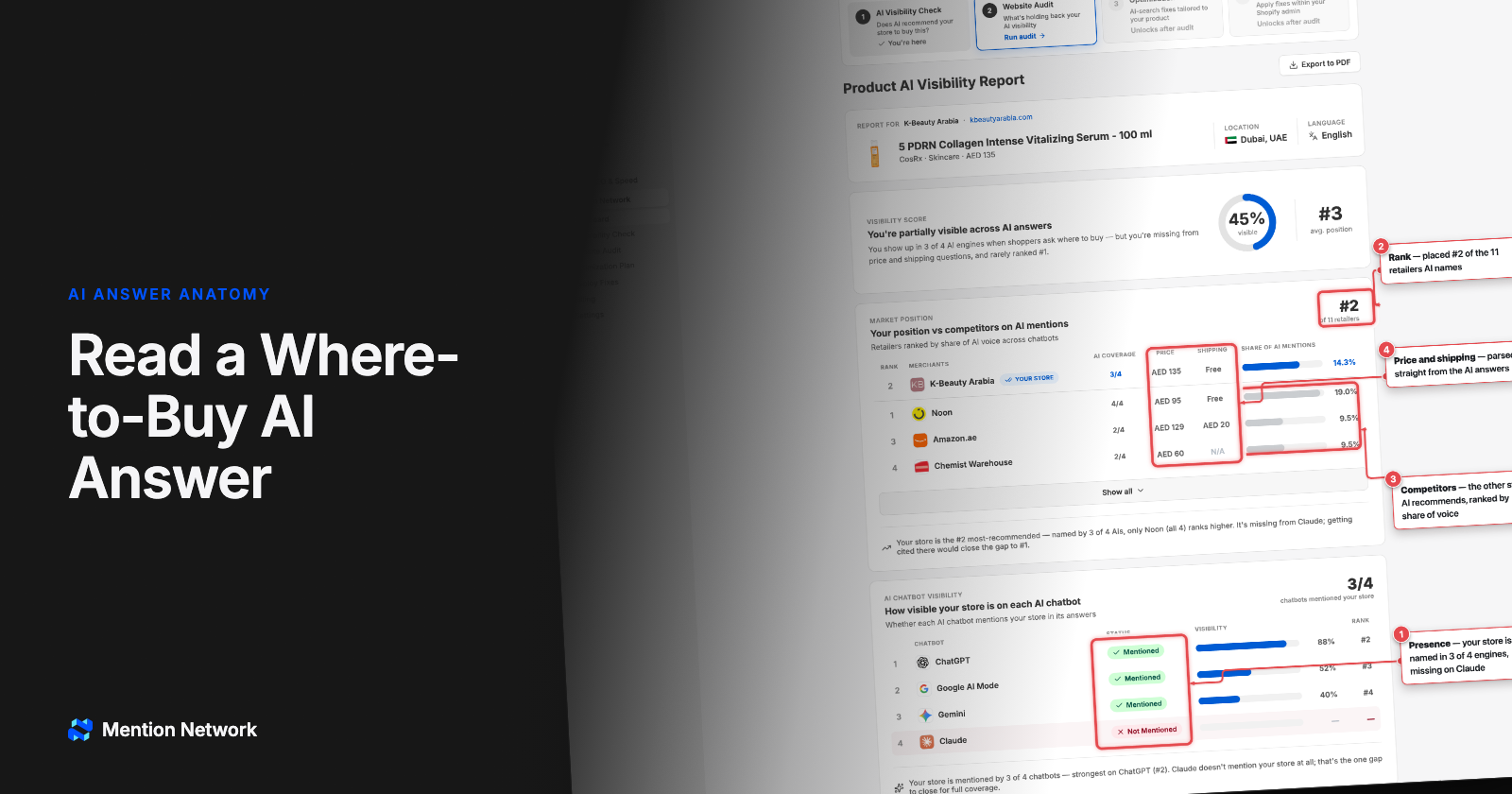
TL;DR A where-to-buy answer reads like prose but resolves to 4 fields: presence, rank, competitors, price + shipping. One product in one city is 20 answers (currently 5 intents × 4 assistants). Score the fields, don't skim the prose.
This is the where-to-buy measurement satellite in the product visibility cluster. The broader framework is AI product visibility, and the shopping-system context sits in AI shopping assistants.
Ask an assistant where to buy trail runners in Denver and the reply reads like a helpful paragraph. Read it as a researcher and it's a ranked dataset with 4 fields. Knowing those fields is the difference between "AI mentioned us somewhere" and a measurement you can act on, the same split that separates brand mentions from real product visibility.
Disclosure up front: Mention Network is our product, and the structure below is how we parse these answers in our own checks.
One product, five questions
The where-to-buy moment currently breaks into 5 distinct buyer intents, and assistants answer each with a different list:
| Intent | What the shopper types |
|---|---|
| Where to buy | "where to buy [product] in Toronto" |
| Best place | "best place to buy [product] online in Canada" |
| Authentic | "where to buy authentic [product]" |
| Cheapest | "cheapest place to get [product]" |
| Free shipping | "where to buy [product] with free shipping" |
Same product, 5 lists. A store can win "authentic" and lose "cheapest" on the same day.
The four fields in every answer
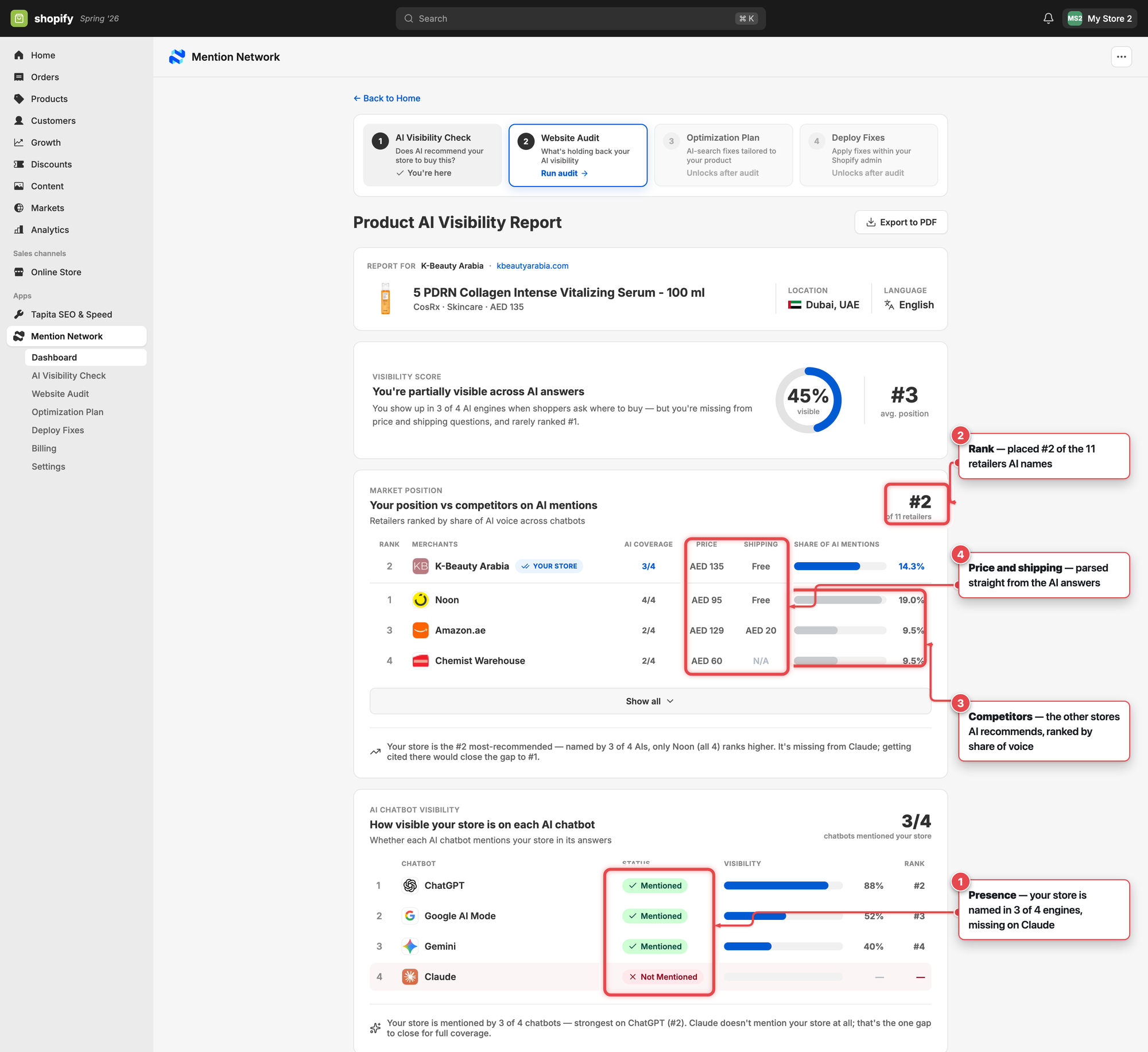
However chatty the prose, each answer resolves to:
- Presence. Is your store named at all?
- Rank. Position 1 and position 5 are different businesses.
- Competitors. Who else got named, meaning who AI treats as the alternatives.
- Price and shipping. When the assistant states them. When it doesn't, the honest value is "not stated", never a guess.
Here is that same decomposition on a real report, each field called out:
Why one assistant is a sample size of one
ChatGPT, Gemini, Google AI Mode, and Claude build their lists from different sources and different retrieval, and ChatGPT increasingly attaches a checkout to its answers (Instant Checkout). The same question routinely returns different stores on different assistants, so we score coverage as x out of 4 per intent.
The full grid: currently 5 intents × 4 assistants = 20 answers for 1 product in 1 location. That's the smallest unit we treat as a measurement rather than an anecdote. Answers also drift between weeks, so any single run is a snapshot, worth re-running after you change something.
Read one yourself
- Pick your best-selling product.
- Ask one assistant the "where to buy" phrasing with your city.
- Score the 4 fields: presence, rank, competitors, price/shipping.
- Repeat with the "cheapest" phrasing and compare the two lists.
How assistants build these lists is worth reading next; the inputs are mechanical, so the fields respond to fixes. For the full 20-answer grid across all 4 assistants, run the free check: it stores the raw answers, so you can verify every parsed field against what the assistant actually said. If you're new to the layers of AI visibility, this whole exercise is layer 2.
Frequently asked questions
How does ChatGPT decide which stores to recommend?
Assistants ingest product feeds, compare sellers on price, availability, shipping, and trust signals, then shortlist a few stores per answer. The inputs are mechanical, which is why a store can audit and improve its odds of being named.
Do different AI assistants give different shopping answers?
Yes. ChatGPT, Gemini, Google AI Mode, and Claude build their lists from different sources and retrieval methods, so the same question often returns different stores. That's why coverage is worth scoring as x out of 4 assistants rather than trusting any single one.
How many AI answers should I check per product?
20 is the useful floor: currently 5 buyer intents (where to buy, best place, authentic, cheapest, free shipping) across 4 assistants. Fewer than that and you're reading an anecdote, not a measurement. Answers drift over time, so re-run after you change anything on your store.