
Brand Visibility vs Product Visibility: Winning the Buying-Decision Moment
Brand-visibility tools measure the discovery phase with category prompts. We measure the one prompt set that runs in a shopper's head right before they click Buy: where to buy this exact product, from whom, at what price, with free shipping.

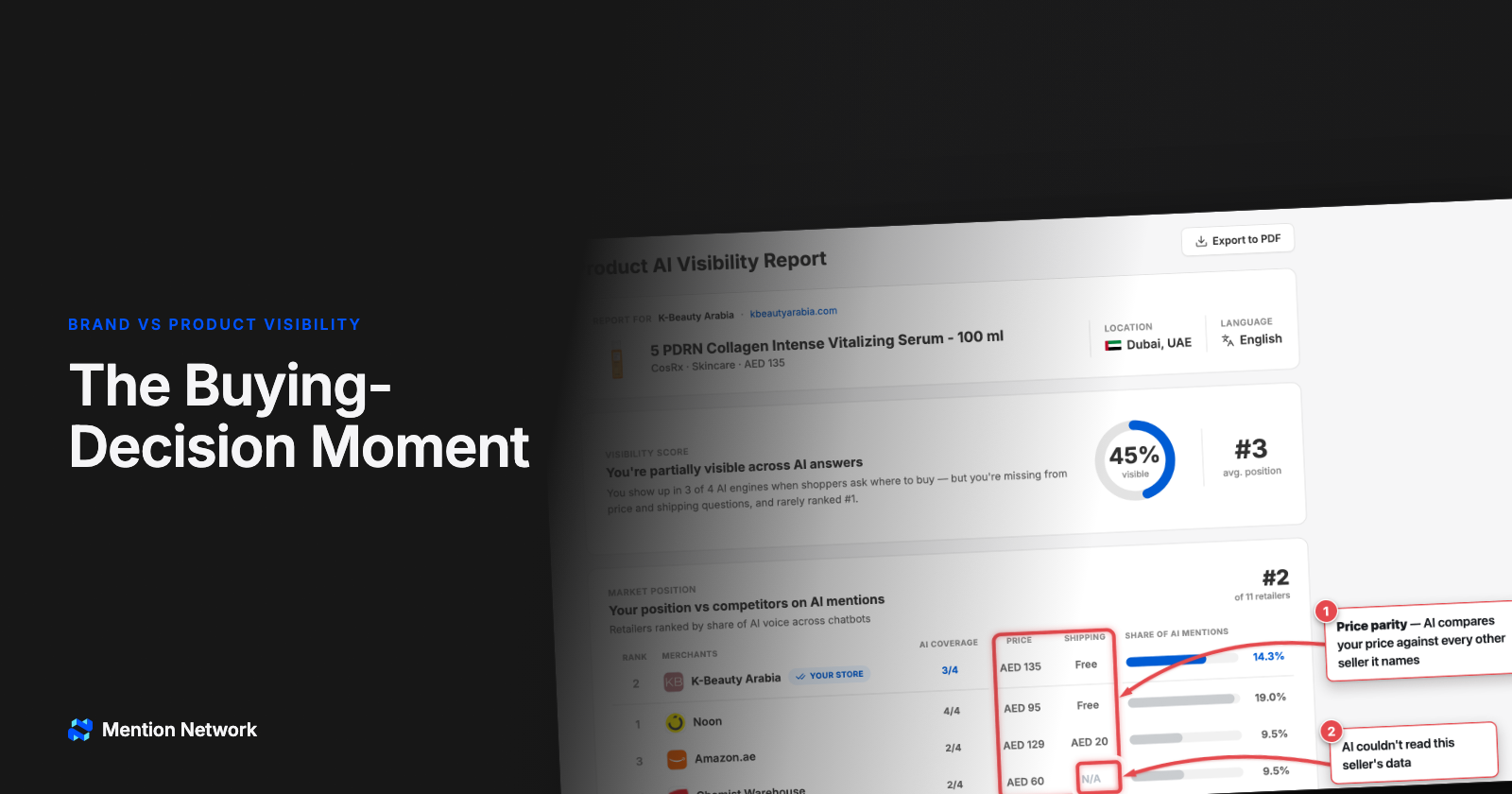
TL;DR Product visibility vs brand visibility is the difference between "does AI name my store at the moment of purchase" and "does AI know my brand." A single free check currently runs 5 buying intents across 4 assistants, 20 measurements per product, and 0 of 20 count a brand mention.
In this piece:
- The two prompt sets are not the same question
- You test a product, not a brand
- 20 measurements, all of them pre-purchase
- Free shipping is a ranking factor
- Why AI trusts a store, and why it is not SEO
- Frequently asked questions
Two shoppers open ChatGPT. The first types "what is the best K-beauty serum brand." The second types "where to buy the COSRX 5 PDRN serum in Dubai with free shipping." Only one of them is about to spend money, and it is not the first one.
Most AI-visibility tools were built to answer the first shopper. They track how often a brand name shows up when someone is still browsing categories. That is the discovery phase, and it is a real job. But it is a brand marketer's job. If you run a store, your revenue does not turn on the discovery question. It turns on the second one: the buying-decision moment, the last prompt a shopper types before they click Buy.
Product visibility is whether AI names your store at that moment. Brand visibility is whether AI knows your brand exists. This piece walks the Mention Network Shopify app screen by screen to show what measuring the buying-decision moment actually looks like, and why it changes what you end up fixing.
The two prompt sets are not the same question
A brand-visibility tool fires category and reputation prompts: "best serums," "top skincare brands," "is COSRX any good." Useful if you own the brand and have a marketing team. Useless if you are a reseller stocking other people's brands, because you will never win a mention for a brand you do not own.
The Mention Network AI Visibility Check fires a different set. Right now it runs five buying-decision intents, each a real question a ready-to-buy shopper asks, in their city, in their language:
- "where to buy [product] in [city]"
- "best place to buy [product] online in [city]"
- "where to buy authentic [product] in [city]"
- "cheapest place to buy [product] in [city]"
- "where to buy [product] with free shipping in [city]"
Same shopper, five different lists, because "cheapest" and "authentic" and "free shipping" return different stores. These are the questions with a credit card behind them. Everything below is how the app measures them.
The question the whole product is built around
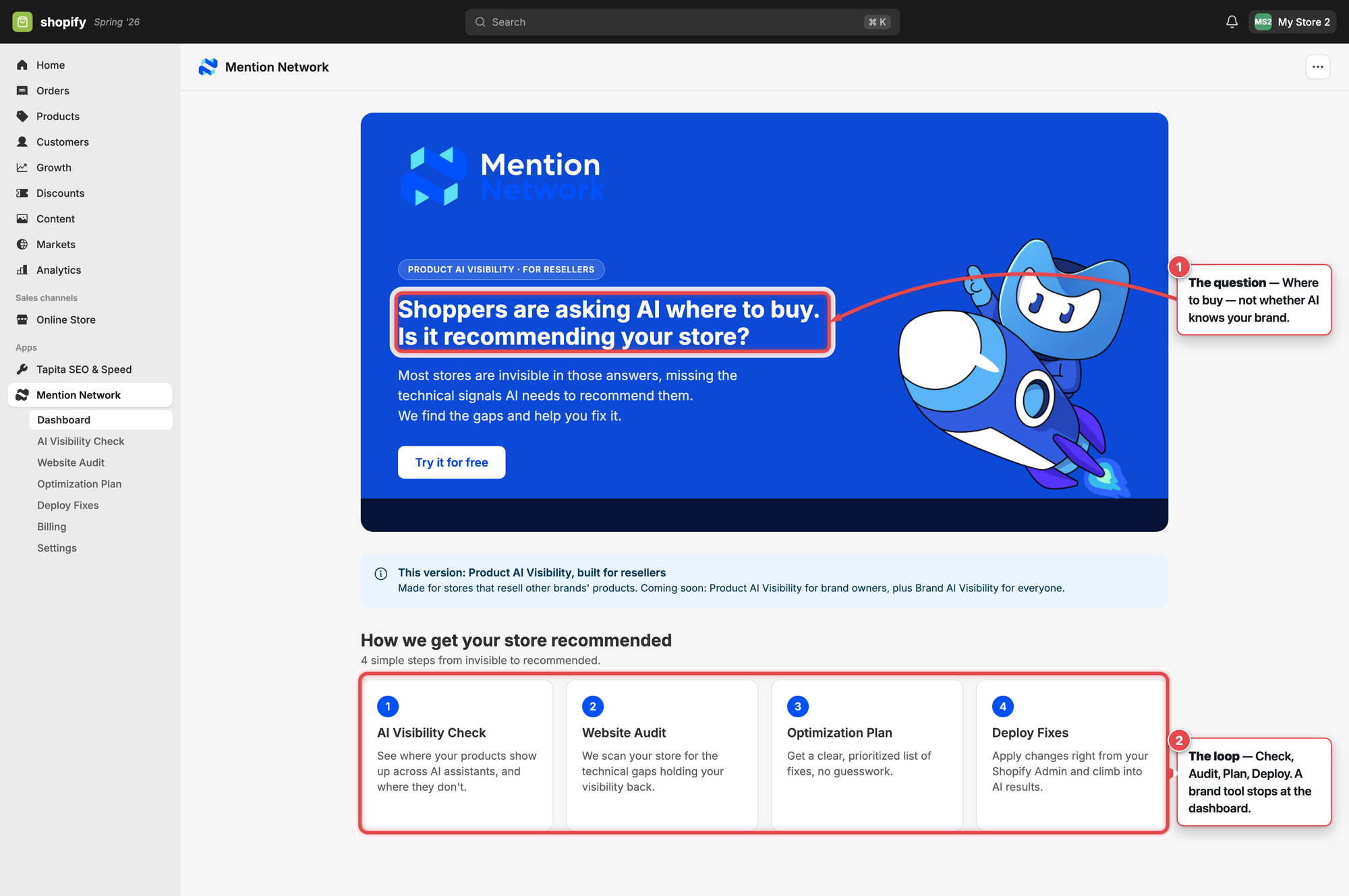
The first screen a merchant sees asks one thing (①): "Shoppers are asking AI where to buy. Is it recommending your store?" Not "is AI aware of your brand." Where to buy. The four-phase journey below it (②) sets the arc: Check what AI says, Audit what is holding you back, Plan the fixes, Deploy them. A brand tool stops at a dashboard. This one is built to close the loop.
You test a product, not a brand
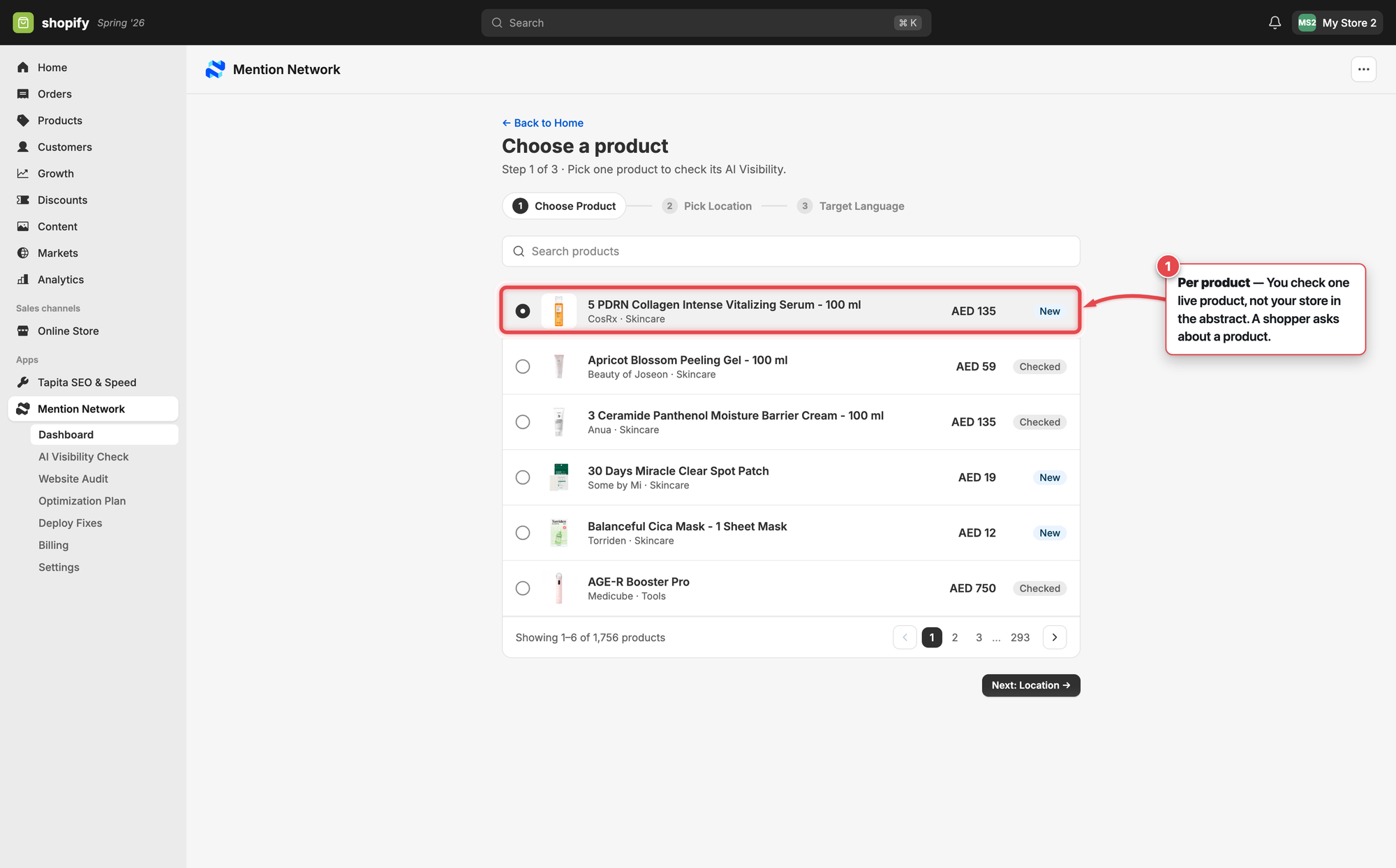
You do not check "your store" in the abstract. You pick one live product (①). This is the first place the tool diverges from brand thinking: visibility is measured per product, because a shopper asks about a product, not a company. A store can be highly visible for one serum and invisible for the one sitting next to it in the same catalog.
One quiet detail matters here: the app only lets you check products that are actually published. A draft product is invisible to shoppers and to AI, so measuring it would flatter you with a number that means nothing.
The buying moment is local and language-bound
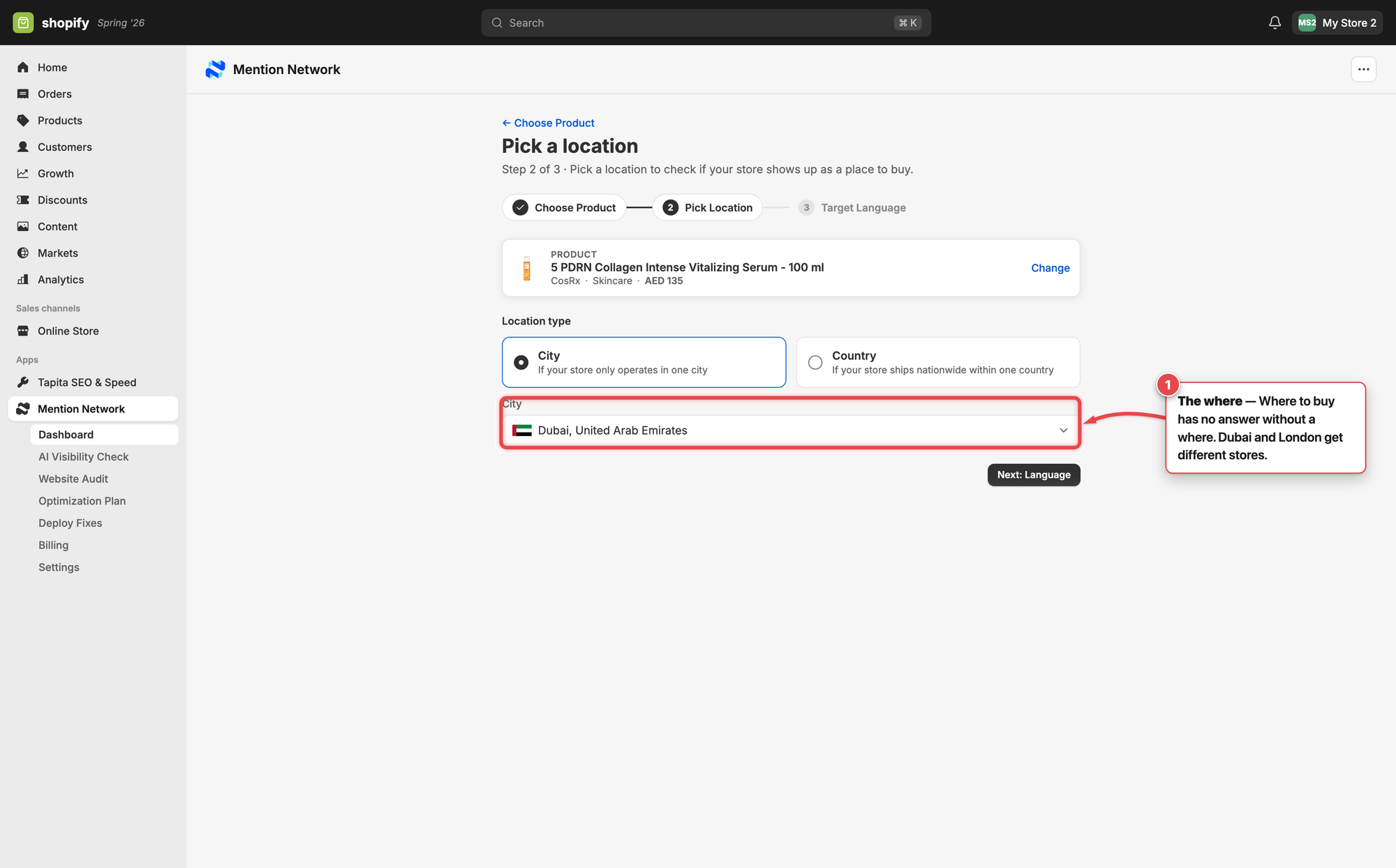
"Where to buy" has no answer without a where. A shopper in Dubai and a shopper in London get different stores, different prices, different shipping promises. So you set the market (①) before anything runs.
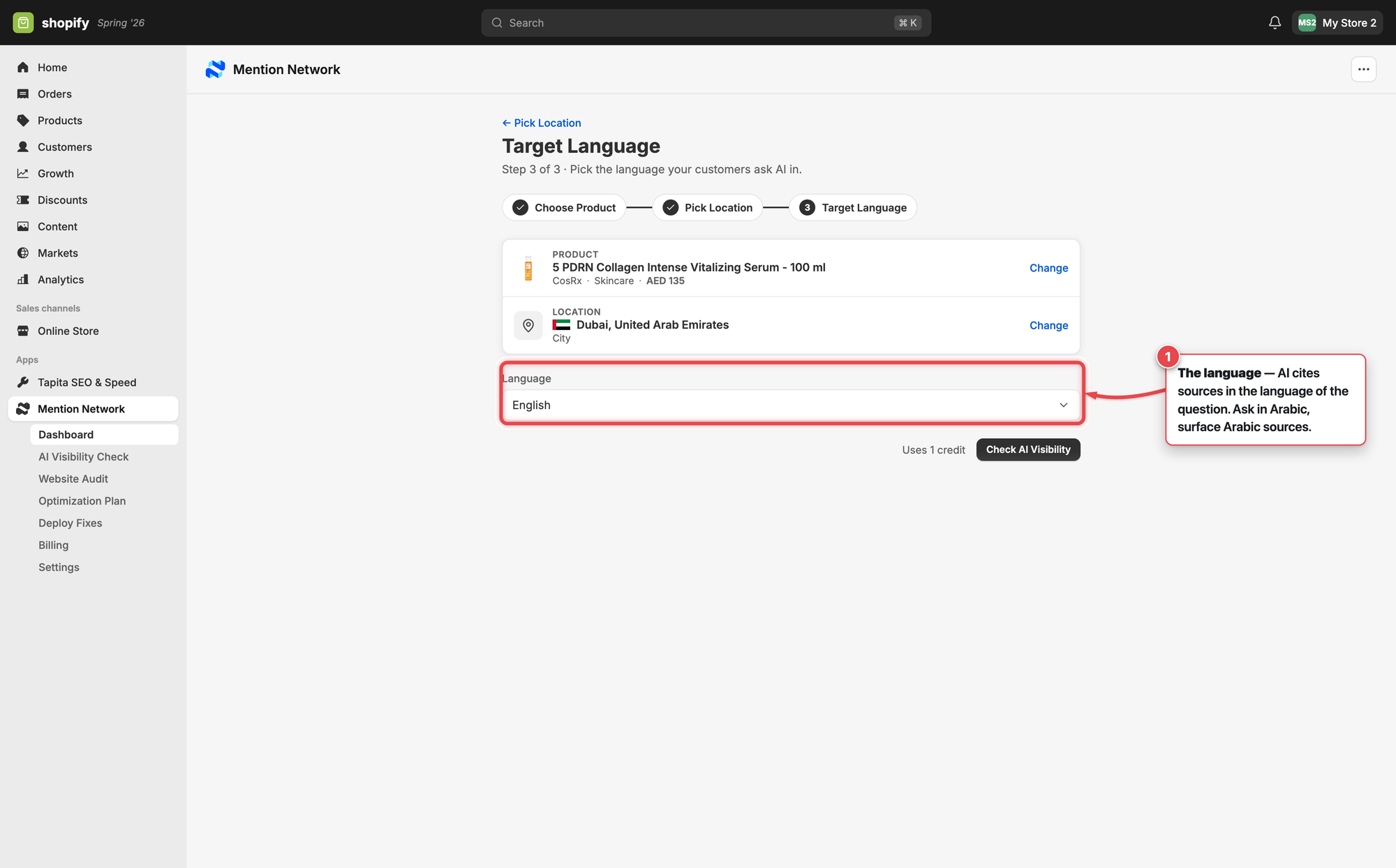
Language is a separate axis (①), and this is a GEO detail most SEO habits miss: AI tends to cite sources in the language of the question, not the location of the shopper. Ask in Arabic and you surface Arabic-language sources; ask in English and you surface English ones. One product, one city, one language is a single measurement. Change any of the three and it is a different question with a different answer.
20 measurements, all of them pre-purchase
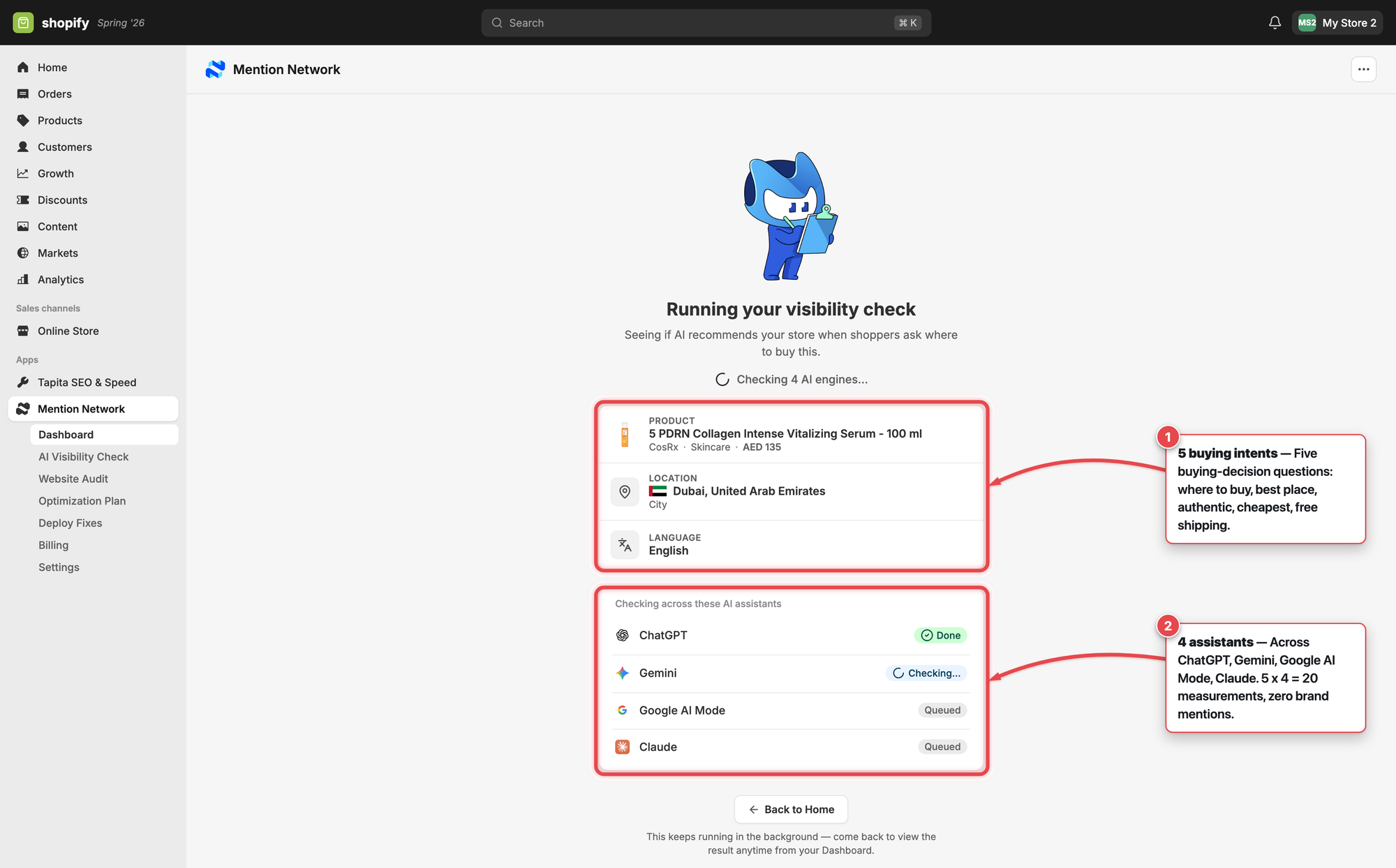
Here is the whole thesis in one screen. The check runs the five buying-decision intents (①) across four assistants, ChatGPT, Gemini, Google AI Mode, and Claude (②), the same assistants that pick products for shoppers every day. Five intents by four assistants is twenty measurements per product, and not one of them counts a brand mention. Every single one is a "where to buy this exact thing" question.
Compare that to a brand tool's twenty measurements, which would be twenty variations of "how often does the brand come up." Same effort, completely different unit. One tells a marketer their share of voice. The other tells a merchant whether they are in the room when money changes hands.
There is a hidden piece of craft here too. Before firing, the app anchors the product's brand and keeps its identity intact, so it asks about "COSRX 5 PDRN Collagen Serum," not a truncated SEO title that an assistant might misread as a different brand. Ask the wrong question and you measure the wrong store.
The report reads like a scorecard, not a vanity metric
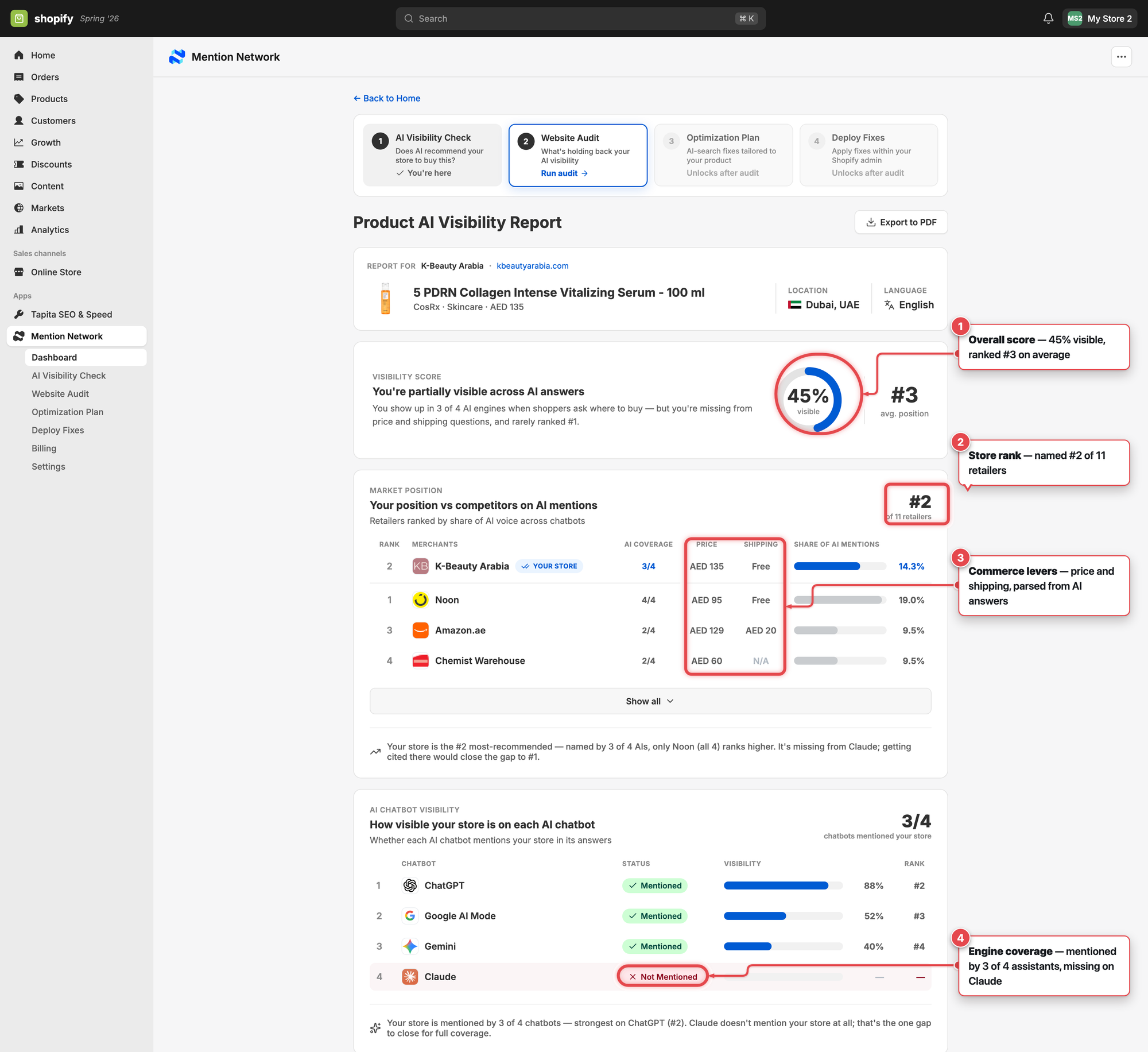
The report front-loads the verdict, then shows its work. Four things carry the story (①–④): an overall visibility score and average rank (①); your store's rank against the other retailers AI names for the same product (②); the commerce levers, price and shipping, parsed straight out of the AI's own answers (③); and your engine coverage, which assistants mention you and which do not (④).
Notice what a brand tool cannot show here. It has no rank-against-other-stores, because it measures brand mentions, not store placement in a where-to-buy list. It has no price-and-shipping column, because those are not brand attributes, they are commerce levers. The unit of measurement is different, so the fixable insights are different.
And because this is a measure-first product, every number is backed by the verbatim AI answers that produced it. You can read exactly what ChatGPT said, with your store name in bold, rather than trusting a score. Reproducible receipts, not a black box.
Free shipping is a ranking factor, and shoppers feel it
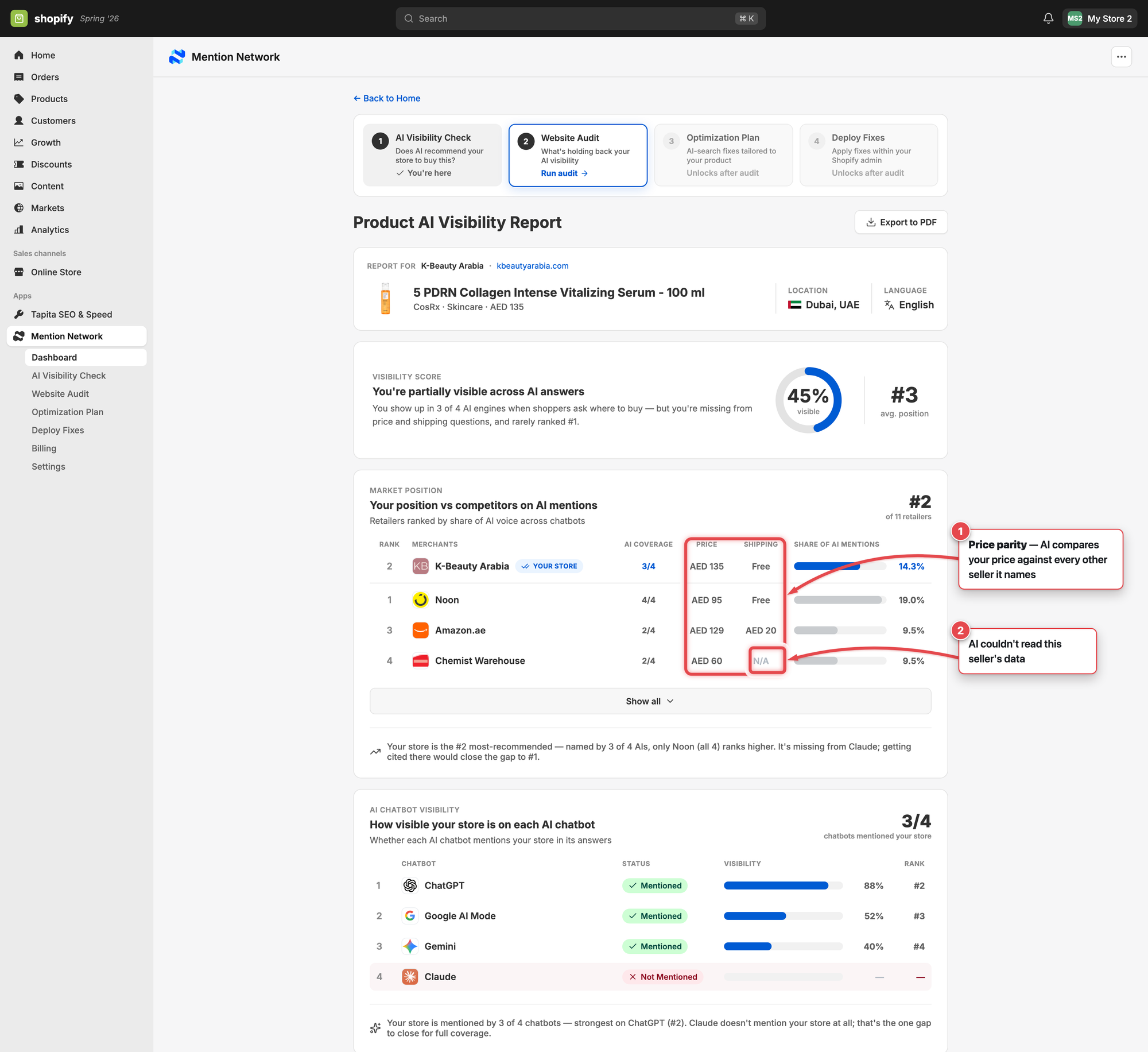
Look at the shipping column (①). When AI answers "where to buy [product] with free shipping," it is reading commerce signals off the product feeds assistants ingest, the seller's own data, and it factors shipping cost into who it names. A store with unclear or missing shipping data can drop out of that answer entirely (②).
This is where buyer psychology and AI ranking point the same direction. Unexpected shipping cost is one of the oldest cart killers in ecommerce, and free shipping measurably lifts completion. The exact same signal that loses you a human checkout loses you the AI placement. So the fix is not a marketing campaign. It is concrete: state free-shipping clearly on the product page, and if there is a threshold, say the threshold. A single item that quietly carries a shipping fee, with no free-shipping path shown, is a problem worth fixing even when the product looks fine otherwise. The shopper who cannot find the free-shipping answer, and the assistant that cannot parse it, both move on.
Why AI trusts a store, and why it is not the same as SEO
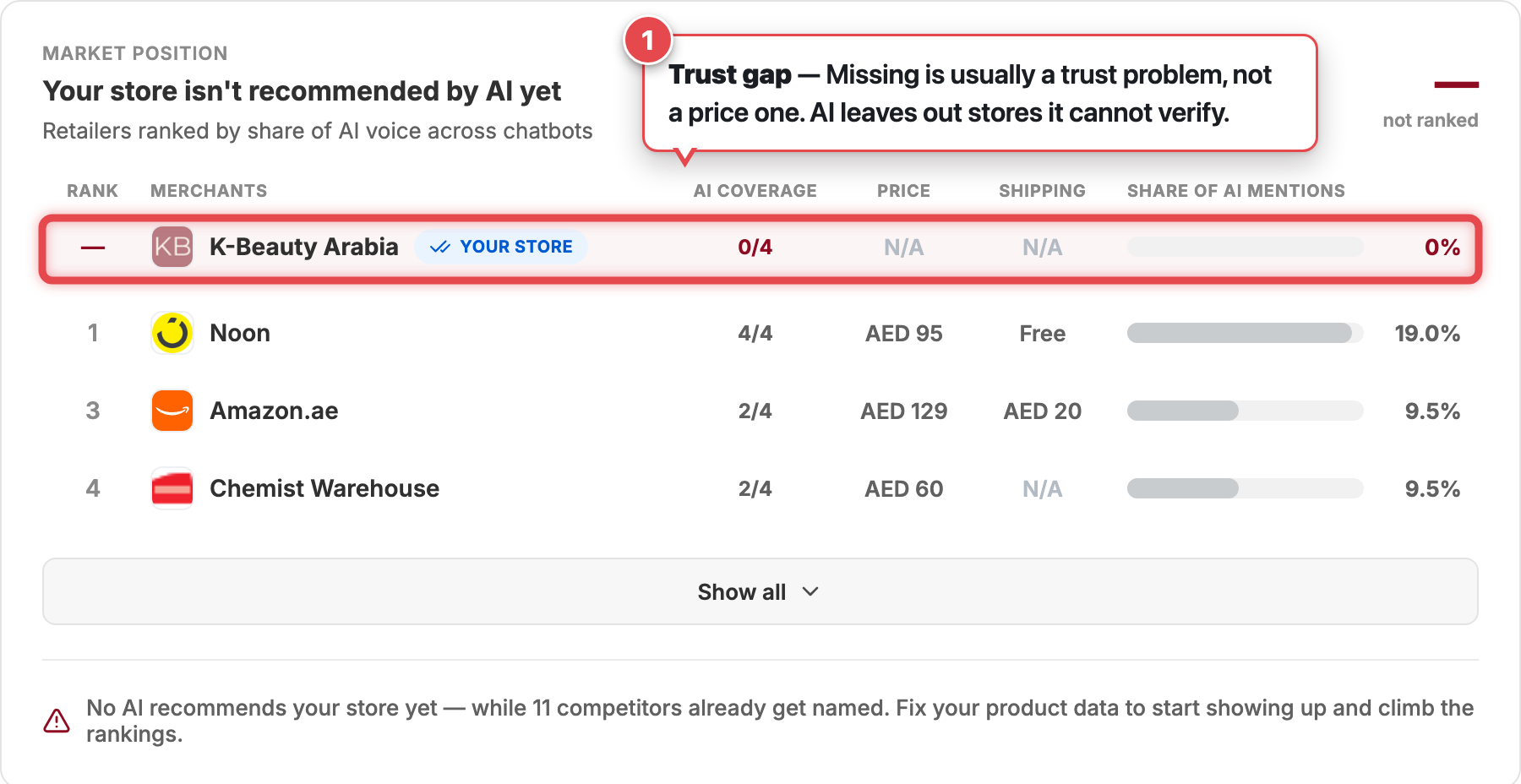
When your store is missing from an answer (①), the reason is often trust, not price. This is the clearest place GEO parts ways with SEO.
Classic SEO rewards backlinks and keywords. An AI assistant does something different: it tries to confirm you are a real, reachable business before it puts its own credibility behind recommending you. Publish a genuine email, phone number, and physical address, keep that name-address-phone identical across your contact page, your structured data, and your Google Business profile, and the assistant can triangulate you as a verified entity. When those signals are consistent, AI is more willing to name you. When they conflict, or when the only "contact" is a bare form, it gets nervous and leaves you out rather than risk recommending a store it cannot verify.
That is the kind of root cause the next phase, the Website Audit, is being built to diagnose and score, so a merchant sees not just that they are invisible but exactly which signal to fix. (The Audit, Plan, and Deploy phases are on the near-term roadmap; the Check runs today.)
Frequently asked questions
What is the difference between product visibility and brand visibility?
Product visibility is whether AI names your store at the buying-decision moment, for a specific product a shopper is ready to buy. Brand visibility is whether AI knows your brand exists during category browsing. A brand tool tracks category and reputation prompts like "best serums"; product visibility tracks "where to buy this exact product" prompts, the ones with a credit card behind them.
How many prompts does a Mention Network AI Visibility Check run per product?
The check currently runs five buying-decision intents (where to buy, best place to buy, where to buy authentic, cheapest place to buy, and where to buy with free shipping) across four assistants: ChatGPT, Gemini, Google AI Mode, and Claude. That is 20 measurements per product, and none of them counts a brand mention.
Is free shipping a ranking factor in AI shopping answers?
Yes. When an assistant answers "where to buy with free shipping," it reads shipping signals from the product feeds it ingests and factors shipping cost into which stores it names. A store with unclear or missing shipping data can drop out of that answer entirely, so stating free shipping, and any order threshold, clearly on the product page is a concrete fix.
Why is my store not showing up in AI recommendations?
Often the reason is trust, not price. Before recommending a store, an AI assistant tries to confirm it is a real, reachable business. Publishing a genuine email, phone number, and physical address, and keeping that name-address-phone identical across your contact page, structured data, and Google Business profile, helps the assistant verify you as a real entity. When those signals conflict, it tends to leave you out.
The point of measuring the right moment
A brand-visibility tool will tell you, accurately, how your brand is doing in AI discovery. If you are a brand owner with a marketing team, buy it. But if you run a store, the number that pays rent is whether AI names you at the buying-decision moment, for the specific products you sell, in the markets you serve, with the price and shipping and trust signals a shopper actually decides on.
That is the product visibility vs brand visibility split in practice. Mention Network measures the moment that pays, and because it measures the moment, it can point you at the fix. See where your store stands: run a free check on your top products.