
How to Rank Shopify Store in AI Search: 2026 Playbook
You enrolled in ChatGPT's Merchant Portal and still get skipped when shoppers ask for products in your category. Here's why, and the four-signal fix that actually moves you into the answer.


TL;DR Here's how to rank Shopify store in AI search in 2026: it comes down to four things. Can AI crawlers reach you, is your product data complete, do shoppers trust you, and do other sites cite you? On March 24, 2026, OpenAI switched on product discovery for millions of Shopify stores through Agentic Storefronts, but enrollment alone does not get you recommended: in our 2026-07-06 API-channel test, GPT-5.5 returned no answer at all for 5 of 10 buyer questions. The upside for stores that fix all four signals is real; one agency-reported case saw a store go from zero ChatGPT mentions to $14,000 in attributed revenue in 60 days.
What you'll learn:
- The Problem: You're enrolled but ChatGPT still skips you
- The Framework: Four signals behind Shopify AI search visibility
- Real Example: The ergonomic office-gear store that hit $14,000 in 60 days
- What To Do This Week
- Frequently Asked Questions
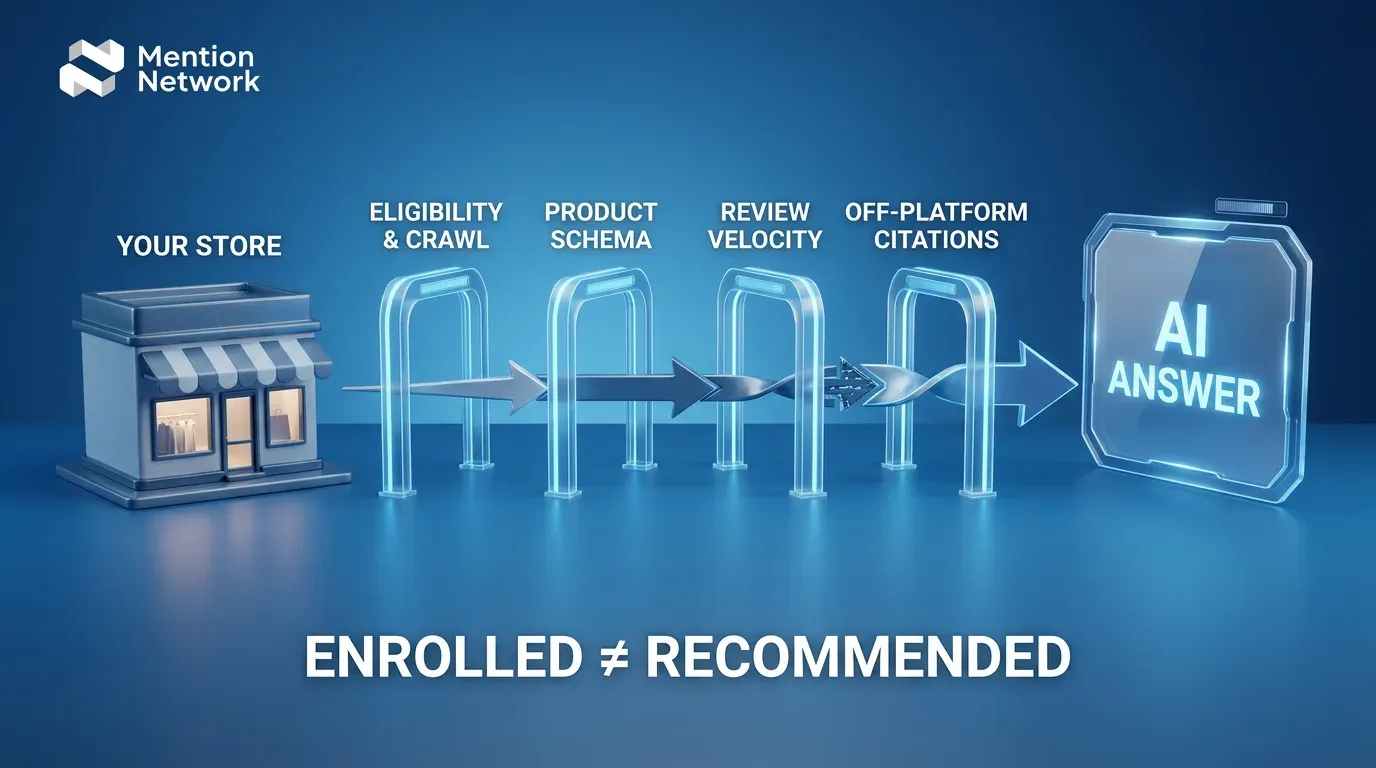
You joined ChatGPT's Merchant Portal the week it opened to your store. You confirmed the catalog was connected, checked the Agentic settings, and waited. Weeks later you ask ChatGPT "where can I buy [your product]" and a competitor shows up where you expected your own store. Enrollment felt like the finish line; it turned out to be the starting line. If you're working out how to rank Shopify store in AI search, that gap (enrolled but never recommended) is the whole problem, and the four signals below are the fix.
The Problem: You're enrolled but ChatGPT still skips you
Auto-enrollment made you eligible. It did not make you chosen. That distinction is the entire game.
When Agentic Storefronts rolled out by default on March 24, 2026, OpenAI put millions of Shopify stores in front of ChatGPT's users overnight (OpenAI announcement). Your catalog went live the same day every competitor's did. Being in the catalog no longer sets you apart; it just drops you into the same pool as everyone else selling what you sell.
This is where most stores stall. In Metricus's own audits of enrolled stores (vendor research: they sell AI-visibility tooling), 41% of Shopify stores in ChatGPT Shopping have product titles too branded or vague to match what shoppers actually type. When a model matches a query, it works from your structured data, so a beautifully designed storefront does nothing if the underlying title and fields don't describe the product in the words a buyer would use. Thin data leaves you invisible for the exact queries that would have converted.
We saw how fragile this is firsthand. In an API-channel test on 2026-07-06 (a directional sample: 10 buyer-intent questions across GPT-5.5, Gemini 3.5 Flash, and Perplexity Sonar Pro, not category-wide evidence), GPT returned no answer for 5 of our 10 questions, including "what are the top ranking signals" and "what schema does a Shopify store need." If the model itself won't commit to an answer on those, you can't guess your way into being the store it names; you have to work the signals it does reward.
The same Metricus audits report that brands with at least one authoritative editorial review for their category are recommended by ChatGPT at 4.2x the rate of brands with zero editorial coverage. Some of what decides the recommendation happens entirely off your store, on the review sites and editorial pages the model already trusts.
The ChatGPT Shopping pilot launched with just 12 Shopify merchants; by late March 2026, Agentic Storefronts rolled out by default, and Alhena reports AI-driven traffic up 7x and AI-attributed orders up 11x since January 2025. The same day the catalog rollout landed, OpenAI expanded its Agentic Commerce Protocol and pushed richer visual shopping to every free, Go, Plus, and Pro user. Most stores still have thin schema and weak citations right now, which means fixing yours is easier today than it will be once every competitor in your category has done the same work.
The Framework: Four signals behind Shopify AI search visibility
Across our three engines, the answers kept clustering around the same handful of fixes: get the crawlers in, complete your product data so it matches how shoppers search, earn trust through reviews, and get cited on sites the models already read. That consensus was strong. Our 2026-07-06 test asked 30 questions and got 25 answers back; every one of those 25 named both ChatGPT and Shopify, Google appeared in 17, and Perplexity in 14. The engines keep pointing at the same few platforms and the same few fixes. Below they're ordered the way you should actually work them.
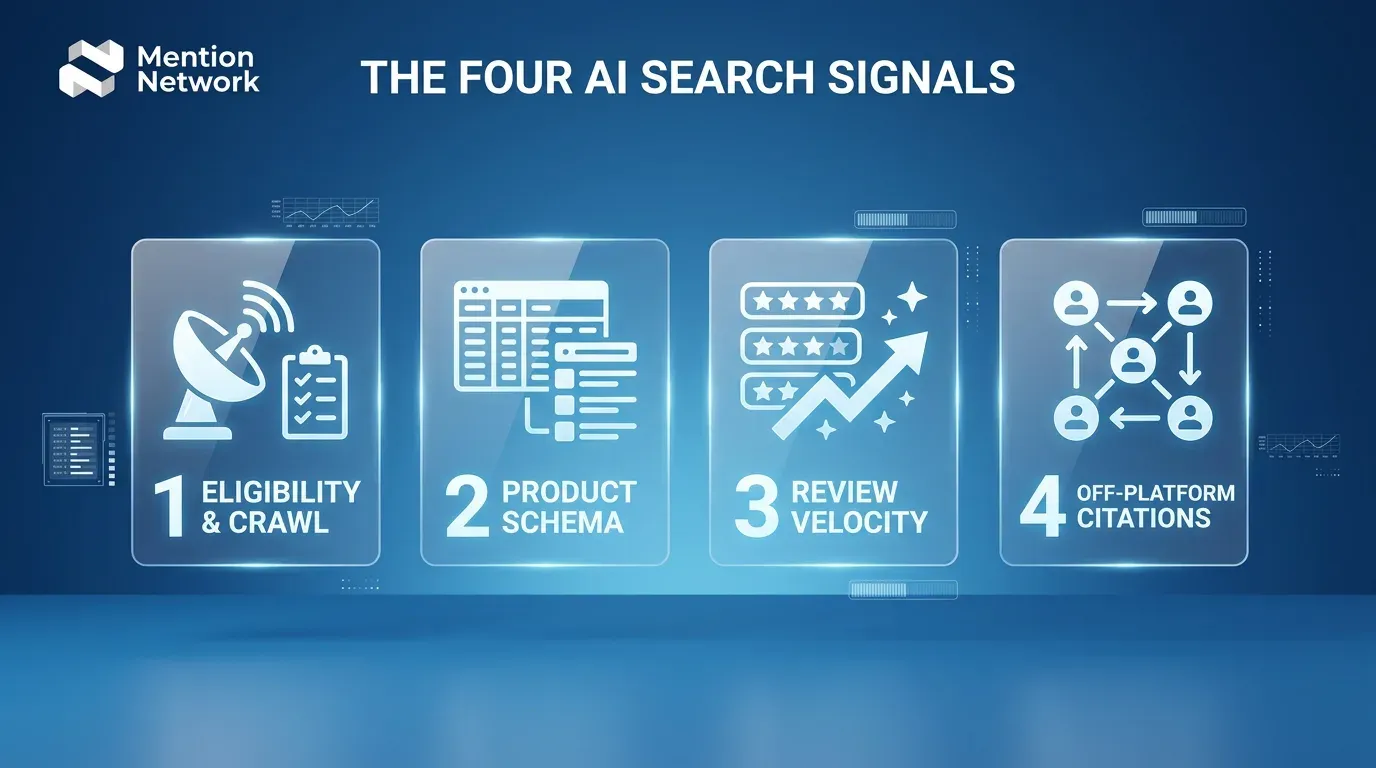
Step 1: Confirm eligibility and clear crawl blockers
Start by checking what the platforms can already see. In Shopify Admin, go to Sales Channels → Agentic to confirm your Shopify Catalog status and ChatGPT access. Then run your own buyer-intent queries directly in ChatGPT (with browsing on) and Perplexity; visibility is query-specific, so there is no single yes/no status to read.
Next, clear the blockers. Confirm your robots.txt does not disallow OAI-SearchBot or PerplexityBot, and that your product feed is complete. While you're at it, some agencies pair these fixes with an llms.txt file at the root domain, a plain-text summary of your store and categories; no engine officially commits to reading it, but it costs minutes and makes the store easier for models to parse. Both Perplexity and Gemini flagged crawlability plus feed completeness as the fastest thing to fix: merchants who clear structural blockers first often report visibility within 1–2 weeks, versus 4–8+ weeks to reach consistent recommendations. If you want the wider context on this shift, our guide on how ChatGPT Shopping is changing where shoppers discover brands covers the mechanics.
Step 2: Complete Product schema so Shopify ChatGPT product recommendations can match you
Shopify generates basic Product schema by default, but that default is almost always incomplete, and empty schema fields are worse than no schema at all. What a crawler parses is your JSON-LD, so gaps in the code are gaps in your visibility no matter how the page looks.
The core stack the engines named: Product (name, description, image, price, availability, GTIN, brand, SKU), AggregateRating, Organization (with sameAs pointing to your review platforms), FAQPage, and BreadcrumbList. This is also where semantic clarity lives: the title and description fields have to describe the product in the words a shopper types, not just your brand name, or you land back in that 41% of stores whose titles can't be matched.
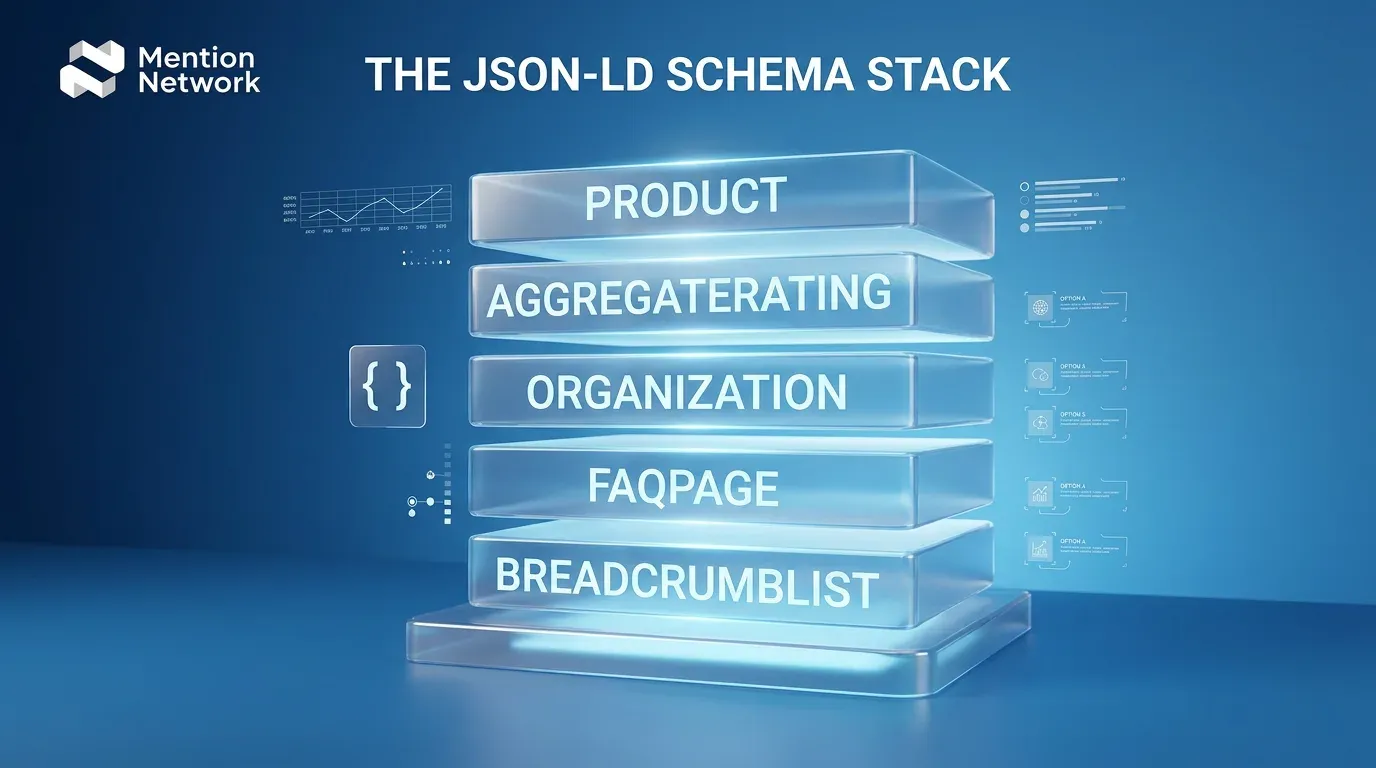
To add it on Shopify: the basic Product subset auto-generates, but AggregateRating, Organization, and FAQPage usually don't. Open Online Store → Themes → Edit code and add the JSON-LD block to theme.liquid or your product template, or manage the underlying values through product metafields. A review app that outputs AggregateRating markup (many popular Shopify review apps support this, so check the app's schema or SEO documentation before installing) wires ratings in without hand-coding. This is the single highest-return fix: OpenAI's own help page lists structured metadata first among the inputs ChatGPT uses to select products (OpenAI Help Center). If schema is new to you, start with how schema markup tells AI Overviews what your store sells.
Step 3: Build review velocity and trust signals
Every engine ranked reviews and reliability among the deciding factors. ChatGPT recommends products it can "understand, trust, and match," and trust is carried by AggregateRating markup, clear shipping and return policies, and a consistent organizational identity.
Concretely: get real review volume onto platforms the models already index, wire those ratings into AggregateRating schema (the same review app from Step 2 handles this), and make sure your Organization data links out to each profile with sameAs. The more consistent and verifiable those trust signals are, the more AI answers your store shows up in. It's the same discipline covered in the seven-step framework for getting AI systems to understand your content.
Step 4: Earn off-platform citations, the Shopify Perplexity optimization edge
This is the signal enrollment can never hand you. Perplexity cites its sources on every answer, which turns citation density into a visibility signal you can actually measure.
For ChatGPT specifically, the Bing index is the gatekeeper. Seer Interactive's 2025 analysis of 500+ SearchGPT citations found roughly 87% matched Bing's top organic results, against just 55% for Google. That is older, directional data, and model behavior may have shifted since, but the practical read holds: a store buried on page 3 of Bing is hard for ChatGPT to surface. Pair that with Metricus's 4.2x editorial-coverage multiplier and the move is clear: earn category reviews, editorial mentions, and citations on sites AI already trusts. It's the same shift covered in making the shift from classic SEO to AI search engine optimization, and it's where why generative engine optimization rewrites the rules of search visibility stops being theory and starts paying.
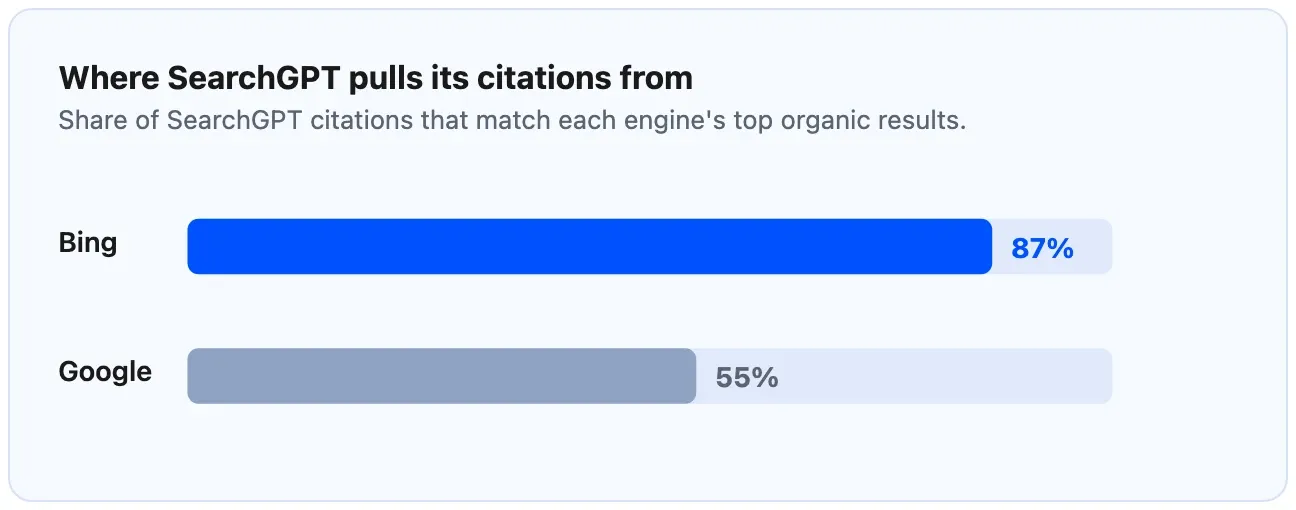
Data: Seer Interactive, Feb 2025. Analysis of 500+ SearchGPT citations. Older directional data; model behavior may have shifted.
Real Example: The ergonomic office-gear store that hit $14,000 in 60 days
One reported case is worth walking through, with its source stated plainly. Comergent, an AI-visibility agency that sells an llms.txt app for Shopify, describes an anonymized Shopify store selling ergonomic office gear that went from zero ChatGPT mentions to $14,000 in attributed revenue in 60 days after fixing two things from Step 1: crawlability and an llms.txt file. The case has not been independently verified, and Comergent has an obvious interest in the llms.txt part of the story. Read it as one vendor's account, not industry data. Still, the mechanics it describes (no new ad spend, no rebrand, just making the store legible to crawlers and models) match what every engine in our test kept rewarding.
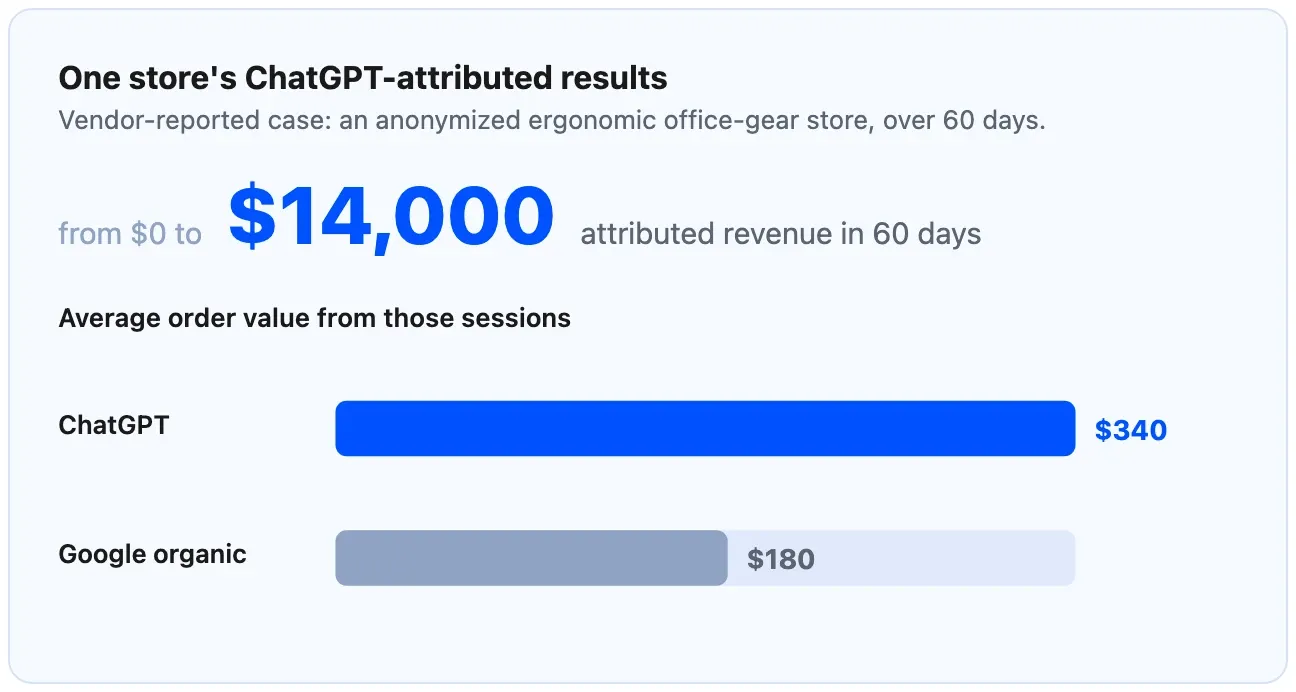
Data: Comergent case study, Nov 2025.
Per the same account, average order value from that store's ChatGPT referrals was $340, versus $180 from Google organic: AI-referred shoppers arrived later in the decision and spent nearly twice as much. That fits the wider trajectory Trackbee reports: ChatGPT drives only about 0.06% of Shopify traffic overall today, but top-performing stores already pull 5%+ of their orders from AI discovery, a spread Trackbee compares to early TikTok adoption in 2019. Getting these four signals right is how you reach that top tier before the channel fills up.
What To Do This Week
Five moves, each finishable in under an hour:
- Open Sales Channels → Agentic in Shopify Admin and confirm your Catalog is connected and syncing.
- Check
robots.txtfor any rule blocking OAI-SearchBot or PerplexityBot, and remove it. - Audit your Shopify AI search visibility by running five real buyer queries in ChatGPT and Perplexity; note where a competitor appears and you don't.
- Add or complete AggregateRating and Organization schema (with
sameAs) on your top 10 products. - List the category review sites and editorial outlets that already rank on Bing, and pitch one this week.
Do them in order. Steps 1–2 get you eligible and crawlable; steps 3–5 are what get you chosen. That's how to rank Shopify store in AI search without guessing at it.
Frequently Asked Questions
Does connecting my Shopify store to the ChatGPT Merchant Portal automatically make my products appear?
No. Auto-enrollment through Agentic Storefronts (which rolled out to eligible US merchants in March 2026) makes your products eligible, not guaranteed. ChatGPT selects products independently based on shopping intent, structured data quality, reviews, and query relevance. Connection is necessary, not sufficient.
How long after these fixes does a Shopify store start appearing in ChatGPT Shopping?
In our API-channel test, estimates ranged from initial appearances in 1–3 weeks to consistent recommendations in 4–8+ weeks. Merchants who fix structural blockers like robots.txt and feed completeness first tend to see visibility fastest, often within 1–2 weeks. There is no fixed timeline published by OpenAI, because selection is query-specific rather than a timed index window.
Does Shopify's default SEO setup handle AI shopping visibility?
It's a real baseline, but not the whole job. Shopify handles SSL, sitemaps, canonical tags, and basic Product microdata, but every engine we tested agreed extra work is required: complete Product schema with attributes like GTIN and brand, AggregateRating markup, Organization trust signals, and off-page citations.
What schema markup does a Shopify store need, and does Shopify generate it?
The core stack is Product (with rich attributes), AggregateRating, Organization (with sameAs), FAQPage, and BreadcrumbList. Shopify generates only a basic Product subset automatically; AggregateRating, Organization, and FAQPage typically require custom implementation or an app. Empty schema fields are worse than none, so complete them fully.
Can I track which AI platforms send traffic to my Shopify store?
Partly. Shopify Analytics and GA4 can surface chatgpt.com, perplexity.ai, and gemini.google.com referrers, and ChatGPT often tags visits with utm_source=chatgpt.com. But some AI traffic always arrives with no referrer and appears as "Direct," so treat the numbers as directional signals rather than a complete count.