
Agentic Commerce: The Third Layer of AI Visibility
Everyone is prepping for AI agents that shop and check out. But an agent cannot buy from a store it never recommends. Win that layer first.

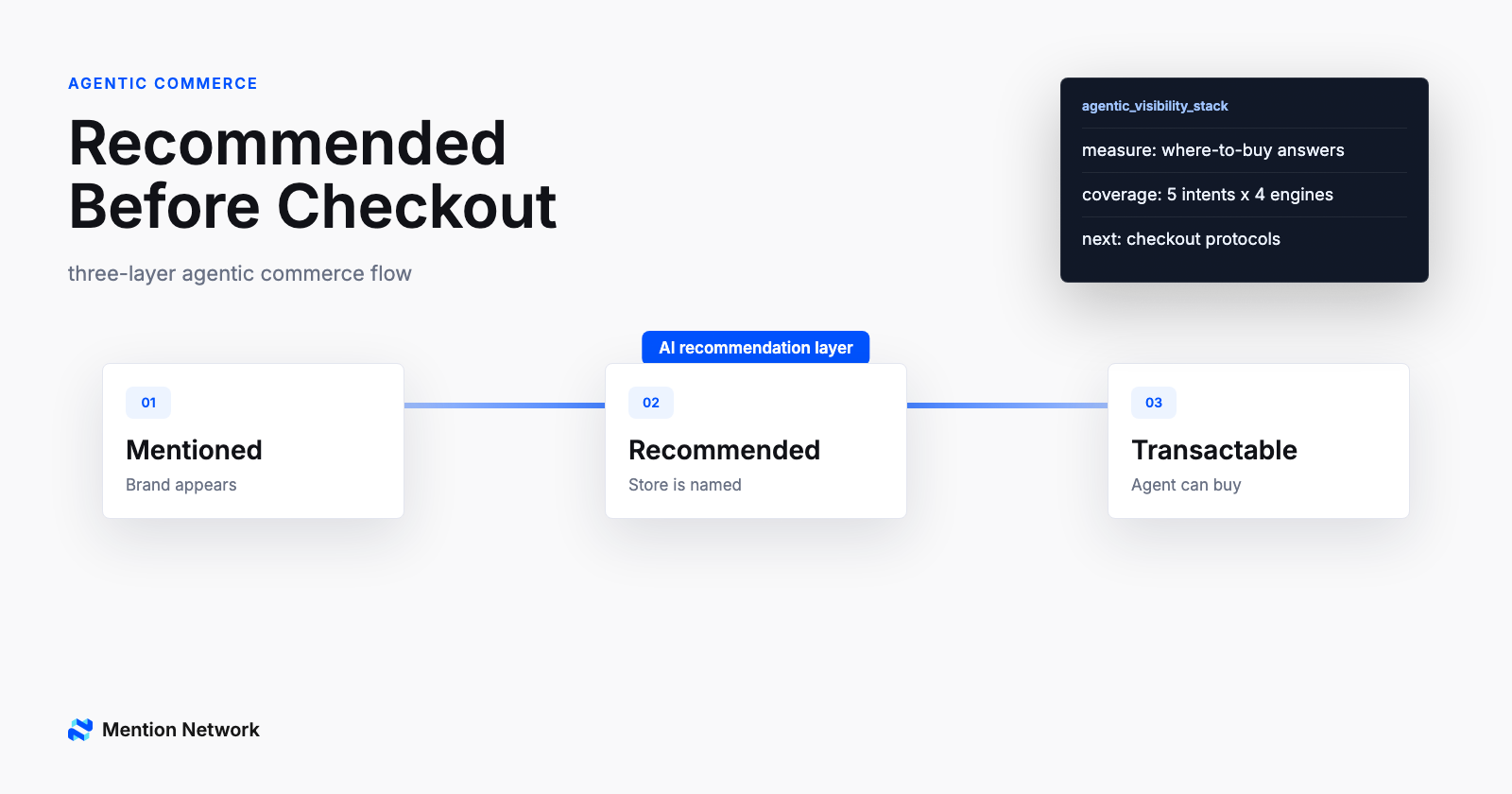
TL;DR Agentic commerce visibility has three layers: being mentioned, being recommended in a where-to-buy answer, and being transactable by an agent. The checkout layer is still forming, but an agent can only buy from a store AI already recommends. That middle layer is the one you can measure today, currently across 5 buyer intents and 4 AI engines.
She keeps seeing the same headline: AI agents can now shop and check out for people, and every store needs to be "agent-ready." So she goes looking for a checkout plug-in to install. Then, almost as an afterthought, she asks ChatGPT where to buy the sunscreen she sells. Her store is not in the answer. Not ranked low: absent.
The agent everyone is preparing for cannot buy from a store it never names. That is the layer worth fixing first.
What is agentic commerce visibility?
Agentic commerce visibility is whether an AI agent can find, recommend, and act on your store, and it comes in three layers. First, your brand or product gets mentioned. Second, your store gets recommended when a shopper asks where to buy. Third, an agent can transact with you directly. If you spent a decade on SEO, the shape is familiar: getting indexed, then ranking, then converting. The layers stack, and you cannot skip the middle one.
Most of the noise right now is about layer three. The layer that decides whether an agent ever reaches your store is layer two, and almost nobody is measuring it.
Do I need to be "agent-ready" before AI recommends my store?
No, and the order matters. The transactable layer is real and moving fast: Stripe and OpenAI shipped Instant Checkout in ChatGPT powered by the Agentic Commerce Protocol, an open standard for agents and businesses to complete a purchase (announced September 29, 2025, accessed July 14, 2026). The tooling side has its own open standard in Anthropic's Model Context Protocol (November 25, 2024).
But agents do not crawl and guess. They act on structured product feeds. Google's own Shopping Graph carries "more than 50 billion product listings, 2 billion of which are updated every hour" (November 13, 2025, accessed July 14, 2026). A product missing from that graph is invisible for where-to-buy, and no checkout protocol can transact with a store an agent never surfaces.
How do you measure the layer that comes first?
You measure whether AI recommends your store, not whether it mentions a brand. An AI Visibility Check asks the where-to-buy questions the way shoppers phrase them, currently 5 buyer intents across 4 assistants (ChatGPT, Gemini, Google AI Mode, and Claude) for 20 answers per product. It shows whether your store and products appear, at what rank, against which competitors, with the verbatim AI answers as receipts. Coverage is a plain score of how many of the 4 engines name you, so 2 of 4 is a very different store from 4 of 4.
That is the product-visibility layer brand tools miss, and it is the prerequisite for everything agentic. Win it, and being transactable becomes the next frontier to prepare for instead of a box you check in the dark.
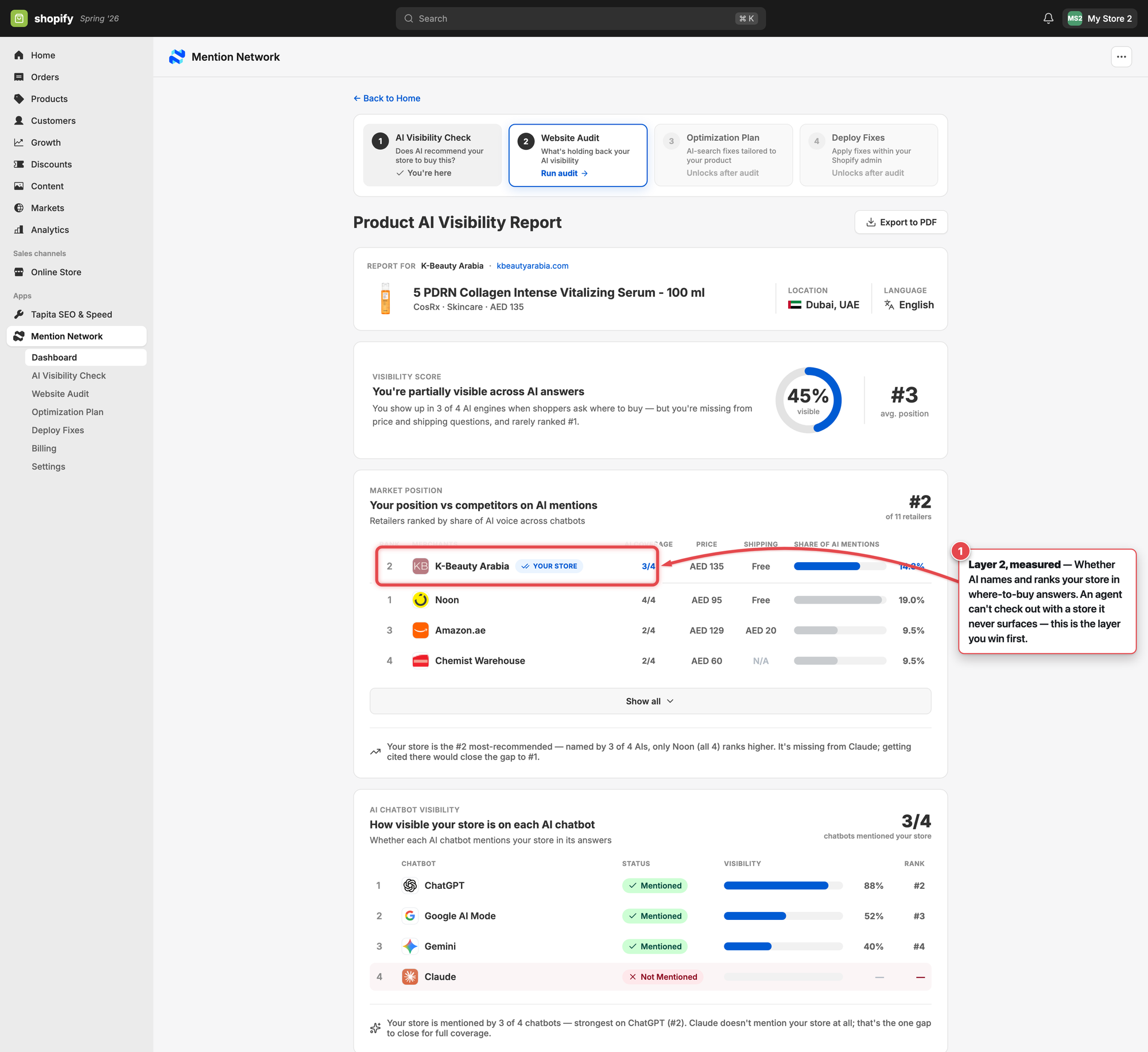
The layers stack: an agent can only transact with a store AI already recommends, so layer 2 is where the work is today.
The Shopping Graph carries more than 50 billion product listings, 2 billion of them refreshed every hour [Source: Google, November 13, 2025]. If your products are not in the feed AI reads, no agent checkout can reach them.
Where to start
- Ask ChatGPT or Gemini where to buy one of your best sellers, the way a shopper would, and read whether your store is named.
- Run an AI Visibility Check to see your rank and competitors across all four engines, not just one anecdote.
- Fix the recommendation layer first; treat agent checkout as the frontier to prepare for, not the first thing to buy.
Frequently Asked Questions
What is agentic commerce visibility?
It is whether an AI agent can find, recommend, and act on your store. It has three layers: being mentioned, being recommended in a where-to-buy answer, and being transactable by an agent. The middle layer is the one you can measure and fix today.
Do I need to integrate an agent checkout protocol first?
No. Standards like the Agentic Commerce Protocol run at the payment layer, but an agent only reaches checkout after AI recommends your store. If AI does not name your store when a shopper asks where to buy, the checkout plumbing has nothing to act on.
How do I check whether AI recommends my store?
Run an AI Visibility Check. It asks the where-to-buy questions across the major assistants, currently 5 buyer intents on 4 engines, and shows whether your store and products appear, at what rank, and against which competitors.
Next step
For the full picture of where this middle layer sits, see the three layers of AI visibility and how ChatGPT Shopping is changing product discovery. Then run a free AI Visibility Check to see whether AI recommends your store today.