Key components of AI SEO (and why it’s not just “SEO with AI”)
AI SEO is more than SEO with AI tools. Learn the six core components, from AI search visibility to authority signals, that determine whether AI systems select and cite your brand.

Traditional SEO decides where your page ranks in a list of links. AI SEO decides something else: whether an AI system understands your brand well enough to name it, summarize it, and reuse it inside a generated answer.
That gap matters because AI systems don't treat the web as a level field. They compress it into a small set of trusted entities and a few repeated narratives. If you're not in that set, you're not in the answer. This page is the components satellite; the canonical definition and strategy page is What is AI SEO?.
What you'll learn:
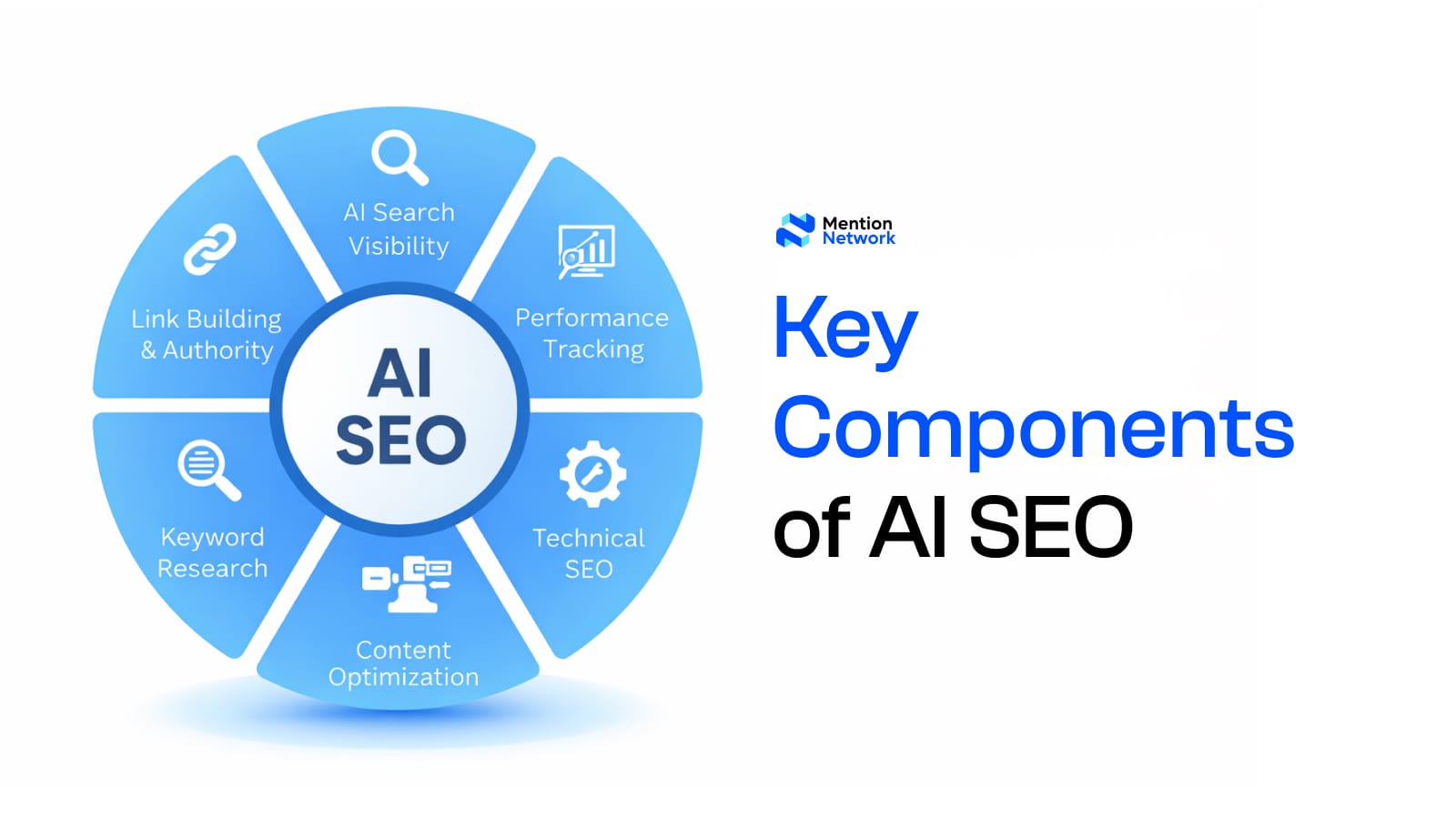
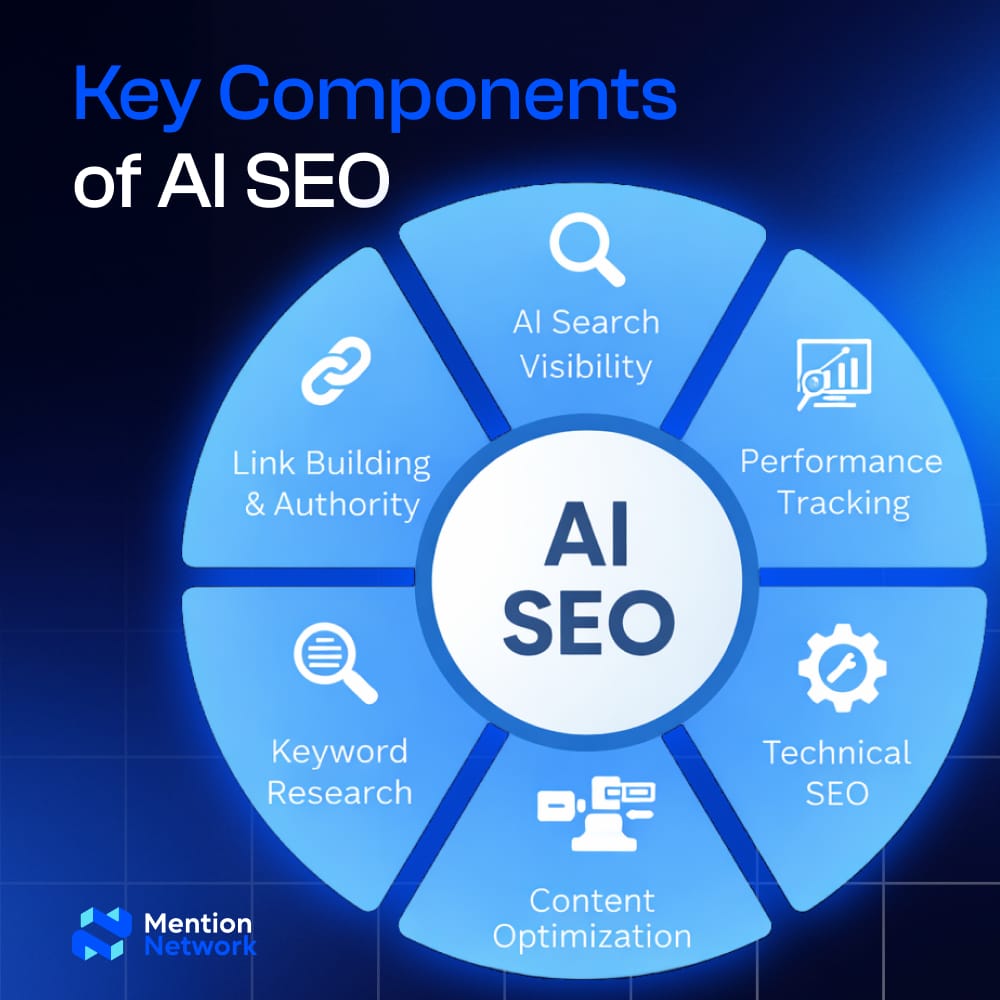
6 key components of AI SEO
AI SEO rests on a handful of components that make content easy for LLMs to read, judge, and cite. They're less about pleasing an algorithm and more about being clear enough to reuse.
1, AI search visibility: the core metric that didn’t exist before
AI Search Visibility sits under everything else, because it answers a question marketers never had to ask: when someone puts a question to ChatGPT or Google AI, does your brand show up at all?
It measures presence inside the generated response. How often you're named, how you're described, whether you're recommended next to competitors. And it matters because the answer often replaces the click, the reader takes it and moves on.
A 2025 SEMrush study of more than 150,000 AI citations found that fewer than 20% of domains ranking on page one of Google were consistently referenced inside AI answers. Ranking, it turns out, doesn't buy you inclusion.
| Metric | Traditional SEO | AI SEO |
|---|---|---|
| Primary signal | Rank position | Brand mention & citation |
| Visibility surface | SERP | AI-generated answers |
| Failure mode | Low traffic | Total absence |
| Measurement tools | SEO dashboards | AI visibility monitoring |
So there's a failure mode that didn't exist a few years ago. You can win the SEO game and still be invisible in AI.
2, Content optimization for AI understanding
Content optimization still counts, but the target moves. You're no longer only persuading a reader or signaling relevance to a ranking algorithm. You're writing something an AI system can lift without getting it wrong, so the words have to be clear, scoped, and safe to quote.
Structure decides what gets reused. ChatGPT and Perplexity tend to pull passages that sit near the top of a section, right under a clear heading. Content that travels well usually has:
- A tight definition early in the section
- Explicit scope (what the product covers, and where it stops)
- Neutral, factual language
Example (before vs after optimization):
| Version | AI reuse likelihood |
|---|---|
| Marketing-heavy description | Low |
| Clear, scoped definition | High |
Rewrite a page around those three habits and you'll often see AI inclusion climb while your Google rankings sit exactly where they were. Different axis, different reward.
3, Keyword research as intent modeling
Keyword research doesn't disappear either. It turns into intent modeling.
Most AI Search queries arrive with a constraint attached: a budget, a use case, an audience. "Best insulated bottle under $40" isn't the keyword "water bottle", and a flat keyword list can't hold that nuance. So instead of chasing isolated terms, map the shapes real questions take:
- Conversational phrasing
- Use-case language
- Comparative framing ("X vs Y", "best for…")
The workflows that do this well pair keyword data with the actual queries people type into AI. Map your content to those intent clusters and inclusion rates go up.
4, Authority signals in an AI context
Authority still carries weight, but AI systems read it through a different lens. Backlinks alone don't cut it. What they look for is cross-source corroboration, the same claim about you showing up in places you don't control.
Citation analysis keeps surfacing the same reference types:
- Wikipedia
- Industry publications
- Review platforms
| Source type | AI trust signal |
|---|---|
| Brand-owned content | Low |
| Neutral reference sites | High |
| User-generated consensus | Very high |
Picture a fintech startup that lands coverage in 2 neutral industry reports and a Wikipedia citation. Its AI mentions can climb even though traffic barely moves, because that corroboration works as a trust signal for reuse, not a source of visits.
That's why building authority pays off for AI Search specifically, not just for rankings.
💡Read more: AI SEO Strategies Learned from the PlushBeds Case Study
5, Technical SEO as AI readiness infrastructure
Technical SEO is the plumbing that lets AI models read you correctly. They're more forgiving than a classic crawler, but they still lean on clean structure, unambiguous entities, and consistent formatting. Where the structure is messy, the meaning gets fuzzy, and AI routes around anything it can't parse with confidence.
A crawlability audit across 300 AI-visible pages found that pages with a clean entity hierarchy and schema markup were 2.3x more likely to be cited in AI answers. The signals that move that number:
- Clear, consistent entity naming
- Internal links that reinforce topic relationships
- Structured headings and schema
AI SEO tools tend to catch the interpretability gaps a rankings-focused audit walks past, the ambiguous entity references and inconsistent page structure it never thinks to flag.
6, Performance tracking beyond traffic and rankings
AI SEO needs its own scoreboard, because a traffic dashboard can't see what happens inside an answer. A page can shed clicks and gain influence at the same time, if it becomes the thing AI quotes.
Useful tracking watches:
- How often you're named in AI answers
- The context and sentiment around each mention
- Which competitor displaces you, and where
Example dashboard metrics:
| Metric | Insight |
|---|---|
| Mention frequency | Inclusion strength |
| Model coverage | Ecosystem resilience |
| Competitor replacement | Lost visibility |
Platforms like Mention Network turn those into standing metrics, so a team can build a feedback loop instead of guessing. Without them, you can't tell whether a visibility dip is real or just zero-click behavior hiding the win. That's the line between working from evidence and working from a hunch.
AI SEO builds on SEO
AI SEO doesn't throw SEO out. It stacks on top, adding a layer of structure, context, and semantic clarity aimed at AI systems, so your content earns its place in both the ranking and the generated answer.
Why SEO still matters
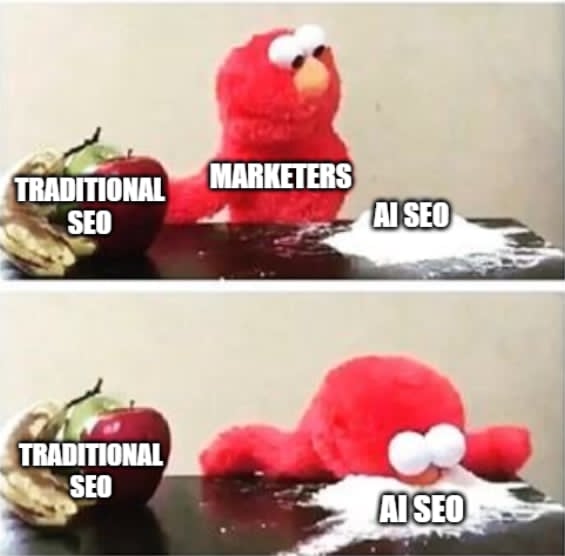
SEO is still the base layer, because an AI model can only reuse what it can reliably find, read, and trust. Pages blocked by indexing errors, buried under heavy scripts, or missing clear entity signals give the model less to work with. Solid SEO is what makes your content eligible in the first place: it fixes crawlability, builds topical authority, and raises the odds your pages land in the corpus models learn from or pull during AI Search.
The trap is assuming eligibility equals selection. SEO gets you indexed and ranked; it doesn't guarantee your brand makes the AI answer. An AI answer compresses the web into a few named sources rather than laying out a full list, and plenty of high-ranking pages never make the cut. Their content is hard to summarize, their claims are vague, or they say different things about themselves in different places. That's where AI SEO picks up.
Where AI SEO adds strategic value
On top of SEO, AI SEO adds a representation layer. It governs how your brand gets described inside an answer, which attributes get repeated, and whether the model treats you as a safe pick in context. Ranking is about being findable in the results; representation is about being the brand chosen inside the answer.
Which explains a pattern you see all the time. Two brands post near-identical SEO numbers, yet one keeps surfacing in AI Search and the other never does. The gap usually comes down to clarity and consistency: the chosen brand has simpler definitions, a cleaner category story, stronger backing from neutral sources, and more liftable units like comparisons, FAQs, and scoped explanations. AI SEO works on how reusable your information is.
💡Learn more: Case Study: 2,300% Traffic Growth with AI SEO
Why Mention Network matters
Mention Network measures what a traditional SEO platform can't see: how AI actually talks about your brand and your products across models, categories, and competitors. Most tools are built around SERP positions and clicks. They were never meant to answer "which model recommends us most," "which attributes keep getting repeated about our store," or "which competitor takes our spot when a shopper asks AI what to buy." Mention Network turns those blind spots into numbers you can track.
It works on two layers. Brand AI Visibility tells you whether AI names and recommends your brand when a shopper asks about your category. Product AI Visibility tells you whether it points those shoppers to your specific products, including the where-to-buy answers that decide a sale. From there the workflow is measure, diagnose, fix: a store audit explains why AI isn't picking you, and the platform drafts the change for the product page so you can preview it, approve it, and apply it in your store admin.
For a merchant that means you can:
- Track AI Search Visibility across ChatGPT, Gemini, and Google AI in one place
- See what drives a competitor's selection, which topics trigger it and which product attributes keep getting repeated
- Check whether a change actually moved the needle: more mentions, a more accurate description, a bigger share of voice inside AI answers
AI behavior shifts faster than search rankings do, so monitoring is how you catch a drop early, trace it to a cause (fuzzy content, entity confusion, thin corroboration, a missing comparison), and fix the thing that changes whether AI picks you. It's Shopify-first today, with WooCommerce and custom stores over the API next. You can start with a free check-up, pay as you go, no demo gate.
You can run a free AI Visibility check at mention.network and see how your brand shows up in AI answers today.
Got questions? Email [email protected], or book a quick call for free support with our team.
FAQs
Is AI SEO replacing SEO? No. It builds on SEO and carries it into AI-driven discovery. SEO handles eligibility, making your content crawlable, indexable, and authoritative. AI SEO handles selection, making your brand easy for AI systems to describe and reuse inside answers.
Can rankings predict AI inclusion? Not reliably. Plenty of top-ranking pages never appear in AI answers because they're hard to extract, too vague, or at odds with other sources. AI systems often prefer clearer, better-corroborated information over the highest-ranking result.
How long does AI SEO optimization take to show results? It depends on the category and how often the models get updated or retrieval kicks in. Think weeks and months, not days. You'll usually see description accuracy and topic-level presence move first, then recommendation frequency.
Why are neutral sources so important? AI systems lean on third-party validation to lower the risk of reusing a claim. Neutral sources like encyclopedic references, reputable publications, and large review platforms act as corroboration. They give the model confidence that your claims hold up beyond your own marketing.
What is the biggest mistake in AI SEO today? Treating traffic as visibility. In AI Search you can lose clicks without losing influence, and lose influence without any obvious traffic signal. Skip the monitoring and teams end up polishing the wrong pages and misreading what's actually happening.