
How AI SEO Drove a 472% Traffic Surge for a Struggling eCommerce Website

Turning around a website that is experiencing stagnant or declining traffic is never easy. For most businesses, it might seem like a monumental task. However, by employing the right combination of AI SEO strategies, a struggling eCommerce site can be transformed into a long-term growth machine.
This is the success story of one eCommerce business that saw a remarkable 472% increase in organic traffic in under two years, thanks to a tailored approach that integrated AI-optimized SEO execution, content built around search intent, and the power of topical authority.
The Results: A Staggering Transformation
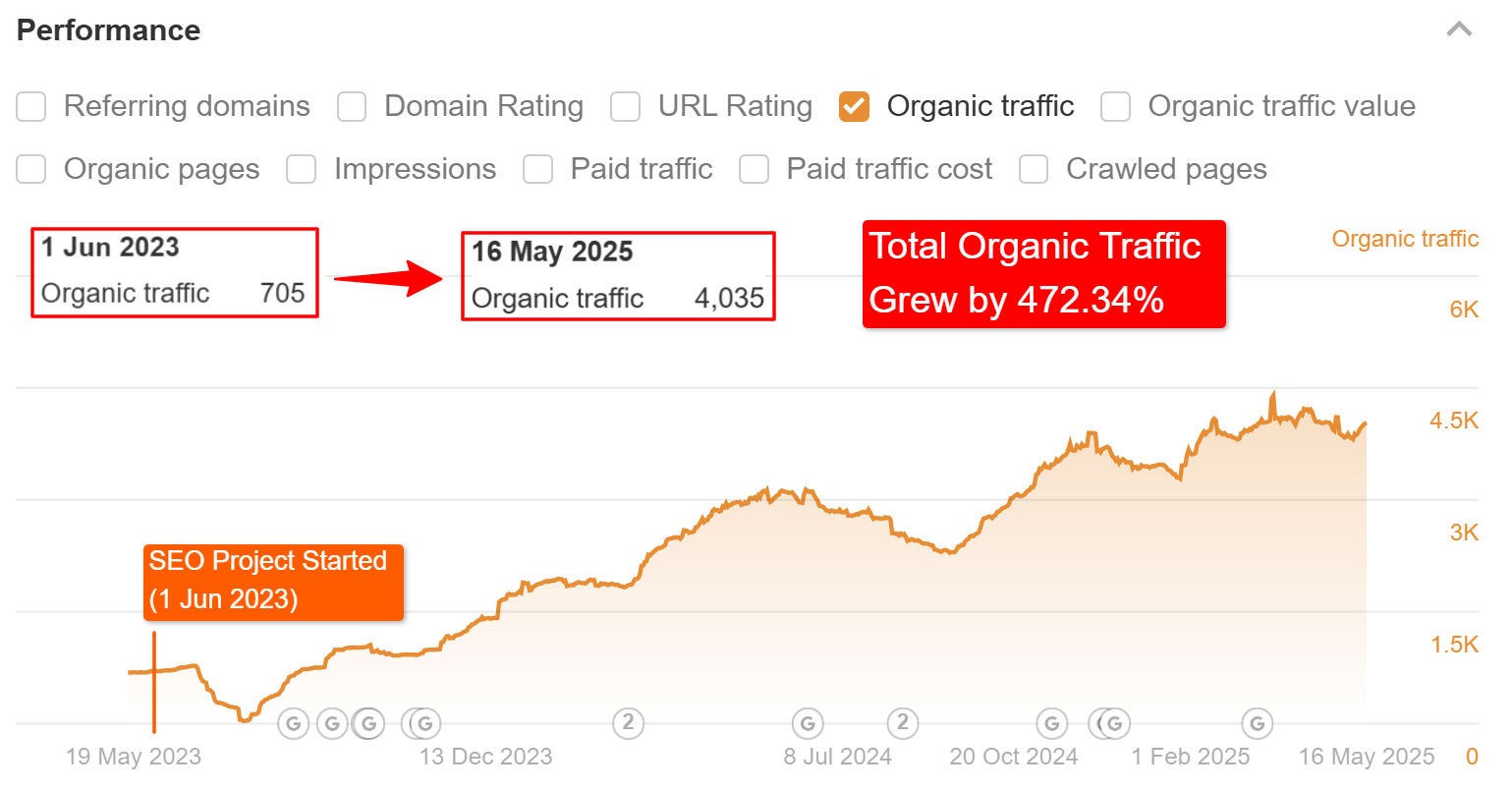
When the eCommerce site first started working with an AI-focused SEO strategy in June 2023, it was facing stagnation. Traffic was flat, rankings were sluggish, and the website was nowhere near competing with its market peers. Fast forward to May 2025, and the results of their strategy were clear:
Key Results:
- Organic Traffic Growth (June 1, 2023 – May 16, 2025): 472.34% growth (from 705 to 4,035 sessions)
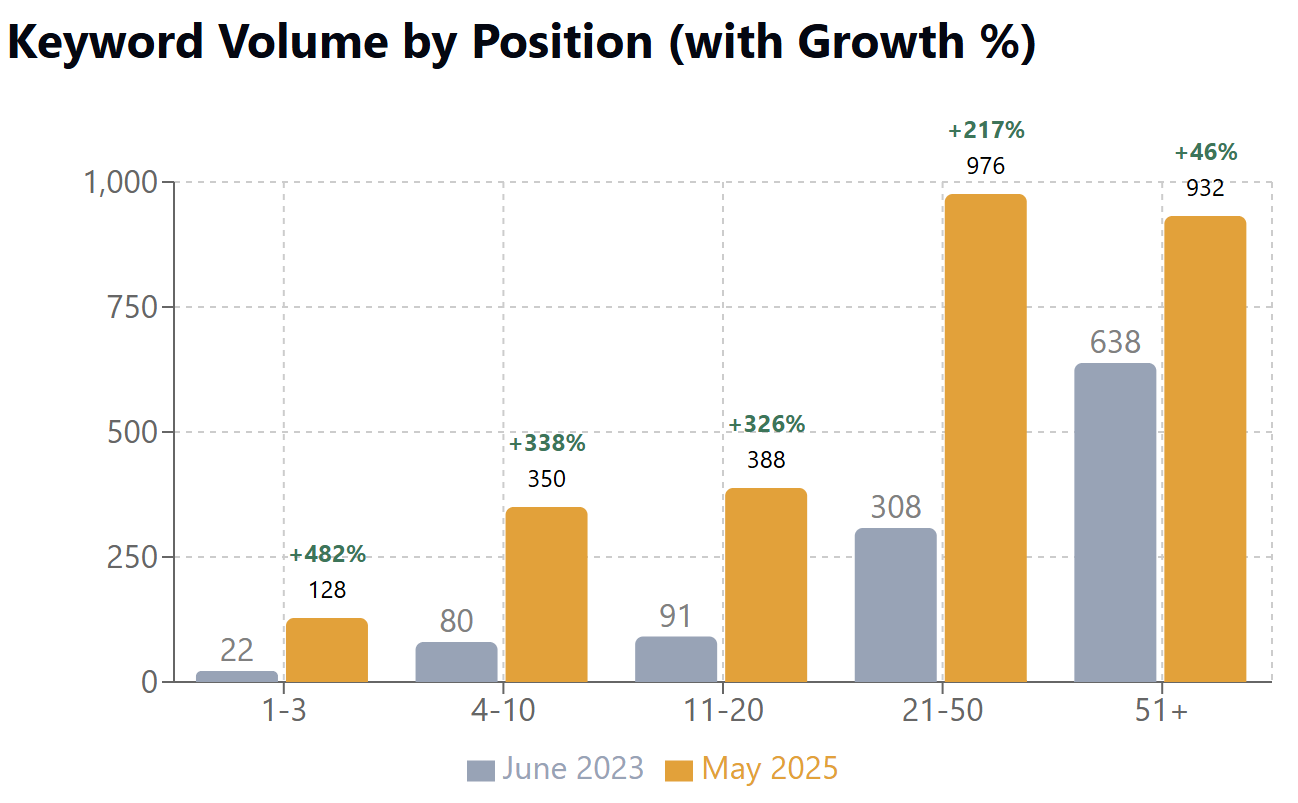
- Ranking Improvements (June 2023 vs May 2025):
- Top 3 Positions: 22 to 128 keywords (+482%)
- Positions 4–10: 80 to 350 keywords (+338%)
This growth didn’t happen by accident; it was driven by a strategic, multi-pronged approach focused on improving AI visibility and leveraging AI search engines in ways traditional SEO strategies simply couldn’t.
You can try a free AI Visibility tool at mention.network to see how your brand shows up in AI answers.
If you have any questions, email us at [email protected], or book a quick call for free support with our team here
The Strategies That Led to Success
The impressive results came from implementing AI SEO, focusing on improving AI visibility through a combination of content optimization and AI search monitoring.
1. Search Intent-Based Content Creation
The first step toward optimizing this eCommerce site was aligning content with search intent. Instead of focusing solely on high-volume keywords, the content was crafted to directly answer specific queries, using natural language that AI models could easily understand and extract.
Key Strategies:
- Understanding buyer intent: The content strategy focused on creating pages that answered real-life questions people were asking, like “best running shoes for flat feet under $100” or “affordable SEO tools for small businesses.”
- AI Visibility Boost: By aligning content with these intent-driven queries, the brand began appearing more frequently in AI-generated answers, like those found in Google AI Mode or other AI search engines like ChatGPT and Google Gemini.
This approach ensured that content wasn’t just ranking, but it was also directly serving AI models with the information they needed to recommend the brand.
2. AI-Optimized Content Structuring
AI search engines don’t just rank content based on keywords; they interpret the structure of the content and the context within. Therefore, structuring content for AI search visibility became a priority.
Key Tactics:
- Content structure for AI models: Using techniques like LLM optimization, the content was rewritten to cater to AI models, ensuring that the main points were easily extracted and presented by AI-powered search systems.
- Semantic clarity: Ensuring content was semantically rich and contextually relevant helped AI systems associate the brand with specific topics or product categories, improving both AI Search Visibility and general brand visibility.
The result? Not only did the content rank well, but it was also AI-friendly, meaning AI systems could easily identify and recommend it when relevant queries were posed by users.
3. Topical Authority Building
Building topical authority was a critical strategy. The website focused on deep, interconnected content around core themes relevant to their products, which signaled to AI systems that the site was an expert in its field.
Key Strategies:
- Internal linking: By creating strong connections between related articles and product pages, AI systems could better understand the breadth and depth of the website's expertise.
- Focused content clusters: These content clusters focused on specific product categories, strengthening the site's E-E-A-T (Expertise, Experience, Authoritativeness, and Trustworthiness) across AI models.
By positioning itself as an authority in these topics, the site gained more AI visibility as AI systems recognized it as a trusted source of information on those subjects.
4. Monitoring AI Visibility Metrics and Optimization
AI systems are constantly evolving, and so is the way they prioritize content. Regular AI Search monitoring was vital in ensuring the site’s content stayed aligned with changing AI behaviors.
Monitoring Metrics:
- Brand mentions in AI responses: Using AI search tools like Mention Network, the brand could track how often it appeared in AI-generated answers, what context it was mentioned in, and how frequently it was chosen over competitors.
- Sentiment analysis: Monitoring sentiment helped the brand understand how AI described it whether in a positive or negative light.
By continuously optimizing based on these insights, the site stayed competitive and kept adapting to the evolving AI search landscape.
5. Schema-Rich Content for Improved Crawlability
One of the most impactful strategies was the implementation of schema markup on key pages. Structured data helps AI models easily parse and categorize content, ensuring the site’s product pages and FAQs were highly visible to AI systems.
Key Tactics:
- Product schema: This was added to product pages to make sure AI systems could easily identify the key attributes of each product.
- FAQ schema: FAQs were optimized with schema markup to help AI systems pull concise answers directly from the page, improving the chances of being featured in AI search answers like People Also Ask (PAA) boxes.
By ensuring the site’s pages were optimized for structured data, it became more accessible to AI models, increasing the likelihood of being cited in AI answers.
The Future of AI SEO: Why AI Visibility Will Matter Even More
As AI models become more sophisticated, traditional SEO strategies will continue to play a role, but AI SEO optimization will be essential for staying competitive. The rise of AI-driven search engines like Google AI Mode, ChatGPT, and Gemini signals a shift away from traditional keyword-based ranking. Instead, it’s about visibility in AI-generated answers, and brands that understand and optimize for AI visibility will have a competitive advantage.
Key Trends:
- Semantic Optimization: AI systems are moving toward semantic relevance, meaning content must be clear, precise, and contextually relevant to user queries.
- Shift in Focus: The focus is moving away from ranking alone to ensuring that your brand appears in the right context when AI models are making recommendations.
In this evolving landscape, brands that master AI visibility optimization will not only survive but thrive in the AI-first era.
Conclusion
Turning around an eCommerce website with stagnant traffic requires a comprehensive approach that blends traditional SEO with AI-driven techniques.
By optimizing for AI visibility, creating search intent-based content, focusing on topical authority, and continuously monitoring AI search performance, brands can achieve sustained growth and stay ahead of the competition in this new era of AI search engines.
FAQs
Q1. What is AI SEO?
AI SEO refers to the process of optimizing content specifically for AI-driven search engines, such as ChatGPT, Google AI Mode, and Perplexity, to ensure your brand is included in AI-generated answers.
Q2. How can I measure my brand’s AI visibility?
You can measure your brand’s AI visibility using tools like Mention Network, which tracks your brand’s presence across AI search engines and provides insights into your competitive positioning.
Q3. Does AI visibility matter for traditional SEO?
Yes, AI visibility and traditional SEO work hand-in-hand. While SEO ensures your content ranks on search engines, AI visibility ensures it appears in AI-generated answers, which is increasingly important for capturing traffic and conversions.
Q4. How can I optimize my content for AI search engines?
To optimize for AI search engines, you need to focus on clarity, structure, and search intent. Use schema markup, align your content with user intent, and ensure your content is easy for AI systems to interpret and reuse.