
Product Information Management (PIM) for Shopify: Do You Need One? (2026)
As you add products and channels, your product data drifts out of sync. A PIM is the one source of truth that fixes it. Here's what a PIM does, when a Shopify store needs one, and when metafields are enough.

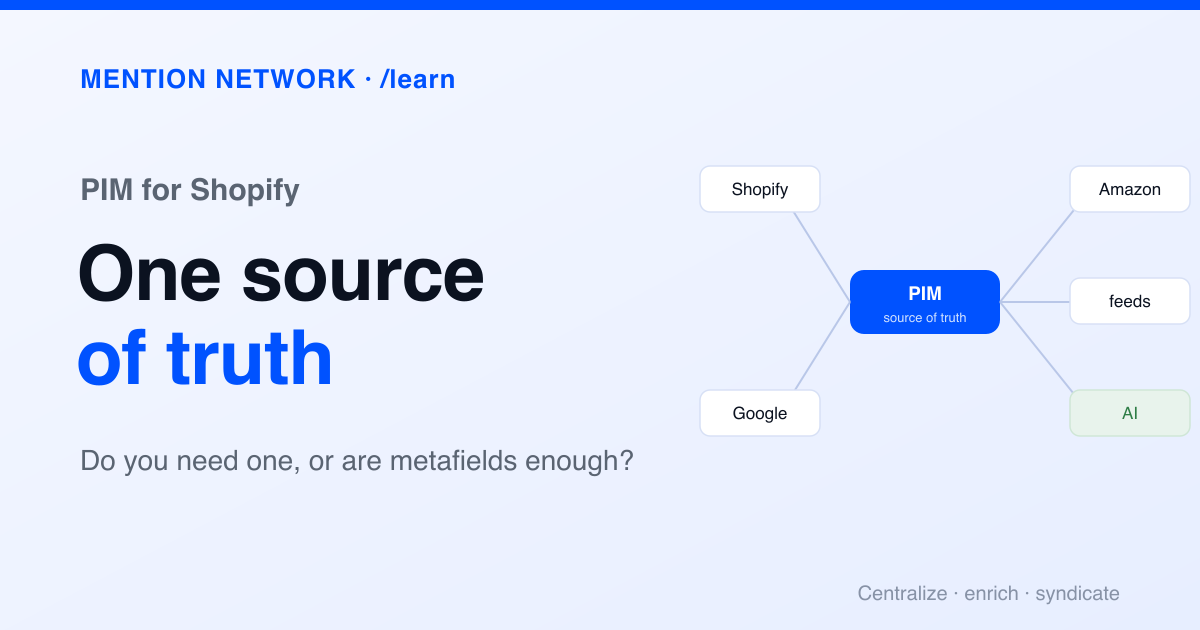
Product data drifts. A spec that's right on your Shopify store is wrong on Amazon. A description you updated last week is stale in three other places. A new attribute your team agreed on lives in a spreadsheet nobody syncs. The more products and channels you run, the worse the drift, and the more often a machine reads a different version of you depending on where it looks. A Product Information Management system (PIM) is the fix: one governed source of truth for product data. This guide covers what a PIM does, when a Shopify store actually needs one, and when metafields are enough.
What a PIM does
A PIM stores all your product data in one place, then enriches, validates, and publishes it to every channel in the shape that channel needs. Think of it as the layer that sits above your store and feeds. Every PIM does five jobs.
Shopify is not a PIM (and that's fine)
Shopify is a commerce platform, not a PIM, though the two integrate well. In a PIM setup, the PIM sits upstream as the source of truth. Teams finalize product data there, and the PIM routes approved content into Shopify's product fields, collections, and metaobjects. Your store stays the storefront. The PIM becomes the place the data is actually managed.
That distinction matters, because for many stores Shopify's own tools are the right amount of structure, not a lighter version of a PIM you're missing out on.
When you need a PIM, and when you don't
Most stores do not need a dedicated PIM. Shopify metafields and metaobjects give you structured attributes, reusable objects, and standard definitions inside the admin, which covers a single store with a manageable catalog.
A PIM earns its cost when data governance outgrows the admin. The common triggers:
- Scale of catalog or channels. Thousands of SKUs, or selling across Shopify plus Amazon, Walmart, and retail partners at once.
- Multi-team workflows. Several people writing, translating, and approving product content, needing review steps and ownership.
- Channel-specific data. Each channel wants attributes in its own format, and you're maintaining those transforms by hand.
- Complex attribute models. Specialized, deep attribute structures that Shopify's fields strain to hold.
Below those triggers, reach for metafields first. Above them, a PIM stops the drift that manual syncing can't.
Why one source of truth is an AI-visibility move
Here's the part most PIM guides miss. AI assistants and the feeds behind them read your product data wherever they find it. If your Shopify listing, your Google feed, and your Amazon page disagree, a machine gets conflicting signals about the same product, and inconsistency erodes the trust that decides whether you get recommended. A PIM keeps one complete, validated record flowing to every surface, so AI reads the same accurate story about you everywhere.
Consistency and completeness are exactly what the structured data behind AI visibility depends on. A PIM is how large catalogs keep that quality high at scale, feeding clean data into schema, feeds, and every channel at once.
Getting started
- Start with metafields. Model your key attributes in Shopify first. Most stores never need more.
- Watch for the triggers. When catalog, channels, or teams cross the lines above, price a PIM against the hours you lose to manual syncing and the sales you lose to inconsistent data.
- Keep the goal in view. The point of a PIM is not more software. It's one clean, complete product record that every channel and every AI surface can trust.
Clean data at scale gets you readable everywhere. Whether AI then recommends you is the separate question worth measuring.
Is AI recommending your store? Check free.
Frequently asked questions
What is a PIM?
A PIM (Product Information Management system) is software that stores all your product data in one governed place, then enriches, validates, and publishes consistent listings to every channel: your store, marketplaces, feeds, and retail partners.
Is Shopify a PIM?
No. Shopify is a commerce platform, not a PIM, though the two integrate well. A PIM sits upstream as the source of truth and routes approved product data into Shopify's fields, collections, and metaobjects.
When does a Shopify store need a PIM?
When product data governance outgrows the Shopify admin: many products or channels, multi-team approval workflows, channel-specific data needs, or complex attribute models. Below that, Shopify metafields and metaobjects usually cover it.
How does a PIM help AI visibility?
A PIM keeps one complete, consistent product record that flows to every channel and feed. That consistency is what lets AI assistants read the same accurate data about you everywhere, instead of conflicting details across surfaces.