Top 3 Best AI Search Visibility Tool Alternatives For Otterly
AI-powered search has crossed a threshold. It is no longer an experiment, a novelty, or something only early adopters care about. Today, LLMs such as ChatGPT, Google AI Overviews, Perplexity, and Claude actively shape how users discover products, compare solutions, and form opinions about brands before they ever visit a website.
This shift is the reason AI search visibility tools alternatives are becoming a serious conversation inside marketing and SEO teams. Tools that once felt “good enough” for experimentation now struggle to support strategic decisions, competitive analysis, and long-term AI SEO execution.
Why AI Search Changes the Rules of Brand Visibility
Traditional SEO is built on rankings, clicks, and relatively stable results. AI Search operates under an entirely different logic.
When a user asks an LLMs a question, the system:
- selects a small set of entities it “trusts”,
- synthesizes an answer rather than displaying options,
- and often mentions only two or three brands.
This makes AI Visibility binary in many cases. You are either included in the answer or you are not. There is no page two, no scrolling, and no long tail of impressions to fall back on.
More importantly, AI Search outputs are probabilistic. The same prompt can produce different brand mentions depending on context, model version, or retrieval signals. This variability is exactly why screenshots and manual checks are misleading. Serious AI SEO requires pattern detection at scale.
That is the environment in which AI search visibility tools alternatives matter.
Otterly.AI in Practice: What It Solves and What It Cannot
Otterly.AI deserves credit for making AI Search tangible to marketers. Many teams would not even be talking about AI Visibility without it.
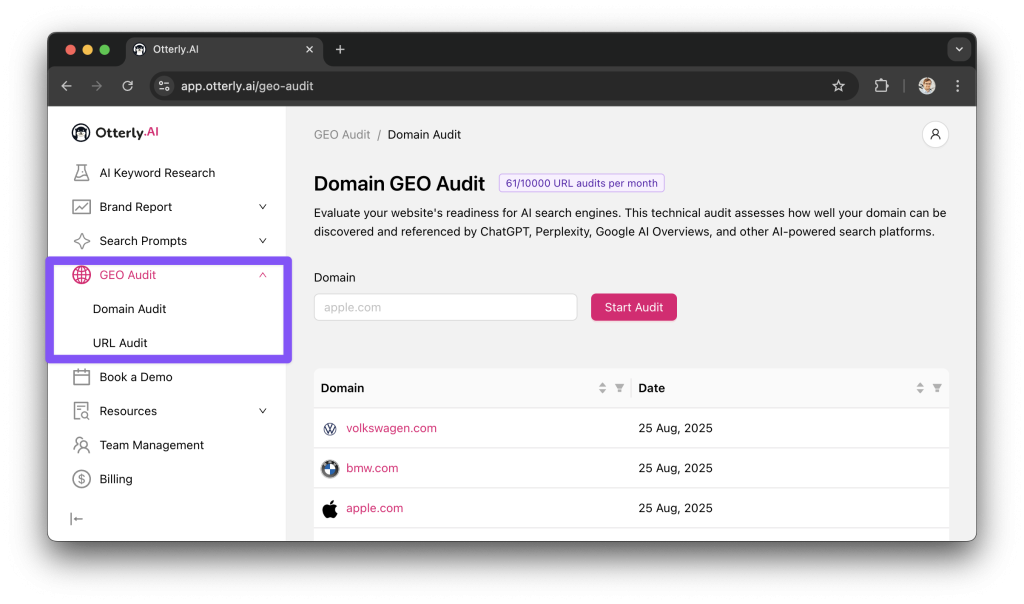
Where Otterly.AI Delivers Real Value
Otterly’s biggest strength is accessibility. It removes the mystery around AI Search by letting users run prompts and see whether a brand appears. This is incredibly valuable early on, because it turns an abstract concept into something concrete.
Otterly also works well for:
- validating whether AI Search is relevant in your niche,
- spotting obvious visibility gaps,
- and educating stakeholders that LLMs do mention brands.
For small teams or early-stage experimentation, Otterly acts as a bridge between classic SEO and AI SEO awareness.
Where Otterly.AI Reaches Its Ceiling
The limitations of Otterly emerge when teams move from awareness to optimization.
First, Otterly’s analysis is largely prompt-centric. AI Search does not operate on single prompts in isolation. Visibility only becomes meaningful when observed across many prompts, topics, and time periods. Without strong aggregation, teams risk overreacting to noise.
Second, competitive context is limited. AI Search is inherently comparative. If your brand disappears, another brand takes its place. Otterly shows whether you appear, but often lacks depth in explaining who replaced you and why.
Third, Otterly struggles to connect visibility outcomes to content optimization decisions. Teams can see changes, but not always trace them back to content structure, authority signals, or topic coverage.
These gaps are not flaws; they reflect Otterly’s positioning. It is an entry-level AI Visibility tool. Once AI Search becomes a core acquisition or reputation channel, teams naturally start evaluating AI search visibility tools alternatives with deeper analytical capabilities.
What Advanced AI Search Visibility Tools Must Do Better
Before naming alternatives, it is important to clarify what “better” actually means in practice. Advanced tools tend to focus on three critical dimensions:
1. Visibility as a Pattern, Not an Event: AI Search varies by nature. Serious tools must normalize this variability by analyzing trends across hundreds or thousands of prompts. Without this, AI SEO becomes reactive rather than strategic.
2. Competitive Framing by Default: Visibility without competitors is meaningless. Advanced platforms show which brands dominate AI answers, how often they appear, and in which contexts. This is the foundation of actionable AI Visibility.
3. Clear Links to Content and Authority Signals: Visibility data must point back to pages, topics, and sources. Otherwise, teams cannot translate insights into content optimization actions.
With these criteria in mind, the following AI search visibility tools alternatives stand out.
Option 1: Mention Network
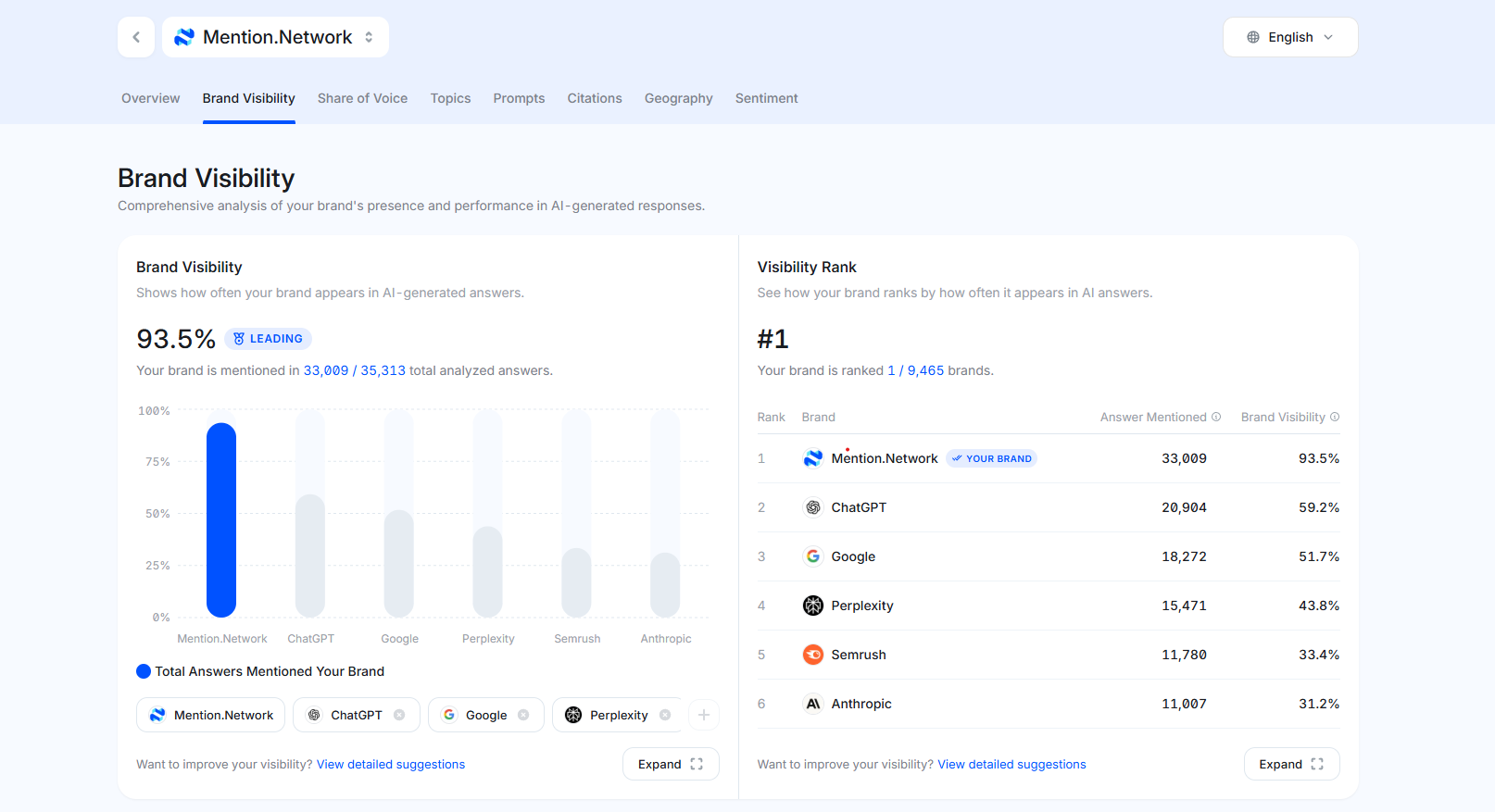
Mention Network takes a different architectural approach compared to SEO-extended platforms. Instead of evolving from a traditional SEO toolkit, it is designed from the ground up to measure how brands appear inside AI-generated answers.
This distinction matters because Mention Network does not treat AI Search as a derivative of rankings or traffic. It treats it as a separate discovery layer with its own rules, volatility, and competitive dynamics.
Strategic Positioning
Mention Network focuses on one core problem: When users ask AI systems questions, how often does a brand appear, in what context, and alongside which competitors?
Rather than optimizing pages directly, the platform prioritizes visibility diagnostics. It answers whether a brand is being selected by AI models at all, before any content or SEO adjustments are made. This positioning makes it especially relevant for teams that already have strong SEO foundations but lack clarity around AI-driven discovery.
Where Mention Network Performs Well
Mention Network’s primary strength is model-level visibility analysis. It tracks brand mentions across multiple AI systems and surfaces patterns that are difficult to observe through manual testing or classic SEO tools.
Teams typically use Mention Network to:
- Identify which AI models consistently include or exclude their brand
- Understand which topics trigger brand mentions and which do not
- Compare AI presence against direct competitors across similar prompts
- Detect sudden visibility changes after content, PR, or product updates
Because the data is prompt-driven and model-specific, the insights tend to be diagnostic rather than prescriptive, helping teams decide where to act before deciding how to act.
Practical Limitations
Mention Network does not aim to manage SEO execution directly. It does not replace:
- Keyword research platforms
- Technical SEO audits
- Content production or optimization tools
As a result, it works best alongside existing SEO stacks. Teams still rely on their primary SEO tools to implement changes, while Mention Network helps validate whether those changes improve AI-facing visibility.
Best Fit Use Case
Mention Network is most effective when:
- The team already operates mature SEO and content workflows
- AI Visibility needs to be measured independently from rankings
- Competitive intelligence inside AI answers is a priority
- Decision-makers need evidence before reallocating SEO or content budgets
It is less suitable for teams that are still building basic SEO hygiene or those looking for an all-in-one execution platform.
You can try a free AI Visibility tool at mention.network to see how your brand shows up in AI answers.
If you have any questions, email us at [email protected], or book a quick call for free support with our team here
Option 2: SE Ranking
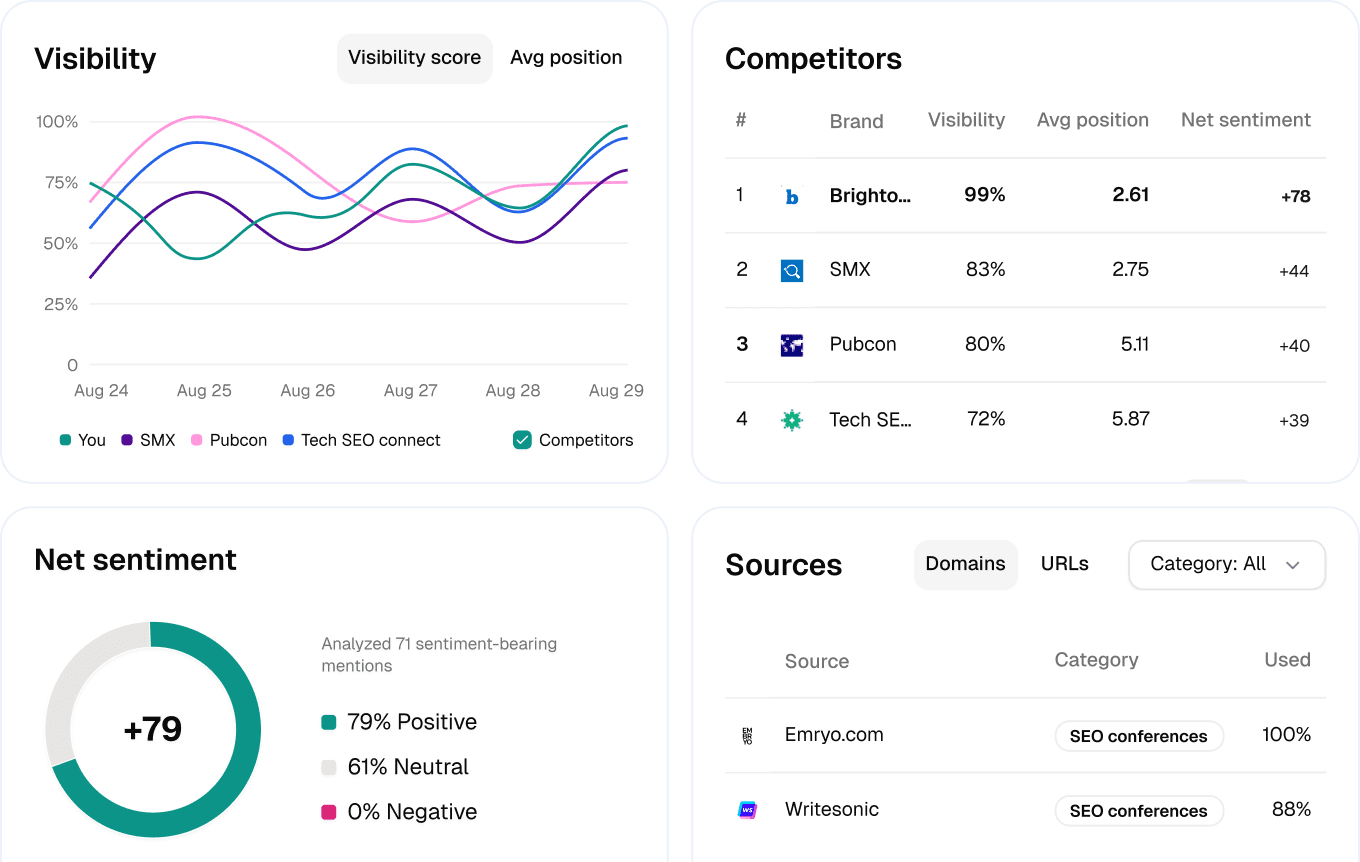
SE Ranking represents an incremental evolution, not a radical shift. Instead of positioning itself as a standalone AI Search platform, it expands an established SEO toolkit to cover AI-driven surfaces. This makes it appealing to teams that want to add AI Search Visibility without restructuring their entire SEO operation.
Where SE Ranking Performs Well
SE Ranking’s biggest strength is correlation analysis. Teams can observe how pages that perform well organically behave inside AI Search environments, and identify patterns where AI systems diverge from traditional rankings.
This allows marketers to:
- See which indexed pages are reused by LLMs
- Compare organic keyword performance with AI mentions
- Identify gaps where SEO success does not translate into AI Visibility
For organizations early in AI SEO adoption, this reduces uncertainty and helps teams justify AI-related work using SEO language stakeholders already understand.
Limitations to Be Aware Of
While SE Ranking supports AI Search Visibility, it is not built as a deep conversational intelligence platform. Analysis tends to stay at page and keyword level rather than exploring how AI systems frame brands, weigh competitors, or select sources across long-form answers.
This means:
- Less insight into why a brand is chosen inside AI answers
- Limited ability to analyze AI-generated narratives or sentiment
- Fewer tools for competitive framing analysis inside AI responses
In short, SE Ranking helps teams observe AI Visibility, but not always interrogate it deeply.
Best Fit Use Case
SE Ranking is a strong choice when:
- The team already operates a structured SEO workflow
- AI SEO is being introduced gradually, not as a standalone initiative
- Stakeholders need AI Search insights tied closely to SEO fundamentals
- Operational simplicity matters more than advanced AI modeling depth
It is less suitable for teams whose primary goal is strategic AI Visibility optimization across multiple models and conversational contexts.
Option 3: Semrush AI Visibility
Semrush approaches AI Search from a different direction. Rather than evolving a lightweight SEO suite, it extends one of the most mature SEO ecosystems in the market to include AI Visibility signals.
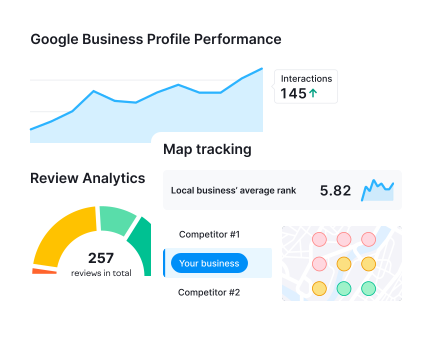
Semrush treats AI Search as part of a broader search intelligence framework. Its goal is not to isolate AI answers, but to connect AI Visibility with content performance, keyword authority, and backlink ecosystems.
This allows teams to answer questions such as:
- Which AI-cited pages also rank organically?
- Which topics generate AI mentions but limited traffic?
- How does AI Search overlap with existing keyword clusters?
The value here is not novelty, but integration.
Where Semrush Performs Well
Semrush excels at connecting AI Visibility to content optimization and authority building. Because the platform already tracks keywords, backlinks, and competitor strategies at scale, AI Search data becomes another signal feeding into strategic decisions.
Key strengths include:
- Strong competitive benchmarking across SEO and AI Search
- Clear mapping between AI citations and content assets
- Scalable reporting suitable for executive and client-facing use
- Easier adoption for teams already trained on Semrush workflows
For organizations managing dozens or hundreds of pages, this connection between AI SEO and content operations is often more valuable than raw AI experimentation.
Limitations to Be Aware Of
Semrush is not a pure AI Search platform, and this shows in certain areas. Conversational-level analysis, prompt variability, and AI narrative modeling are not its primary focus.
Common constraints include:
- Less visibility into how AI systems phrase or contextualize brand mentions
- Limited insight into model-specific behavior differences
- AI metrics can be misinterpreted if teams treat them like classic rankings
Additionally, Semrush’s breadth comes with complexity and cost, which can be excessive for teams that only need focused AI Search Visibility tools alternatives.
Best Fit Use Case
Semrush AI Visibility works best when:
- The organization already relies on Semrush for SEO operations
- AI SEO needs to integrate cleanly into existing reporting structures
- Teams prioritize scale, consistency, and stakeholder communication
- AI Search is viewed as an extension of SEO governance, not a separate discipline
It is less effective for teams seeking deep, model-level AI behavior analysis or narrative control.
How to Choose the Right AI Search Visibility Tools Alternative
Choosing between these tools depends less on feature checklists and more on organizational maturity.
- If AI Search is exploratory, Otterly may still be enough.
- If AI Visibility affects revenue or brand trust, deeper tools become necessary.
- If SEO teams are evolving rather than reinventing, hybrid platforms make sense.
The biggest mistake teams make is treating AI Search as a side project. The most effective organizations integrate AI Visibility tracking into weekly SEO reviews, content planning, and competitive analysis.
Conclusion
Otterly.AI remains a valuable entry point, but it is not designed for sustained competition in AI Search. As the landscape matures, teams need AI search visibility tools alternatives that provide depth, context, and actionable insights.
Mention Network stands out for strategic AI Visibility. SE Ranking offers a balanced bridge between SEO and AI Search. Semrush provides continuity for teams already invested in its ecosystem.
FAQs
Is Otterly.AI obsolete?
No. It remains useful for early-stage AI Visibility monitoring.
Do AI Search visibility tools replace SEO tools?
No. They complement SEO by addressing discovery before clicks.
How often should AI Visibility be reviewed?
Weekly trend analysis is more reliable than daily spot checks.
Can strong Google rankings guarantee AI inclusion?
No. AI Search selects brands based on trust, relevance, and context.
When should teams upgrade from Otterly?
When AI Search begins to influence revenue, reputation, or competitive positioning.