
Brand Mentions in AI Search: How They Really Form
Brand mentions in AI search come from identity, product data, and the sources AI trusts. For ecommerce stores, the real question is whether AI recommends your store when shoppers ask where to buy.

TL;DR Brand mentions in AI search form from 3 connected signals: the entity AI recognizes, the product data it can read, and the sources it trusts enough to cite. Mention Network's current check turns 5 of 5 buyer intents across 4 engines into 20 answer receipts. For stores, the useful metric is narrower than a mention count. You need to know whether AI recommends your store when a shopper asks where to buy.
The reseller sees the brand everywhere: in the product title, the product page, and the way customers ask for it. Then an AI answer gives the shopping credit to someone else because the query no longer carries enough identity to connect the product, the brand, and the store.
That is the hard part of AI brand mentions. Being named somewhere in the answer is only the first layer. Being chosen as a place to buy is the layer that pays.
What counts as an AI brand mention?
An AI brand mention is the moment when an AI answer names a company, product line, store, or source as part of its response. In the SERP era, you watched rankings and snippets. In the AI-answer era, you watch whether the answer includes you, how it frames you, and which sources made the model confident enough to name you.
For a brand team, the mention itself can be the scoreboard. For an ecommerce store, the scoreboard needs one more column. If a shopper asks where to buy a product, the answer may mention the manufacturer, a marketplace, and 3 competing retailers. Your store only wins if it appears in that buying list.
So the better question is not just "did AI mention my brand?" It is "did AI recommend my store for the product a shopper wants?"
How do brand mentions in AI search form?
Brand mentions form when an AI can connect 3 things cleanly: identity, product context, and trusted evidence. Identity tells the system which entity it is looking at. Product context tells it what category, attributes, price, availability, and seller are involved. Trusted evidence tells it whether the entity is safe to name in an answer.
OpenAI's own shopping docs point in this direction. ChatGPT shopping can visually browse products, compare options side by side, and use more complete product coverage for merchants, according to OpenAI's March 24, 2026 product discovery announcement. Its commerce docs also say product feeds help ChatGPT surface products with accurate pricing, availability, and seller context through structured catalog data. I verified both OpenAI references on July 15, 2026, because commerce surfaces decay fast.
That matters because AI search is not only reading your homepage. It is assembling an answer from product data, known entities, retail pages, citations, reviews, and the query itself.
Why brand mentions fail for ecommerce stores
The failure usually starts when a product identity gets stripped back. In Mention Network's product-grounding example, verified in product on July 10, 2026, shortening 5 PDRN Collagen Intense Vitalizing Serum to PDRN Collagen Serum flipped the AI's brand match to Medicube. The real COSRX product fell into the "other" bucket.
That is a small naming change with a big consequence. A generic phrase can make the AI answer about the category, the wrong brand, or a better-known seller. For a reseller, this is the blind spot: you may sell the right product, but AI may still give the answer to the brand owner, Amazon, or another retailer.
This is why broad AI brand monitoring feels incomplete for stores. A brand dashboard can tell you whether a name appears. It cannot tell you whether a buyer sees your store as the place to buy. Use that monitoring layer alongside tracking brand mentions and citations in AI search when you need the source trail behind a mention.
How do you measure the store layer?
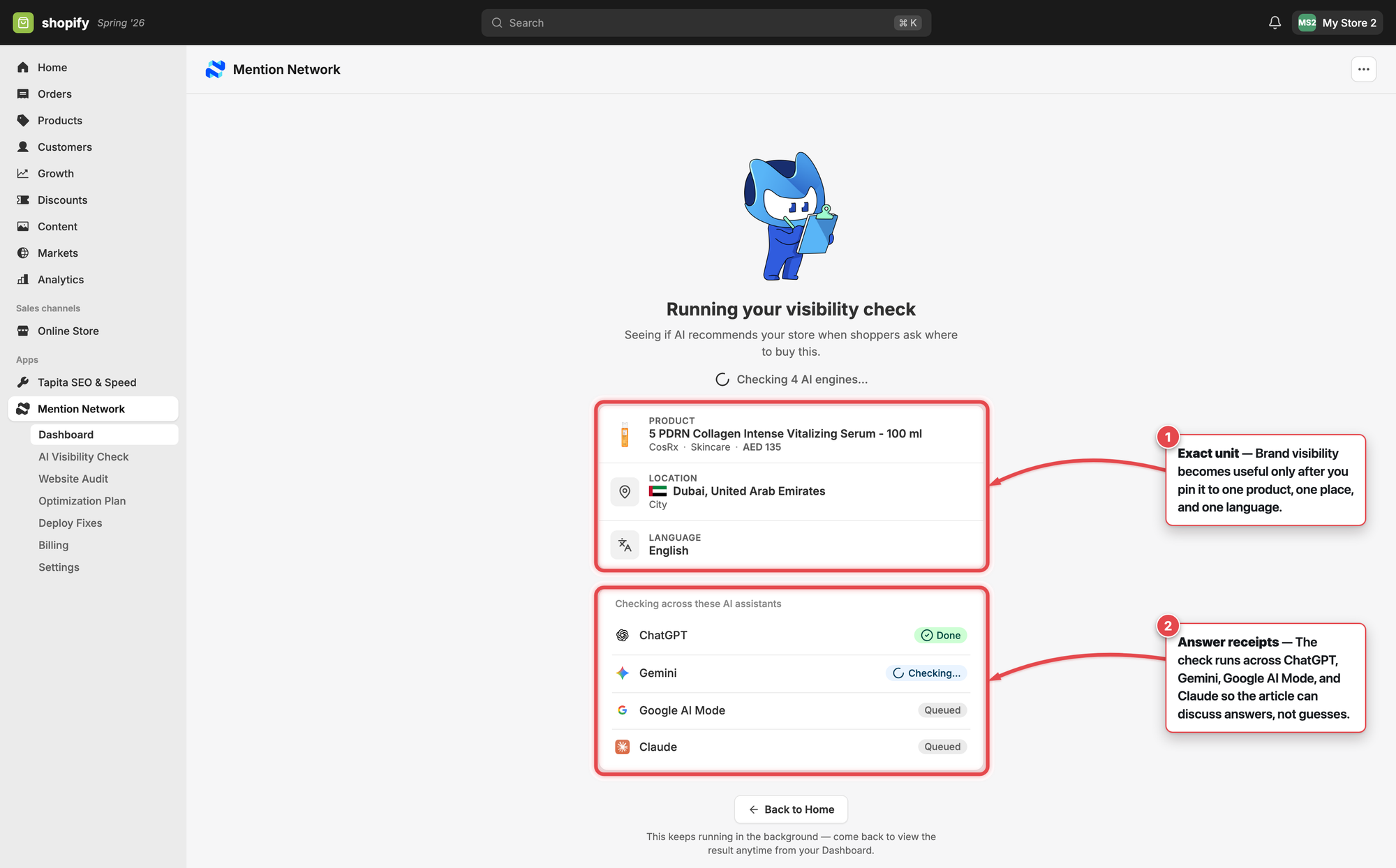
Measure the exact buying question, not the brand in isolation. The unit matters: 1 product, 1 location, 1 language. A store can be visible for a COSRX serum in Dubai in English and invisible for the same product in another market or language.
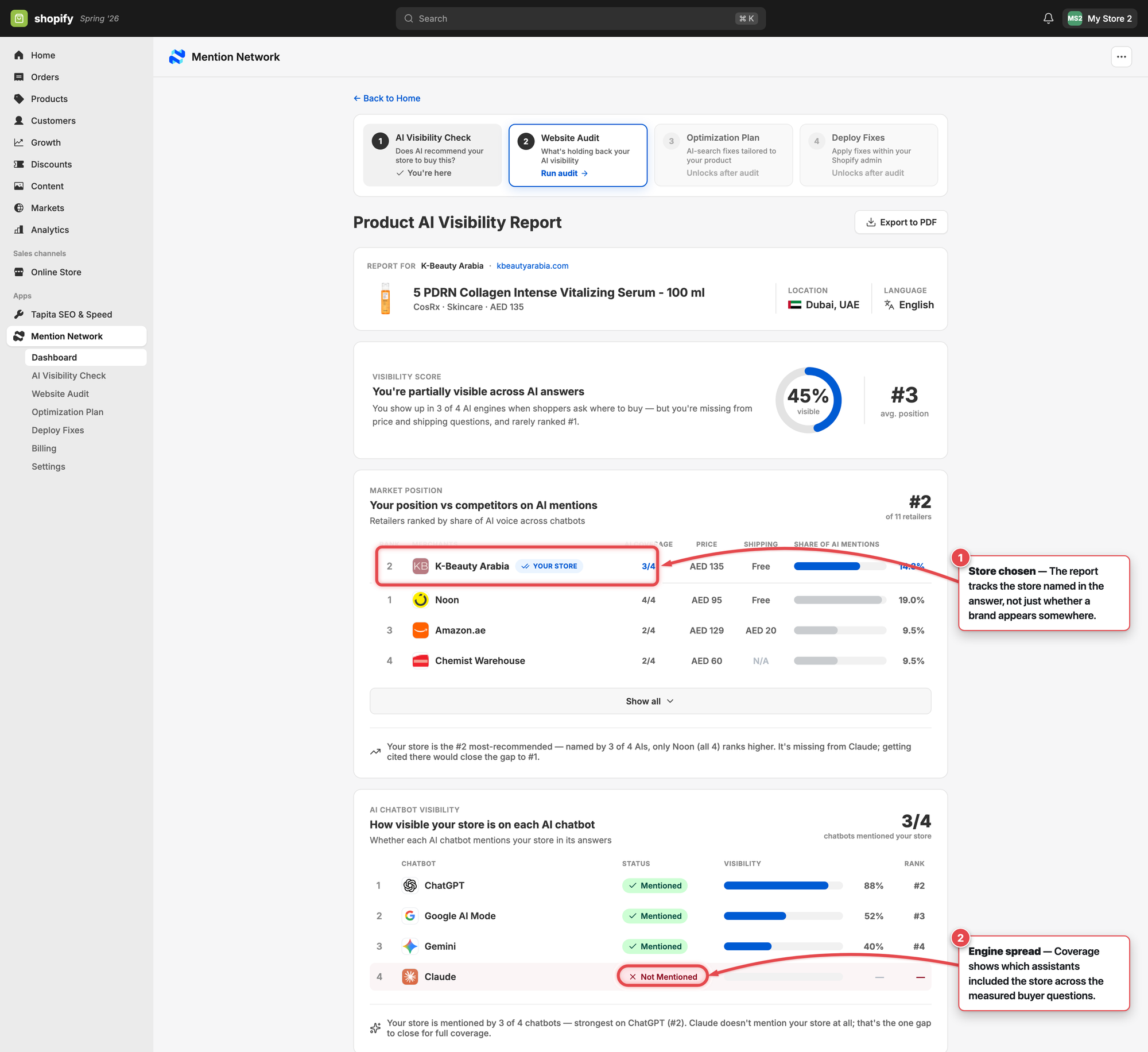
Mention Network's AI Visibility Check currently runs 5 buyer intents across 4 engines, ChatGPT, Gemini, Google AI Mode, and Claude. That gives you 20 answer receipts for one product, place, and language. The shipped status for this check is verified as of July 11, 2026. The report shows whether your store appears, how it ranks, which competitors are named, and the raw AI answers behind the verdict.
That is closer to rank tracking than social listening. In SEO, a keyword rank only mattered once you knew the query and location. In AI search visibility, a brand mention only matters once you know the shopper question and whether your store made the buying list.
What should you do after tracking brand mentions?
Start with the mention, then move down to the buying unit.
- Pick one product that matters commercially, not the whole catalog.
- Run buyer-language prompts: where to buy, best place to buy, authentic, cheapest, and free shipping.
- Check more than one engine. A store visible in ChatGPT but absent in Claude has a different problem from a store absent everywhere.
- Read the raw answer. Look for the source, competitor, marketplace, or missing product detail that explains the recommendation.
- Use a visibility check when you want the answer receipts in one place, then use the gaps to decide which product data, source, or trust signal to fix next.
Keep your SEO tools. They still tell you how Google sees your pages. Put AI answer receipts beside them, because the next shopper may never click a result page at all.
Frequently Asked Questions
How do AI brand mentions form?
AI brand mentions form when the AI can connect entity identity, product context, and trusted evidence into a confident answer. For ecommerce, the useful version of that mention is a store recommendation for a specific buying question.
Are AI brand mentions the same as AI visibility?
No. Brand mentions are one layer of AI visibility. Ecommerce AI visibility also measures whether a specific store or product appears when a shopper asks where to buy, at what rank, and against which competitors.
Which AI search engines should I check?
Check the engines your buyers use, then keep the set stable so changes are comparable. Mention Network's current check covers ChatGPT, Gemini, Google AI Mode, and Claude.
How can I check if AI recommends my store?
Run buyer-intent prompts across more than one AI engine, then record whether your store appears, where it ranks, and which sources the answer uses. You can also run an AI Visibility Check to see the raw answers in one place.
Next step
Read the AI product visibility pillar if you want the full brand versus product/store model. Then pick one product where the buying moment matters, ideally a product with real margin or repeated questions from shoppers.
Run the same buyer prompt across a few engines and save the raw answers. Start with 1 product, 1 location, and 1 language so the comparison stays clean. If your store appears, note the rank and the sources attached to the answer. If another retailer appears, note the product detail or trust signal AI used instead.
Repeat the same prompt set after you update product data, titles, reviews, or source coverage. Then run a free check to see whether AI recommends your store for a real product today.