10 practical ways to get your brand mentioned in AI answers
Ten practical tactics to get your brand mentioned in AI answers, from extractable definitions and comparison pages to consistent descriptions and monitoring.


Generative AI has become the front door to discovery. People ask one question, trust the synthesized answer as a credible shortcut, and move on. That answer is now the surface where decisions get made, the job a page of search results used to do.
So visibility changes shape. You win by getting named inside the answer, because that's where recommendations, comparisons, and explanations happen now. Being mentioned there has turned into a real competitive edge across SaaS, e-commerce, finance, and consumer brands.
What you'll learn:
- Why brands struggle to appear in AI answers
- 10 proven tips to get your brand mentioned in AI answers
- Common mistakes that prevent brands from being mentioned in AI answers
- FAQs
Why brands struggle to appear in AI answers
Most brands miss AI answers for one reason: the model can't pin down what they are. Without consistent signals, clear context, and recognizable associations, a brand reads as ambiguous. And ambiguous brands get left out when a model decides what to include.
Why SEO rankings no longer guarantee inclusion
Ranking high on Google feels like it should carry over. It usually doesn't. Plenty of pages that dominate SERPs never surface in an AI answer, because they're hard to summarize, too promotional, or broken into fragments a model can't reassemble.
AI models don't judge content the way a search engine does. They assemble the safest explanation rather than pick the best page. Mixed messaging, a definition buried three scrolls down, a hard sell in every paragraph, and the model routes around you. Teams watching only their SEO dashboard read the rankings as a win while staying invisible in AI search.
Why being brand mentioned requires different signals
To get brand mentioned, a model has to answer three questions about you with confidence: what you are, when you're relevant, and why you fit what the user asked. Traditional marketing copy rarely spells any of that out.
Vague positioning. Product descriptions that drift from page to page. Value props pitched at the clouds. Each one chips away at your AI visibility, and when a model isn't sure, it leaves you out. That's how a brand ends up everywhere online and nowhere inside the answer.
10 proven tips to get your brand mentioned in AI answers
Getting named in AI answers comes down to clarity more than reach. The ten tactics below help a model recognize your brand, place it in the right context, and reference it when a relevant question comes up.

1. Write clear, extractable definitions
LLMs don't read your page the way a person does. They extract a piece, compress it, and reuse it somewhere else. A clean definition is the smallest unit of trust they can lift. If your brand can't be summed up in one or two precise sentences without losing meaning, a model won't risk reusing it.
A strong definition nails three things right away:
- what the product or brand is
- who it's for
- what problem it solves
Weak vs strong:
| Weak definition | Strong definition |
|---|---|
| “We are a modern platform helping teams work better.” | “Mention Network is an AI visibility platform for e-commerce that measures how often ChatGPT, Gemini, and Google AI name and recommend a store's brand and products.” |
The second one gives a model something safe to quote, because it can cite you without guessing at what you do. That's the whole game with definitions: strip out the ambiguity, and your AI visibility has room to climb.
2. Use comparison pages to teach AI context
Models learn a category by contrast. If you never say how you differ from the alternatives, the model has to guess where you belong, and it guesses conservatively. A comparison page removes that guesswork by drawing the competitive boundaries for it.
Skip the generic "us vs them" blog. Build a structured comparison around the decision criteria buyers actually weigh:
| Attribute | Product A | Product B |
|---|---|---|
| Target user | Small teams | Enterprises |
| Pricing model | Monthly | Annual |
| Core strength | Speed | Customization |
Treat that table as a template, not a finding. It's deliberately generic. The point is the shape: a clean side-by-side gives a model ready-made shortlist context for "best tool for X" questions, the kind of context a single feature page can't supply on its own.
3. Maintain consistent descriptions across platforms
Models cross-check facts across sources. If your homepage, Crunchbase profile, press hits, and review-site listings all describe you a little differently, the model loses confidence and skips you rather than pick one version to trust.
Consistency beats creativity here.
Standardize three things everywhere you appear:
- one primary brand description
- one core use-case statement
- one category label
Here's what fragmentation looks like:
- Website: “AI analytics platform”
- Blog: “marketing intelligence tool”
- Press: “data infrastructure company”
To a model, that's three different companies. Line the descriptions up and it has one consistent entity to reference instead of three fuzzy ones.
Read more: SEO content vs AI-friendly content: same page, different outcome in AI visibility
4. Publish use-case focused content
AI answers follow intent. A feature list tells a model what your product has, but not when to recommend it.
Use-case content answers the situational questions people actually type:
- “best tool for small remote teams”
- “best solution for compliance-heavy industries”
A page like that works when it covers the scenario, the constraints around it (budget, scale, industry), and why your product fits those constraints specifically. That's what lets a model map you to a real situation and surface you for longer, intent-rich queries.
5. Answer real user questions directly with FAQs
AI answers often borrow FAQ-style phrasing straight from the page. Content that mirrors how people actually ask is easy to extract and safe to reuse. So pull the answer out of the paragraph and state it plainly.
Q: “What is AI visibility?” A: “AI visibility measures how often, and in what context, a brand shows up inside AI-generated answers.”
An answer like that gives a model something it can lift verbatim, without rewriting and without risking a distortion.
6. Use structured data where appropriate
Structured data hands a model explicit signals about what your content means and how its pieces relate. Schema won't carry a weak page on its own. What it does is cut ambiguity at the moment of extraction.
The schema types that pull the most weight for AI answers:
- FAQ schema for question-based content
- Product schema for attributes and pricing
- Organization schema for entity clarity
Mark your pages up and your information gets easier to parse, classify, and reuse across systems, which is exactly what feeds AI search visibility.
7. Reinforce authority with external validation
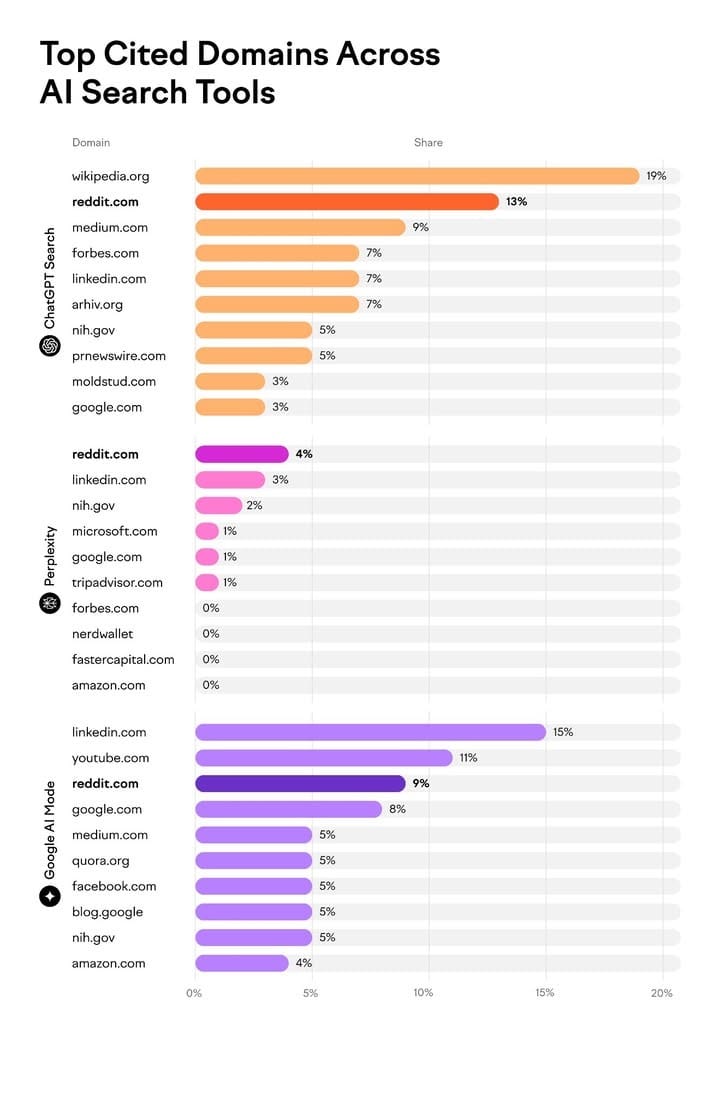
Source: Semrush
The chart shows the same pattern across ChatGPT, Perplexity, and Google AI Mode: models lean hard on a small set of trusted third-party domains, Wikipedia, Reddit, LinkedIn, Medium, and the big publishers. Those sources dominate AI answers because they read as collective, neutral, and cross-checked, not because anyone marketed their way in.
The takeaway for you is direct. A model builds confidence by triangulating a fact across places it already trusts. Show up on those platforms, through references, citations, community threads, or a solid profile, and you lower the risk the model takes by mentioning you. External validation means being present where the model already believes the truth lives.
8. Avoid marketing language and focus on facts
Models tend to skip inflated claims because reusing them is risky. “Best in class,” “industry-leading,” and the rest usually get ignored. Trade the persuasion for precision.
- Marketing: “the most powerful platform ever built”
- Factual: “monitors ChatGPT, Gemini, Claude, and Perplexity”
Factual lines are verifiable, which makes them safe to repeat inside an answer, and that's what improves AI visibility.
9. Monitor AI search visibility regularly
Models update, queries drift, and your position moves with them. Without monitoring, you can't tell when you've lost ground or when a competitor has taken your spot. Tracking regularly answers the questions that matter:
- which AI systems mention you most often
- which competitors are replacing you
- which attributes get pulled into answers
That's the difference between sustained improvement and a one-time cleanup that quietly decays.
10. Show up across multiple AI systems
ChatGPT, Gemini, Claude, and Perplexity don't surface the same brands. Each one trains on different data, retrieves differently, and favors different sources. Tuning for a single system leaves the rest on the table.
Covering several at once spreads your dependency, lifts your total AI search visibility, and keeps you steady as any one model shifts. Brands that show up across systems are the ones that stay in AI answers over time.
Read more: A practical guide for modern marketers: tracking brand mentions and citations in AI search
Common mistakes that prevent brands from being mentioned in AI answers
Most missed mentions trace back to a handful of avoidable mistakes in how a page is built and positioned. Each one makes a brand harder for a model to recognize, trust, and quote, so the brand gets left out even when the information is right there on the page.
| Mistake | What AI “sees” | Result | What to change |
|---|---|---|---|
| Keyword-heavy writing | Repetitive, low-information text | Low reuse, fewer mentions | Write definitions and examples, cut the fluff |
| No competitor context | No positioning signals | Skipped in comparisons | Add comparison pages and decision criteria |
| SEO-only mindset | Ranking without extractable insight | Traffic but no AI inclusion | Build AI-ready structure and summaries |
Over-optimizing for keywords instead of clarity. Repeating a keyword does nothing for AI answers. A model reaches for content it can explain cleanly and reuse without distortion, and a page written for keyword density rarely gives it a precise definition to grab. Low clarity, and the model skips the source.
Ignoring competitive context. Most AI queries are comparative underneath. If your content never names an alternative, a use case, or a decision criterion, a model has no way to slot you into a shortlist. The brands that say plainly when they're the better or worse choice get mentioned far more often.
Assuming SEO performance equals AI visibility. High rankings and heavy traffic don't buy you a place in AI answers. A page can rank all day and stay invisible to a model because it has no extractable structure, no clean summary, no factual framing. AI visibility rewards content built to be reused.
Getting mentioned in AI answers is a deliberate outcome of how clearly and accurately you present yourself to these systems. The brands that adapt early are the ones that get picked.
You can try a free AI visibility check at mention.network to see how your brand shows up in AI answers. Questions? Email [email protected], or book a quick call for free support from our team.
Get free AI Visibility report now
FAQs
Q1: Why do some high-ranking pages never appear in AI answers?
A1: Because ranking doesn't guarantee extractability. A model prefers content that's easy to summarize, tightly scoped, and safe to reuse. Plenty of ranking pages are built for clicks, not for a model to quote.
Q2: Do keywords still matter for AI answers?
A2: They help a model detect the topic, but they don't decide the outcome. Semantic clarity, clean definitions, and context beat keyword repetition.
Q3: How important is competitor comparison for AI visibility?
A3: Very. Most AI answers are comparative by default, so content that spells out how you differ from the alternatives gives a model the context it needs to include you.
Q4: Is AI visibility the same as SEO performance?
A4: No. SEO measures traffic and rankings. AI visibility measures your presence inside AI-generated answers, and a brand can do well on the first while staying invisible in the second.
Q5: How can brands track whether AI is mentioning them?
A5: With AI visibility tools that monitor real answers across ChatGPT, Gemini, Claude, and Perplexity. They surface the mentions, descriptions, and competitive positioning that traditional SEO platforms can't see.