
AI SEO for ecommerce: a practical store playbook
AI SEO for ecommerce means making product pages, feeds, trust signals, and buyer-intent content readable enough for AI answers to recommend the store.

TL;DR AI SEO for ecommerce is the work of making product pages, feeds, schema, reviews, shipping, returns, and buyer-intent content clear enough for AI systems to recommend the store. Start with product facts before blog content. Then measure whether AI names the store in buying answers, not only whether Google ranks the page.
If you sell online, AI SEO has one job: help systems like ChatGPT, Gemini, Google AI Mode, and AI shopping assistants understand what you sell, who should buy it, why your store is safe, and whether you deserve the recommendation.
This article is the ecommerce satellite for the broader What is AI SEO? pillar. Use the pillar for the full definition. Use this page to fix store-level gaps.
What is AI SEO for ecommerce?
AI SEO for ecommerce is the practice of shaping product pages, category pages, feeds, schema, and trust signals so AI systems can understand and recommend a store in buying answers.
Classic SEO asks: can the page rank?
Ecommerce AI SEO adds another question: can the assistant confidently name this store when a shopper asks where to buy?
That difference matters because AI answers compress the shopping journey. The shopper may never compare 10 search results. They may ask for the best product, the safest seller, the cheapest option with shipping, or the store that carries a specific SKU, then act on the answer.
Shopify's own AI optimization guidance frames the same direction: product pages should be designed for humans and AI, with clear product information that improves visibility in AI search results. Verified as of July 16, 2026.
What should ecommerce stores fix first?
Start with the pages and fields closest to purchase.
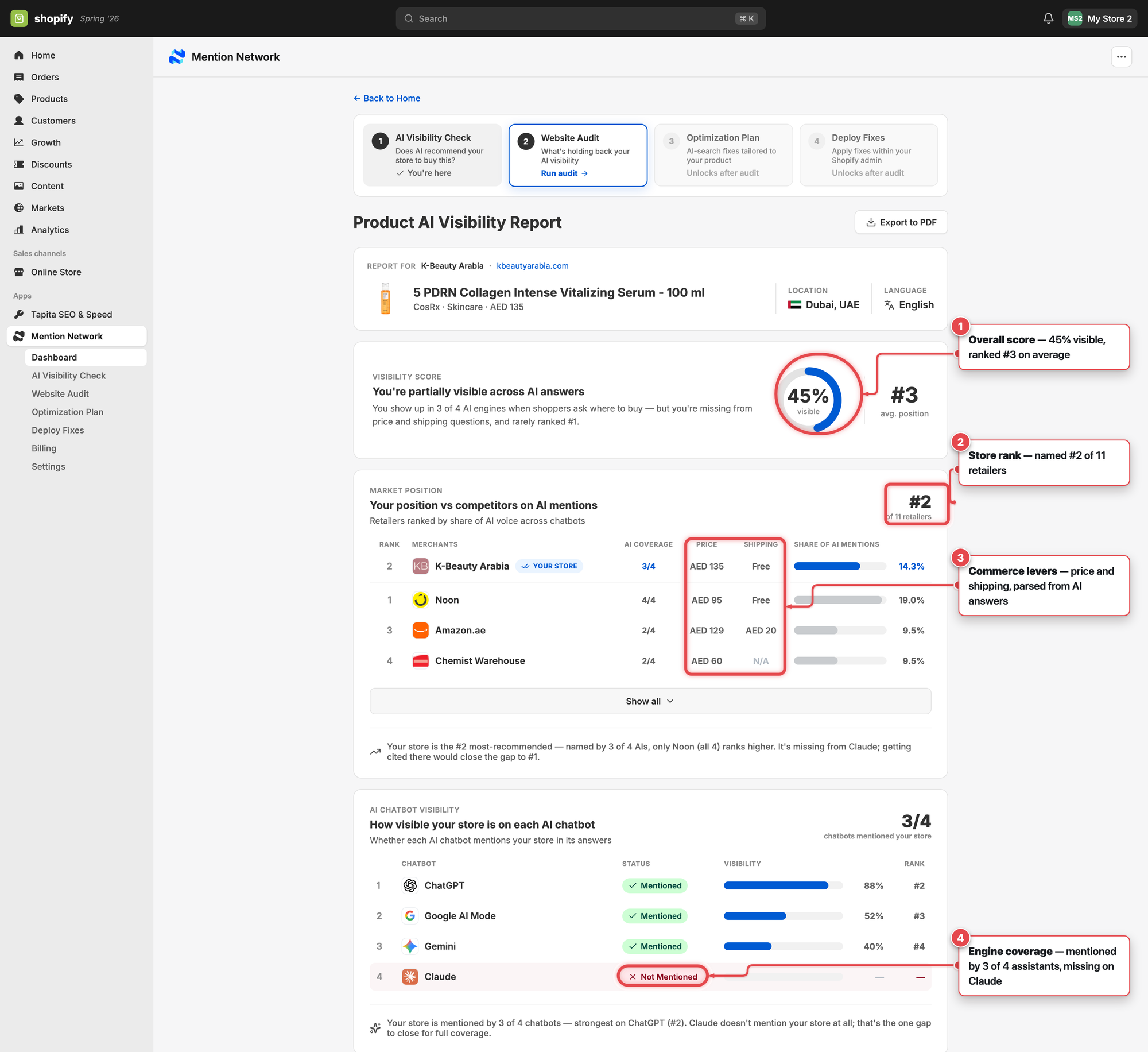
Most ecommerce AI SEO work fails because teams begin with blog content while the store's product facts are still messy. AI systems need the basics before they can recommend you: product name, brand, variant, price, availability, shipping, return policy, review signals, and a clear category fit.
Google's Product structured data documentation says product markup can help search systems understand price, availability, review ratings, and shipping information. Google's Merchant Center product data specification also says product data helps Google match products to relevant queries.
For a store, those fields are not decoration. They are the product truth AI systems compare.
Use this quick order:
- Fix product titles so they include brand, product type, and variant.
- Rewrite descriptions around buyer questions, not internal merchandising copy.
- Add or repair Product and Offer schema.
- Keep price, availability, shipping, and returns consistent across page, feed, and schema.
- Build comparison and use-case content only after the product facts are clean.
Which content actually helps ecommerce AI SEO?
The best ecommerce content answers the question a shopper would ask an assistant.
That usually means fewer generic blog posts and more pages that map to buying moments:
| Buyer question | Better content format | Store signal it gives AI |
|---|---|---|
| Which product should I buy for this use case? | Use-case guide | Category fit |
| Where can I buy this product with fast shipping? | Product or collection page | Merchant eligibility |
| Is this store trustworthy? | Returns, reviews, warranty, about page | Trust and authority |
| How does this product compare with alternatives? | Comparison page | Decision support |
| Does this variant fit my need? | Product page with variant details | Attribute clarity |
This is where AI SEO touches AI product visibility. A brand mention is useful, but a store recommendation is the ecommerce win.
For Shopify stores, connect this work to structured data for AI, schema markup, and Google Merchant Center. Those pieces make the same product facts legible in different systems.
How do you measure store AI SEO?
Measure AI SEO with prompts that look like real shopping questions.
A simple manual test is 5 buyer intents across 4 assistants, which gives you 20 answer receipts. Mention Network uses that exact shape in the AI Visibility Check: 5 intent types across ChatGPT, Gemini, Google AI Mode, and Claude, then records whether the store appears, where it ranks, which competitors appear, and what the raw answer said.
The point is repeatability. A single ChatGPT answer is a screenshot. A repeated prompt set is a measurement.
Use prompts like:
- Where can I buy [product type] in [location]?
- Best [product type] under [price].
- Which store sells [brand or product] with fast shipping?
- [Product A] vs [Product B], which should I buy?
- Best [category] for [specific use case].
Run the same prompts before and after you change product pages, schema, feeds, or trust content. If the store moves from absent to named, or from named to recommended, the AI SEO work is doing something real.
What does the 30-day ecommerce AI SEO workflow look like?
Use 30 days to clean the store before expanding the blog.
Week 1 is measurement. Pick 5 products or categories that matter commercially. Run the 20-answer prompt set for each. Save the raw answers.
Week 2 is product truth. Repair product titles, descriptions, images, variant fields, price, availability, shipping, return policy, and schema. Match page, feed, and structured data.
Week 3 is trust. Add or improve reviews, warranty language, shipping clarity, returns, author/company details, and relevant third-party references. AI systems lean on repeated evidence across sources, so make the store's claims consistent.
Week 4 is content. Build one use-case page, one comparison page, or one category guide tied to the products that stayed invisible. Link it back to the product pages and the relevant pillar.
Then re-run the same prompt set. Keep the changes that moved answers. Roll back or rewrite the ones that did nothing.
If you need software support for that loop, use the comparison guide to AI SEO tools for ecommerce. Use the broader AI search engine optimization guide when the problem is not only ecommerce SEO, but answer selection across AI search surfaces.
What should stores avoid?
Avoid treating AI SEO as a new label for old keyword stuffing.
AI systems do not need the phrase "best AI-ready ecommerce product page" repeated 11 times. They need a page that says what the product is, who it is for, what it costs, whether it is available, why the seller is credible, and what evidence supports that.
Also avoid publishing more generic AI SEO posts while the store pages stay vague. That adds noise. For this cluster, the canonical AI SEO page handles the broad term. This page should stay focused on ecommerce execution.
Run the store through an AI visibility check after the first cleanup pass. The useful output is not a score by itself. It is the answer evidence: the exact prompts, assistants, competitors, ranks, and missing product facts that explain why the store was or was not recommended.
FAQ
What does ecommerce AI SEO mean?
AI SEO for ecommerce is the work of making product pages, category pages, feeds, schema, and trust signals clear enough for AI systems to cite or recommend the store in buyer answers.
Is AI SEO different from ecommerce SEO?
Yes. Ecommerce SEO tracks rankings, crawlability, and traffic. AI SEO also checks whether assistants name the store or product inside generated answers, especially for where-to-buy and comparison prompts.
Does schema markup guarantee AI visibility?
No. Schema helps machines read the page, but it does not guarantee inclusion. Treat schema as hygiene. Pair it with complete product data, trust signals, and repeated measurement.
What is the fastest first fix?
Fix the product page fields that AI can compare: title, brand, variant, description, price, availability, shipping, returns, reviews, Product schema, and Merchant Center feed data.