
AI Search Engine Optimization: Ecommerce Guide
This guide helps ecommerce stores become understandable, trusted, and chosen in AI answers when shoppers ask what to buy or where to buy it.

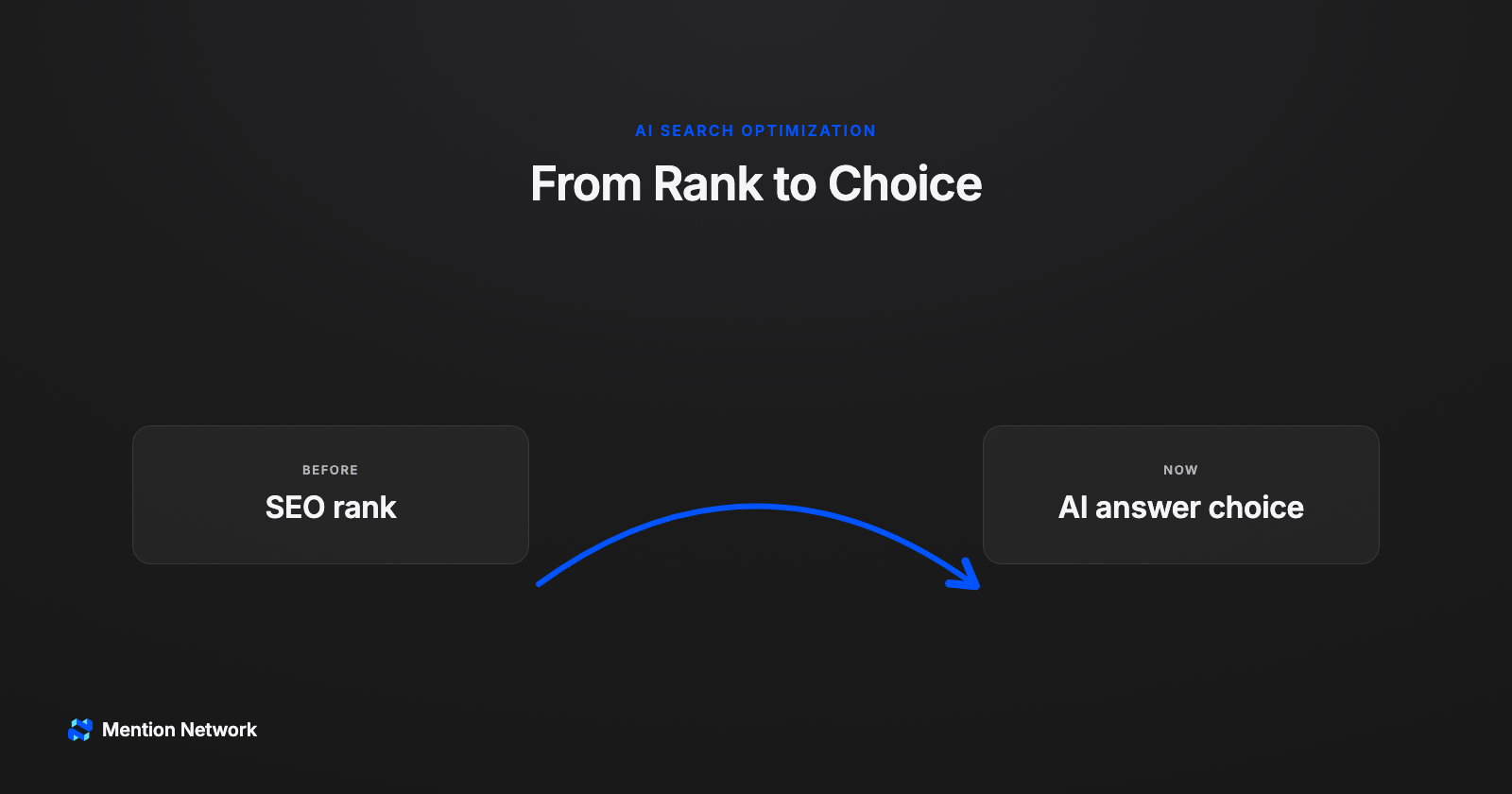
TL;DR AI search engine optimization is the work of making an ecommerce store understandable, trusted, and selectable inside AI answers. SEO still matters, but the unit has changed. The useful question is not only "does this page rank?" It is "does AI recommend this store when a shopper asks where to buy?" Mention Network's current check measures 1 product, 1 location, and 1 language across 5 buyer intents and 4 engines, which creates 20 answer receipts instead of one rank position.
The Shopify reseller can rank on Google and still lose the sale inside an AI answer. A shopper asks where to buy a product, and the answer names another store because the AI trusts that store's product data, seller evidence, pricing, or shipping more.
That is the real job of answer-engine work for ecommerce. It is not a new acronym for the same SEO checklist. It is the operating system for being chosen when AI turns a search into an answer.
Contents
- Definition
- How is this different from traditional SEO?
- What should an ecommerce store optimize first?
- What product data does AI need?
- Which trust signals affect AI answers?
- How do you measure AI search visibility?
What is AI search engine optimization?
AI search engine optimization is the practice of making your products, pages, and proof easy for AI systems to understand, trust, and select in an answer. For ecommerce stores, the practical goal is not just a citation. It is appearing in the buying list when a shopper asks what to buy or where to buy it.
This matters because generative search is no longer one interface. Google says AI Mode expands AI Overviews with follow-up interaction and simultaneous subtopic searches, verified on July 15, 2026 in Google Search Help. OpenAI's product discovery announcement from March 24, 2026 says Shopify product data is integrated into ChatGPT so products can appear more accurately in relevant conversations (OpenAI).
So the ecommerce version of the work is concrete. You make the product legible, the seller credible, the offer comparable, and the answer measurable.
How is this different from traditional SEO?
Traditional SEO optimizes a page for crawling, indexing, ranking, and clicks. The ecommerce answer layer keeps that foundation, then adds answer selection. The AI has to decide which entities, products, sellers, and sources are safe enough to put into a synthesized response.
That creates 2 scoreboards. A category page can rank, while the store is absent from a ChatGPT or Google AI Mode buying answer. A product page can have a solid title tag, while the AI answer gives the purchase credit to Amazon, Noon, a marketplace, or a competitor with clearer seller evidence.
The clean way to separate the two:
| Classic SEO question | AI answer question |
|---|---|
| Can Google crawl and rank this page? | Can AI understand the product and seller? |
| Does the page match a keyword? | Does the answer match a buyer's prompt? |
| Did the searcher click? | Did AI name the store, rank it, and show a reason? |
Keep SEO. It is still the base layer. Just stop using rank as a proxy for AI recommendation.
For the broader discipline behind that answer-selection layer, use the AI SEO pillar. Ecommerce teams should also use the AI SEO for ecommerce playbook when the missing signal is product data, feeds, schema, reviews, shipping, or store trust.
What should an ecommerce store optimize first?
An ecommerce store should optimize the buyer prompt first, because that is the unit AI answers. A broad keyword can hide the real commercial question. A shopper does not ask for a page. They ask where to buy a named product in a specific market, whether it is authentic, who ships it, and which seller is safest.
Mention Network's product truth uses that unit. The current AI Visibility Check measures 1 product, 1 location, and 1 language. It currently runs 5 buyer intents across 4 engines: ChatGPT, Gemini, Google AI Mode, and Claude. That creates 20 measurements, verified in the content fact inventory on July 11, 2026.
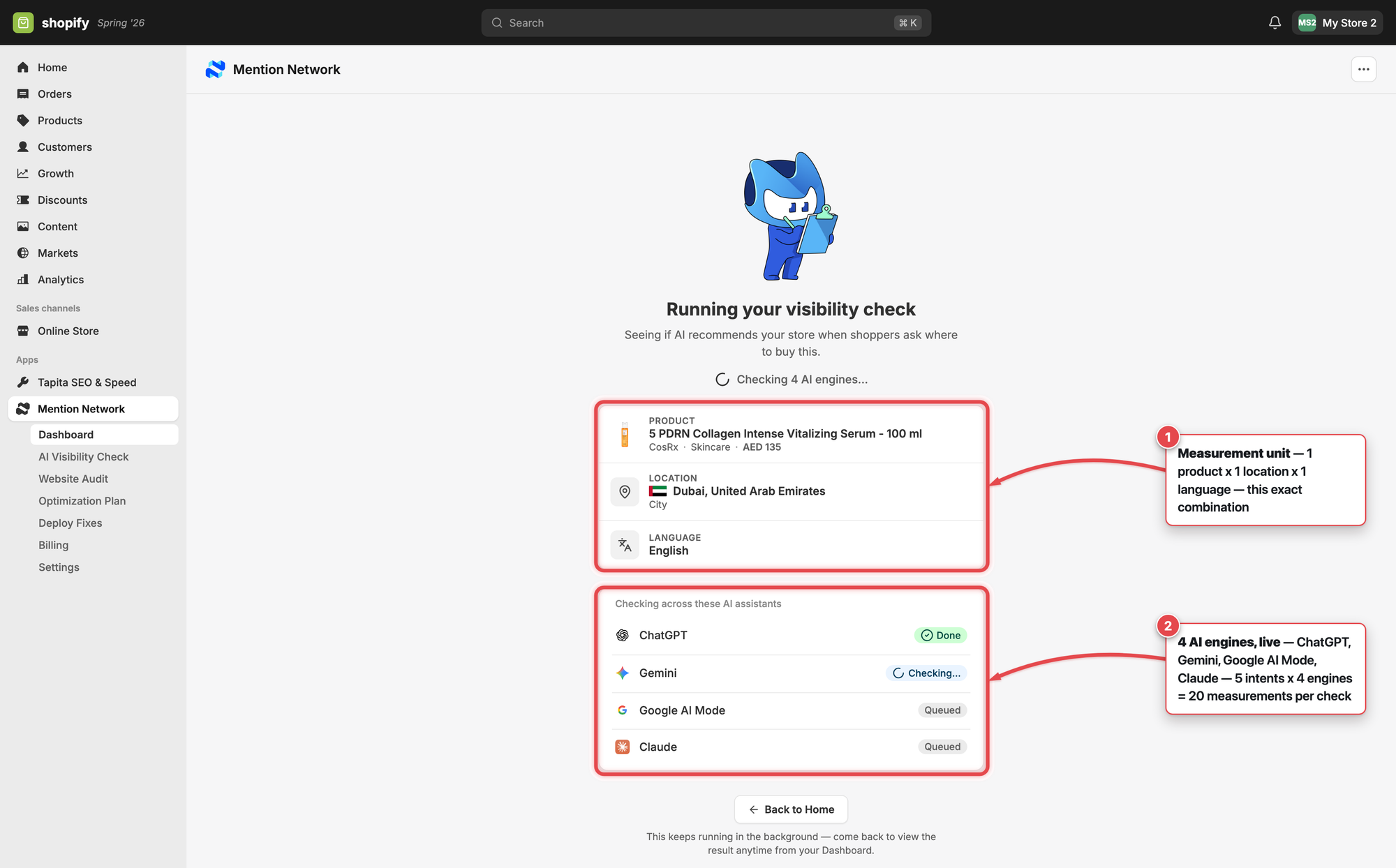
Use this as the working model. Pick one product that matters, one market where the product can sell, and one language your buyers actually use. Then run the same buyer prompts repeatedly after each fix.
What product data does AI need?
Product data is the first clarity layer. AI needs to know what the product is, who sells it, where it is available, what it costs, and whether the seller is a credible option for the shopper's market.
OpenAI's commerce docs say structured product feeds help ChatGPT index and display products with up-to-date price and availability (OpenAI Developers, accessed July 15, 2026). Google also says structured data is still useful for normal Search features, while warning that there is no special schema required for generative AI Search (Google Search Central, accessed July 15, 2026).
That is the useful middle ground. Do not treat schema as a magic AI citation switch. Treat product data as disambiguation. If the title drops the brand, model line, size, or seller context, the answer can drift to a different product or a stronger marketplace.
Mention Network's Query Builder exists for this reason. It preserves product identity, including brand/vendor and key tokens, before building the buyer prompts used in the check.
Which trust signals affect AI answers?
Trust signals affect whether AI feels safe naming a seller. For stores, those signals include recognizable product identity, crawlable pages, consistent seller information, reviews where AI can see them, clear price and shipping, and off-store mentions that support the store's legitimacy.
This is where old "brand mention" thinking gets thin. A brand may be famous, but a reseller still has to prove it is the right place to buy. The AI answer may mention the manufacturer, a marketplace, and 3 retailers. Only one of those positions belongs to your store.
In our 2026-07-15 SOV run, Mention Network had 0 mentions and 0 citations across 6 ecommerce AI-visibility prompts on ChatGPT, Perplexity, Gemini, and Claude: 0 of 24 answer surfaces. That is not a product claim about every market. It is a recovery receipt for our own content program: broad answer-engine pages were not enough to make us the answer.
The fix is sharper content and sharper measurement. The canonical pillar explains the model; satellites like brand mentions in answer engines handle the narrower mention layer.
How do you measure AI search visibility?
Measure AI search visibility by reading the answer, not by guessing from a SERP rank. The useful ecommerce fields are simple: did the store appear, what rank did it get, which competitors appeared, what price or shipping detail did AI state, and what raw answer explains the result?
That is why 1 number is not enough. Mention Network's report shows verdict, score, average rank, AI Coverage x/4, Share of AI Voice, per-engine visibility, per-intent visibility, and the raw answer evidence behind the result. Price and shipping stay N/A when AI does not state them.
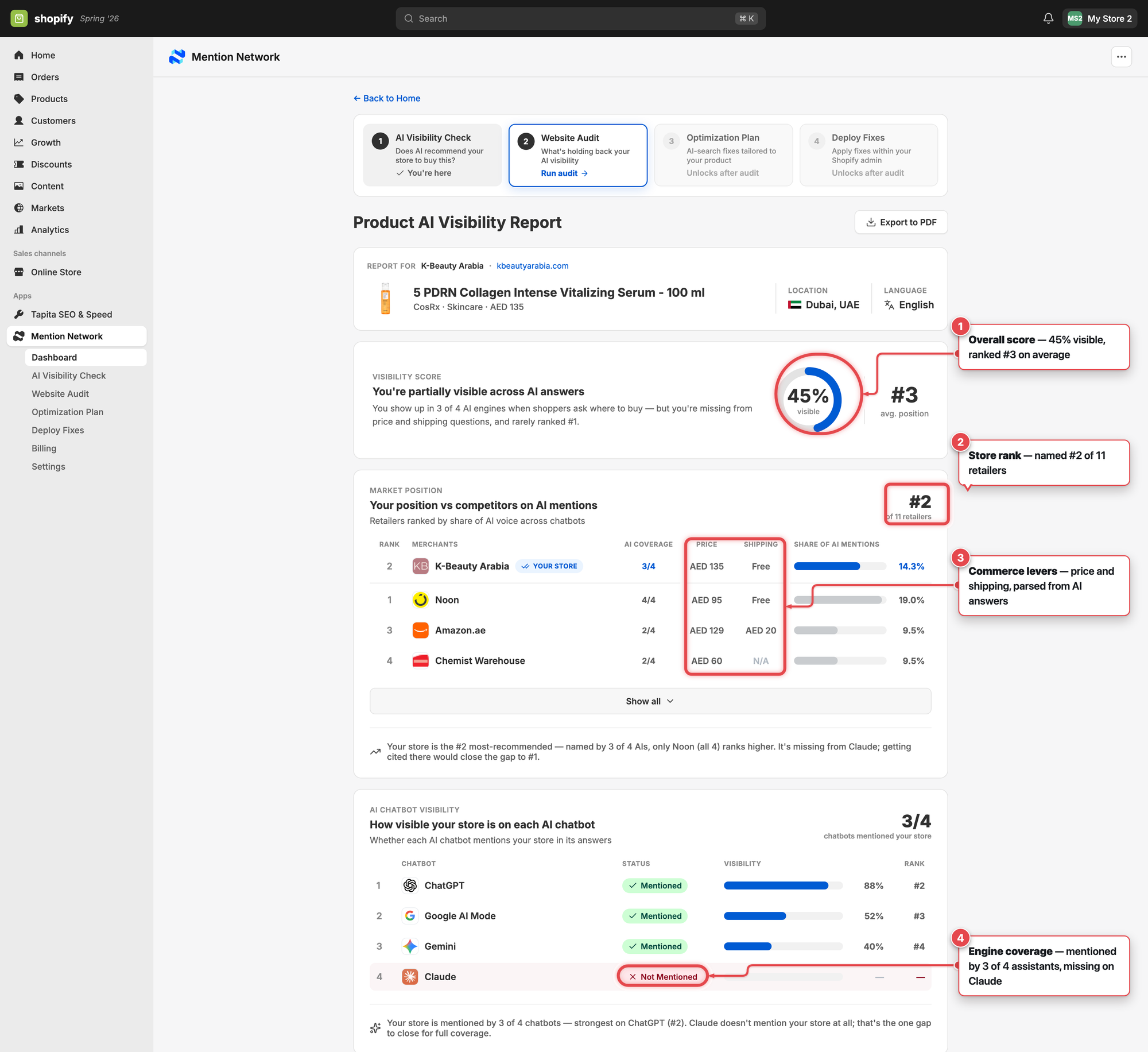
This is closer to rank tracking than social listening, but the rank is inside the answer. You are not measuring whether AI knows the brand in abstract. You are measuring whether the store is selected for a specific buying question.
What should you fix after the first check?
After the first check, fix the missing layer shown by the answer receipts. If AI names competitors but not your store, the issue may be product identity, crawlability, seller trust, price clarity, shipping clarity, or off-store proof. If one engine sees you and another does not, the issue may be source mix rather than the product page alone.
Work in this order:
- Confirm the product page is live and crawlable.
- Rewrite the title and description so the product identity survives a buyer prompt.
- Add or clean structured product data that matches visible content.
- Strengthen seller trust: returns, shipping, reviews, and source consistency.
- Re-run the same product, location, language, and prompts so the before/after comparison stays clean.
The wider framework lives in the AI product visibility pillar. Read it if you need the difference between brand visibility, product visibility, and store visibility in one place.
Frequently Asked Questions
These 4 answers summarize the model before you update product data.
What is AI search engine optimization?
AI search engine optimization is the practice of making your products, pages, and proof easy for AI systems to understand, trust, and select in an answer. For ecommerce, the practical goal is store visibility in buyer-intent answers.
How is this different from SEO?
SEO still helps pages rank and earn clicks. This approach adds another layer: whether AI answers can name your product or store, explain why it fits the query, and show enough evidence for a shopper to act.
What should ecommerce stores measure first?
Measure one product, one location, and one language against real buyer-intent prompts. Track whether your store appears, where it ranks, which competitors appear, and what raw answer evidence explains the result.
Does schema markup guarantee AI search visibility?
No. Schema helps machines understand content and supports normal search features, but Google says there is no special schema required for generative AI Search. Treat schema as clarity, not a magic citation switch.
Next step
Pick 1 product where the buying moment matters. Run the exact same buyer prompts across more than one engine, save the raw answers, and look for the reason another store was chosen.
Then run a free check to see whether AI recommends your store for a real product today.