
Why Visibility in Business Is the Real Growth Advantage


Visibility in business is no longer a secondary branding outcome. It is a core condition for participation in modern markets. Buyers rarely evaluate every option available. In many categories, decision-makers narrow down quickly to a short list before deeper evaluation. That makes visibility in business a gatekeeper: if a company is not present at the moment of intent, it is not even considered, regardless of product quality.
As discovery shifts across search, marketplaces, review sites, partner ecosystems, and AI-driven interfaces, visibility in business becomes structural rather than promotional. It shapes credibility before persuasion begins, and it directly influences how efficiently a business converts attention into revenue.
Understanding Business Visibility: Key Concepts
Business visibility refers to how easily and accurately a brand is recognized across search engines, AI systems, and digital platforms. Understanding its core concepts helps businesses move beyond rankings to focus on relevance, authority, and consistent presence in modern discovery environments.

What visibility in business actually means
Visibility in business refers to a company’s measurable presence in the places where stakeholders search, compare, and validate solutions. It is not just exposure. It is inclusion inside the buyer’s active path. A business is “visible” when it appears consistently across high-intent surfaces and can be understood quickly by both humans and systems.
High intent surfaces usually include:
- Search results for category keywords and solution queries: This is where intent is explicit and time-to-decision is short.
- Comparison and review pages: These pages shape preference by framing tradeoffs and expectations.
- Marketplaces and directories: Inclusion signals legitimacy and reduces buyer uncertainty.
- AI-generated answers and summaries: When buyers ask for recommendations, visibility becomes shortlist inclusion.
Visibility vs awareness vs credibility
These three are connected but not interchangeable. Awareness is memory, visibility is availability, credibility is trust. Many teams overinvest in awareness and assume it automatically produces visibility, but the buyer journey does not work that way. People can recognize a brand yet still never encounter it during evaluation.
Here is a simple comparison that makes the difference obvious:
| Layer | Core question | What success looks like | What failure looks like |
|---|---|---|---|
| Awareness | Do they recognize the brand | Recall, familiarity, brand lift | The brand is forgotten |
| Visibility | Do they see it at decision time | Presence, share of voice, inclusion | The brand is never encountered |
| Credibility | Do they trust it enough to choose | Reviews, proof, consistency, authority | The brand is doubted or rejected |
Visibility as a system, not a channel
Visibility in business is not a single-channel KPI. It emerges from consistency across an ecosystem. If a brand is strong on social but absent on reviews and comparisons, it may feel “famous” yet lose at purchase intent. If it ranks in search but is misrepresented in listings or AI summaries, it can appear visible yet fail conversion.
A practical way to think about visibility as a system is to check alignment across three layers:
- Owned layer: website, product pages, docs, pricing, FAQs
This defines the canonical truth of the business. - Earned layer: press, reviews, partner mentions, community discussions
This influences perceived legitimacy and trust. - Interpreted layer: search engines, marketplaces, AI systems
This determines what gets surfaced when buyers ask for options.
Importance of Visibility in Business
Visibility is critical to business success because it determines whether a brand is discovered, trusted, and considered at the moment of decision. In an AI-driven landscape, strong visibility ensures a business remains relevant not only to users, but also to the systems that influence what information gets surfaced.
Visibility determines inclusion before preference
Before preference is formed, inclusion happens. Visibility in business decides whether the brand enters the shortlist. If the buyer’s first pass removes a brand due to absence, no amount of sales enablement can recover that lost slot easily. This is why visibility is often more predictive of revenue than creative quality.
What marketers should watch for:
- Are you present on the pages buyers use to compare? If competitors occupy comparisons and you do not, you are losing before evaluation.
- Are you visible in your category language? If your positioning is unclear, systems cannot match you to intent queries.
- Are you “discoverable” by people who do not already know you? A brand that only converts returning visitors is not truly visible.
How visibility accelerates trust formation
Visibility compounds trust because repetition across credible environments reduces perceived risk. Buyers interpret frequent appearances in relevant contexts as a signal that the brand is legitimate and adopted. This is not about vanity impressions, it is about repeated exposure inside decision contexts.
Example pattern that builds credibility fast:
- A buyer sees your brand in a comparison article
- Then sees it again on a review platform
- Then sees consistent messaging on your website
- Then sees it mentioned in an AI summary
The repeated alignment makes your claim feel safer, even before any demo.
Visibility as a compounding advantage
Visibility in business behaves like an asset. Once your brand becomes associated with a category in multiple systems, it becomes easier to maintain inclusion. Competitors then have to spend more to displace you, because they are fighting not just one ranking but an ecosystem of reinforcement.
A useful mental model is to treat visibility like distribution. You build it once, then it keeps paying back if maintained. That is why “building brand visibility” is typically a higher leverage play than constantly launching new campaigns with no durable footprint.
The Visibility → Credibility → Profitability Model
This model explains how visibility drives business outcomes: being consistently seen leads to credibility, and credibility creates trust that converts into revenue. In AI-influenced discovery environments, businesses that control visibility are better positioned to build authority and long-term profitability.
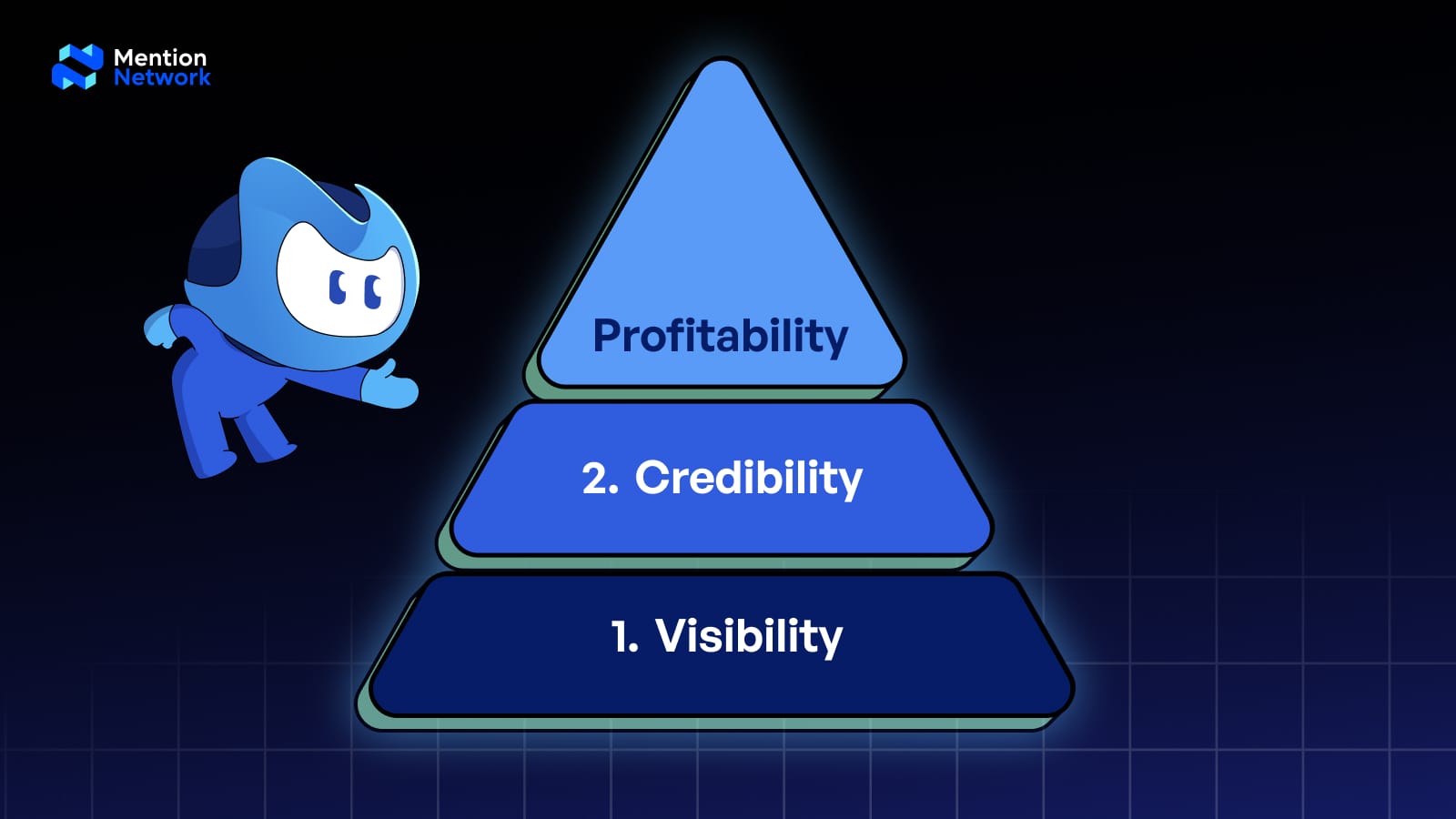
Visibility as the entry condition
Without visibility, you do not get evaluated. It is the only part of the funnel that determines whether persuasion can even happen. When visibility in business is low, teams misdiagnose the problem as messaging or product. Often the real issue is that the brand simply does not appear where decisions are made.
Quick diagnostic questions:
- If a buyer searches “best X for Y,” do you show up anywhere
- If a buyer compares top alternatives, are you mentioned
- If a buyer asks an AI assistant for recommendations, are you included
If the answer is “no” to any of these, the entry condition is broken.
Credibility as the reinforcement layer
Credibility decides whether visibility turns into consideration. The buyer’s brain treats credibility as a risk filter. If your brand appears but lacks proof, clarity, or consistent details, the buyer may discard it quickly.
Credibility signals that strengthen conversion:
- Clear category positioning and product narrative
- Consistent pricing and feature descriptions
- Trust artifacts like case studies, benchmarks, certifications
- Third-party reviews with specific outcomes
Visibility drives the first look. Credibility keeps you in the running.
Profitability as the outcome
Profitability is the downstream result of stable visibility plus earned credibility. When both are strong, businesses win in three ways: lower acquisition costs, faster sales cycles, and improved pricing power. Buyers pay more willingly when they feel confident and when alternatives feel less proven.
To make this concrete, here is how the model maps to business outcomes:
| Model stage | Leading indicator | Business impact |
|---|---|---|
| Visibility | Share of voice, inclusion rate, impressions in intent surfaces | More inbound demand and more qualified leads |
| Credibility | Review quality, proof density, consistency | Higher conversion rate and shorter evaluation cycles |
| Profitability | CAC efficiency, win rate, retention | Sustainable growth and stronger margins |
From Visibility to Credibility to Profitability
- Visibility creates access: Visibility creates access to demand. Without access, persuasion does not matter. The goal is not “be famous,” it is “be present when buyers decide.”
- Credibility reduces friction: Credibility reduces friction by reducing uncertainty. It prevents drop-off after first exposure and improves trust speed.
- Profitability scales outcomes: Profitability follows when visibility and credibility reinforce each other. This is how visibility in business translates into real, measurable growth.
How to Increase Visibility in Business
Increasing business visibility requires clear positioning, consistent presence across digital channels, and content that both users and AI systems can easily understand and trust. When visibility is built strategically, it strengthens brand recognition and creates more opportunities for engagement and growth.
Increase visibility through clarity and categorization
Many brands fail to increase visibility because they are not easily classifiable. Systems and humans struggle to map them to a clear category, so they do not get surfaced for the right queries. The fastest visibility gains usually come from sharper positioning and tighter category language.
What clarity looks like in practice:
- One primary category statement repeated across channels
- Feature language mapped to buyer intent, not internal jargon
- Product pages structured so key details are extractable
This makes it easier for search, marketplaces, and AI systems to match you to intent.
Improve visibility at high-intent moments
Not all visibility matters equally. The visibility that drives growth happens at high intent moments, where the buyer is actively deciding. That is why improving visibility in business is often about prioritizing the surfaces closest to purchase, not just increasing reach.
High intent surfaces to prioritize first:
- Category comparisons and “alternatives” pages
- Review platforms where buyers validate decisions
- Marketplaces where buyers filter options
- AI summaries where buyers ask “best tool for my case”
When you show up here, you do not just gain attention, you gain consideration.
Building business visibility across ecosystems
Visibility is fragile if your data and narrative diverge across platforms. A common failure mode is inconsistent naming, outdated descriptions, or mismatched pricing across sources. Systems interpret inconsistency as lower confidence and may surface competitors instead.
A practical approach is to run a quarterly visibility consistency audit across:
- Website and product pages
- Listings, directories, marketplace profiles
- Review pages and earned media mentions
- AI summaries and recommendation contexts
This is how building brand visibility becomes durable rather than campaign-dependent.
Conclusion: Visibility Is a Strategic Growth Lever
Visibility in business is the structural foundation of modern growth. It determines inclusion, accelerates trust formation, and compounds over time. Businesses that treat visibility as a system build more resilient demand and reduce reliance on paid channels for survival.
If there is one takeaway, it is this: visibility is not a nice-to-have metric. It is a prerequisite for credibility and profitability. The most effective teams focus on where decisions happen, ensure consistent representation across ecosystems, and measure presence at the moment of intent.
You can try a free AI Visibility tool at mention.network to see how your brand shows up in AI answers.
If you have any questions, email us at [email protected], or book a quick call for free support with our team here
FAQs
What is visibility in business?
Visibility in business is how often and where a company appears when people are searching, comparing, or deciding. It is about being encountered at the point of intent, not just being known.
How do I increase visibility without increasing ad spend?
Improve visibility by clarifying positioning, strengthening presence on comparisons and review platforms, and aligning your listings and product data across ecosystems. These actions often outperform incremental paid reach.
Is business visibility the same as brand awareness?
No. Awareness is recognition and recall. Business visibility is being present during evaluation. A brand can be well-known but still invisible when buyers search for options.
How do I measure visibility in business?
Track inclusion rate on high intent surfaces, impression share for category queries, presence in comparisons and reviews, and where your brand shows up in recommendation contexts.