The visibility gap: Why your brand is invisible to AI
Your brand can rank on page one of Google and still be missing from ChatGPT and Perplexity answers. Learn why this AI visibility gap happens and how to close it.


The shift from search engines to answer engines opened a blind spot for brands, and most SEO dashboards can't see it. Your store can rank on page one of Google and still be missing from what ChatGPT, Gemini, and Google AI tell shoppers. That gap has a name: AI visibility.
Search engines hand back ten links and let the shopper choose. Answer engines hand back one synthesized paragraph, and if your brand isn't in it, you're out of the consideration set entirely. LLMs assemble that paragraph from trust, authority, and consensus across the web. So when your brand isn't part of the web of mentions these models lean on, you drop out of the AI buying journey. Closing the gap means moving from keyword SEO to generative engine optimization (GEO): earning the third-party citations models actually read.
Key takeaways
- Most AI shopping answers now resolve inside the chat, with no click to any site, so traffic analytics miss the moment.
- Models reward co-occurrence: brands named often alongside category terms across sources they trust.
- Inconsistent messaging across the web makes AI skip your brand or describe it wrong.
- Third-party citations, more than your own site copy, decide whether AI recommends you.
The hidden crisis of brand anonymity in the AI era
Traditional SEO metrics no longer capture a brand's real reach, because LLMs act as a filter that drops high-ranking but low-authority pages before an answer gets written.
A growing share of searches now ends inside the AI interface, with no click through to a website. By early 2026, 68% of US Google searches ended without a click, up from 60% two years earlier, per SparkToro's read of Similarweb clickstream data. This "zero-click" behavior means the synthesized summary satisfies the shopper on the spot. Traffic counts stop telling the whole story. What matters is whether your brand's value shows up inside that answer.
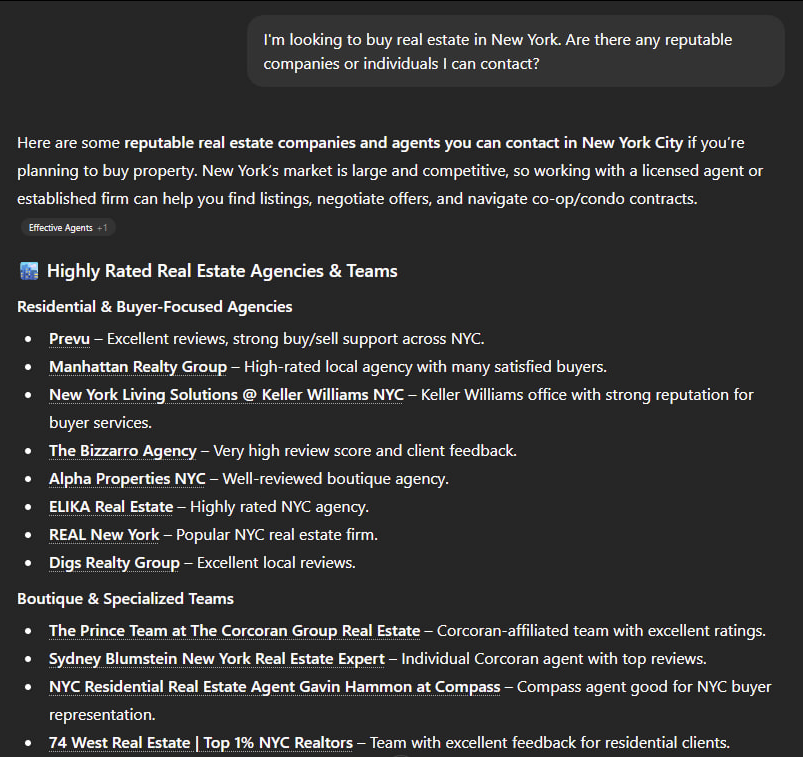
Example for AI search.
The model behaves like a concierge. It gives one authoritative answer stitched from a handful of trusted sources, and if your brand isn't named in that paragraph, your product page is effectively invisible no matter how well it ranks. Google's Decoding Decisions research shows buyers loop through a "messy middle" of exploration and evaluation before they settle; the AI now runs that loop for them and hands back only the shortlist it trusts.
This comes down to how LLMs are trained. They look for patterns of consensus. Ask one for the "best insulated water bottle under $40" and it weighs which brands come up again and again across Reddit, review sites, buying guides, and news. If your brand lives only on your own domain, the model has no outside signal to justify recommending you.
Why it matters
You lose the chance to frame the story around your product before a shopper ever reaches your site. Shoppers increasingly trust AI's summarized consensus over a page of links, so being left out of the summary blocks even well-known brands from the buying journey. That's the split between brand awareness and brand visibility: people can know your name and still never meet you at the moment of decision. And when you can't see how AI describes you, your team keeps steering by clicks and impressions that no longer match how people actually buy.
This is why we built Mention Network, an AI search monitoring platform for e-commerce. It measures how ChatGPT, Gemini, and Google AI surface your brand and products, then shows you the picture conventional analytics can't: what the models say about you, and why.
How Mention Network reclaims your narrative
Mention Network turns AI from an opaque black box into a channel you can read and act on. It runs as a loop: measure, diagnose, fix.
Measuring works on two layers. Brand AI Visibility asks whether models name and recommend you when a shopper asks about your category, and what they say when someone asks about you directly. Product AI Visibility goes narrower: does the assistant suggest your specific products and SKUs, including in "where to buy" answers. From there, a store audit diagnoses why AI is skipping you, drafts the fix for the affected product page, and lets you preview and apply it in your store admin. It's Shopify-first today, with WooCommerce and custom stores next over the API.
Passive tracking stops being enough once AI models are shaping what shoppers believe before they land on your site.
The Mention Network AI visibility report
The Mention Network AI visibility report reads the answer, not just the ranking.
A traditional tool tells you that you got mentioned. The AI visibility report tells you how. It reads the sentiment behind each mention and the sources feeding it, so you can act on specifics instead of guesses.
You see whether the model frames you as a premium pick, a budget option, or a newer name to watch. You see which sources shape that view, from Reddit threads to review sites to buying guides. And you see your share of voice against competitors, so you know who's winning the consensus in your category and by how much.
You can run a free check-up at mention.network to see how your brand and products show up in AI answers today. Pricing is pay-as-you-go, so you go deeper only when it earns its keep.
Have questions? Email us at [email protected], or book a quick call with our team.
FAQ
How does a mention network help my brand?
A web of third-party citations, from news and reviews to social posts, signals to AI models that your brand is credible and recognized in your category. The more consistent those signals, the more often the model names you.
Do I still need a website if AI handles the search?
Yes. Your site is the source of truth. Its structured data (Schema) and detailed product content are what models crawl to verify the answers they synthesize, so thin pages give AI less to work with.
What is the fastest way to improve AI visibility?
Earn mentions in the authoritative lists, directories, and community threads that AI models already treat as high-trust sources. Find where your category gets discussed, then make sure your brand belongs there. This is the same reason visibility compounds into a growth advantage: every consistent third-party mention makes the next recommendation more likely.