
Google AI Overviews for Ecommerce: What Merchants Can Control
Google AI Overviews are a bigger Search surface for ecommerce, not a separate magic index. Here is what merchants can control: crawlability, product data, Merchant Center, useful content, and measurement.

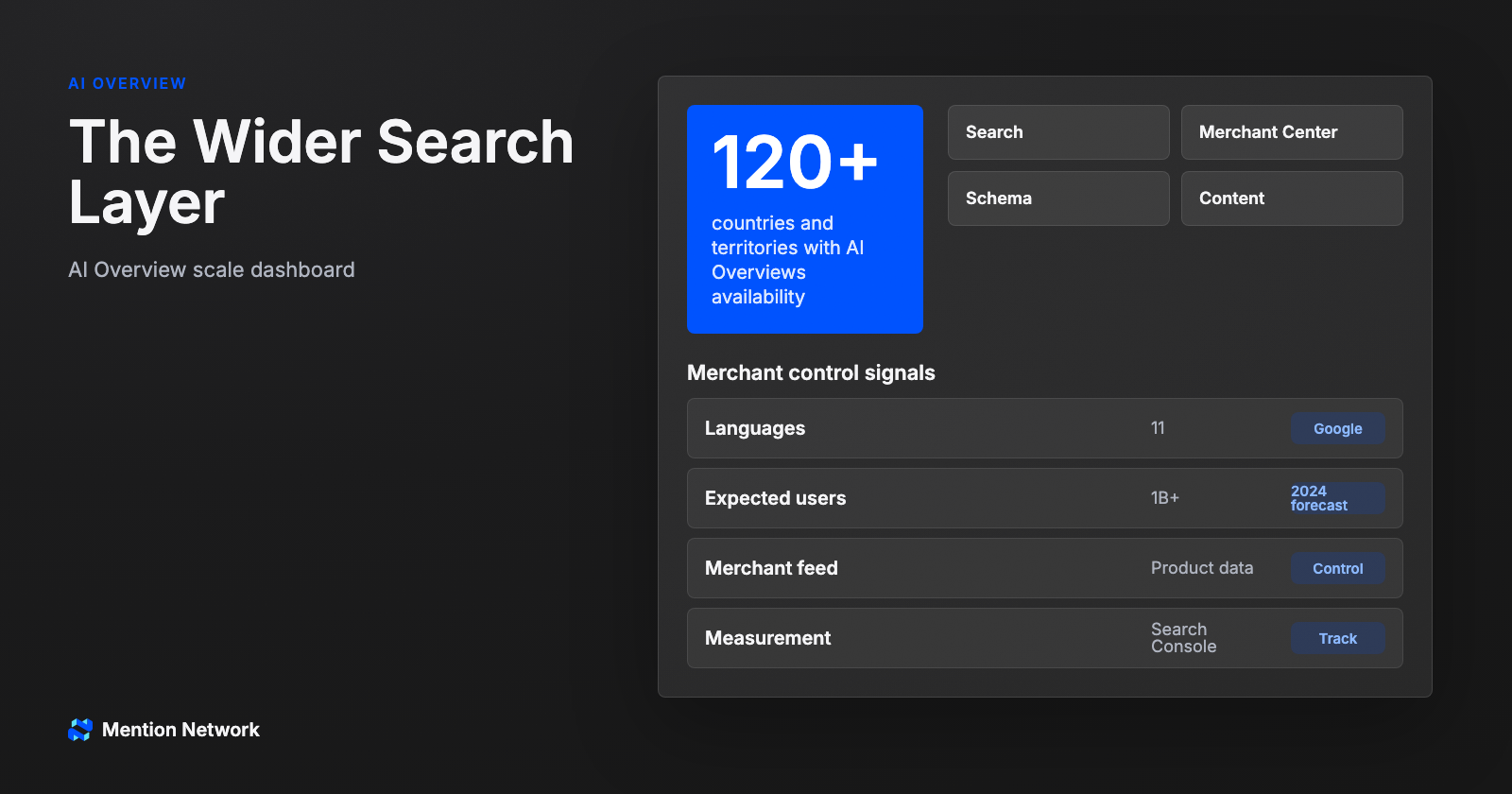
For years, ecommerce SEO had a clean ritual. Check rankings, fix product schema, watch category pages, then compare Search Console traffic. Google AI Overviews didn't erase that ritual. They made the answer surface wider.
Google AI Overviews for ecommerce are a new Search visibility layer where Google can answer a shopper with a generated summary, links, product information, and sources before the classic blue-link scan starts. Verified as of 2026-07-16, Google says AI Overviews are available in more than 120 countries and territories and 11 languages. That scale makes the surface hard to ignore.
TL;DR: Google AI Overviews for ecommerce still run through Google Search systems. The merchant control stack is 5 of 5 practical: crawlability, product data, Merchant Center, useful content, and measurement.
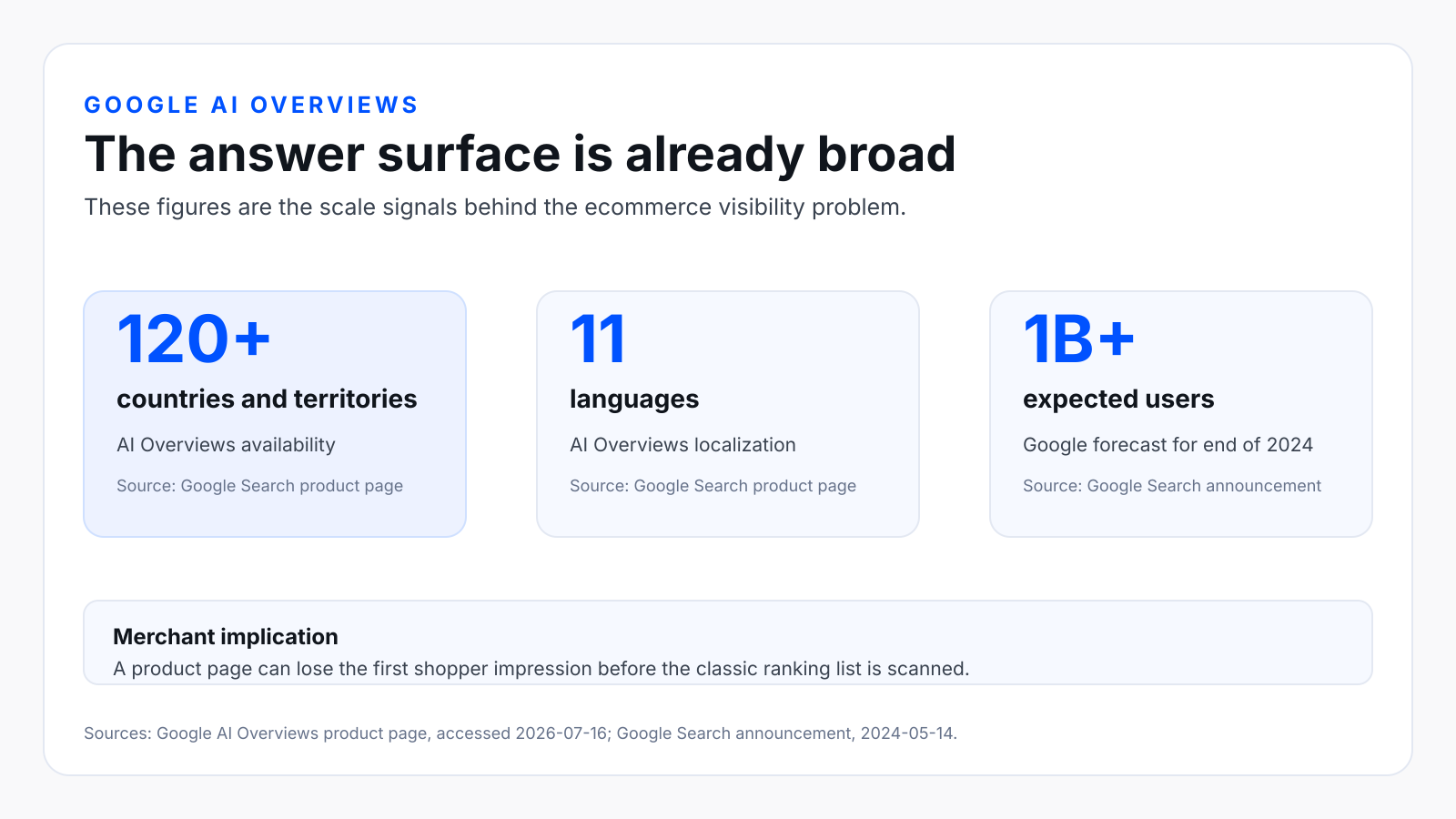
The useful takeaway is calm: ecommerce teams should keep the parts of SEO that help Google crawl, understand, and trust product pages, then add a measurement loop for AI answers. The broader AI Overview strategy lives in our Google AI Overviews pillar. This piece is the merchant version.
AI Overviews still start with Search
Google AI Overviews are a Search feature, not a parallel ecommerce database. Verified as of 2026-07-16, Google Search Central says AI Overviews and AI Mode use Search systems, including retrieval-augmented generation and query fan-out, to gather supporting pages and links from the Search index.
That matters because the control surface is familiar. A product page has to be crawlable, indexable, eligible for a snippet, and useful enough for Google Search before it can be a serious candidate in Google's generative Search features. Google also says there are no extra technical requirements to appear in AI Overviews or AI Mode.
So the ecommerce work starts with the old crawl. Clean canonicals, readable product copy, real reviews, product schema, useful category pages, and no blocked important content. AI added a new answer format, but it didn't make technical SEO optional.
Ecommerce has a product-data advantage
Ecommerce has one input most content sites don't: structured product data. Verified as of 2026-07-16, Google's generative AI guidance says AI responses can include product listings, product information, and local business information. Google also names Merchant Center feeds and Google Business Profiles as surfaces that can help products and services show in AI responses and other Search results.
For a merchant, that moves the work beyond blog posts. Your product title, images, availability, price, shipping, return policy, variants, reviews, and feed health all become part of the visibility system. If Google can't reconcile those details, an AI Overview has less reason to trust the store.
This is why AI product visibility is a better ecommerce frame than generic brand visibility. A shopper may ask Google about a product type, a price range, or a place to buy. The store wins only when the product and store are both readable enough to be chosen.
What merchants can control this week
The control list is short, and it mostly looks like serious ecommerce SEO with fewer shortcuts.
- Keep important product and category pages indexable. AI Overview eligibility still depends on Google being able to find and serve the page in Search.
- Fix Product, Offer, Review, and Breadcrumb structured data where it is incomplete. Structured data is not special AI markup, but it still helps Google understand commerce pages.
- Keep Merchant Center feeds clean. Product identifiers, availability, shipping, image quality, and disapproval fixes matter because Google named Merchant Center as an ecommerce input for AI responses.
- Write pages that answer buyer questions directly. Size, fit, compatibility, material, warranty, return policy, and comparison context help a page satisfy a shopper query.
- Add real media when it helps. Google's AI guidance says images and video can create more opportunities for websites to appear beyond plain web links.
This is where the overlap with GEO vs SEO for ecommerce is obvious. SEO gets the page into Google's retrieval system. GEO asks whether the answer actually names, cites, or recommends the store.
What to ignore for Google AI Overviews
For Google, llms.txt is neutral. Verified as of 2026-07-16, Google says Search ignores llms.txt for visibility in Google Search, including its generative AI features. It can still be useful for other systems, but it is not a Google AI Overview ranking lever.
The same caution applies to AI-only markup claims. Google says there is no special schema.org markup required for generative AI Search. Use structured data because it is good ecommerce SEO and rich-result hygiene, not because someone promised a private AI Overview switch.
Google also warns against inauthentic mentions. That is worth taking seriously in ecommerce, where thin roundup placements and fake forum chatter are tempting. Durable visibility comes from clear product data, useful pages, real reviews, and credible third-party coverage. Shortcuts decay faster than the surface they are chasing.
How to measure the Google layer
Google gives site owners a Google-specific loop through Search Console. Verified as of 2026-07-16, Google points merchants to the Generative AI performance report to understand how content performs in generative AI features on Google Search and Discover.
Use that report next to the classic Search Console views. The classic report still tells you queries, pages, clicks, and impressions. The generative AI report adds the answer-surface view for Google's own features. Together, they tell you whether Google is still discovering the page and whether the AI surface is creating visibility.
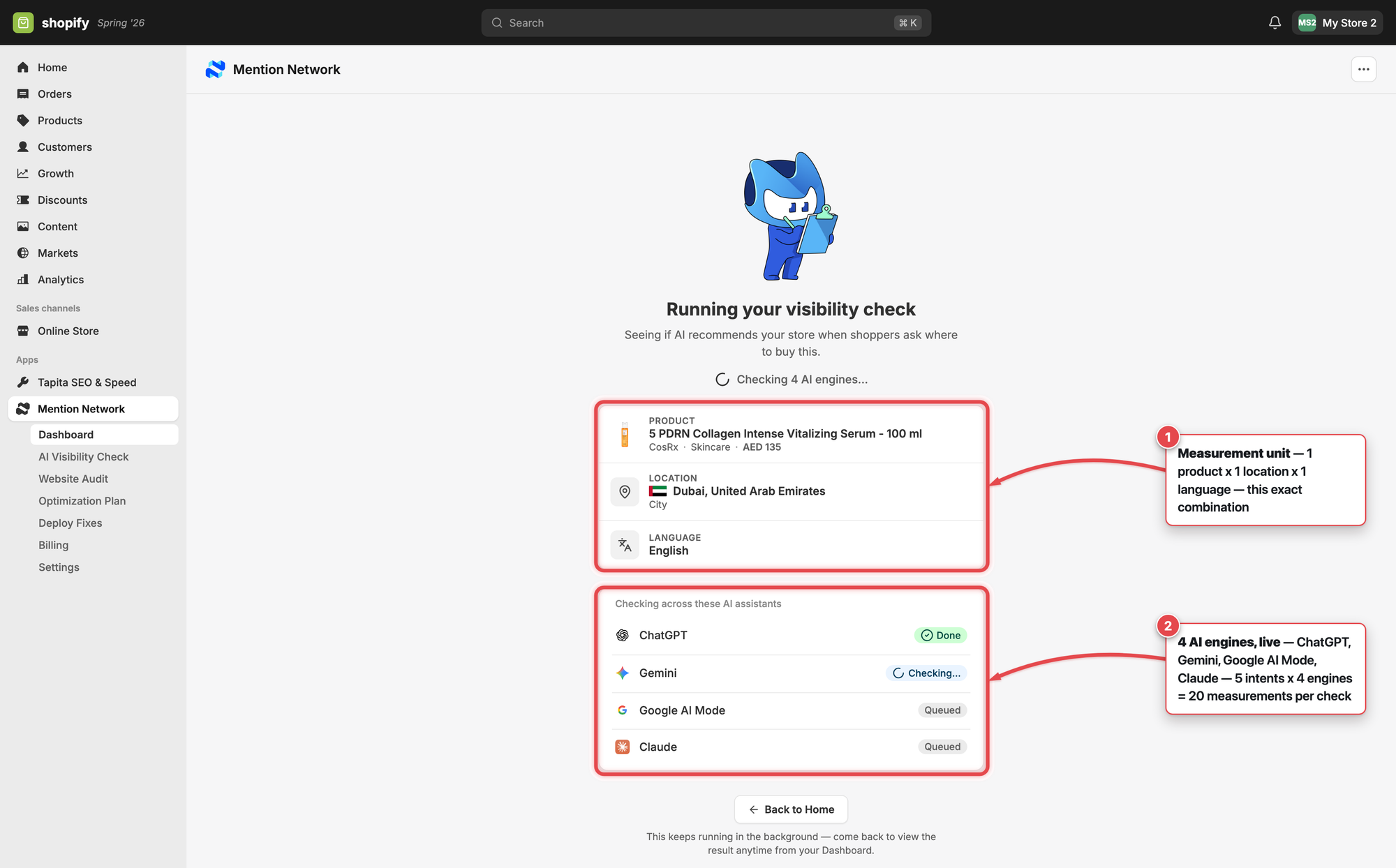
Then measure outside Google. Shoppers also ask ChatGPT, Gemini, Claude, and other answer engines. Mention Network's current free AI Visibility Check, verified as shipped on 2026-07-11, runs 5 buyer intents across 4 engines for 20 measurements and shows the raw answers. That is the product/store layer Google Search Console won't cover.
The merchant playbook
Google AI Overviews make ecommerce SEO more accountable. A merchant can't stop at ranking position, because a shopper may read the AI answer first. A merchant also can't chase every AI tactic, because Google's own docs keep pointing back to Search quality, product data, and useful content.
The practical sequence is simple:
- Make the store technically readable.
- Make the product feed accurate.
- Make product and category pages answer buyer questions.
- Measure Google's generative Search layer in Search Console.
- Test store and product visibility across AI engines.
That is the bridge from old SEO to AI visibility. Keep your rank tracker. Add the answer receipts beside it.
Want to know whether AI engines recommend your store today? Run a free check.