
AEO for Ecommerce: Getting Products into AI Answers
AEO for ecommerce means making product pages, offer data, trust signals, and answer receipts readable enough for AI systems to name your store when shoppers ask where to buy.

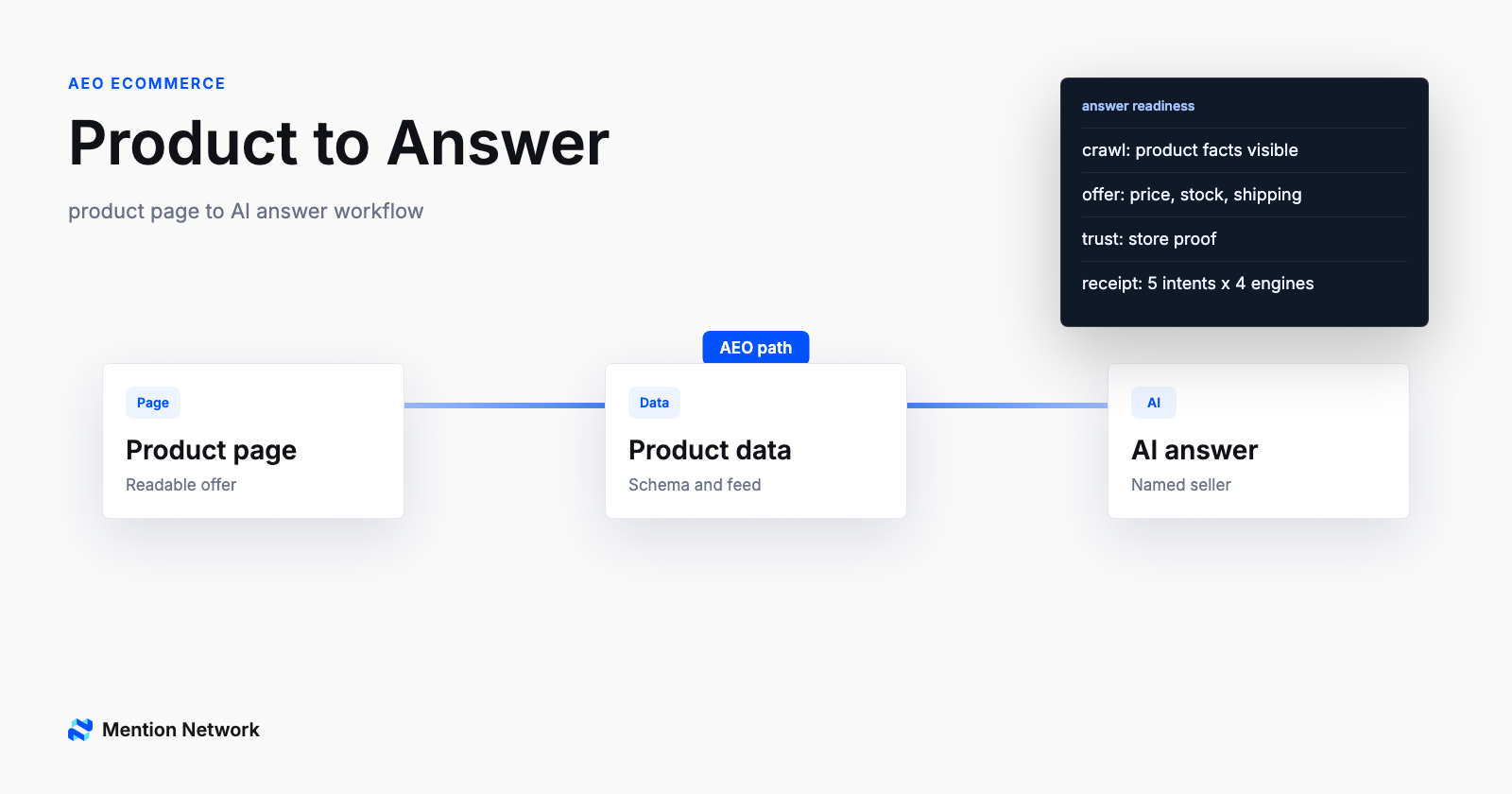
A store can rank in Google and still disappear when a shopper asks AI where to buy the product. That is the uncomfortable part of AEO for ecommerce: the answer engine is deciding whether a product, offer, and seller deserve to be named.
The broader discipline lives in our Answer Engine Optimization pillar. This piece is the ecommerce version: what changes when the answer is not a definition, but a buying recommendation.
TL;DR: AEO for ecommerce has 4 practical layers: readable product pages, machine-readable offer data, trust signals around the store, and answer receipts that show whether AI actually names you.
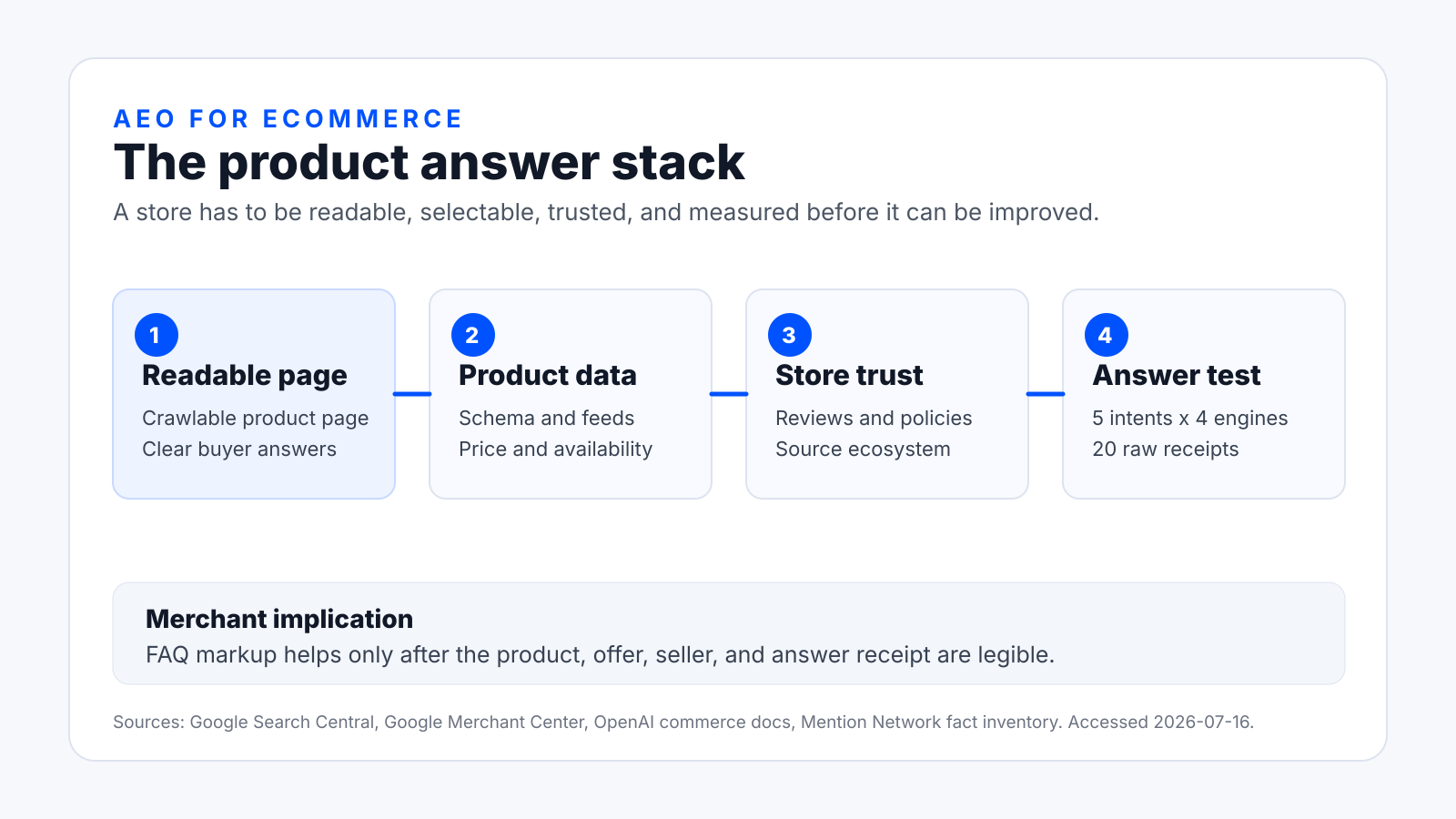
The answer engine optimization ecommerce stack
Answer engine optimization ecommerce work starts with extraction. The page has to say what the product is, who sells it, whether it is available, what it costs, where it ships, and why the store is credible.
Classic SEO still matters here. A crawler that cannot read the product page cannot extract the answer. But ecommerce adds a second layer: the offer. A page about a moisturizer and a page selling that moisturizer are different objects to an AI system.
Verified as of 2026-07-16, Google says generative AI responses can include product listings and product information. Google also says Merchant Center feeds can help products appear in AI responses and other Search results. That is the ecommerce AEO clue hiding in plain sight.
Products in AI answers need offer data
Products in AI answers need clean offer data, not just persuasive copy. Google Search Central says product structured data can expose price, availability, review ratings, shipping information, and other product details in Search experiences.
For pages where customers can buy from you, Google's merchant listing markup supports detailed product information such as apparel sizing, shipping details, and return policy information. Google also says rich product data can come from Product structured data, Merchant Center feeds, or both.
OpenAI's commerce docs point in the same direction. Verified as of 2026-07-16, OpenAI says product feeds help ChatGPT surface products with accurate pricing, availability, and seller context. The exact systems differ, but the merchant lesson is stable: answer engines prefer product facts they can parse.
FAQ schema is only one layer
FAQ schema helps when the answer is a question and response. Ecommerce AEO asks for more. The assistant has to connect a product to a seller, an offer, and a reason to trust the store.
Think of it like the SEO jump from a blog post to a product listing. A blog post can win by explaining. A product page has to be eligible for a transaction. That means Product, Offer, Review, AggregateRating, shipping, return policy, variant, GTIN, image, and availability data have to stay consistent with what the shopper sees.
Google Merchant Center is blunt about this. Its product data specification says Google uses product data to match products to the right queries, and that inaccurate or missing product information can cause disapprovals, limited eligibility, or incorrect product displays.
Store trust changes the answer
Ecommerce AEO is not only a page-level exercise. A store can publish a technically clean product page and still lose the answer if the assistant has stronger evidence for another seller.
That evidence can come from reviews, policies, product identifiers, source coverage, and buyer context. Ecommerce answer generation research makes the same point from a different angle. Rajasekar and Garera's ecommerce QA paper used product specifications, reviews, and similar questions as separate sources for answer generation, reporting gains across F1, ROUGE, BLEU, and human-evaluated accuracy.
That does not mean every store needs a research pipeline. It means your answerable product page should not be lonely. Reviews, return policy, shipping clarity, clean product identifiers, and third-party trust all make the store easier to choose.
AI answers ecommerce testing loop
AI answers ecommerce visibility is a receipt problem. You need to see the actual answer, because a rank tracker will not tell you whether ChatGPT, Gemini, Google AI Mode, or Claude named your store in a buying answer.
Mention Network's shipped AI Visibility Check currently runs 5 buyer intents across 4 engines for 20 measurements per check. The unit is one product, one location, and one language. That matters because "where to buy COSRX in Dubai" and "cheapest place to buy COSRX in London" are different answers.
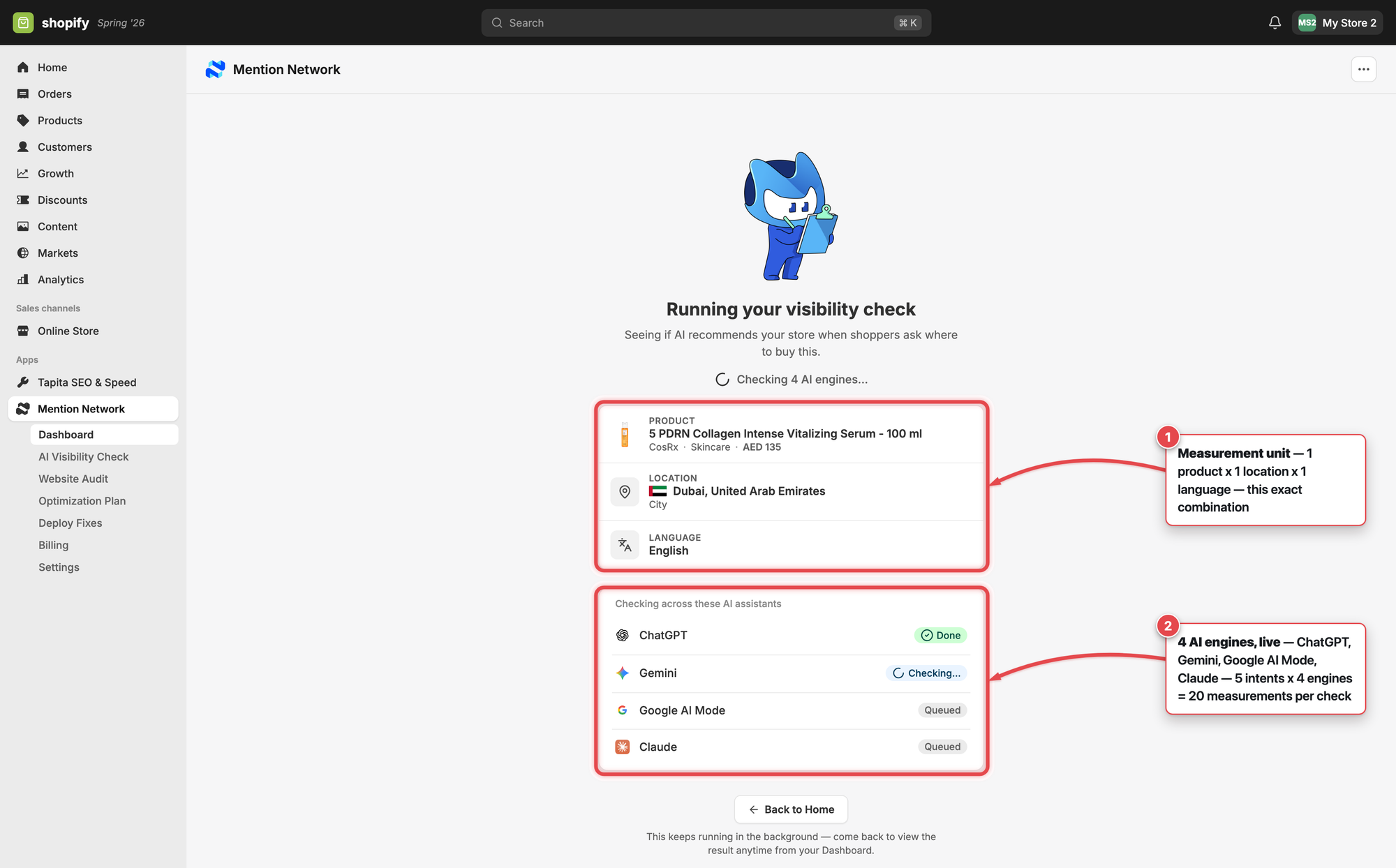
The point is not to admire the dashboard. You get 20 of 20 raw answers to inspect: who was named, whether your store appeared, what price or shipping details were shown, and which competitor got the answer instead.
Ecommerce AEO checklist
Use this as the working checklist before you chase more content.
- Make the product page crawlable. Important product copy should be in the HTML, not trapped in a widget an AI crawler cannot use.
- Keep Product and Offer structured data complete. Match visible price, availability, reviews, variants, and identifiers.
- Keep feed data clean. Merchant Center and product feeds are where offer truth becomes machine-readable.
- Answer buyer questions on the page. Size, compatibility, authenticity, shipping, returns, warranty, and use cases belong near the product.
- Build off-page trust. Reviews, credible mentions, and consistent seller information help AI decide whether the store is safe to name.
- Test actual buyer prompts. This loop improves only when you know which answers mention the store today.
That is also where AEO vs GEO becomes practical. AEO makes the product page extractable enough to answer a question. GEO builds the wider evidence graph that makes the store worth citing.
What to measure first
Start with the buying moment. The most useful prompts are not generic brand prompts; they are shopper prompts.
- Where to buy the product in a location.
- Best place to buy the product online.
- Where to buy the authentic product.
- Cheapest place to buy the product.
- Where to buy the product with free shipping.
Those prompts map to real ecommerce decisions. They also expose the fields covered in our where-to-buy answer anatomy: presence, rank, competitors, price, and shipping.
Keep your Search Console and Merchant Center reports. They still matter. Then put answer receipts beside them, because the AI answer is the surface the shopper may act on first.
For the broader store-versus-product model, use the AI product visibility guide as the companion frame.
Want to see whether AI names your store for real buyer prompts? Run a free check.
Frequently asked questions
What is AEO for ecommerce?
AEO for ecommerce is the practice of making product pages, offer data, trust signals, and answer receipts readable enough for answer engines to name a store or product in buying answers.
Is FAQ schema enough for ecommerce AEO?
FAQ schema can help extraction, but it is only one layer. Ecommerce AEO also needs crawlable product pages, accurate feed or structured data, offer details, trust signals, and measurement across buyer intents.
How should stores measure products in AI answers?
Stores should test buying prompts across multiple engines and keep the raw answers as receipts. Then compare whether the store, product, price, shipping, and competitors appear.