
AI Product Visibility: Why Brand Tools Can't See Your Store
Brand visibility tools count how often AI mentions a name. Your store has a different problem: when a shopper asks AI where to buy something, does your store make the list? That's product visibility, and it's measurable.

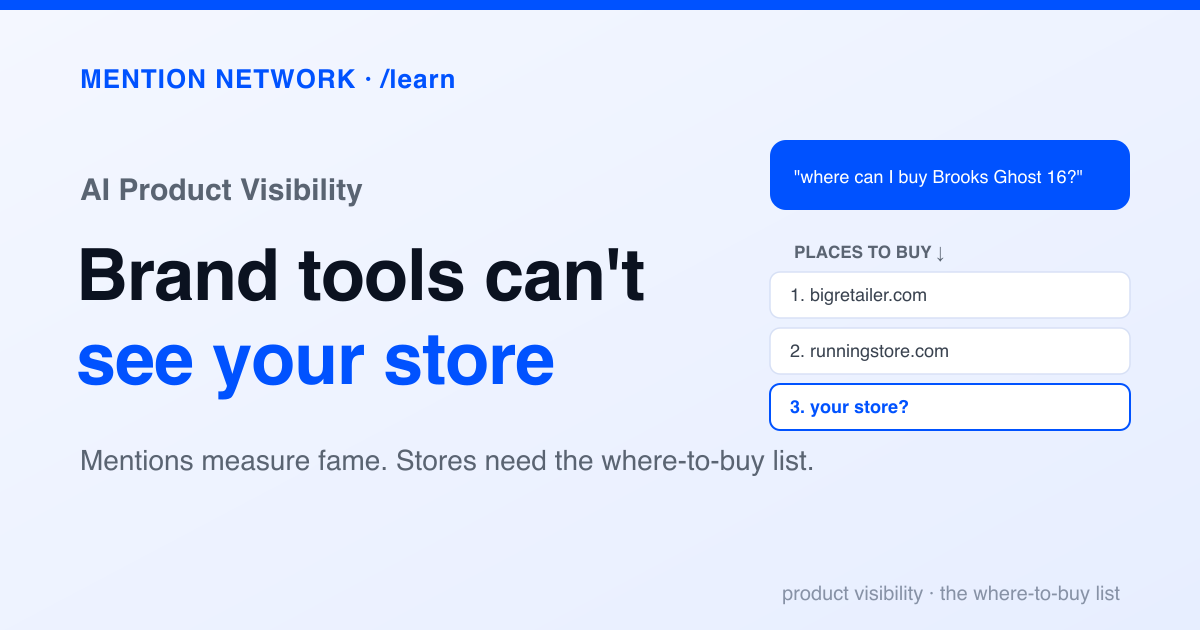
Ask an AI visibility tool how your business is doing and it answers one question: how often does AI mention your name? That's the right question for a brand. If you run a store, it's the wrong one, and acting on it wastes your money. The question a store lives or dies on is different: when a shopper asks ChatGPT or Gemini where to buy something you sell, does your store make the list?
Those are two different measurements. The industry has a name for the first one, brand visibility, and a shelf of tools that track it. This piece is about the second one, product visibility: what it is, why brand tools structurally miss it, and how to measure it for your store.
The where-to-buy moment
Shopping questions to AI assistants have a distinct shape. "Best running shoes for flat feet under $150." "Where can I buy Brooks Ghost 16 in Canada." "Cheapest place to get a Dyson V15 with fast shipping." The assistant answers with a short list: products, and for each product, places that sell it.
That list is the where-to-buy moment, and it's winner-take-most. A handful of stores get named. Every other store that carries the same product is invisible, and the shopper never knows it existed. How the assistants build that list is mechanical: they read structured product data, compare on price, availability, shipping, and trust, then shortlist. Which means making the list is not luck. It's a set of measurable conditions.
Brand visibility and product visibility measure different things
Brand visibility tools like Profound, Peec, and Otterly track prompts and count mentions: share of voice, sentiment, citations. Useful, if the thing being measured is your brand.
Product visibility measures something else. Here's the difference side by side:
Neither column is wrong. They answer different questions for different businesses. The problem starts when a store buys the left column expecting the right one.
The reseller blind spot
Here's where the gap turns expensive. Say you run a store selling Brooks and Hoka running shoes. You're a reseller: the brands you carry belong to someone else.
Point a brand visibility tool at your situation and it tracks mentions of Brooks and Hoka. Those numbers measure the brands' fame. They move when Brooks runs a campaign, and they tell you nothing about whether a single shopper was ever sent to your store. Track your own store's name instead and the numbers are near zero, because nobody asks AI about a store by name. Shoppers ask about products. The store appears, or doesn't, inside the answer.
So for a reseller, brand tracking is structurally empty. The measurable thing, the only thing that pays, is whether your store makes the where-to-buy list for the products you carry. That's a product-visibility question, and no mention counter answers it.
What product visibility is made of
If the where-to-buy list is built mechanically, you can score how ready a store is to make it. We built that scoring framework for our Shopify app, and it groups the conditions into four factors:
- Discoverability. Can AI find and read your products at all? Crawler access, readable content, and structured data, with product schema carrying the most weight. This is the layer most stores fail without knowing it, and the fixes are the most mechanical.
- Content quality and coverage. Once AI can read a product page, does the page answer a shopper's actual questions? Specifications, sizing and compatibility, honest limitations, FAQs, extractable formatting. We weighted these criteria against published research on what generative engines actually cite, including the Princeton GEO study, rather than guessing.
- Entity, trust, and authority. Would AI trust this store enough to recommend it? Real contact and policy pages, consistent business identity, reviews on and off the store, mentions in places AI reads.
- Merchant competitiveness. The commerce levers nobody else scores: price against other sellers of the same product, and shipping. AI where-to-buy answers factor cost, and free shipping is a strong signal. Shipping fees are also a classic conversion killer, with studies putting cart abandonment from unexpected costs around 18 percent.
One honest note: some of these conditions live off your store (Reddit threads, press, third-party reviews) and change slowly. The on-store ones, which is most of the first two factors, are directly fixable, and structured product data is the fastest lever.
Measuring it: outcome first, then readiness
Product visibility gets measured in two layers, in this order.
Outcome: are you on the list today? Ask the assistants real shopper questions for your products, the way a customer would, and record whether your store appears. This is ground truth. Do it manually for your top products, or use the free check, which asks the where-to-buy questions across assistants and shows you who made the list.
Readiness: why, and what to fix. If you're missing from answers, the reasons live in the four factors above. Audit them, fix what's on-store, and re-measure. Because the conditions are mechanical, this loop actually converges. It's the difference between watching a dashboard tell you you're losing and working a checklist that changes the answer.
The where-to-buy moment is already deciding where a growing share of shoppers spend. Brand tools will keep measuring fame. For a store, the measurement that matters is simpler and closer to the money: when someone asks where to buy what you sell, be on the list.
Find out if you're on it. run a free check.
Frequently asked questions
What is AI product visibility?
AI product visibility is whether your store and its products show up when a shopper asks an AI assistant a commerce question, like "where can I buy X" or "best X under $100." It's measured at the product and store level, unlike brand visibility, which counts name mentions.
How is product visibility different from brand visibility?
Brand visibility asks "does AI talk about this brand?" Product visibility asks "does AI list my store as a place to buy?" A store can sell well-known brands and still be invisible, because the brands get mentioned while the store never makes the where-to-buy list.
Why can't brand visibility tools help a reseller?
A reseller sells other companies' brands, so tracking brand mentions measures the brands' fame, not the reseller's presence. The question that matters for a reseller is whether AI names their store as a place to buy, and brand tools don't measure that.
How do I measure my store's AI product visibility?
Two layers. First, check outcomes: ask the AI assistants real where-to-buy questions for your products and see if your store appears. Second, audit readiness: whether AI can crawl, read, and trust your product data. Mention Network's free check runs the first layer in minutes.