
AI Shopping Assistants: How They Pick Products (2026)
Shoppers now ask an AI for the best product, not a search box. The assistant reads structured data, not your storefront design. Here's how AI shopping assistants pick products, and what gets your store on the shortlist.

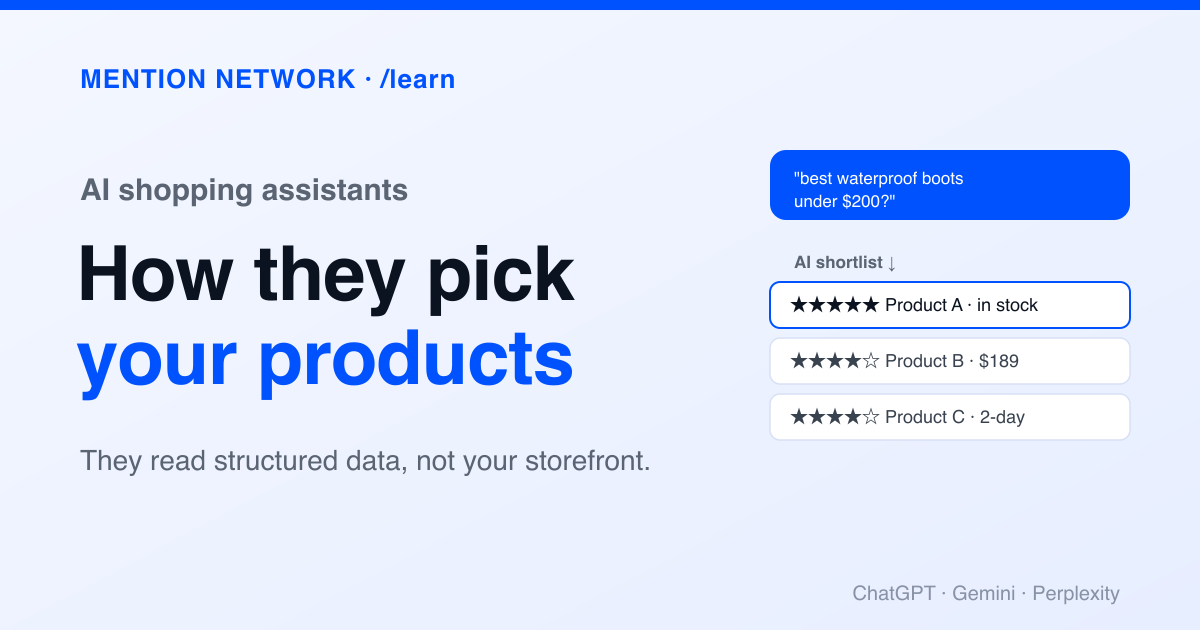
A shopper used to type keywords into a search box and scroll through blue links. Now a growing share of them ask an assistant: "best waterproof hiking boots under $200." The assistant returns a short list, already compared, sometimes with a buy button attached. It picked those products in under a second, and it never looked at your storefront design. It read your structured data. This is how discovery works now, and it changes what a store has to get right.
This guide covers how AI shopping assistants actually pick products, the platforms and protocols behind them, and what makes your store legible enough to be recommended. It's the selection side of the structured data AI reads from your store.
What an AI shopping assistant is
An AI shopping assistant is an agent inside a tool like ChatGPT, Gemini, Perplexity, or Amazon's assistant that handles the parts a shopper used to do by hand: discovery, comparison, and increasingly the purchase. The shopper sets the intent and the guardrails, and the agent does the searching and shortlisting. These platforms are shifting from smart assistants to full retail channels, where the whole path from question to checkout happens in the chat.
The plumbing that makes the purchase work is a set of new protocols. Here's the current landscape.
How they actually pick a product
The selection is more mechanical than it looks from the shopper's chair. It runs in roughly four steps.
- Intent becomes structure. The model turns "waterproof hiking boots under $200" into machine constraints: category boots, attribute waterproof, price under 200. Your product either matches those constraints in data, or it doesn't surface.
- It searches structured sources. The agent queries merchant feeds and on-page structured data for candidates. It reads fields, not your hero banner. As one industry account puts it, agents explain products by their structured data, not their visual merchandising.
- It compares fast. An agent can weigh thousands of listings in under a second on price, ratings, delivery, and returns at the same time. Your product is judged against the field on hard attributes.
- It shortlists. A handful of products come back, sometimes with a buy button. Everything not in that list is invisible to the shopper.
The step that quietly kills stores is comparison. AI agents dislike ambiguity because they have to decide quickly. When delivery windows, shipping costs, or return terms are unclear or inconsistent, the agent can skip the offer, and no human ever sees it. A missing size, a stale price, an availability that doesn't resolve: each is a reason to pass you over.
What this means for your store
The good news is that the levers are the same ones that make you legible everywhere. Being recommended by an AI assistant comes down to three things.
- Be legible. Complete structured data, schema markup, and a clean Google Merchant Center feed so agents can read and match your products.
- Be unambiguous. Accurate availability and price, clear shipping and returns. These are the fields agents check before they commit, and vagueness gets you dropped.
- Be complete. Fill the attributes shoppers filter on with metafields: material, size, color, features. Every filled attribute is another query you can match.
The platform-specific playbook for ChatGPT lives in our guide to optimizing your store for ChatGPT Shopping. The principles above apply across all of them.
Legible is not the same as chosen
Clean, unambiguous data gets you into the running. It doesn't decide the outcome. Whether an assistant actually puts your product on the shortlist, and how often, is something you can measure across the assistants that matter, rather than assume from the fact that your data is tidy.
Is AI recommending your store? Check free.
Frequently asked questions
What is an AI shopping assistant?
An AI shopping assistant is an agent inside a tool like ChatGPT, Gemini, Perplexity, or Amazon's assistant that handles product discovery, comparison, and increasingly the purchase itself. A shopper describes what they want in plain language and the assistant returns a shortlist.
How do AI shopping assistants pick which products to show?
They turn the shopper's request into structured constraints, search product feeds and structured data for matches, then compare candidates on price, ratings, availability, delivery, and returns. They read structured data, not your storefront design.
How do I get my store recommended by AI shopping assistants?
Make your product data legible and unambiguous: complete structured data and schema, a clean product feed, clear shipping and returns, and accurate availability. Ambiguous or missing data gets your offer skipped before a human sees it.
What are ACP and UCP in agentic commerce?
They're the protocols that let AI assistants transact. ACP, the Agentic Commerce Protocol from OpenAI and Stripe, has run in ChatGPT since 2025. UCP, Google's Universal Commerce Protocol announced in early 2026, brings the same to Google Search AI Mode and Gemini.