
Measuring AI visibility: The metrics that matter in AI search
The six essential metrics for measuring AI visibility in AI search: answer presence, share of voice, citation share, model distribution, topic-level visibility, and entity authority.

AI search is reshaping how people discover brands. Instead of clicking through links, users now receive synthesized answers from ChatGPT, Perplexity, Claude, and Google Gemini. According to Rand Fishkin of SparkToro, fewer than one third of United States Google searches sent a click to the open web in early 2026 (SparkToro). More discovery now happens inside AI answers. This shift makes visibility inside AI-generated responses just as important as traditional rankings. AI visibility shows whether models recognize, trust, and cite your brand when users ask the questions that matter.
TL;DR: AI visibility metrics measure whether AI search engines recognize, trust, and cite your brand. The six that matter are answer presence, share of voice, citation share, model distribution, topic-level visibility, and entity authority. Track them together, across models, to see where you win and where you are invisible.
What you'll learn:
- AI Visibility Begins With Answer Presence
- Share of Voice Reveals Competitive Weight in AI Search
- Citation Share Shows Whether AI Trusts Your Content
- AI Model Distribution Shows Platform-Specific Performance
- Topic-Level Visibility Reveals True Strength Across User Intent
- Entity Authority Determines Long-Term AI Visibility
- A limitation worth naming
- FAQ
These AI visibility metrics are the measurement layer of a broader AI product visibility strategy, and each one answers a different question about how models treat your brand.
Key Takeaways
- AI visibility measures how often AI models mention or cite your brand in generated answers.
- SEO rankings do not guarantee AI visibility, because both systems use different trust signals.
- Share of voice, citation share, and topic visibility are essential AI search metrics.
- Structured content and entity clarity directly influence AI visibility.
- Tracking visibility across multiple AI models reveals platform strengths and weaknesses.
1. AI Visibility Begins With Answer Presence
Answer presence is the foundation of AI visibility because it measures how often your brand appears in AI-generated responses.
Answer presence reflects the frequency with which AI models mention your brand across thousands of topic-specific queries. It is the most direct indicator of whether AI systems consider you relevant enough to include in an answer.
Why it matters
- It shows real visibility in zero-click environments.
- It uncovers whether AI systems understand your brand's role in the category.
- It helps you compare brand presence across multiple AI platforms.
How it works
AI models interpret a user query, evaluate trusted sources, and synthesize an answer. During this process, they may reference your brand if your domain or entity appears authoritative.
Example
Suppose your brand is referenced in 70 percent of AI responses for onboarding queries but only 15 percent for security topics. Your visibility is uneven and requires strategic focus. Topic-by-topic gaps like this are well documented in generative engine optimization research.
Common mistakes
- Assuming a high SEO ranking ensures an AI mention.
- Only measuring branded queries.
- Ignoring the content quality signals AI relies on.
2. Share of Voice Reveals Competitive Weight in AI Search
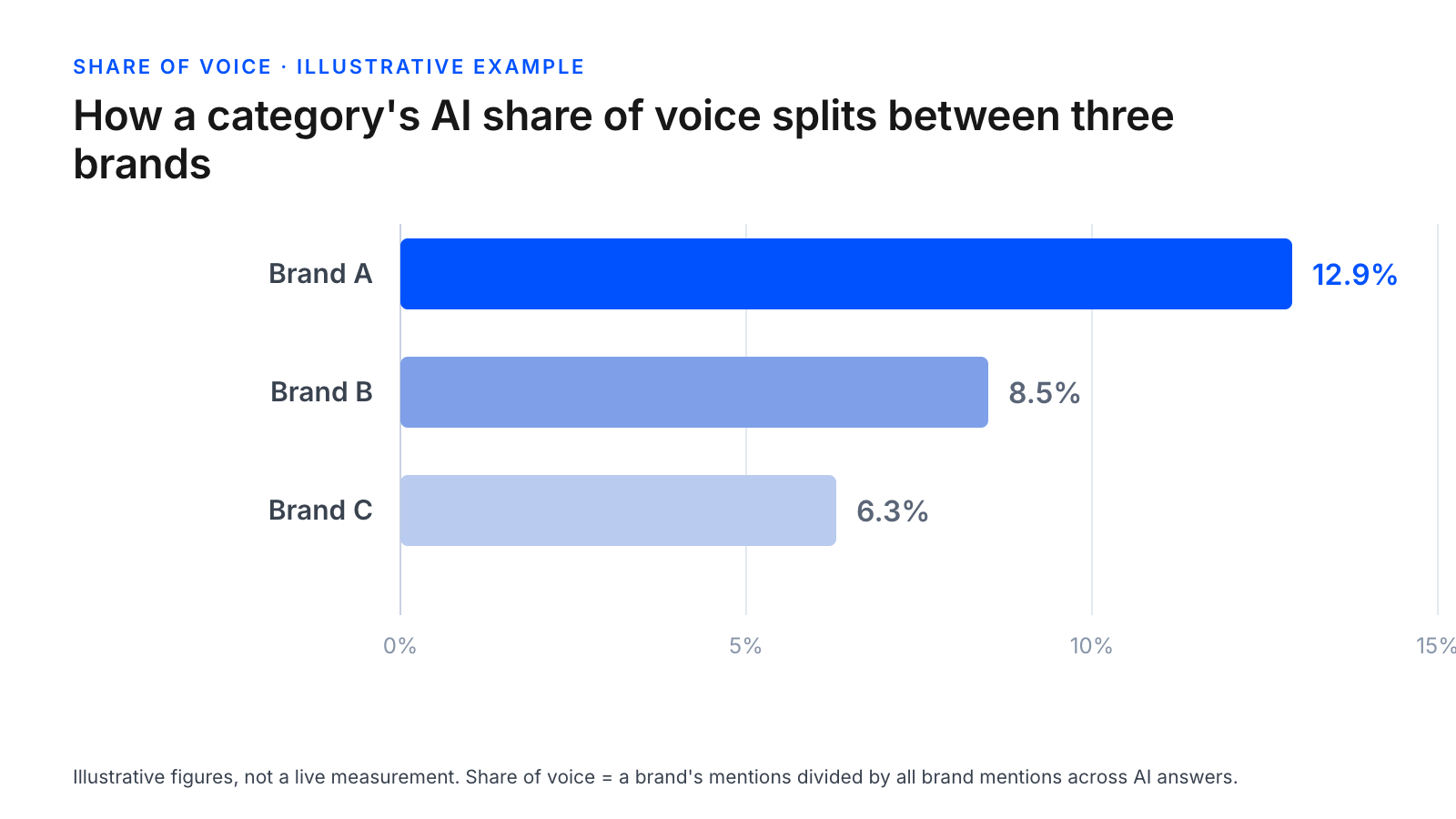
Share of voice measures how much of the total AI conversation your brand occupies compared to competitors.
This metric goes beyond appearance rate and shows how dominant your brand is in AI-generated recommendations. It gives a complete view of your competitive footprint in AI search.
Why it matters
- It identifies category leaders within AI-generated answers.
- It shows whether your brand controls the narrative.
- It helps you uncover overperforming or underperforming competitors.
How it works
It is calculated as your brand mentions divided by total brand mentions across all AI answers.
Share of voice, visualized
Common mistakes
- Measuring it only monthly instead of by industry, topic, and model.
- Confusing high volume with high reliability.
- Ignoring emerging competitors gaining momentum.
3. Citation Share Shows Whether AI Trusts Your Content

Citation share reveals how often AI models use your domain as a source, which is a direct indicator of trust.
Citations act as the AI equivalent of backlinks. When a model cites your content, it signals confidence in your accuracy, structure, and authority.
Why it matters
- A high citation share increases the chance of being referenced again.
- Strong citations help you win new queries and categories.
- Citation share reveals whether AI views your site as factually reliable.
How it works
Citation share tracks:
- Citations of your domain.
- Citations of competitor domains.
- Third-party citations such as news, reviews, and encyclopedic sources.
Example
Your brand may appear often in AI answers but rarely be cited. That means AI models know your brand exists but do not fully trust your content structure or factual depth.
Common mistakes
- Publishing long articles without structured clarity.
- Ignoring schema markup and factual sourcing.
- Assuming traffic equals authority.
You can track this using Mention Network
With the Mention Network Brand Visibility Report, you can see:
- How often each AI model cites your domain.
- Whether your citation share is rising or falling over time.
- Which competitors receive more citations.
- Which topics drive the most citations, or where you are absent.
This gives you a clear diagnostic of how much AI trusts you, where you are losing authority, and what needs improvement.
4. AI Model Distribution Shows Platform-Specific Performance
AI models differ significantly in how they generate answers, so visibility must be measured per model.
ChatGPT, Perplexity, Gemini, Claude, and DeepSeek all use different ranking signals, data sources, and synthesis styles. Optimizing for only one leads to incomplete visibility, so reading AI visibility metrics per model prevents blind spots.
Why it matters
- It reveals platforms where you are strong or weak.
- It helps you allocate effort based on model behavior.
- It tracks emerging platforms gaining influence.
How it works
Evaluate presence and citations separately for each model. Some may over-cite third-party domains, while others may favor structured websites or authoritative institutions.
Example
If you have high presence in ChatGPT but weak presence in Gemini, the issue may be entity clarity, schema markup gaps, or insufficient structured data.
Common mistakes
- Optimizing only for ChatGPT exposure.
- Ignoring Google Gemini despite its rapid integration into search.
- Assuming all AI models rank sources the same way.
5. Topic-Level Visibility Reveals True Strength Across User Intent
Topic visibility shows how your brand performs across specific search categories.
Measuring visibility by topic uncovers areas where your brand leads, gaps where competitors dominate, and opportunities for fast growth.
Why it matters
- It provides actionable direction for content strategy.
- It shows how AI perceives your expertise across subtopics.
- It helps you prioritize content updates and expansions.
How it works
AI visibility platforms group prompts into themes such as:
- Pricing
- Security
- Product reviews
- Tutorials
- Troubleshooting
- Comparisons
Then they calculate visibility per topic cluster.
Example
A brand might dominate the "Trading Fees" topic but perform poorly in "Security Features". This helps teams understand exactly where to invest next.
Common mistakes
- Focusing solely on branded queries.
- Ignoring long-tail topic clusters.
- Creating broad articles instead of intent-specific content.
Learn more: How to Get Cited by AI: A Marketer's Guide to Winning in AI Search.
6. Entity Authority Determines Long-Term AI Visibility
AI visibility becomes sustainable only when your brand is recognized as a clear, consistent entity across the web.
Entity authority is the long-term foundation of AI visibility. AI models rely on entity graphs to understand relationships, credibility, and content relevance.
Why it matters
- High entity authority increases mention and citation likelihood.
- It prevents misinformation or identity confusion.
- It strengthens cross-platform visibility.
How it works
AI models evaluate:
- Brand consistency across platforms.
- Structured data and schema markup.
- Author expertise and signals.
- Content clarity and factual grounding.
- Mention quality across trusted publications.
Common mistakes
- Publishing content without entity markup.
- Using inconsistent naming conventions across platforms.
- Overproducing low-authority articles that weaken entity confidence.
A limitation worth naming
Skeptics rightly point out that AI visibility metrics are noisy. Large language models are non-deterministic. The same prompt can surface different brands from one run to the next, and citation numbers shift with small changes in wording. One snapshot can mislead. That said, the honest fix is not to ignore the numbers but to measure trends across many prompts and repeated runs, where the signal stabilizes and real movement becomes visible.
According to researchers at Princeton, generative engine optimization techniques can raise a source's visibility in AI answers by up to 40% (GEO: Generative Engine Optimization). Consistent investment in these signals compounds over time.
The six AI visibility metrics above sit alongside traditional SEO rather than replacing it. Is AI recommending your store? Run a free check.
FAQ
What is AI visibility?
It measures how often AI models mention or cite your brand inside generated answers.
Why is citation share important?
It shows whether AI systems trust your content enough to use it as a source.
Do high SEO rankings guarantee high AI visibility?
No. AI search uses different signals and often ignores top-ranking pages.
Which AI models should I track?
Start with ChatGPT, Perplexity, Gemini, Claude, and DeepSeek.
How long does AI visibility improvement take?
Most brands see measurable changes within 2 to 6 months, in line with the multi-week to multi-month timelines that generative-engine researchers describe (GEO study).