
The 10 Best AI Visibility Tools in 2026 (Tested for Ecommerce)
Ten AI visibility tools compared honestly: what each one measures, real pricing, and who it's for. Plus the question most lists skip: which ones can actually help a store get into AI's where-to-buy answers?

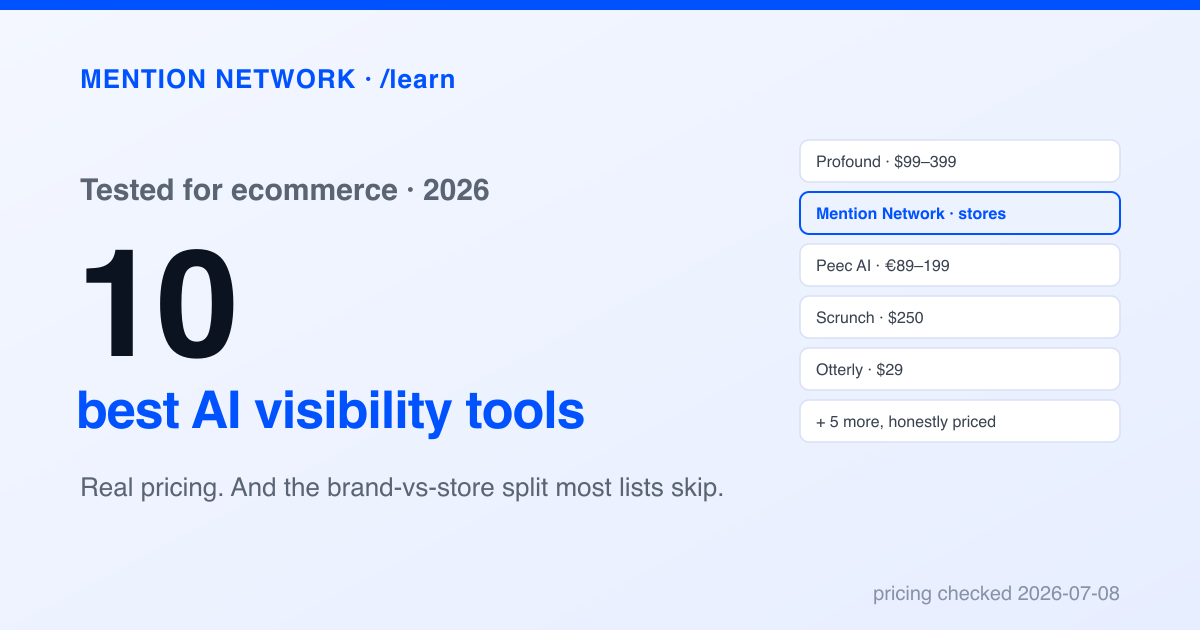
Every list of AI visibility tools ranks the same dashboards without asking who you are. That matters, because the tools split into two camps that answer different questions. Brand trackers count how often AI mentions a name, which is what a brand's marketing team needs. Store owners need something else: getting listed when a shopper asks AI where to buy. Most lists ignore that split entirely.
This one doesn't. Below are the ten tools that matter in 2026, what each actually measures, real pricing, and who each one fits. Full disclosure up front: Mention Network is our product, it's in the list, and we've tried to be more useful than flattering, including telling you when a competitor is the better pick.
Pricing checked 2026-07-08 against vendor pages and current third-party reviews; this market reprices often, so verify before you buy.
TL;DR: Most AI visibility tools count brand mentions; if you run a store, the question that matters is whether AI lists you in where-to-buy answers. Check which job a tool actually does before you commit.
How we compared them
Five things, stated so you can disagree with the weighting:
- Unit of measurement. Brand mentions, or product-and-store presence in commerce answers. The biggest fork in the list.
- Engines covered. ChatGPT, Gemini, Perplexity, Google AI Overviews and AI Mode, Copilot.
- Measure only, or measure and fix. Dashboards report. A few tools also diagnose and repair the underlying causes.
- Where it runs. External dashboard, or inside your store's admin.
- Price against team size. Enterprise money for enterprise problems, and not otherwise.
1. Profound
The category leader and the tool enterprise brand teams benchmark against. Profound tracks brand presence across AI engines with prompt-level detail, citation analysis, and the deepest answer-engine research in the space (their published citation-pattern studies are genuinely useful). Pricing runs $99 Starter for a single engine, $399 Growth for three, with enterprise deployments reported in the $2,000 to $5,000+ range.
Pick it if you're a brand with an enterprise budget and a team to act on the data. For a store, its unit of measurement is the mismatch: it counts mentions of brand names, and a reseller's problem lives elsewhere.
2. Mention Network (ours)
Our product, so judge this entry accordingly. Mention Network measures the thing the rest of this list doesn't: whether AI names your store when shoppers ask where to buy the products you sell. It works at the product and store level, not the brand level, which is why it exists at all. Resellers can't win brand mentions, and don't need to.
It runs as an app where you sell (Shopify app, WordPress plugin covering both plain WordPress sites and WooCommerce stores) instead of an external dashboard, and it closes the loop: check where-to-buy answers, audit why you're missing (crawlability, product data, trust signals, price and shipping competitiveness), then fix the on-store causes from inside the app. The free check shows whether AI recommends your store today.
Pick something else if you're a brand marketing team tracking share of voice across a portfolio. That's the job the rest of this list does well.
3. Peec AI
The mid-market favorite, and the best pure brand tracker for the money. Clean prompt tracking, competitor benchmarks, and fast iteration from a well-funded team ($29M raised). Starter is €89/month for 25 prompts, Pro €199 for 100. If Profound is more tool than your team needs, Peec is usually the right downgrade without losing the core measurement.
Same fork as Profound for merchants: the unit is brand mentions.
4. Scrunch AI
Conceptually the closest to product visibility thinking on the brand side: Scrunch talks about the "agent experience" and audits how AI agents see your site, alongside prompt tracking. Core plan around $250/month for 125 prompts on 4 platforms. If you're a content-heavy business that wants site readiness plus monitoring in one place, it's a strong pick.
What it doesn't model is commerce: catalogs, offers, price, and shipping as ranking inputs in where-to-buy answers.
5. Otterly.AI
The accessible one. Monitoring across major engines starting at $29/month, simple setup, honest scope: it watches and reports. If you want to know what AI says about your brand without committing real budget, start here. You'll outgrow it the day you need to know why you're absent and what to change.
6. AthenaHQ
Y Combinator-backed, positioned as measure-and-act: tracking across 8 LLMs plus recommendations and content actions. Self-serve at $295/month, Growth at $545. The "act" part targets content and brand signals, which makes it a genuine step past pure dashboards for marketing teams. The actions stop at the content layer; catalog-level levers stay out of scope.
7. Bluefish AI
Enterprise brand governance for AI: how models describe you, where they're wrong, brand safety across answers. Custom pricing. If you're a large consumer brand worried about AI misrepresenting you at scale, Bluefish is built for that conversation. It's not a store tool and doesn't pretend to be.
8. Evertune
An AI brand index: survey-style measurement of how models perceive brands across categories, built for brand and insights teams. Custom pricing. Think brand research instrument, closer to a tracking study than an optimization tool.
9. Semrush AI Toolkit
The pragmatic pick if you already pay for Semrush: a $99/month add-on that layers AI visibility scoring, prompt tracking, and sentiment onto the suite you're in daily. Depth trails the specialists, and the convenience is real. SEO-lens caveat: it sees AI visibility as an extension of search, which fits content sites better than catalogs.
10. Ahrefs Brand Radar
Ahrefs' answer, with a real differentiator: prompts grounded in actual search behavior (260M+ monthly prompts) across six AI surfaces, living next to your backlink and keyword data. The catch is cost: independent reviews put a realistic six-surface setup at $828/month on top of suite tiers. Strong for SEO teams already deep in Ahrefs; heavy for anyone else.
Also worth knowing
Daydream pairs measurement with content rewrites inside an agency retainer, which is a service, not a tool, and priced like one. Goodie AI, Rankscale, and xfunnel are earlier-stage trackers worth watching. Geoffy approaches ecommerce from the generation side (creating content for stores) rather than measurement.
The honest bottom line
If you're a brand marketing team: Profound at enterprise scale, Peec at mid-market, Otterly on a budget, Semrush or Ahrefs if you live in those suites already. All of them count mentions well.
If you run a store, count something else first. Ask whether AI lists you as a place to buy, because that's the answer shoppers act on, and mention counters don't measure it. That's the product-visibility question, explained in full here, and it's the one we built for.
See if AI recommends your store. Check free.
Frequently asked questions
What do AI visibility tools do?
They measure how visible a brand or store is in AI answers from ChatGPT, Gemini, Perplexity, and Google's AI results. Most track prompts and count brand mentions, sentiment, and citations. A smaller group audits and fixes the underlying readiness, like structured data and content.
Which AI visibility tool is best for an ecommerce store?
Most tools measure brand mentions, which suits brands with marketing teams. A store, especially a reseller, needs product-level measurement: whether AI lists the store in where-to-buy answers. Mention Network is built for that; brand trackers like Profound and Peec serve brand teams better.
How much do AI visibility tools cost?
As of July 2026: entry monitoring starts around $29/month (Otterly), mid-market trackers run $99 to $399 (Profound, Peec, Scrunch, AthenaHQ), and enterprise or suite setups run $500 to over $2,000 (Ahrefs Brand Radar realistic minimums, Profound enterprise, Bluefish, Evertune).
Are GEO tools and AI visibility tools the same thing?
Mostly yes. GEO (generative engine optimization), AEO (answer engine optimization), and AI visibility describe the same practice: getting chosen and cited by AI engines. Tools in the space mix measurement, monitoring, and optimization in different ratios.