Which Search Engine Does Each AI Actually Use to Search the Web?
When an AI chatbot searches the web, it reads a specific search index, not the open internet. ChatGPT leans on Bing, Gemini and Google AI Mode on Google, Claude on Brave. That single fact is the root of GEO.

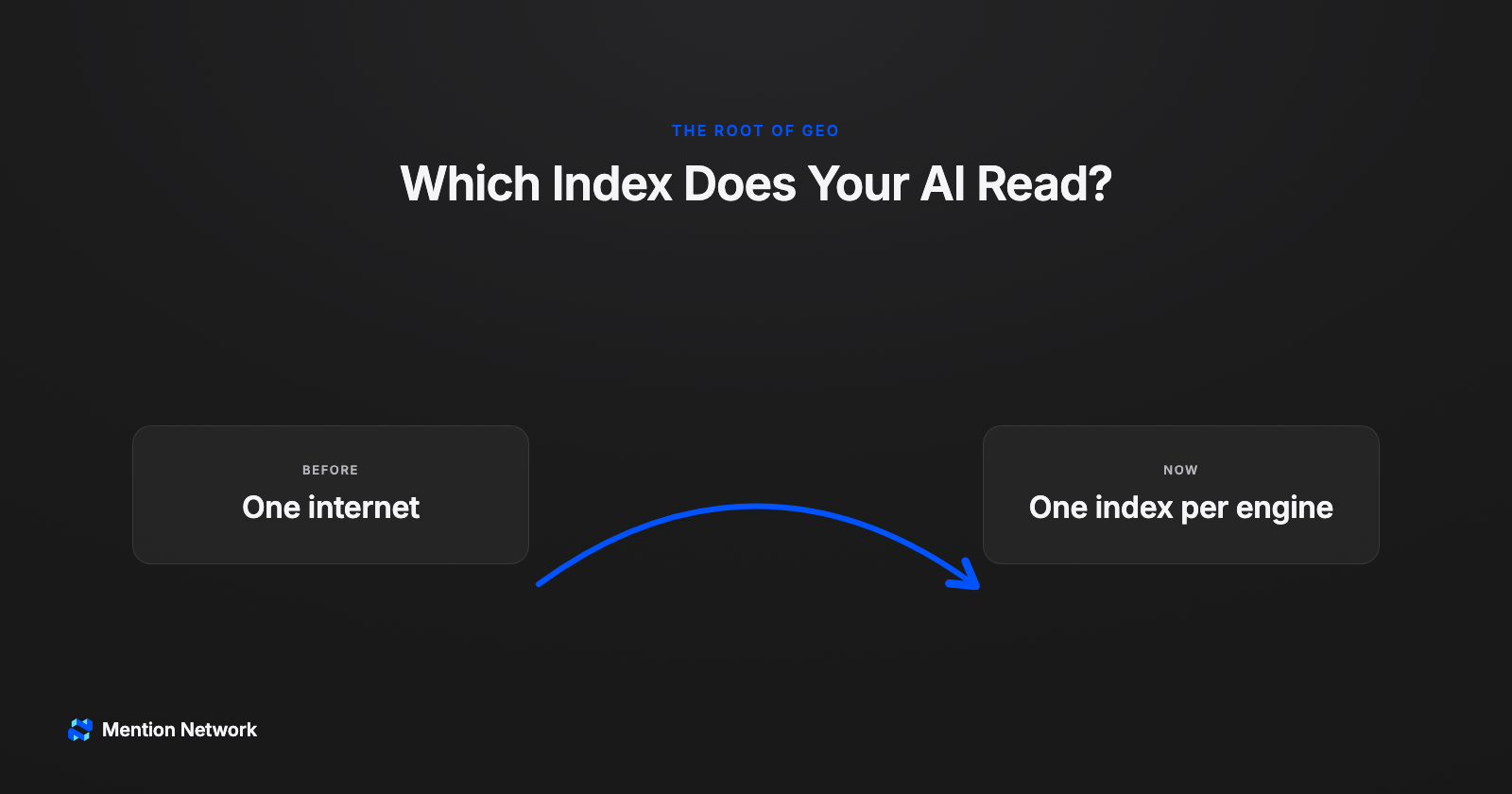
TL;DR How AI chatbots search the web is not one search: each assistant reads a specific search index. ChatGPT reads Bing, with a Google fallback. Gemini and Google AI Mode read Google. Claude reads Brave. You get cited only if that index can crawl and rank you, so GEO is index-by-index work. A store can appear on 3 of 4 assistants and still miss the fourth.
Priya did everything the SEO playbook told her to. Her COSRX serum sits on Google's first page, so when she typed "where to buy COSRX snail mucin" into ChatGPT and her shop was nowhere in the answer, it did not add up. She was winning search. What she did not know is that ChatGPT never looked at Google. It searched a different index, and her page-one ranking was invisible there. (Priya is an illustrative example, not a real customer.)
For ten years, our job was easy to describe: rank on page one. We tracked positions, built links, fixed crawl errors, and traffic followed. AI answers break that loop in a way most SEO dashboards cannot see. So here is the question almost nobody asks before they start optimizing for AI: when an AI chatbot searches the web, which search engine is it actually reading?
The short answer: AI search is not one search
AI web search is a lookup against a specific search index, not a sweep of the open internet. Each chatbot hands your query to a search engine behind the scenes, gets a short list of pages back, and weaves some of them into its answer. Those engines are not the same, so the same question can surface different stores depending on which assistant a shopper asks. A team at DEJAN ran one identical query through Google, OpenAI, and Anthropic on the same day and found "three completely different shapes underneath."
Here is the map as of July 2026. Arrangements like these change, so treat the dates as freshness stamps, not permanent truths.
| AI assistant | Search index it reads | What that means for your store |
|---|---|---|
| ChatGPT | Bing first, with a Google fallback | Being indexed in Bing is table stakes for ChatGPT, and Google still helps |
| Gemini | Your Google crawlability and ranking carry straight over | |
| Google AI Mode | Google (via Googlebot) | Same index as classic Search, so classic SEO still applies |
| Claude | Brave | A separate index most merchants have never optimized for |
Which search engine does ChatGPT use?
ChatGPT's web search is powered primarily by Microsoft Bing, the default search partner since OpenAI and Microsoft tied the two together in 2023. On top of Bing, OpenAI now runs its own search crawler, OAI-SearchBot, to build its index. The picture has one wrinkle worth knowing. In a 2025 test, SEO expert Aleyda Solis created a brand-new page that Bing had not indexed, and ChatGPT surfaced a snippet that matched Google's result, not Bing's. Ahrefs later ran 118,931 fan-out queries probing the same question. So the honest answer is Bing-first, with a Google fallback when Bing comes up short. For your store, that means Bing indexing is the floor, and Google still matters even for the assistant everyone calls "the Bing one."
Which search engine do Gemini and Google AI Mode use?
Both read Google's own Search index, which is the friendliest news in this whole article for anyone who already does SEO. The DEJAN grounding test showed Google returning sources straight from its index (delivered through vertexaisearch grounding links), and Google's own documentation describes AI Mode as built on Search. The key detail: AI Overviews and AI Mode crawl with Googlebot, the same bot that powers classic Search, not a separate AI-only crawler. If Googlebot can reach and rank your product pages, those pages are eligible to be cited by Gemini and Google AI Mode. Your existing Google technical SEO, your crawl budget, your structured data, all of it carries over. This is the one index where "keep doing good SEO" is a complete GEO strategy.
Which search engine does Claude use?
Claude reads Brave Search, and this is the index most merchants have never touched. When Anthropic shipped web search in March 2025, developer Simon Willison confirmed the source: Anthropic's own subprocessor list added "Brave Search" as of March 19, 2025. He reproduced it directly, prompting Claude to "search for pelican facts" and getting back ten citations that were an exact match for that same search on Brave, with Claude's search function exposing a BraveSearchParams field. TechCrunch reported the same disclosure. Brave runs an independent index built from its own crawler, so a store that ranks fine on Google and Bing can still be invisible to Claude. If Claude matters to your buyers, Brave is a separate box to tick.
Why the index is the root of GEO
Once you know each assistant reads a specific index, the whole of GEO snaps into focus: you get cited only if that index can crawl, read, and rank your pages. Three mechanics decide it. First, the crawler gate. OpenAI's own documentation states that OAI-SearchBot "is used to surface websites in search results in ChatGPT's search features," and that blocking it removes you from those results. Google AI Mode uses Googlebot, so a Googlebot block is an AI block too. Second, rendering. AI search crawlers download your JavaScript but do not execute it, so content injected by client-side widgets can be complete for a shopper and empty for the bot. Third, feeds. AI shopping answers lean on structured product feeds, so a product missing or disapproved in your feed is invisible for where-to-buy questions. Get those three right for each target index, and you have done the real work of product AI visibility.
How to optimize for each index
Think of it as running your technical SEO checklist once per index instead of once for Google. Allow the search crawlers you want to be seen by: Googlebot for Gemini and Google AI Mode, OAI-SearchBot and ChatGPT-User for ChatGPT, and check that your pages are reachable and rankable in Bing and Brave, not only Google. Server-render the facts that matter, such as price, availability, and product descriptions, so a non-executing bot still reads them. Keep your product feed clean and approved. Then earn the off-store signals these engines quote, since assistants cite forums, review sites, and "best of" lists far more than your own marketing pages. Resellers feel this hardest, because they can never win a brand mention and live or die on the where-to-buy list. None of this is exotic. It is the SEO craft you already have, pointed at four indexes instead of one.
Stop guessing which engine sees you
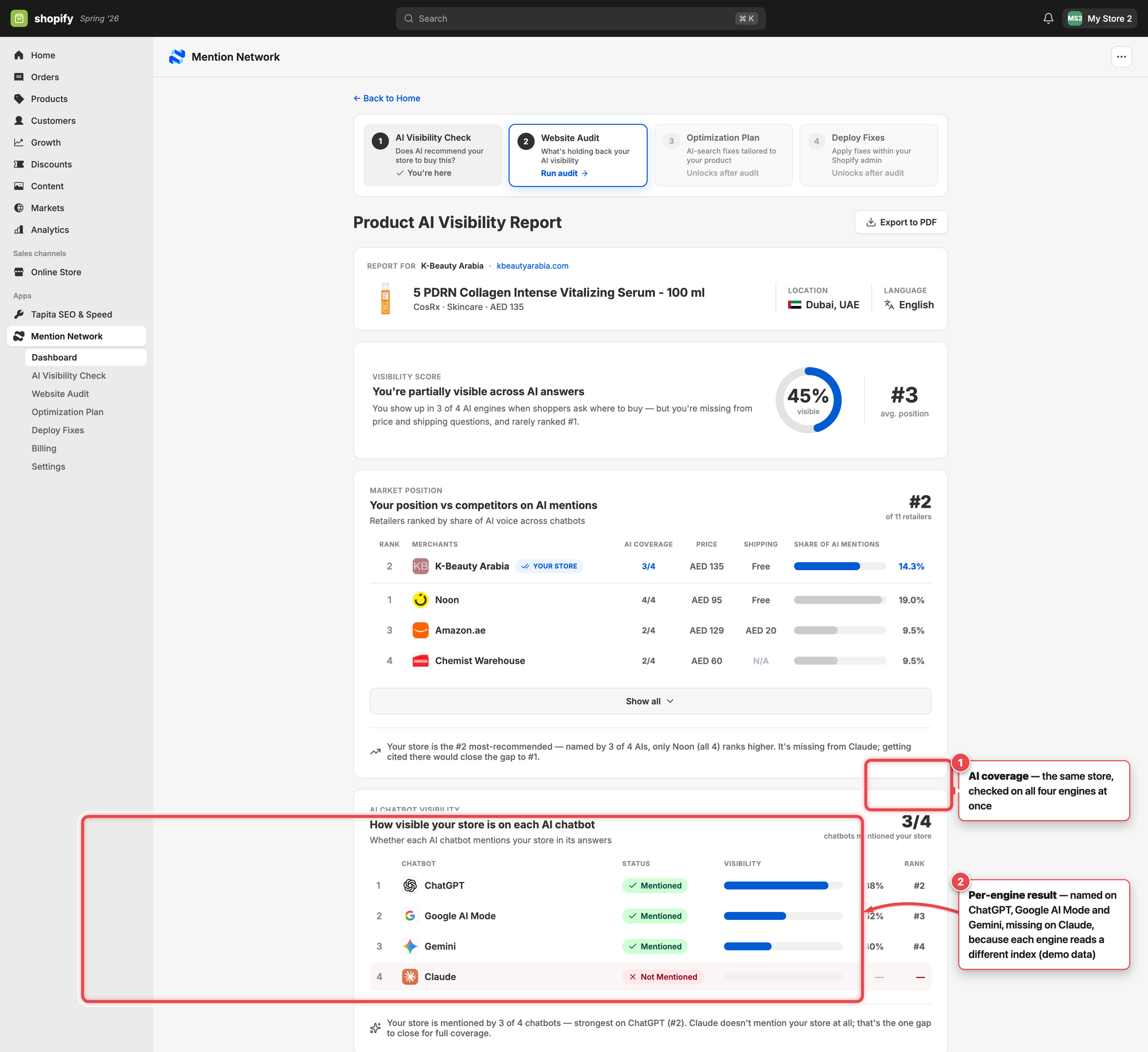
The trap Priya fell into is assuming one ranking speaks for every assistant. It does not, because each one reads a different index. Knowing how AI chatbots search the web is the whole game. The fastest way out is to measure per engine instead of guessing. You can run a free check that asks the real buying questions across all four assistants, currently 5 buyer intents across ChatGPT, Gemini, Google AI Mode, and Claude, which comes to 20 answers per check, and shows you the verbatim answer each one gave with your store name bolded. That turns "which search engine does the AI use?" from a trivia question into a to-do list: get crawlable and citable in the index each engine actually reads. Keep your rank tracker. Add this next to it.
FAQ
Which search engine does ChatGPT use to search the web?
ChatGPT's web search is powered primarily by Microsoft Bing, plus OpenAI's own OAI-SearchBot index. Experiments in 2025 also show ChatGPT falling back to Google search snippets when Bing has not indexed a page.
Does Claude use Google to search the web?
No. Claude's web search reads Brave Search. Anthropic added Brave Search to its published subprocessor list in March 2025, and Claude's search function exposes a BraveSearchParams field.
Do Gemini and Google AI Mode use the same search index?
Both ground their answers on Google's own Search index. Google AI Mode and AI Overviews run on Googlebot, so the pages Google can crawl and rank are the pages these features can cite.
Why does the search index behind each AI matter for GEO?
Because you get cited only if you are crawlable and rankable in the index that specific engine reads. Winning Google does not put you in front of ChatGPT if ChatGPT is reading Bing. GEO is index-by-index work.