BYOK for AI Visibility: Run the Same Check on Your Own Keys
BYOK lets you run an AI Visibility Check on your own AI keys, pay the model's raw cost instead of a subscription, and keep your data. Here is what is shipped, what is on the roadmap, and when it beats a managed tracker.

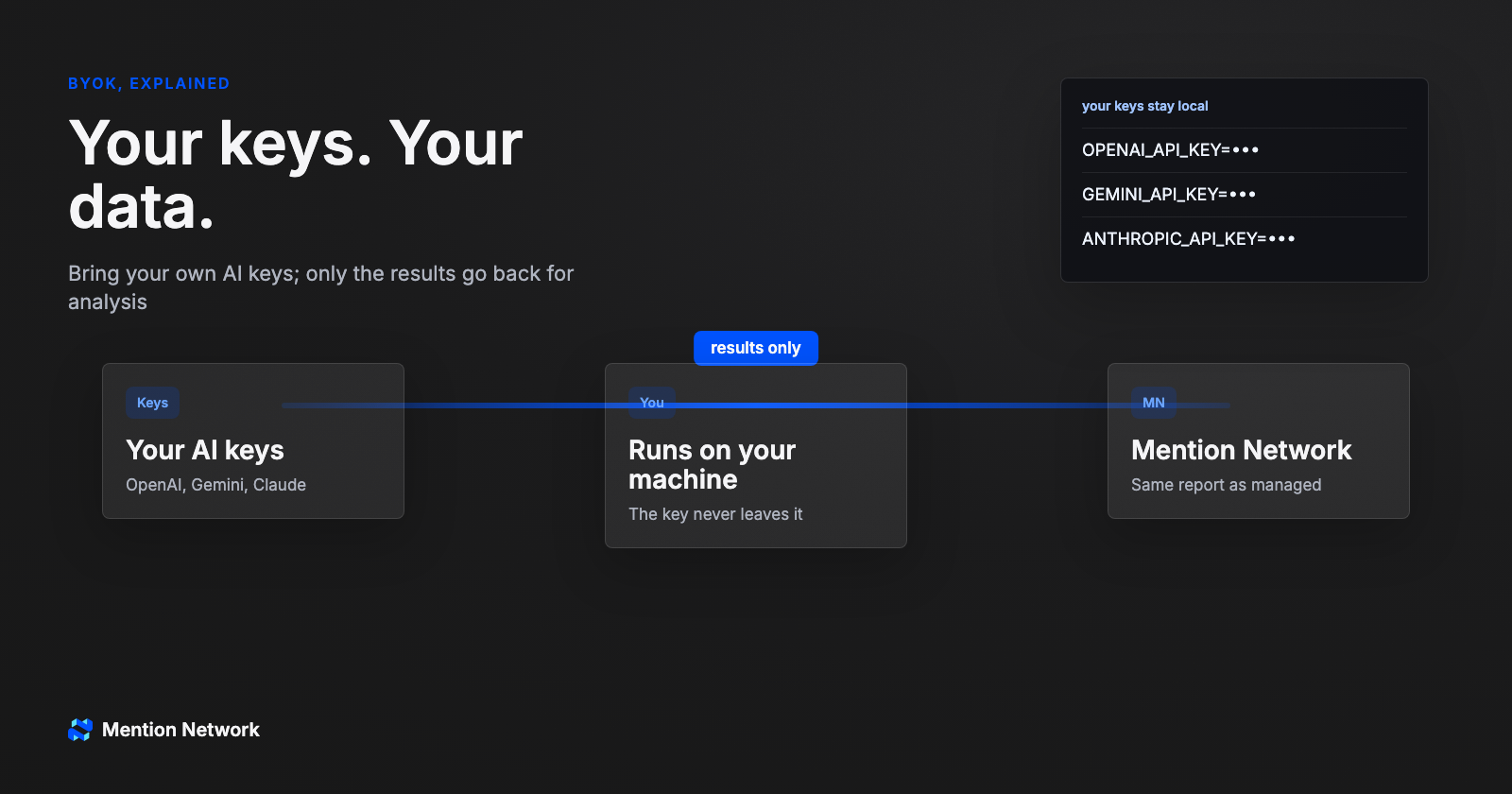
TL;DR: BYOK AI visibility means running an AI Visibility Check with your own AI API keys instead of the vendor's. Your key never leaves your machine, you pay the model provider directly (cents, not a subscription), and the analysis and report are identical to the managed lane. Free, bring-your-own-key trackers already exist as open-source projects, so BYOK itself is not new. What is different here: BYOK feeds anonymized results into a shared, cross-store directory, the foundation for an industry baseline a lone report cannot build. That baseline is on the roadmap, not shipped today. Verified against product docs as of 2026-07-24.
In this guide:
- What BYOK is
- Whether the report changes with your own key
- What you need to run it
- Managed vs open-source vs BYOK
- Why a number needs a baseline
- When BYOK beats a managed check
Sarah runs a mid-size Shopify skincare shop. Her first AI Visibility report came back with one line she kept staring at: a Share of AI Voice score of 22%. Good? Bad? She had no way to tell, and the app was already nudging her toward a paid plan to "find out more." The useful question was one the report never put in front of her: whose AI account, and whose data, is this check actually running on?
That question is what BYOK answers.
What is BYOK in AI visibility?
BYOK AI visibility is running the exact same AI Visibility Check with your own AI provider keys instead of the vendor's. You (or an AI agent, or the AI Visibility Studio desktop app) run the standard question set with your keys, then send only the results back for analysis.
Three properties define it, and all three are shipped today:
- Your key never leaves your machine. The backend does not store it, proxy it, or see it.
- You pay the AI provider directly, so you can run as many checks as you want.
- Only the results travel back. The measurement and the report are the same ones the managed lane produces.
The managed lane is the default: Mention Network runs the questions on its own accounts and charges credits. BYOK swaps who presses run and who pays the model bill. Nothing else about the measurement changes.
Do you get a different report with your own key?
No. The report is identical. BYOK feeds into the same query step as the managed lane, then joins the same analysis queue. Same engine, same numbers, same evidence.
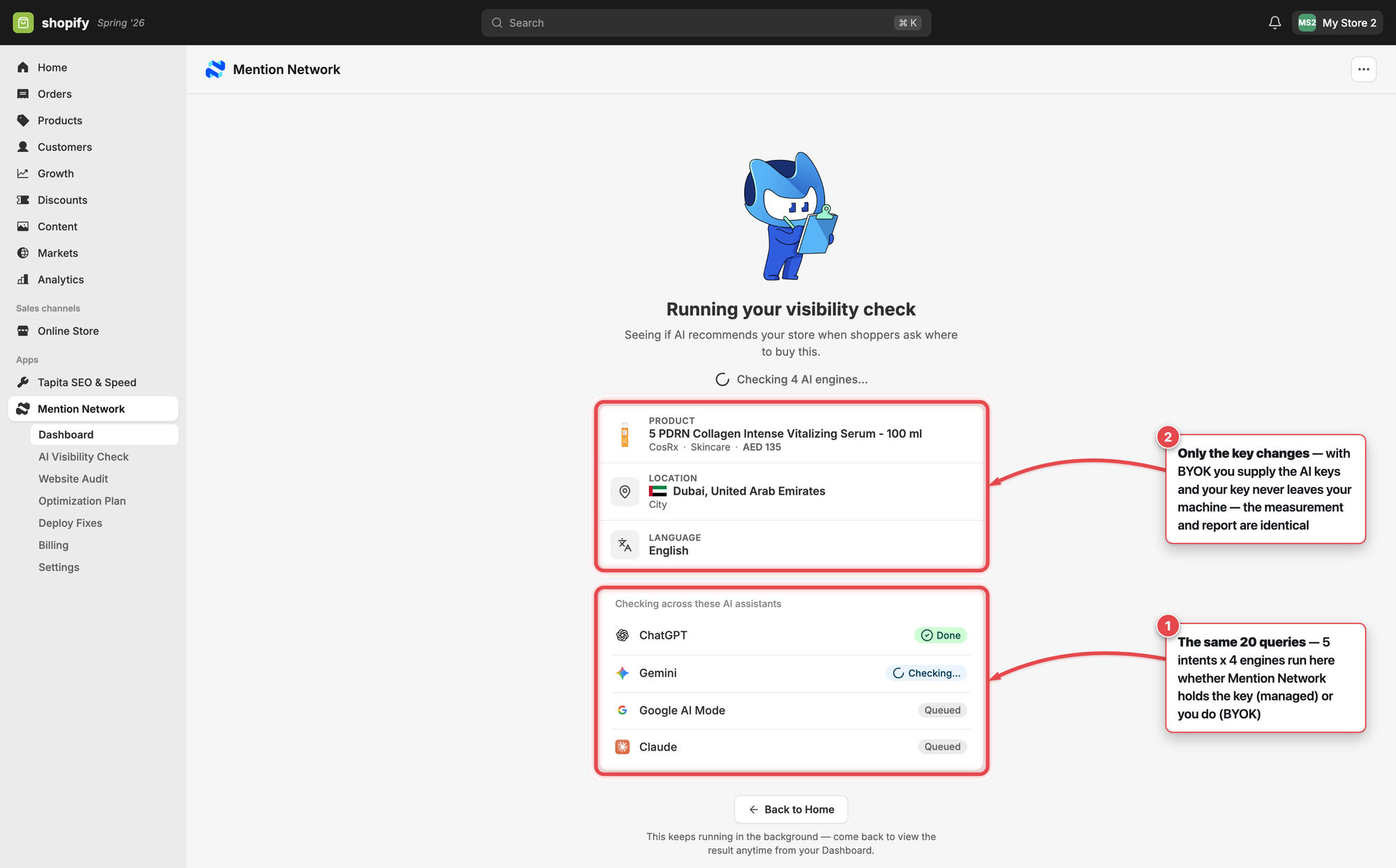
Every check is 5 buyer intents across 4 AI engines, which is 20 measurements for one product in one location and one language. The report you read at the end carries the same verdict tiers, the same Share of AI Voice score, and the same verbatim AI answers as proof. The only variable BYOK changes is the account the 20 queries run on.
What do you need to run BYOK yourself?
To match a managed run exactly, you need access to all four engines. Miss one and that engine's slot is skipped, so the result will not fully line up with a managed check.
The four, verified as of 2026-07-24:
- An API key or SDK for ChatGPT (OpenAI), Gemini, and Claude.
- A page-reading route for Google AI Mode. This one is not a plain API key; it needs a way to read the answer off the results page.
Today the shipped path for BYOK is the route over MCP and the AI Visibility Studio desktop app. A native BYOK runner built into the Shopify app, per-tenant keys inside the app, and credit enforcement on the managed lane are on the roadmap, not available today.
Managed, open-source, or BYOK: what actually differs?
Free, bring-your-own-key trackers are not new. OneGlanse is open source and runs "using your own accounts, on your own infrastructure." Aperture ships a self-hostable stack with "full data ownership." Elmo is open source and self-hosted for free. So the honest comparison is a three-way one.
| Lane | Who runs the queries | Who holds your key | Where your data lives | Cost model | Cross-store benchmark |
|---|---|---|---|---|---|
| Managed SaaS (e.g. Profound, Peec, Otterly) | The vendor | The vendor's account | The vendor's servers | Subscription, roughly $29 to $489/mo self-serve, enterprise custom | Possible (they hold the data), but not BYOK |
| Open source, self-hosted (OneGlanse, Aperture, Elmo) | You | Your keys | Your own infrastructure | Free code plus your raw model cost | No, data stays local |
| AI Visibility Studio (BYOK) | You | Your keys, never leave your machine | Your machine; only results sent back | Free plus your raw model cost | Foundation shipped; industry baseline on the roadmap |
The subscription is the part worth pausing on. Managed trackers charge a recurring fee, roughly $29 to $489 a month on self-serve tiers (verified 2026-07-27), because they run inference on their accounts. With BYOK you pay the model's list price instead: GPT-4o mini bills $0.150 per million input tokens and $0.600 per million output tokens, so a 20-query check is a few hundred thousand tokens at most, a fraction of a dollar. Some managed tools do expose an API or MCP, but for pulling results out or on higher tiers, not for supplying your own key and paying the model directly.
Why your number means nothing without a baseline
A Share of AI Voice score, on its own, is not actionable. Sarah's hypothetical 22% is only good or bad next to the category average and her direct rivals, and a report built from her data alone has no such reference point.
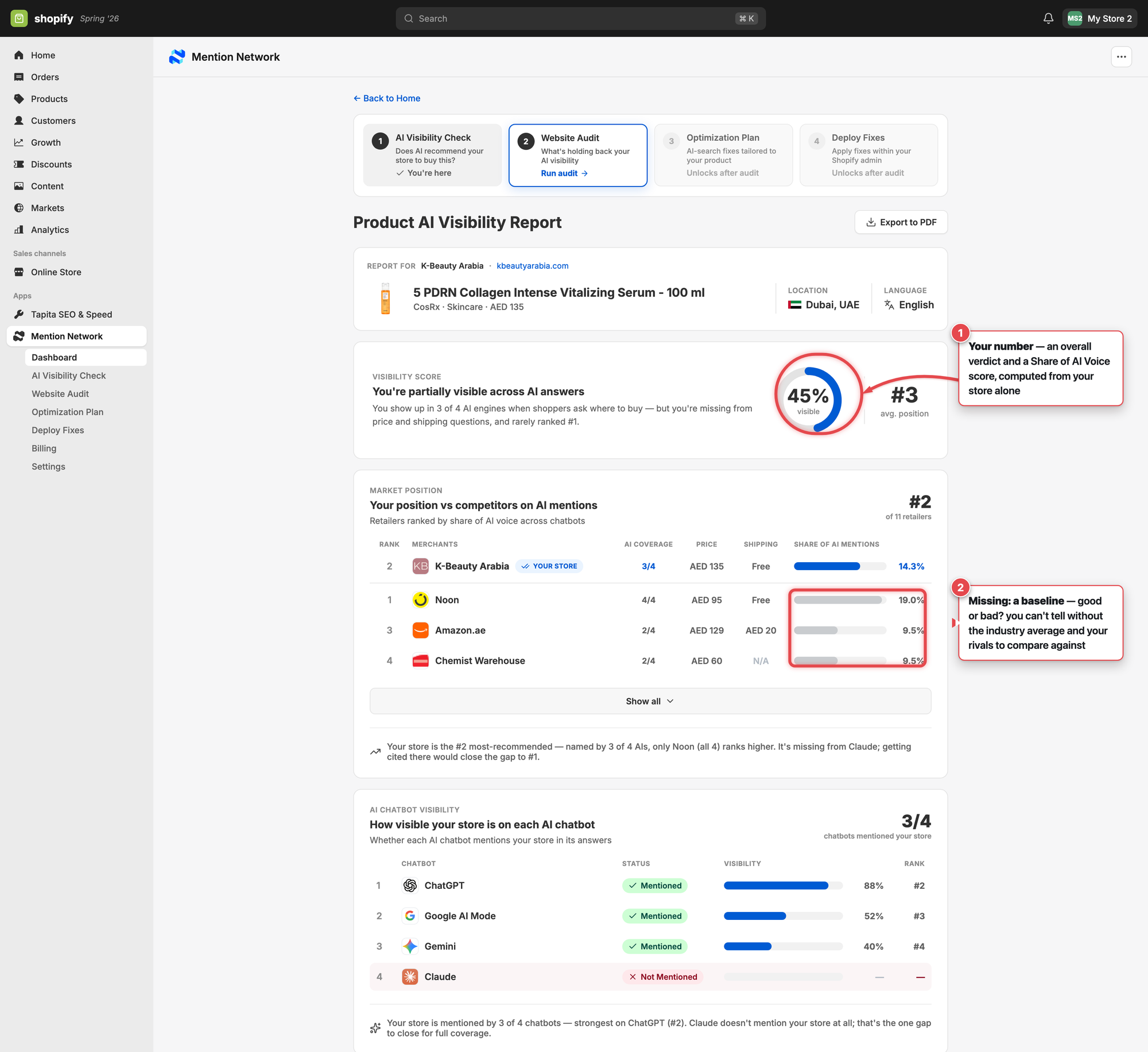
The stakes are rising. Adobe Analytics measured traffic to US retail sites from generative AI sources up 1,200% in February 2025 versus July 2024, with 39% of US consumers reporting they have used generative AI to shop. And being named in the answer, your AI product visibility, matters because shoppers still act on it: the IAB found that in AI shopping sessions, nearly 80% of people still visited a retailer or marketplace to validate the purchase. As Razorfish's Anthony Ductan put it, "Brands that try to optimize for AI search in isolation will miss the point." A number with no baseline is exactly that: measuring in isolation.
What BYOK can do that neither managed nor open-source can
Here is where the three lanes separate. Open-source trackers keep your data on your own infrastructure, so each install is an island: useful for you, blind to everyone else. Managed tools can aggregate across their customers, but they hold your key and your data. BYOK sits at the intersection. You keep your key and your data, and the anonymized results feed a cross-tenant shared retailer directory that belongs to no single shop.
That directory is shipped, and today it powers cross-store comparison inside your own report. The next step, handing back an industry baseline so you can read your 22% against the category average and named competitors, is what AI Visibility Studio is built to do as more stores run it. It is on the roadmap, not a feature you get today. The design point stands either way: BYOK is the only lane where owning your data and contributing to a shared benchmark are not in conflict.
When BYOK beats a managed check
- You run checks often and want to pay model cost, not a subscription: BYOK.
- You want your keys and data to stay on your machine: BYOK or an open-source tracker.
- You want the same report plus a path to a shared industry baseline: BYOK through AI Visibility Studio.
- You want zero setup and someone else to hold the keys: the managed lane.
Either way, the measurement is the same. BYOK AI visibility changes whose account and whose data the check runs on, not the report you get. Start with a free run, then decide whose account you want it on. Run a free AI Visibility Check on your top product, or read how the check works end to end before you pick a lane. If you are still deciding what to even measure, start with product vs brand visibility.
Frequently asked questions
What does BYOK mean for AI visibility?
BYOK, or bring your own key, means running an AI Visibility Check with your own AI provider keys instead of the vendor's. You run the standard question set on your keys and send only the results back for analysis. Your key never leaves your machine and you pay the model provider directly.
Is BYOK cheaper than a managed AI visibility tool?
For frequent checks, usually yes. Managed trackers charge a subscription (roughly $29 to $489 a month on self-serve tiers as of 2026) because they run inference on their accounts. With BYOK you pay the model's raw list price, which is cents per check, though you take on the setup of four engine credentials.
Do you need all four AI engines for BYOK?
To match a managed run, yes: OpenAI, Gemini, and Claude via API or SDK, plus a page-reading route for Google AI Mode. If you skip one, that engine's slot is skipped and the result will not fully match a managed check.
Does BYOK give a different report than the managed lane?
No. BYOK feeds the same query and analysis steps as the managed lane, so the verdict, Share of AI Voice, competitor table, and verbatim AI answers are identical. The only difference is whose account runs the queries and who pays the model bill.