
Inside the Shopify App Ecosystem: What 36,306 Apps Reveal About Merchant Spending
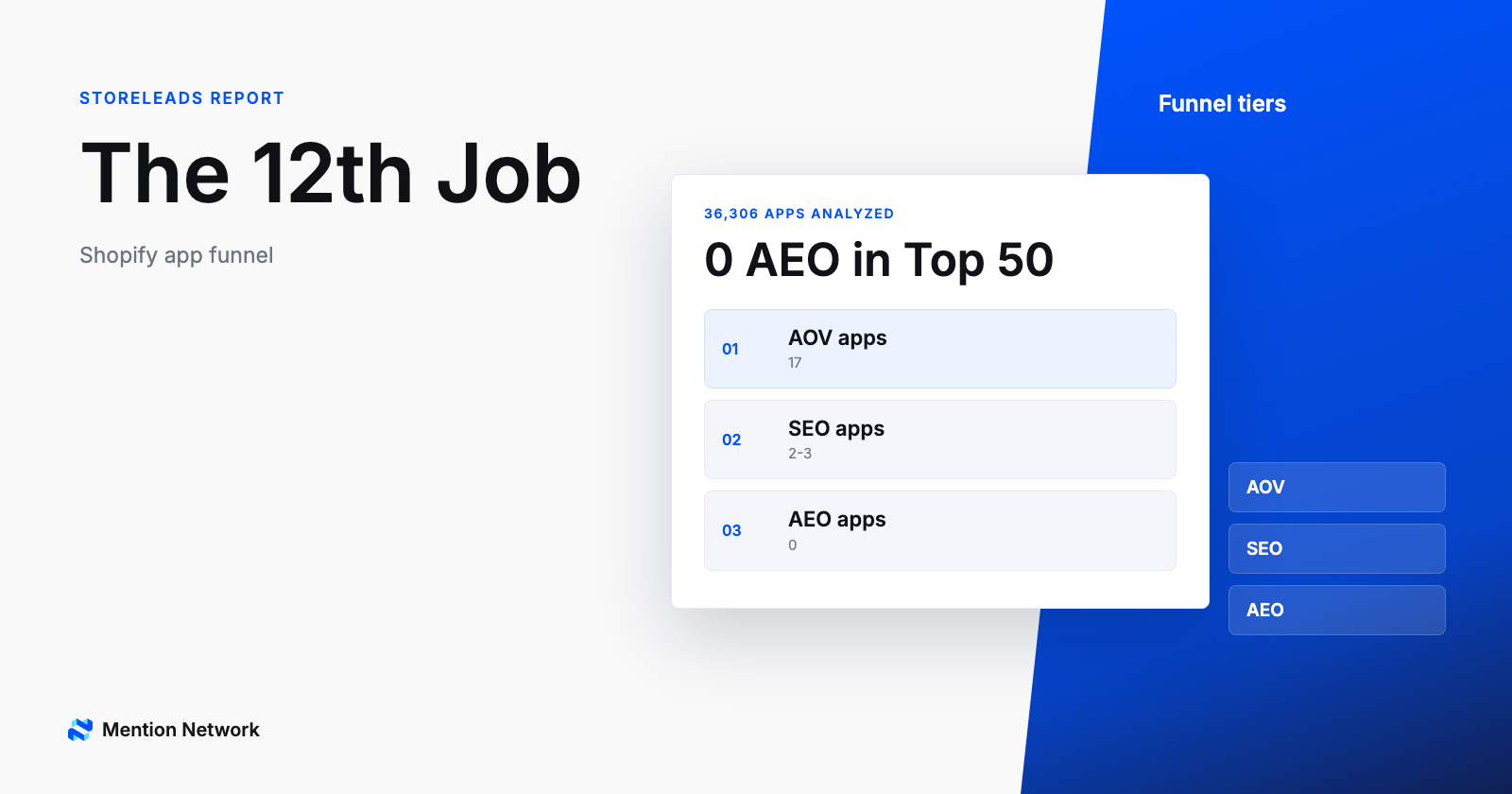
One in five Shopify stores installs Judge.me, yet no one tracks whether AI cites their store. Our analysis of 36,306 apps on StoreLeads shows merchants fund 17 apps for AOV, 2-3 for SEO, and almost none for AEO in the Top 50. The category exists. The adoption hasn't arrived.

In this piece:
- TL;DR
- Opening: what the biggest number hides
- Merchants fund the bottom of the funnel and leave the top empty
- The paradox: a fifth of stores already feed AI, and no one measures it
- Why this gap is dangerous right now
- Three more signals that the ecosystem follows demand
- What Shopify merchants should do
- Conclusion: the 12th job is waiting
TL;DR
TL;DR: In a Shopify app ecosystem of 36,306 apps, merchants pour install-share into jobs they can measure (AOV, retention, conversion) and leave one job almost empty: getting found by AI. In the Top 50 most-installed apps, 17 target AOV, 2-3 do SEO, and 0 do AEO (StoreLeads, snapshot 2026-07-24). Meanwhile the most popular app of all, Judge.me, already emits the exact review data AI needs to cite a store. Twenty percent of merchants are feeding AI without measuring it.
Key takeaways
- The dominant App Store number is 592,507. The number that matters is 0, in the Top 50. Judge.me is installed by 1 in 5 Shopify stores (20.4% penetration), yet no AEO app has cracked the Top 50 most-installed apps (StoreLeads).
- Merchants pay to squeeze more from old customers, not to find new ones. In the Top 50, 17 apps target AOV (average order value) and about 15 capture leads. Only 2-3 do SEO, and 0 do AEO, the work of getting cited by AI (StoreLeads).
- AEO is not "nobody's built it." Adoption just hasn't arrived. Searching "AEO" or "GEO" on the App Store already returns specialized apps, but all sit long-tail: tens to hundreds of reviews, versus 5,000 to 42,000 for the Top 50.
- The paradox: the single most-installed app (Judge.me) auto-generates the exact data AI needs to cite a store. Twenty percent of merchants already feed AI, but almost none measure whether AI names them.
- Why it's urgent: 48% of Google searches now show an AI Overview, ChatGPT handles about 20% of search traffic, and roughly 60% of searches end with no click. Nearly 30% of search traffic has left Google.
- The conclusion: of the 11 jobs merchants hire apps to do at scale, the 12th job, "get found by AI," is still almost empty at the adoption tier (StoreLeads). It is the App Store's largest white space in 2026.
Opening: what the biggest number hides
In a Shopify app ecosystem of 36,306 apps, one number makes you stop: 592,507, the install count of Judge.me, the review app that 1 in 5 Shopify stores trust.
A 20.4% penetration is unheard-of dominance. The #2 app (Klaviyo) sits at 14.3%, and the #10 app has already dropped to 4.8% (StoreLeads).
| Rank | App | Category | Installs | Penetration | Rating |
|---|---|---|---|---|---|
| 1 | Judge.me | Reviews, SEO | 592,507 | 20.4% | 5.0★ |
| 2 | Klaviyo | Email, SMS | 415,351 | 14.3% | 4.7★ |
| 3 | Shopify Inbox | Chat | 358,008 | 12.4% | 4.6★ |
| 4 | Klarna On-Site | Banners | 332,573 | 11.5% | 2.6★ |
| 5 | Product Reviews | Reviews | 240,686 | 8.3% | 3.6★ |
| 10 | Printful | Print-on-demand | 139,799 | 4.8% | 4.8★ |
Top 5 plus #10. Source: StoreLeads, snapshot 2026-07-24, pool of 36,306 Shopify apps.
The real story is not "reviews win." It is that the Shopify app ecosystem, read by where the money goes, draws a map with one region left completely blank, and Judge.me, almost by accident, is standing right at the edge of it.
Merchants fund the bottom of the funnel and leave the top empty
Rank the Top 50 apps (5.08 million installs combined) by their position in the sales funnel and the imbalance is immediate (StoreLeads): the closer a job gets to bringing in new demand, the thinner the app density becomes, until AEO hits zero in the Top 50.
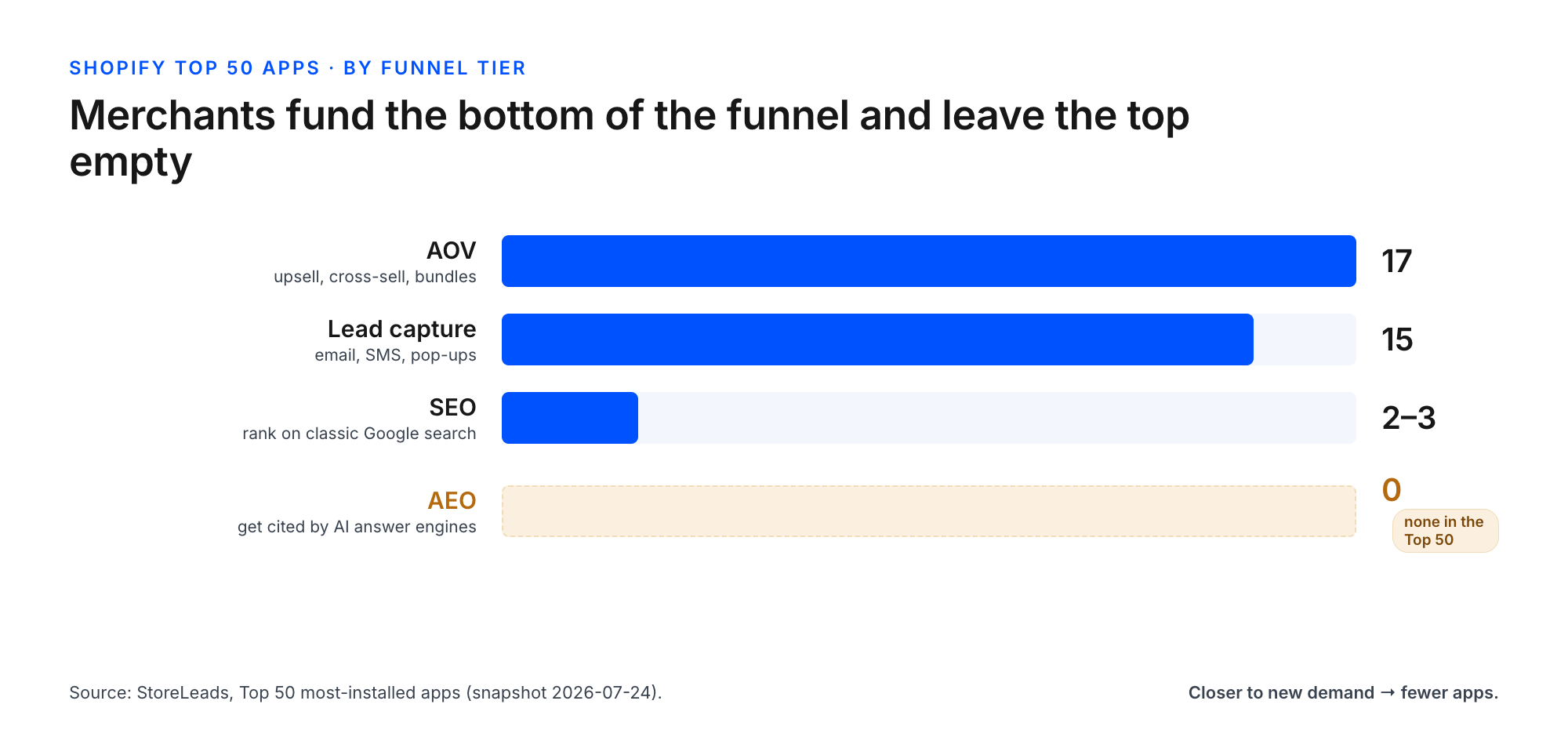
The numbers are blunt (StoreLeads): 17 apps to "squeeze another $10 out of each order," only 2-3 to "find 10 new customers," and 0 to "get found by AI."
This is not an accident. It is a deliberate strategy. Merchants know ads keep getting more expensive, so they optimize the traffic they already have instead of buying more. The app ecosystem is simply reflecting demand: supply follows.
Data note. StoreLeads' Top 50 is a sample of the most-installed apps. It measures adoption at scale, not the full 36,306-app catalog. It does not prove "no AEO app exists." It shows that no AEO app has reached the popularity of the leaders. In fact, searching "AEO" and "GEO" on the App Store already returns specialized apps, all still long-tail.
Momentum confirms where the money is flowing
Net installs over 90 days show where merchants are pouring in, and where they are pulling out (StoreLeads).
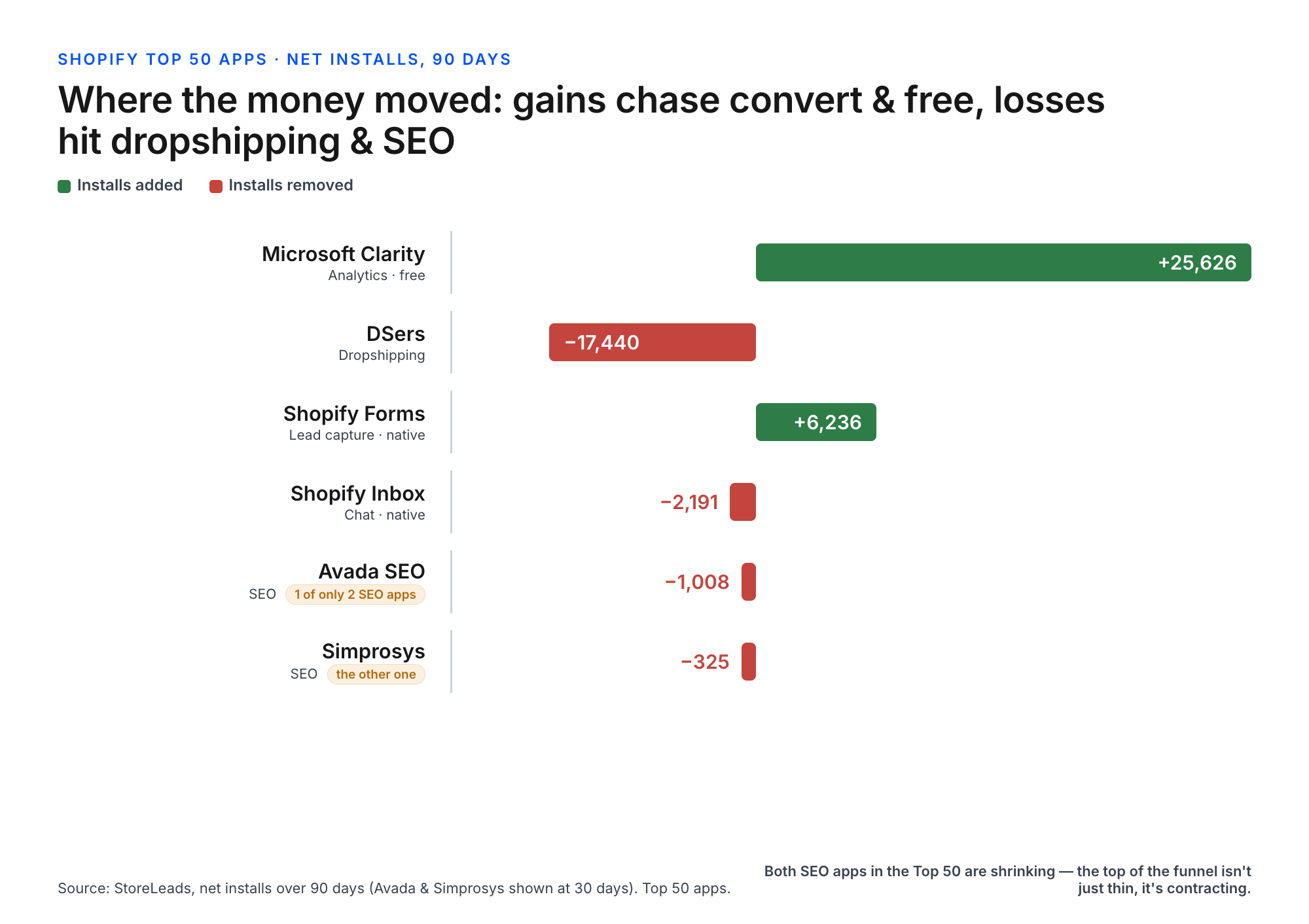
Note the detail that matters most: both of the only two SEO apps in the Top 50 are negative, Avada at minus 1,008 and Simprosys at minus 325 over 30 days (StoreLeads). The top of the funnel is not just thin. It is contracting.
The category distribution tells the same story at higher resolution:
| Category | Apps in Top 50 | Funnel position |
|---|---|---|
| Upsell & Cross-sell | 8 | Bottom |
| Email Marketing | 7 | Middle |
| Product Bundles | 5 | Bottom |
| SMS / Pop-ups | 8 | Middle |
| Product Variants / Reviews / Page Builder | 10 | Bottom |
| SEO | 2-3 | Top |
| AEO | 0 | Top, 0 in the Top 50 |
Source: StoreLeads, category distribution from the top 50 apps.
The crux. Merchants are data-driven people: conversion rate, AOV, email open rate. Whatever they can measure, they optimize. AI visibility isn't measurable for most of them yet, so it falls off the radar. They aren't lazy. They just don't have a gauge for it. This entire piece is about that gap.
The paradox: a fifth of stores already feed AI, and no one measures it
Return to Judge.me. It is not an upsell app or an email app. It is a reviews app, and it leads by a wide margin because social proof is the strongest closing tool there is. Loox (another review app) also sits in the top 11: 2 of the top 11 slots are reviews (StoreLeads).
Here is the interesting part. When you install Judge.me, the app automatically adds the following (Judge.me's Help Center confirms it):
- JSON-LD schema markup
- Structured review data (rating, author, date, text)
- Product aggregate ratings
- Q&A schema
That is exactly the format AI engines need to answer shopping questions. Ask ChatGPT "which Shopify store has good reviews for outdoor gear?" and it cites stores with rich review structured data. That is precisely what Judge.me builds by default.

Twenty percent of merchants already have the raw material. Almost none track "does AI cite my store?" They are building content for AI without knowing it, and no popular app closes the loop.
SEO is not AEO, and that is why the gap exists
The Top 50 has 2 SEO apps (Avada, Simprosys) and 0 AEO apps (StoreLeads). The difference is not wordplay:
- SEO (search engine optimization) means optimizing to rank on classic Google search.
- AEO (answer engine optimization) means optimizing to be cited by AI engines: ChatGPT, Perplexity, Google AI Overviews, Gemini.
A few years ago, typing "AEO" into the App Store returned almost nothing. Now it returns real apps. "AEO" and "GEO" surface llms.txt generators, "agentic storefront" tools tuned for ChatGPT, Claude, and Gemini, even apps that track brand AI visibility. But look at the review counts and the problem is clear. They stop at tens to hundreds of reviews, while every Top 50 app has 5,000 to 42,000. The category has formed. What hasn't happened is adoption. And ranking #1 on Google no longer means being named by AI.
Why this gap is dangerous right now
Leaving the top of the funnel empty used to be fine, back when 100% of customers still arrived from Google. In 2026 it isn't, because "search" itself is moving off Google.
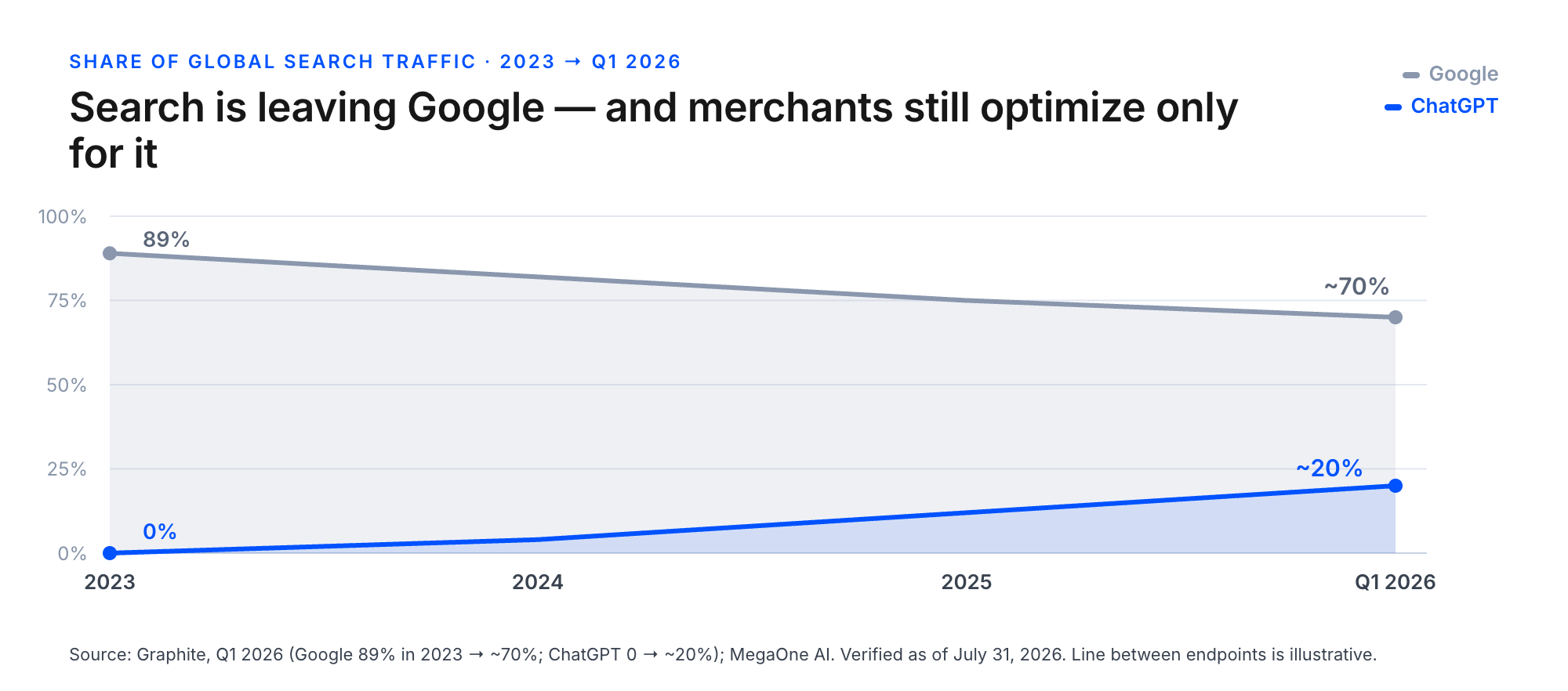
Three numbers reset the rules (verified as of July 31, 2026):
- 48% of Google searches now show an AI Overview (Stacc / Advanced Web Ranking, March 2026).
- ChatGPT handles about 20% of global search traffic (Graphite, Q1 2026).
- About 60% of searches end without a single click (SparkToro / Datos, 2025), the zero-click era has arrived.
That means if your store isn't cited by AI, you are invisible to nearly half of all searches. The shopper asks AI, AI answers, and your name never comes up. And when an AI Overview appears, organic click-through rate drops 34-61% (Seer Interactive and Ahrefs, 2025): traffic doesn't just move to AI, it evaporates when AI answers directly.
The opportunity-cost math. An upsell app ($20-50/month) lifts AOV 10-15%. An email app ($50-200/month) retains 20-30% of customers. But if traffic falls 34-61% because you are invisible to AI, a 10% AOV lift can't cover it. Merchants are optimizing the +10% and leaving blank what could be a 40%+ new traffic source, only because the second one isn't measurable yet.
You do not have to guess where you stand. Run a free check to see whether AI names your store when shoppers ask where to buy.
Three more signals that the ecosystem follows demand
If the Shopify app ecosystem is a mirror of merchant behavior, then beyond the lopsided funnel, the data holds three more signals worth reading.
1. Dropshipping is retreating. DSers (the #34 dropshipping app) lost 17,440 installs in 90 days, the largest churn in the Top 50 (StoreLeads). The "source cheap, sell on markup" model is running out of breath.
2. Shopify is eating its own app market. Shopify Forms (native) gained +6,236 in 30 days while Shopify Inbox (native) lost 2,191 (StoreLeads). When Shopify prioritizes a new feature, it replaces the very third-party apps around it.
3. Free analytics pulls hard, a signal for the no-upfront-cost model. Microsoft Clarity gained +25,626 in 90 days (StoreLeads). Merchants want insight but resist paying for it, which fits the free and BYOK (bring your own key) mindset.
And one red flag for reading data soberly: more installs does not always mean more demand.
| App | Installs | Reviews | Ratio | Rating | Reading |
|---|---|---|---|---|---|
| Klarna | 332,573 | 100 | 3,326:1 | 2.6★ | ⚠️ Partner push |
| Judge.me | 592,507 | 42,155 | 14:1 | 5.0★ | ✅ Organic |
| Klaviyo | 415,351 | 2,905 | 143:1 | 4.7★ | ✅ Organic |
| Shopify Inbox | 358,008 | 5,464 | 66:1 | 4.6★ | ✅ Organic |
Source: StoreLeads top 50 apps data.
Klarna has an abnormal installs-to-reviews ratio (3,326:1, roughly 23 times Judge.me's) and only a 2.6★ rating (StoreLeads). That signals a partner push or bundle deal, not organic demand: merchants install it because they were nudged, not because they wanted it. The lesson is to read momentum alongside ratio and rating, or you will mistake "pushed" for "needed."
What Shopify merchants should do
The blind spot here isn't the merchant's fault. They improve what they can measure. The problem is that "get found by AI" hasn't been packaged into a job with a gauge yet. While the App Store catches up, here is what you can do today.
- Keep upsell and email, but add the top of the funnel. Lifting AOV is still right. It just isn't enough on its own. Keep upsell, bundles, and email, then add tracking for AI citation. The Best GEO tools for Shopify merchants is a useful starting map.
- Track AI visibility like you track conversion rate. Ask the right questions: Does my store appear in ChatGPT's answers? When a shopper asks Perplexity about my niche, am I named? Do Google AI Overviews cite my reviews or products? The apps that answer this group are still few and not yet popular, but you can measure it now if you are deliberate. This is the AI product visibility layer, and it measures selection, not access.
- Use the review data you already have. If you have installed Judge.me (a 20% chance), you already have the raw material. What remains: verify the schema markup is live, add FAQ schema (AI likes the Q&A format), write "answer-first" content, and monitor brand mentions inside AI answers. Most AI-visibility apps are built for marketers auditing many domains, not for a single store, a gap covered in AI Visibility Tools: Built for Marketers, Not Stores.
The fastest way to see where you stand is to measure it directly. You can Run a free check that asks buyer questions across the major AI engines and reports whether your store gets named.
Conclusion: the 12th job is waiting
The whole piece comes down to a single table. Merchants hire apps to do 11 clear jobs, and there is a 12th that just formed, that no one has claimed:
| # | Job merchants hire apps to do | Apps | Funnel | Trend |
|---|---|---|---|---|
| 1 | Reviews & Social Proof | 3 | Bottom | ⬆️ |
| 2 | Email Marketing | 7 | Middle | ➡️ |
| 3 | Upsell & Cross-sell | 8 | Bottom | ⬆️ |
| 4 | Product Bundles | 5 | Bottom | ⬆️ |
| 5 | Page Builders | 3 | Bottom | ➡️ |
| 6 | Order Tracking | 3 | Post-purchase | ➡️ |
| 7 | Loyalty & Rewards | 2 | Post-purchase | ⬆️ |
| 8 | Chat & Support | 1 | Middle | ⬇️ |
| 9 | Dropshipping & Sourcing | 3 | Fulfillment | ⬇️ |
| 10 | Analytics | 1 | Ops | ⬆️ |
| 11 | Pop-ups & Capture | 4 | Middle | ➡️ |
| 12 | Get found by AI (AEO) | 0 | Top, 0 in the Top 50 | ❓ |
Source: StoreLeads category analysis, top 50 apps snapshot 2026-07-24.
Among the Top 50 most-installed apps, not one does AEO, even though the AEO and GEO category has begun to appear in the long tail (StoreLeads). Of the 11 jobs merchants hire apps to do at scale, the 12th, "get found by AI," is still almost empty.
And here is the prettiest irony in the whole Shopify app ecosystem: the most-installed app of all (Judge.me) is the perfect raw material for AI answers. Twenty percent of merchants are already building content for AI, and almost none can measure it.
The gap is real. The opportunity is clear. The question that remains: who will fill the 12th job first, and which merchant will start measuring before an app tells them to?
The honest counterargument
Skeptics will push back on the headline, and they have a point. The StoreLeads Top 50 is a sample of the most-installed apps, not the full 36,306-app catalog, so "0 AEO apps" means "none at Top-50 adoption," not "none exist." AEO apps clearly do exist in the long tail. A second fair objection: install counts measure demand, not results, and one snapshot (2026-07-24) can't prove a trend on its own.
We accept both limits, and they don't change the conclusion. The claim was never "nobody built an AEO app." It was that adoption hasn't arrived, and a category still measured in tens of reviews while the leaders sit at 5,000 to 42,000 is, by definition, pre-adoption. The demand side, meanwhile, has already moved. According to Ethan Smith of Graphite, whose team ran the search-traffic study, ChatGPT now carries about 20% of search traffic. The mismatch between where shoppers are and where merchants spend is the whole story, sample caveats included.
Frequently asked questions
What do Shopify merchants spend the most on?
Bottom-of-funnel jobs. In the Top 50 most-installed Shopify apps, roughly 17 optimize average order value (upsell, cross-sell, bundles) and about 15 capture or hold leads (email, SMS, pop-ups). Only 2-3 target SEO, and none target AEO. Source: StoreLeads, snapshot 2026-07-24.
Is there an AEO app on the Shopify App Store?
Yes, but not at scale. Searching "AEO" or "GEO" on the Shopify App Store returns specialized apps: llms.txt generators, agentic-storefront tools, even brand AI-visibility trackers. All are long-tail, with tens to hundreds of reviews, while every Top 50 app has 5,000 to 42,000. The category exists; adoption hasn't arrived.
Does installing Judge.me get my store cited by AI?
Not on its own. Judge.me emits JSON-LD review schema, aggregate ratings, and Q&A markup, which is exactly the structured data AI shopping assistants read. That makes your store citable, but citation is not guaranteed and, more importantly, nothing measures whether it happens. Feeding AI and measuring AI are two different jobs.
How do I measure my store's AI visibility?
Treat it like conversion rate: measure it directly. Run buyer-intent prompts (where to buy, best place to buy, cheapest, authentic) against the major AI engines for a specific product, location, and language, and record whether your store is named. Mention Network's free check runs 5 buyer intents across 4 engines for a single product.
Sources
- StoreLeads, "Shopify Top 50 Apps," data snapshot 2026-07-24 (pool of 36,306 apps). All install, penetration, 30/90-day momentum, and installs-to-reviews figures in this piece. Note: the Top 50 is a sample of the most-installed apps, not the full catalog, so it can't be used to conclude a category "does not exist."
- Shopify App Store, results for "AEO" and "GEO" (accessed July 2026). The AEO and GEO category has specialized apps (llms.txt, agentic storefront, brand AI-visibility tracking), all still long-tail, none in the Top 50.
- Judge.me Help Center, "Making reviews visible to AI shopping assistants" (2026). Confirms server-rendered HTML, JSON-LD schema, aggregateRating, and Q&A markup for AI crawlers.
- Stacc / Advanced Web Ranking, "Google AI Overviews in 2026: 48% of Searches Have Them" (July 2026). AI Overviews appear on 48% of searches as of March 2026.
- Graphite (Ethan Smith), "AI is much bigger than you think" (Q1 2026). ChatGPT handles about 20% of global search traffic; Google share down from 89% in 2023.
- MegaOne AI, "ChatGPT Now Handles 20% of All Search Traffic" (April 2026).
- SparkToro / Datos (2025), "In 2026, less than one third of Google searches still send a click," roughly 60% of Google searches end without a click to any website.
- Seer Interactive / Ahrefs (2025), organic CTR falls 34-61% when an AI Overview is present (Seer: 61%, from 1.76% to 0.61%; Ahrefs: 34.5% for position #1).