
Customer Journeys in AI Era: Why AI Visibility Now Shapes Growth


AI agents are increasingly acting on behalf of users including searching, comparing, and shaping decisions before a human ever clicks. As a result, customer journeys are no longer designed only for people, but also for machines that evaluate trust, relevance, and authority.
Designing intelligent journeys today means building experiences that are clear, consistent, and interpretable by both humans and AI agents. Brands that adapt to this shift won’t just attract attention, they’ll earn visibility and preference in an AI-mediated decision process.
Customer behavior: then vs now
Shopping and research used to be linear. A person searched, clicked a few results, read reviews, and compared options. Today, the journey often starts inside chat interfaces, where AI Agents summarize the market before a user ever opens a tab. That shift changes what “being discoverable” means, because AI Visibility is increasingly the first filter.
The classic discovery path
In the old model, brands won by earning attention across many touchpoints: SEO rankings, review sites, social proof, and retargeting. Users explored multiple sources, so even a brand that appeared “second or third” still had a chance to be considered. AI Search Visibility existed indirectly through rankings and snippets, but the user still did the evaluation manually.
The new path: AI first, links later
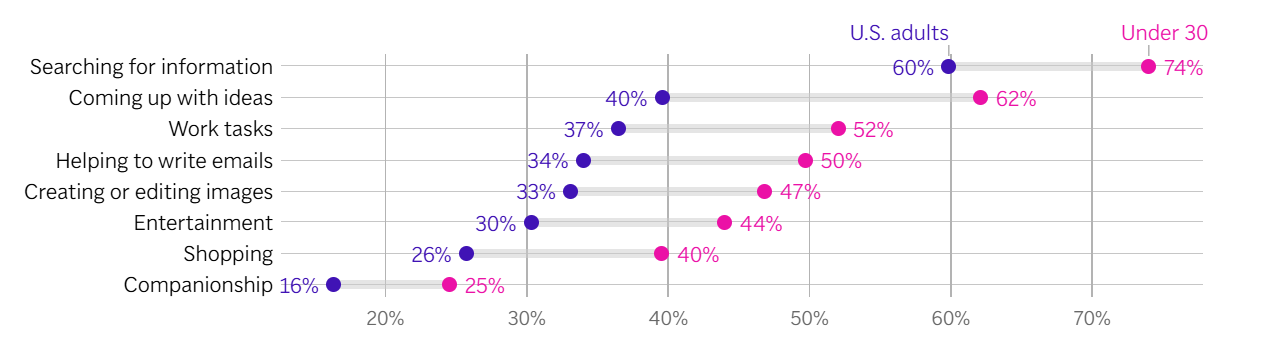
Now, users increasingly ask an AI system for a short list, then verify only one or two options. A recent AP-NORC poll found AI is used to search for information by 60% of U.S. adults, and 74% of people under 30, making it the most common AI use case. The same poll also found about one-quarter use AI for shopping. This is the behavioral fuel behind AI Search Visibility becoming a real acquisition surface, not a buzzword.
Why Gen Z behavior matters for marketers
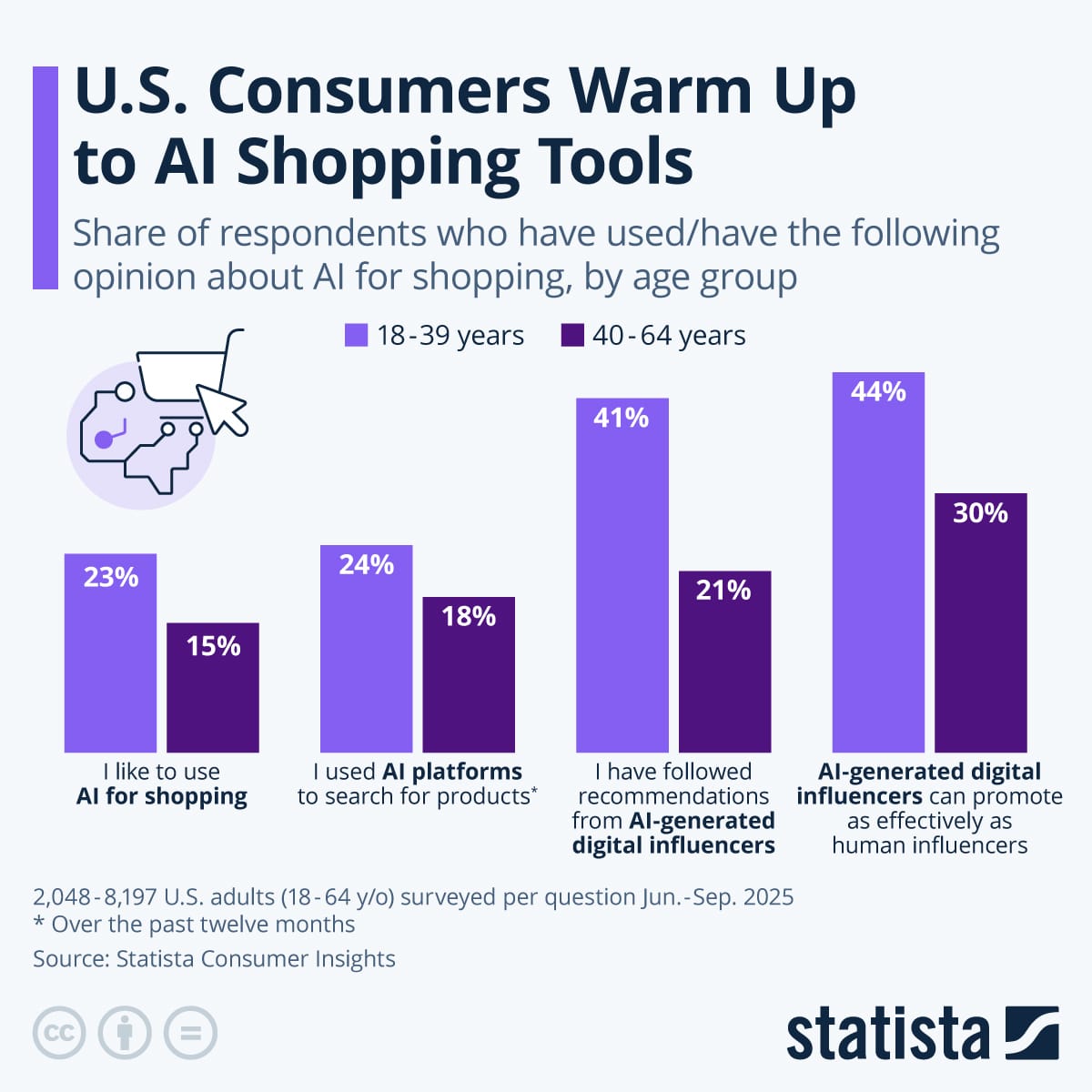
According to Statista, If younger users treat AI as the starting point, the “top of funnel” becomes a generated answer. That means a brand can have decent SEO and still lose the first impression if AI Agents do not include it. In practice, AI Visibility becomes the gateway metric: before traffic, before trials, before conversion.
Here is a simple snapshot of what changed:
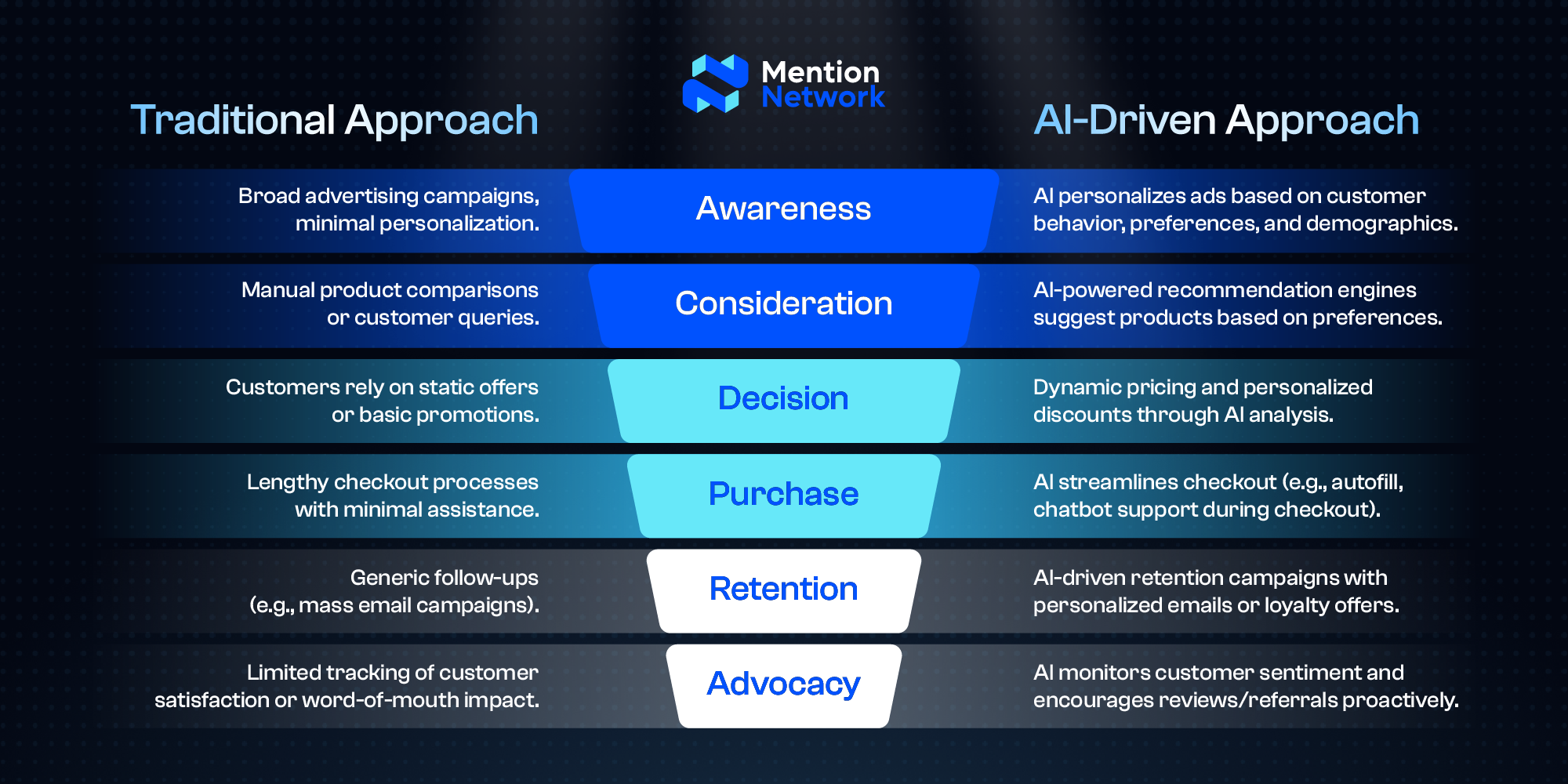
| Stage | Traditional journey | AI-led journey |
|---|---|---|
| Discovery | Many links and tabs | One synthesized answer |
| Comparison | User reads multiple sources | AI compresses tradeoffs |
| Shortlist | Built by user | Built by AI Agents |
| Trust | Influenced by brand + reviews | Influenced by consistency + third-party validation |
Why it matters
When AI Agents mediate discovery, brands compete for selection, not just ranking. AI Visibility is not only about being mentioned, but being framed correctly, included in the right category, and compared on the right criteria.
AI selection compresses the market
AI answers typically present a shortlist. That compresses the competitive set and raises the cost of being excluded. Even if you rank well, the user might never see it if the answer is “good enough.” That is why AI Search Visibility and AI Visibility move from “nice to measure” to “critical to manage.”
“AI SEO” is now a journey design problem
AI SEO is often treated as content tweaks. But with AI Agents, the real question becomes: can the model reliably understand and reuse your information across the whole decision journey? That is where AI SEO Optimization matters. It is less about clever copy, more about reducing ambiguity at every step AI uses to classify, compare, and recommend.
A practical way to think about AI SEO Optimization is to audit the chain below:
- Can AI identify what you are
- Can AI explain what you do without distortion
- Can AI place you in the right competitive neighborhood
- Can AI justify recommending you for a specific use case
If any link breaks, AI Visibility drops even if traffic metrics look fine.
Visibility now happens before clicks
The AP-NORC data suggests younger users already treat AI as the fastest path to information. For brands, that means your “first impression” increasingly happens inside an AI Answer. AI Search Visibility becomes the moment that shapes perception, and sometimes the only moment that matters.
You can try a free AI Visibility tool at mention.network to see how your brand shows up in AI answers.
If you have any questions, email us at [email protected], or book a quick call for free support with our team here
5 ways to increase AI Visibility in AI led journeys
AI Visibility does not improve from “more content” alone. It improves when AI Agents can classify the brand quickly, trust what they see, and reuse it safely inside an AI Answer. The five levers below are practical, measurable, and designed to help teams move from guessing to repeatable AI SEO Optimization outcomes.
1) Publish a canonical “brand identity” block and keep it consistent everywhere
Most LLMs build a mental model of a brand by averaging what they see across surfaces. If the product is described differently on the homepage, docs, LinkedIn, G2, and press mentions, the model becomes uncertain and avoids mentioning it. The simplest win is to standardize one canonical description and propagate it across every high visibility touchpoint to improve AI Search Visibility.
A strong identity block usually includes:
- Category statement (what the brand is)
- Ideal user (who it is for)
- Primary outcome (the job it helps users accomplish)
- One constraint or boundary (what it is not)
- One verifiable proof point (a specific, non-hyped fact)
This is AI SEO fundamentals because it reduces entity confusion. In practice, teams often see AI Visibility improve after they fix category drift, where the same brand is labeled with multiple competing categories across the web.
2) Create comparison assets that teach decision criteria, not feature lists
AI Agents do not compare products the way humans do. They compress tradeoffs into a few dimensions, then produce a shortlist. If your site never teaches those dimensions, the model learns them from competitors or from third party lists, which means you lose control over how you are positioned in AI Answers.
High performing comparison pages focus on decision criteria users actually care about:
- Use case fit and constraints
- Pricing model and total cost drivers
- Integration depth and ecosystem support
- Compliance, data handling, and risk
- Time to value and operational overhead
A useful approach is to publish one “category logic” page, then a small set of head to head comparisons. This supports AI Search Visibility because it matches the way users ask AI questions, such as “best tool for a small team under $X” or “safe option for regulated industries.” This is also where SEO AI still matters, because these pages tend to rank and get referenced by others.

3) Earn external validation in places AI already treats as reliable
LLMs often trust information more when it appears in neutral environments. This does not mean chasing backlinks for traffic. It means increasing the number of places where independent actors describe the brand in consistent terms. That lowers risk for AI Agents when they reuse your claims inside an AI Answer.
Practical validation targets include:
- Credible industry publications or newsletters that summarize products factually
- Reputable review and comparison platforms where users describe outcomes
- Community discussions with real usage details, not brand owned posts
- Reference style sources where category definitions are stable
The goal is corroboration, not hype. When the same description shows up across multiple independent sources, AI Visibility tends to rise because the model can triangulate. For AI for SEO teams, this becomes a measurable program: track which sources get cited in your category, then prioritize accurate representation there.
4) Optimize for intent rich scenarios with answer first structure
AI Search queries are longer and more constrained than classic keyword search. People ask for options that fit budgets, geographies, integrations, timelines, or compliance needs. Pages written for short keywords often fail to appear because the model cannot map them to real scenarios.
A high performing intent page typically follows a structure the model can reuse:
- One sentence answer under the heading that states the recommendation scope
- A short explanation of why, including the constraint context
- A list of key criteria that drove the recommendation
- A transparent section on when the brand is not a fit
- A recap that is easy to extract into AI Answers
This is AI SEO Optimization because it increases extractability. It also improves AI Search Visibility because the content aligns with how users actually ask questions. Teams that do this well usually reduce marketing language and replace it with scoped, factual claims the model can repeat safely.
5) Set up continuous measurement and iteration using AI Search reporting
AI Visibility is dynamic. Models update, retrieval behavior changes, and competitor positioning shifts. Without monitoring, teams do not know whether they are being mentioned, misrepresented, or replaced in AI Answers. Mature teams treat AI Search reporting as an operating loop, not a quarterly slide.
A useful AI Search reporting loop includes:
- Baseline: measure how often the brand appears and in which topics
- Diagnose: identify what the AI is pulling, and what it is missing
- Compare: find which competitors are repeatedly shortlisted instead
- Retrofit: update pages using evidence, not opinions
- Recheck: track whether mentions and framing improved
If teams only implement one of these five levers, they usually see limited gains. The brands that show up consistently tend to do all five, because AI Agents reward ecosystems: consistent identity, structured decision assets, corroboration, intent alignment, and ongoing measurement.
Conclusion
AI Agents are quietly becoming the first step in customer decision-making. That makes AI Visibility and AI Search Visibility strategic, because inclusion determines whether a brand even enters consideration.
The brands that win will design for selection: consistent identity, structured comparisons, third-party validation, intent-based content, and continuous AI Search reporting. AI SEO Optimization is no longer a niche tactic, it is how modern journeys stay readable to both people and AI.
FAQs
What is the fastest way to improve AI Visibility?
Start with consistency. A single, factual identity block reused across your site and third-party profiles reduces ambiguity for AI Agents. Then add a few scenario pages that answer “best for” intents clearly, which improves AI Search Visibility quickly.
Does AI SEO replace traditional SEO?
No. Traditional SEO still feeds discovery, but AI SEO focuses on being selected inside an AI Answer. Many teams treat AI SEO Optimization as a second layer that builds on top of strong technical and content foundations.
How often should teams run AI Search reporting?
At least monthly for most categories, and weekly for competitive markets or fast-moving products. Model behavior and topic trends shift, and AI Agents can change which brands they shortlist without warning.
Why do some brands rank well but never appear in AI Answers?
Because ranking does not guarantee extractability. AI Agents prefer content that is easy to summarize, consistent across sources, and supported by corroboration. If a page is vague, overly promotional, or structurally messy, AI may skip it even if it ranks.