
How to build an AI visibility prompt set
Build an AI visibility prompt set you can measure every week: intent groups, prompt examples, scoring fields, cadence, and the mistakes that make AI visibility data noisy.


TL;DR An AI visibility prompt set is a frozen measurement instrument. Start with 20 to 30 buyer-language prompts across 4 intent groups, run the same prompts on the same engines, and score mention, citation, rank, competitors, and raw-answer evidence. Read the trend after 3 runs, because one answer is just a receipt.
What to build:
The old SEO habit was to track keywords. That habit still helps, but AI answers need a different unit: the prompt that a buyer would actually ask.
The danger is obvious once you try it. One teammate asks ChatGPT for "best running shoes under $150." Another asks for "top shoes for new runners with knee pain." Both feel like the same intent. They can produce different brands.
A 2026 arXiv study on production commercial recommendations found that paraphrases of the same buying intent produced only 14% to 29% recommendation overlap. That is why the prompt set matters. It turns scattered screenshots into a repeatable measurement.
What is an AI visibility prompt set?
An AI visibility prompt set is a fixed list of questions used to measure whether AI systems mention, cite, rank, or recommend your brand, product, or store.
Think of it as rank tracking for AI answers, with a stricter rule: the prompt wording is part of the measurement. Change the wording every week and you are measuring phrasing drift, not visibility movement.
Keep 3 things stable during a measurement cycle: exact prompt text, engine list, and scoring fields. Then record the date, raw answer, cited URLs, competitors, and your position in the answer.
For the metric layer, pair this guide with AI visibility metrics and the starter workflow in free AI visibility tools.
Which prompts belong in the set?
Build the set around 4 intent groups. That keeps the prompt list balanced instead of letting one noisy category dominate the report.
| Intent group | What it measures | Prompt examples |
|---|---|---|
| Category discovery | Does AI know the category and name you? | Best AI visibility tools for ecommerce stores; best GEO tools for Shopify merchants |
| Problem language | Does AI name you when the buyer has the pain, not the keyword? | Why is my Shopify store absent from ChatGPT recommendations? |
| Comparison | Do you appear in shortlist and alternative prompts? | Mention Network vs Profound; best AthenaHQ alternative for ecommerce |
| Buying decision | Does AI recommend a store or product at the moment of choice? | Where can I buy [product] in [location]? |
Start with 5 or 6 prompts per group. A 24-prompt set is big enough to reveal patterns and small enough to rerun without turning the process into a research project.
What should you score for each answer?
Score the answer before you interpret it. A clean scoring sheet should have 9 columns: prompt ID, engine, date, mentioned, cited, rank, competitor names, cited URL, and raw answer link or excerpt.
For ecommerce prompts, add product, location, language, price stated, shipping stated, and store named. Mention Network's current free check uses 5 buyer intents across 4 assistants, which creates 20 answer receipts for 1 product, 1 location, and 1 language.
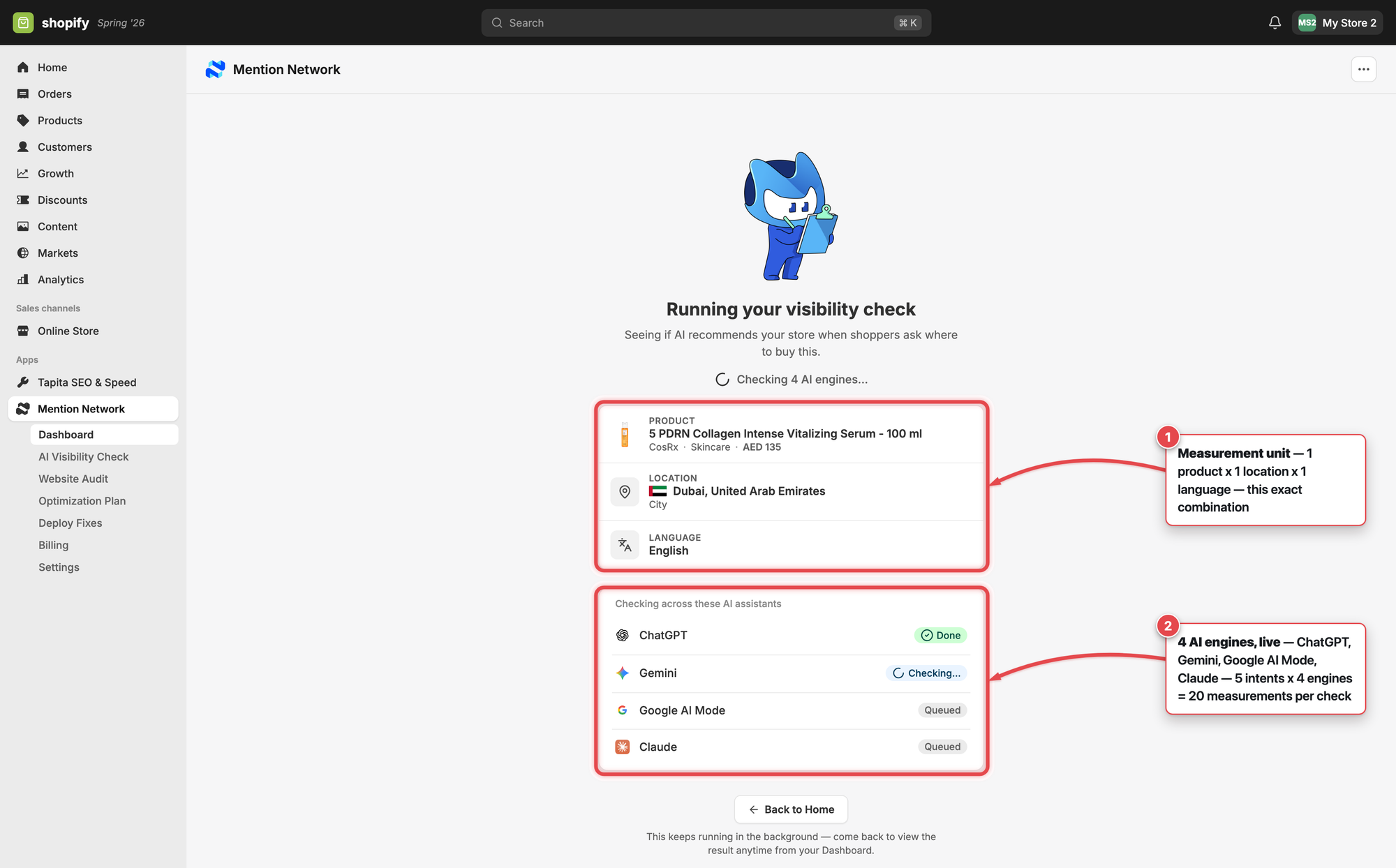
That receipt matters. A 2026 arXiv paper on generative-search measurement uncertainty argues that single-run citation metrics can look more precise than they are because repeated samples vary by engine and time. Save the evidence, then watch the slope.
How often should you rerun the set?
Rerun the same AI visibility prompt set weekly for fast-moving categories and monthly for slower categories. Do not call a win or loss from 1 run.
Use 3 runs as the first real read. If your brand appears in 4 of 24 prompts in week 1, 5 in week 2, and 9 in week 3, you have a trend worth investigating. If the pattern jumps from 4 to 12 to 3, you have volatility, not a victory.
Freeze the core prompt IDs for a quarter. Add new prompts later as new IDs instead of rewriting the old ones. That gives you history and keeps the report honest.
What changes for ecommerce stores?
Ecommerce prompt sets need product and store prompts, not only brand prompts. A reseller can sell Nike, COSRX, or Philips products and still never win a brand-level mention because AI names the manufacturer.
Start with these 5 buying-intent templates:
- Where can I buy [product] in [location]?
- Best place to buy [product] online in [location].
- Where can I buy authentic [product]?
- Cheapest place to buy [product].
- Where can I buy [product] with free shipping in [location]?
Those prompts match the commercial moment. A 2026 arXiv paper on prompt-to-purchase behavior found assistant brand recommendations were followed by higher same-name Google search, own-site visits, and retailer-page visits. The measurement should sit close to that purchase path.
What mistakes make prompt data noisy?
The 5 common mistakes are easy to avoid.
| Mistake | Fix |
|---|---|
| Rewriting prompts every run | Freeze prompt IDs for the quarter |
| Testing only branded prompts | Include problem and category language |
| Counting mentions without citations | Track cited URLs and source types |
| Ignoring competitors | Record every named competitor in the answer |
| Treating 1 answer as truth | Read the trend after at least 3 runs |
The goal is not a perfect score. The goal is a repeatable read that tells you what changed after you improved content, product data, structured data, reviews, or third-party sources.
A simple 24-prompt starter set
Use this starter set, then swap the nouns for your category.
Category discovery
- What are the best [category] tools for [audience]?
- Best [category] brands for [use case].
- Tools to track how AI assistants recommend [product type].
- How do I check my [store or brand] visibility in AI search?
- Best AI search optimization tools for [market].
- What software measures brand mentions in ChatGPT answers?
Problem language
- Why is my [store type] absent from ChatGPT recommendations?
- How do I get my store recommended by AI assistants?
- ChatGPT never mentions my online store, how do I fix that?
- How can resellers show up when people ask AI where to buy a product?
- How do I know if AI recommends my competitors instead of me?
- Why does ChatGPT recommend a marketplace instead of my store?
Comparison
- [Your brand] vs [competitor], which should I use?
- Alternatives to [competitor] for small ecommerce merchants.
- [Tool A] vs [Tool B] for Shopify stores.
- Is [your brand] worth it for a [store type]?
- Cheapest way to track AI visibility for an online store.
- Best [competitor] alternative for product-level AI visibility.
Buying decision
- Tool to check if ChatGPT recommends my store for a specific product.
- How to measure AI visibility for a single Shopify product.
- App that shows which AI chatbots mention my store.
- How to track where-to-buy recommendations in AI answers.
- Shopify app for AI search visibility.
- How to see the exact answers AI gives about my products.
How to use the results
Treat the first run as a baseline. It tells you where AI already recognizes you, where competitors replace you, and which sources the engines trust.
Then fix one layer at a time. Improve product facts, add structured data, clean up category pages, earn third-party proof, or repair thin comparison pages. Rerun the same prompt set after each change.
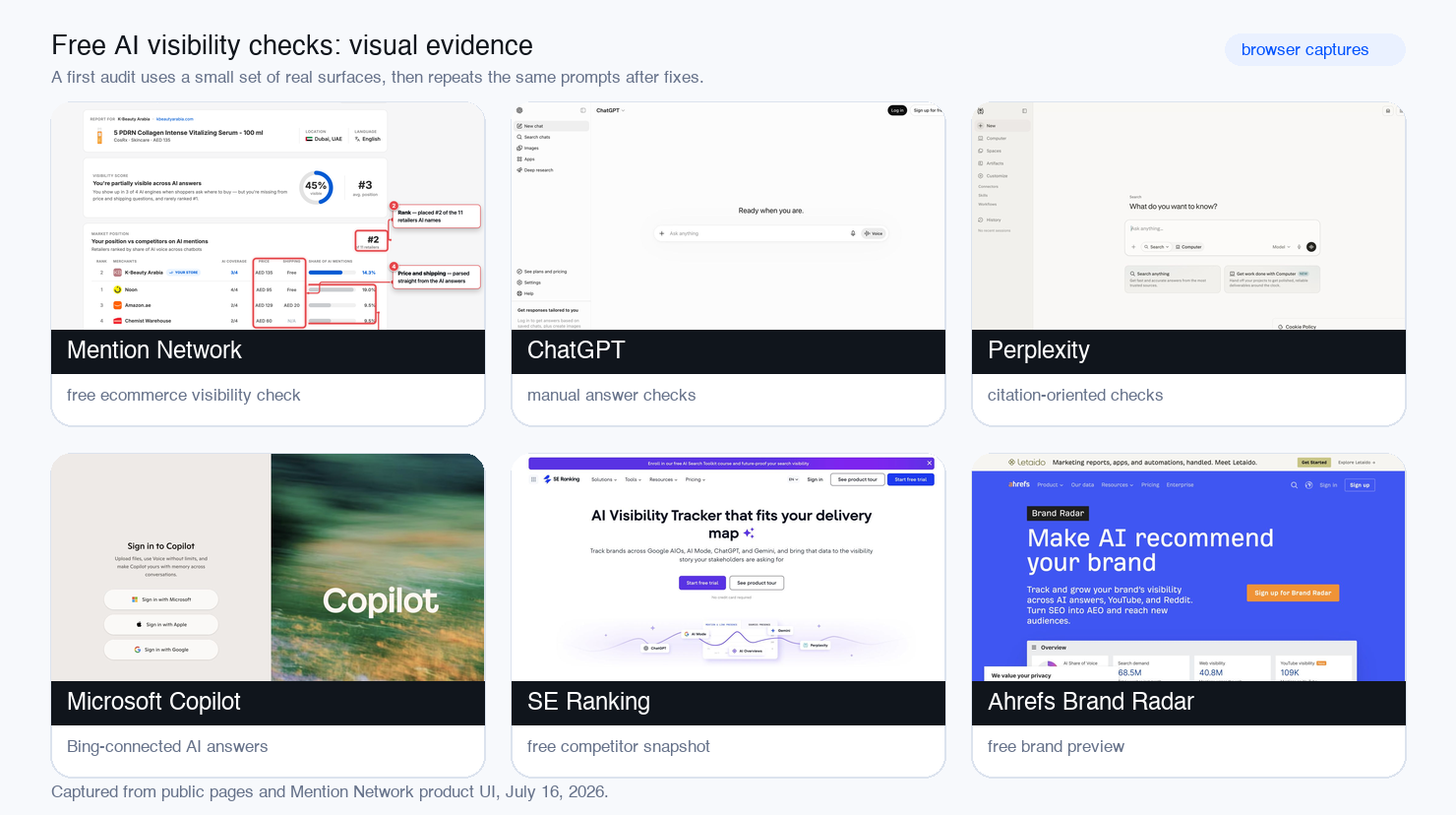
For ecommerce, the fastest first step is to run a free check. It gives you the 20 raw answer receipts first, then you can decide which wider prompt set deserves weekly tracking.
Frequently asked questions
How many prompts should an AI visibility prompt set include?
Start with 20 to 30 prompts across 4 intent groups. Smaller sets work for a first audit, but they should still cover category, problem, comparison, and buying intent.
Should I rewrite prompts every week?
No. Keep the core wording frozen during the measurement period. Add new prompt IDs at quarter boundaries if the buyer language changes.
What should ecommerce stores include first?
Ecommerce stores should include where-to-buy, best-place-to-buy, authentic, cheapest, and free-shipping prompts for priority products and markets.