
Shopify vs WooCommerce: Which Is Better for Your Store in 2026?
Shopify vs WooCommerce in 2026, compared honestly: pricing model, ease of use, SEO and AI visibility, scalability, and who each platform is really for, so you can pick the right one without switching twice.

Every few weeks a store owner asks the same question, and the search data backs it up: "WooCommerce or Shopify" pulls over a thousand US searches a month, with "Shopify vs WooCommerce" close behind. It's the right question to ask before you build, because switching platforms later is real work.
Here's the honest answer up front: neither one wins for everyone. They're built on opposite philosophies, and the better platform is the one whose trade-offs match how you actually run a store. This comparison walks through the differences that matter, then tells you which owner each one fits.
One note on where we sit. We're not Shopify or WooCommerce, so we don't have a horse in this race. We help stores measure how AI assistants recommend them, on either platform, which lets us compare these two on their merits.
TL;DR: Shopify suits owners who want to sell without managing software; WooCommerce suits owners who want full control of their stack. Both platforms can rank well in search and AI answers - the platform choice matters far less than your content, pricing, and product data.
How they stack up:
- Shopify vs WooCommerce at a glance
- The core difference: hosted vs self-hosted
- Which way are stores actually moving?
- Pricing: which is actually cheaper?
- Ease of use
- SEO and AI visibility
- Scalability and maintenance
- Who should choose which?
Shopify vs WooCommerce at a glance
| Shopify | WooCommerce | |
|---|---|---|
| Type | Hosted, all-in-one platform | Free plugin for WordPress |
| Hosting | Included | You buy and manage it |
| Cost model | Predictable monthly fee | Free plugin, you pay the pieces |
| Ease of use | Beginner-friendly | Steeper, more technical |
| Control | Managed, less low-level access | Full control of the stack |
| Maintenance | Handled for you | Your responsibility |
| Best fit | Owners who want to sell, not maintain | Owners who want full control |
The rest of this guide unpacks each row.
The core difference: hosted vs self-hosted
Get this one straight and the others follow.
Shopify is a hosted, all-in-one platform. You pay a monthly fee, and Shopify runs the servers, security, updates, and checkout. You log in and sell.
WooCommerce is a free, open-source plugin that turns a WordPress site into a store. The plugin costs nothing, but you provide everything around it: hosting, a domain, security, and the maintenance to keep it all running. You own the whole stack, for better and worse.
That's the fork in the road. Shopify trades control for convenience. WooCommerce trades convenience for control. Almost every other difference is a downstream effect of this one choice.
Which way are stores actually moving?
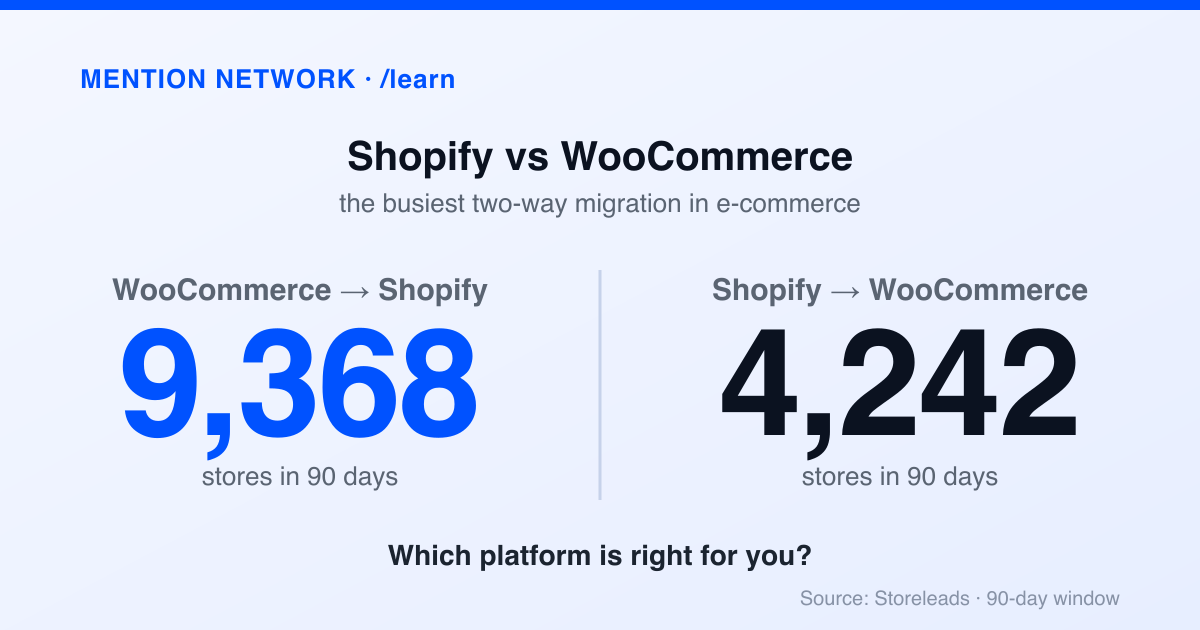
The debate is one thing; the traffic is another. WooCommerce and Shopify are the busiest migration corridor in e-commerce, and stores move both ways.
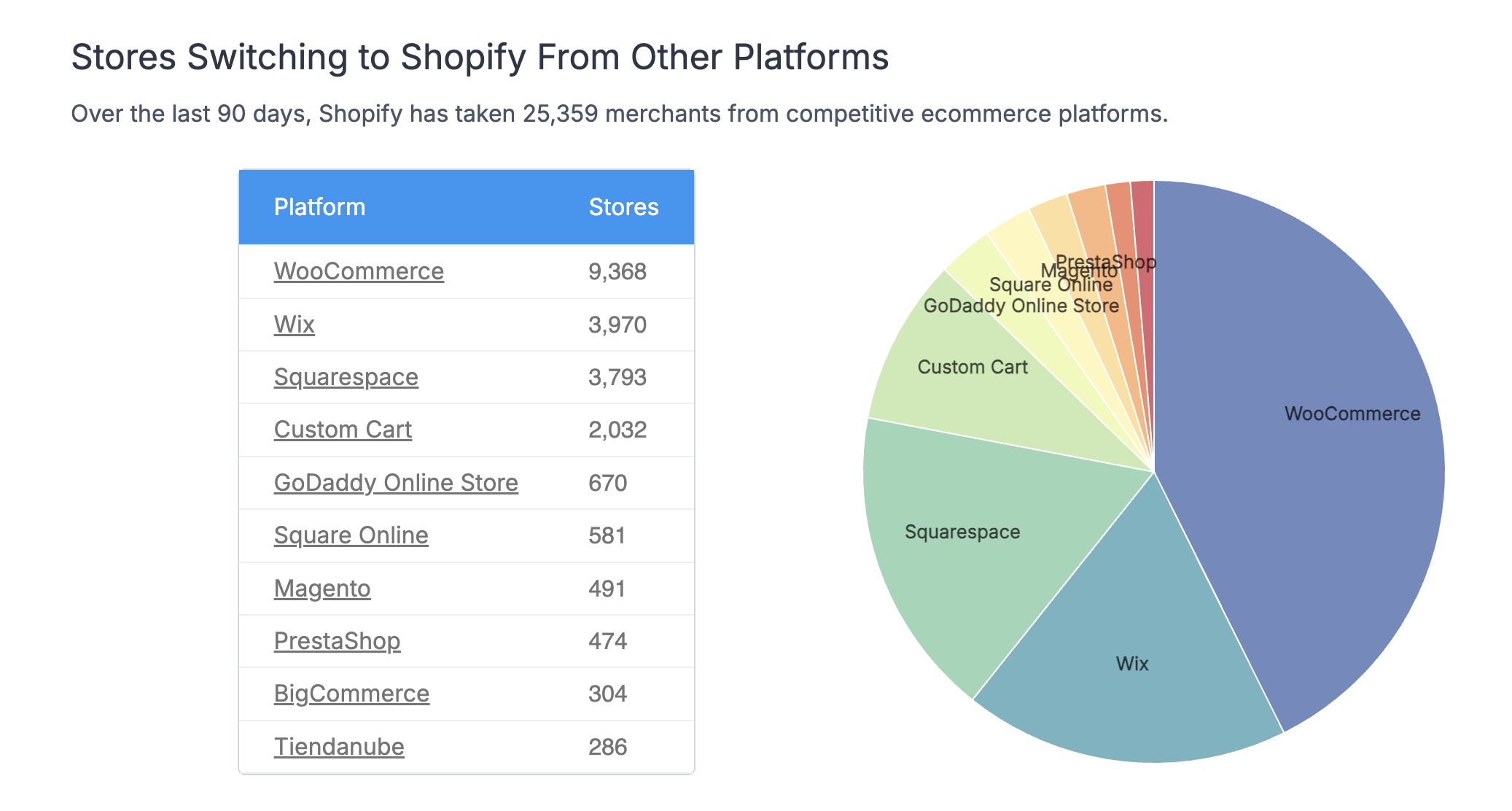
Platform-tracking data from Storeleads (90-day window, accessed July 7, 2026) puts numbers on it. Shopify gained 25,359 merchants from other platforms, and WooCommerce was the top source at 9,368 stores.
Over the same period, Shopify lost 12,890 merchants to other platforms; WooCommerce was the top destination, taking 4,242 of 12,890 of those stores.
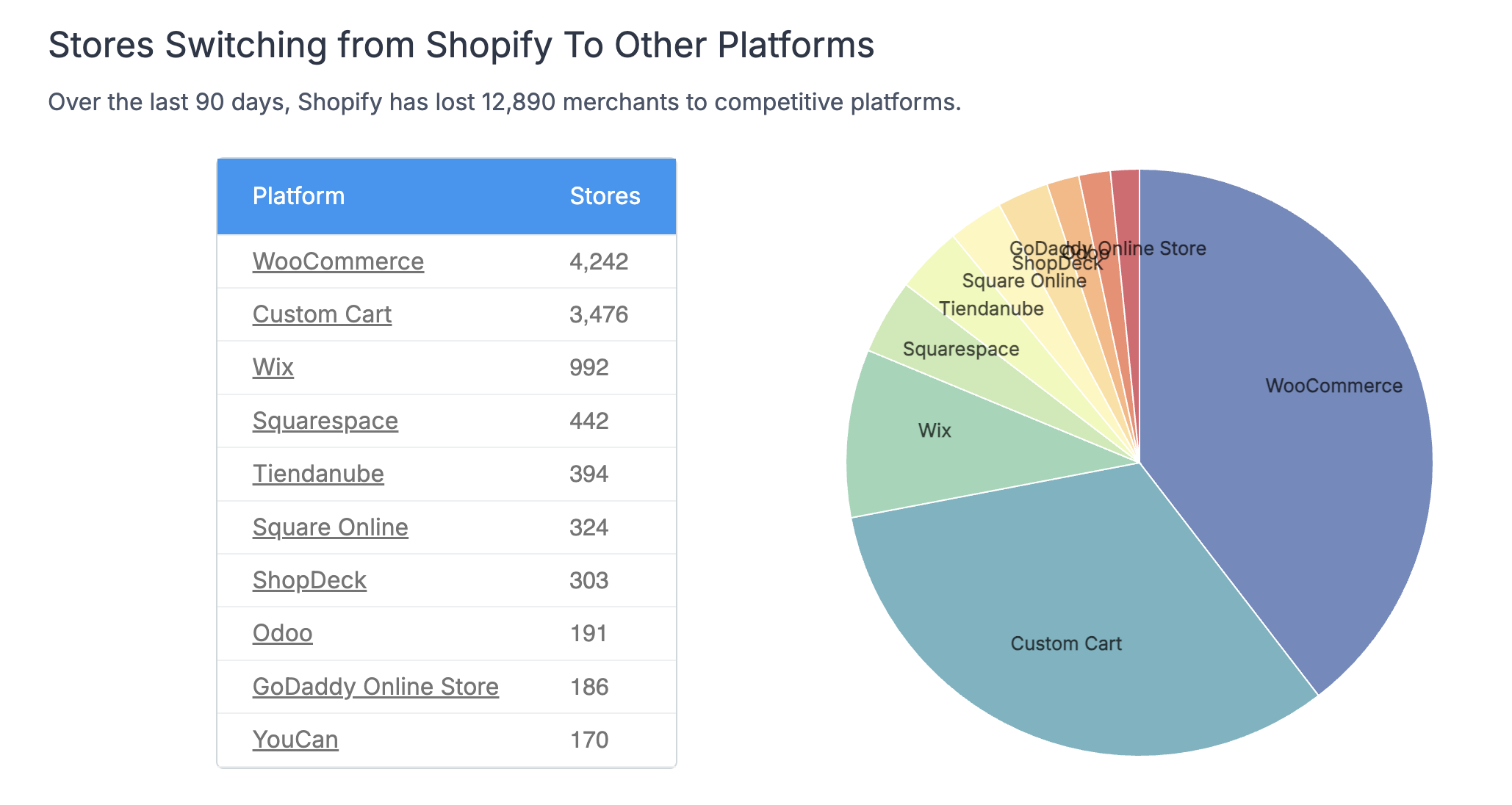
The takeaway is that WooCommerce leads both directions, which makes this a genuine two-way choice, and a reversible one. Roughly twice as many stores move from WooCommerce to Shopify as go the other way, but thousands make each trip every quarter.
Pricing: which is actually cheaper?
WooCommerce looks free, and the plugin is. The real cost lives in the pieces you assemble around it: hosting, a theme, extensions for features Shopify includes, an SSL certificate, and often a developer when something breaks. Those add up, and they're variable month to month.
Shopify charges a predictable monthly fee that bundles hosting, security, and checkout, plus its own app costs on top if you add them. You know the number in advance.
So "which is cheaper" is the wrong question. The honest version is: WooCommerce can be cheaper if you're technical enough to run it yourself, and more expensive if you're not and have to pay for help. Shopify costs more in obvious, predictable ways and less in hidden ones. Pricing changes on both, so check each platform's current page before you commit.
Ease of use
This one isn't close. Shopify is built for someone who has never run a store: guided setup, a clean admin, and hosting you never think about. Most owners are selling the same day they sign up.
WooCommerce assumes more. You need to set up WordPress, choose and configure hosting, install and configure the plugin, and manage updates and conflicts over time. None of it is beyond a determined beginner, but it's real technical work, and it never fully goes away.
If you'd rather spend your hours on products and marketing than on server settings, Shopify wins here. If you're comfortable in WordPress and want the control, the learning curve is a fair price.
SEO and AI visibility
Both platforms can rank. The differences are smaller than platform debates suggest, and the ground has shifted anyway.
WooCommerce, sitting on WordPress, gives you more direct control over technical SEO, URL structure, and content, which is why content-heavy stores often favor it. Shopify handles more for you by default and has been building deeper support for AI shopping, including the connectors that let assistants read and recommend your catalog.
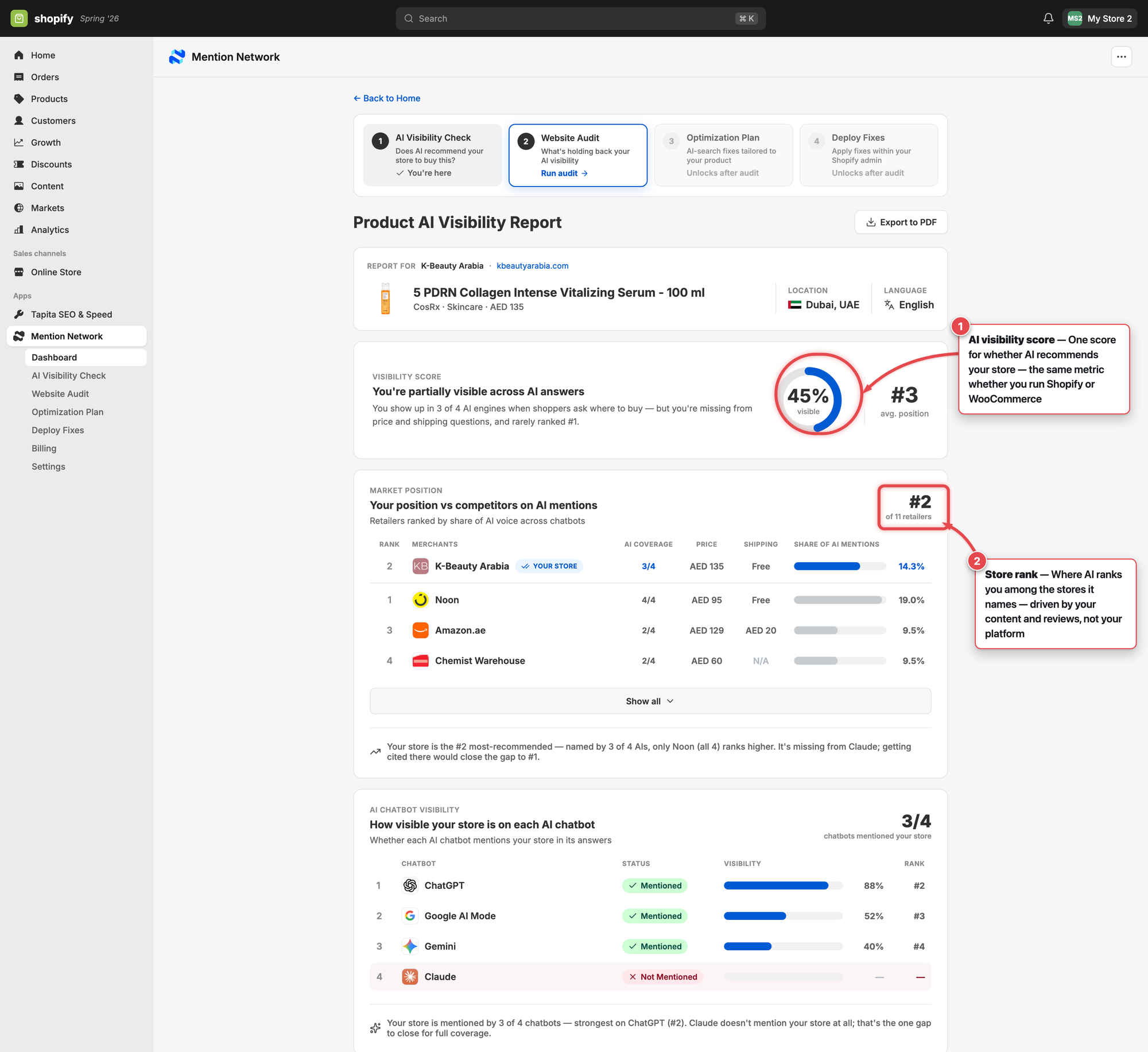
The bigger story in 2026 is AI visibility. Shoppers increasingly ask ChatGPT, Gemini, and Google AI what to buy, and whether those assistants recommend your store depends far more on your content, structure, and reviews than on which platform hosts it. A great WooCommerce store can out-rank a neglected Shopify one in AI answers, and the reverse is just as true. Platform is a smaller lever here than most owners assume. Our guide on how to optimize your store for ChatGPT Shopping covers what actually moves the needle.
Scalability and maintenance
As you grow, the hosted-vs-self-hosted split gets sharper.
On Shopify, scale is Shopify's problem. Traffic spikes, security patches, and uptime are handled by the platform, and higher tiers exist for high-volume stores. You feel scale mostly as a bigger bill, not a bigger workload.
On WooCommerce, scale is your problem. A growing store needs better hosting, performance tuning, and more careful maintenance, and that work lands on you or your developer. The upside is you can optimize exactly how you want; the downside is you have to.
Before you pick a platform, check whether AI already recommends your store.
In the Shopify vs WooCommerce decision, what decides your growth is whether ChatGPT, Gemini, and Google AI name your store when a shopper asks what to buy. It takes a minute to find out.
Run a free checkWho should choose which?
Match the platform to how you want to spend your time.
Choose Shopify if you want to focus on selling rather than software, you're not technical or don't want to be, you value predictable costs, or you want strong out-of-the-box support for AI shopping. It's the lower-friction path for most new and growing stores.
Choose WooCommerce if you want full control of your data and functionality, you already run your business on WordPress, you have the technical skills or a developer, or you want to avoid a monthly platform fee. It rewards owners who want to build exactly what they envision.
There's no wrong answer, only a wrong fit. Pick the trade-off you can live with for the next few years.
Already on WooCommerce and eyeing Shopify?
If you're reading this because your WooCommerce store has grown fragile and you're tempted by Shopify's hands-off model, that's a common path, and it's doable without losing your data or your rankings. We walk through the whole process, the best migration apps, the steps, the costs, and how to protect your SEO, in our complete guide to migrating WooCommerce to Shopify.
On Shopify and considering WooCommerce?
The move runs both ways, and plenty of stores go from Shopify to WooCommerce for the control and the lower recurring cost. It's more work than the reverse, because WooCommerce is self-hosted, so you set up hosting and rebuild payments and shipping yourself. The data still transfers cleanly, and your rankings survive if you redirect properly. Our complete guide to migrating Shopify to WooCommerce covers the tools, the steps, the costs, and the SEO.
Whichever you pick, check whether AI recommends you
Here's the part the platform debate misses. Once your store is live, the question that decides your growth is whether an AI assistant names your store when a shopper asks for a recommendation in your category. The platform choice matters far less than that.
That's true on both platforms, and it's a measurement problem you can check in minutes. Before you obsess over the platform choice, it's worth knowing where your store stands in AI answers today.
Is AI recommending your store? Check free.
Frequently asked questions
Is Shopify better than WooCommerce?
Neither is better outright; they fit different owners. Shopify is a hosted platform that handles hosting, security, and checkout for a monthly fee, which suits owners who want to sell rather than maintain software. WooCommerce is a free, self-hosted WordPress plugin that gives you full control but makes you responsible for hosting and upkeep.
What is the main difference between Shopify and WooCommerce?
Shopify is fully hosted and managed for you, so you trade a monthly fee for someone else running the infrastructure. WooCommerce is open-source and self-hosted, so it's free to install but you own hosting, security, and maintenance. That single difference drives most of the others.
Which is cheaper, Shopify or WooCommerce?
WooCommerce looks cheaper because the plugin is free, but you pay for hosting, a theme, extensions, and security, and often a developer. Shopify bundles most of that into a predictable monthly fee. For many stores the total cost is closer than it first appears; the difference is who you pay and whether it's predictable.
Which is better for SEO, Shopify or WooCommerce?
Both can rank well. WooCommerce, on WordPress, gives you more direct control over technical SEO and content. Shopify handles more for you out of the box and has stronger built-in support for AI shopping. The bigger factor in 2026 is AI visibility: whether assistants like ChatGPT and Gemini recommend your store, which depends more on your content than your platform.
Can I switch from WooCommerce to Shopify later?
Yes. Migration apps move your products, customers, and orders between the two, and 301 redirects protect your SEO in the process. It's real work, so it's better to pick well now, but switching later is a well-trodden path if your needs change.