
Top 10 free AI SEO tools you need to know
A curated list of the top 10 free AI SEO tools, from ChatGPT and Ahrefs Webmaster Tools to Perplexity and Semrush, plus a workflow for combining them into a complete AI SEO strategy.

You can run a full SEO program, keyword research, technical audits, content drafting, and AI-visibility tracking, without paying for software. The free tiers of the big platforms have gotten good enough to carry a small team. We pulled together the 10 free AI SEO tools we'd actually keep in a working stack, plus a workflow that connects them.
Key takeaways
- AI tools for keyword research and content work are now table stakes, not a nice-to-have.
- Generative Engine Optimization (GEO) is the new front. You need tools that track whether AI Overviews and chatbots surface you.
- The free tiers of Semrush, Ahrefs, and Google are strong enough for small teams and startups to compete.
- The best results come from combining tools across content, technical audit, keyword strategy, and LLM visibility.
- These tools work for beginners and still give professionals the data depth they need.
What's inside:
- The AI revolution in SEO: Why free tools are your competitive edge
- Top AI tools for foundational SEO and content strategy
- AI-powered tools for generative engine optimization (GEO)
- Free AI tools for keyword research and strategic content planning
- Free AI tools for technical audits and optimization
- Strategic integration: Building your AI SEO workflow
- FAQ
The AI revolution in SEO: Why free tools are your competitive edge
AI changed how fast SEO moves and how much ground you have to cover. The work now spans traditional SERPs and AI answer engines at the same time, and free AI tools are how a small team keeps up with both.
Manual, siloed SEO is done. AI now sits in every part of the stack, from how you research a topic to how you polish the final draft. The push comes from the search engines themselves, which have poured money into large language models and generative search. The prize now is a citation inside an AI Overview, a scarcer and more valuable spot than a blue link. Skip these tools and you're competing with one hand tied.
The useful part: most high-end platforms give away a genuinely capable free tier or a standalone tool. They're built to prove value fast by solving real problems, finding high-potential keywords, catching technical faults, and checking that content goes deep enough for both Google's ranking systems and an AI's synthesis.
Why it matters: Closing the knowledge and budget gap
For a founder bootstrapping, a developer heads-down on implementation, or a beginner still learning, budget is the hard constraint. Free AI SEO tools open up data that used to sit behind expensive enterprise plans. They turn deep competitor analysis and technical site audits into plain, actionable reports, which lets a small team go up against companies with far bigger budgets.
Top AI tools for foundational SEO and content strategy
Every strong SEO strategy starts the same way. Understand what the user actually wants, then build content that answers it well. These tools use AI to push basic research into real strategy.
1. ChatGPT (free tier): The Swiss army knife for SEO brainstorming
ChatGPT
ChatGPT is the most flexible of these tools, a free assistant for outlining content, generating schema, researching competitors, and working through quick technical questions.
OpenAI's ChatGPT, in its free version, gives you a large language model that's genuinely useful day to day. It isn't a traditional SEO platform stocked with ranking data, but its knack for synthesizing information and following multi-step instructions makes it a strong strategic partner.
| Core SEO Use Case | How ChatGPT Excels (Free) |
|---|---|
| Content Ideation | Generates exhaustive lists of long-tail keywords, blog post titles, and outline structures based on a seed topic and target audience. |
| Meta Data & Copy | Crafts high-CTR titles, compelling meta descriptions, and varied ad copy based on a tone and length requirement. |
| Technical Assistance | Explains complex Google Search Console errors in plain English or writes basic schema markup (e.g., FAQ, HowTo). |
| Topic Clustering | Groups a list of keywords into logical clusters, simplifying the content mapping process for building topical authority. |
How it works: a carefully structured prompt turns the model's training data into fast work on advanced tasks. Try "Act as a technical SEO consultant. Analyze the search intent for 'best free AI SEO tools' and provide a 5-part H2 outline for a comprehensive guide that covers both technical SEO and content optimization."
2. Ahrefs Webmaster Tools (AWT): Technical health and backlink insights
ahrefs
Ahrefs Webmaster Tools is a completely free suite. It scans your site for over 140 technical SEO issues and gives you a foundational read on your organic rankings and backlink profile.
Ahrefs is best known for its paid suite, but AWT holds its own for technical and foundational work, which makes it a favorite of developers and technical marketers. Connect it to your Google Search Console (GSC) data and it goes past a plain site audit, putting real performance numbers next to each error.
Site Audit crawls your site up to a limit and flags broken links, unindexed pages, oversized images, and weak page structure, the things that hurt site health and waste crawl budget. Site Explorer shows your top-ranking keywords and, more importantly, your backlink profile, which is what builds domain authority and E-E-A-T (Experience, Expertise, Authoritativeness, and Trustworthiness).
3. Google's suite: The indispensable free trio
Google's Suite
Google Search Console, Google Analytics, and Google PageSpeed Insights are the first-party data sources every SEO has to use. They tell you how the world's dominant search engine actually sees your site.
No free-tools list is complete without Google's own. They're the single source of truth on how Google reads your website.
| Tool | Primary Function & AI Relevance |
|---|---|
| Search Console (GSC) | Tracks indexing status, reports crawling errors, and, crucially, shows which queries your site ranks for and which are driving clicks. It's the primary way to measure organic performance and identify content gaps. |
| Google Analytics (GA4) | Measures user behavior after the click, providing AI-driven insights into engagement, conversions, and which content successfully fulfills user intent. |
| PageSpeed Insights (PSI) | Analyzes your site's loading speed and user experience on both desktop and mobile, flagging issues that impact Core Web Vitals, a key ranking factor increasingly relevant to AI's content quality assessment. |
AI-powered tools for generative engine optimization (GEO)
The newest front in SEO is Generative Engine Optimization (GEO): shaping your content so AI Overviews and conversational models like ChatGPT and Perplexity cite and surface it.
4. Perplexity.ai: The real-time generative search analyzer
perplexity.ai
Perplexity is a free generative answer engine, and it doubles as real-time competitive intelligence. It shows you exactly which sources get cited for a high-value query, which is a direct map for your GEO content.
Unlike a traditional search engine, Perplexity synthesizes an answer and cites its sources. That makes it genuinely useful for GEO work.
For citation analysis, type in your target keyword and you'll see the handful of sources the model treats as most authoritative. That's an unfiltered look at which competitors you need to beat and what your content has to cover to earn a citation. Its conversational interface also surfaces the intent behind a query and the related questions people ask, which helps you build content that satisfies both traditional and generative search.
5. HubSpot's AI search grader: Measuring your AI visibility
HubSpot
This free tool gives marketers a snapshot of how visible their brand is inside conversational AI search, which turns GEO from an abstract idea into something you can measure and act on.
Free GEO-specific tools are still young, but graders and analyzers like this one are becoming important. They track where you stand in AI-powered search, which works differently from a traditional SERP.
It checks whether LLMs recognize and cite your brand or content, so you can watch your share of voice in the generative space. It also flags topics where you rank well in traditional SEO but stay invisible to AI answer engines, a clear signal to re-work that content.
Free AI tools for keyword research and strategic content planning
Smart keyword research today is less about single terms and more about semantic relationships, topic clustering, and reading user intent. AI tools change how you do all three.
6. Semrush keyword magic tool (free account): Semantic keyword clustering

Semrush
Semrush's free tier gives you limited access to its Keyword Magic Tool, which pulls from a large database to generate related semantic keywords and cluster them by intent.
Even with daily limits, the free access earns its place in planning. It uses machine learning to map the full semantic territory around a topic, well past what a basic keyword planner reaches.
| AI Keyword Feature | Strategic Advantage |
|---|---|
| Long-Tail Discovery | Quickly surfaces question-based keywords and less competitive long-tail variants that align with specific user informational needs. |
| Intent Analysis | Tags keywords by commercial, informational, navigational, or transactional intent, allowing for precise content mapping and funnel alignment. |
| Related Keyword Grouping | Automatically groups highly related keywords into topic clusters, helping you build topical authority that is recognized by all search algorithms. |
7. Google keyword planner (free with Google ads account): Volume and competitor data
Google Keyword Planner
Built for paid search, Keyword Planner is still the most direct source of search volume and competition data straight from Google, which makes it the raw material for validating AI-generated keyword ideas.
People overlook it for organic SEO, but it stays an authoritative source for estimated monthly search volume and competition level. It pairs well with the output from generative AI tools.
Use the volume numbers to check long-tail keywords suggested by ChatGPT or Semrush, so you only chase queries with real traffic behind them. Its forecasting can hint at rising or fading interest too, so you move to emerging topics early.
Free AI tools for technical audits and optimization
Technical SEO is the scaffolding under everything else, and AI tools are getting good at automating the audits and surfacing the structural problems.
8. Semrush site audit (free account): Automated technical health check
Semrush Site Audit
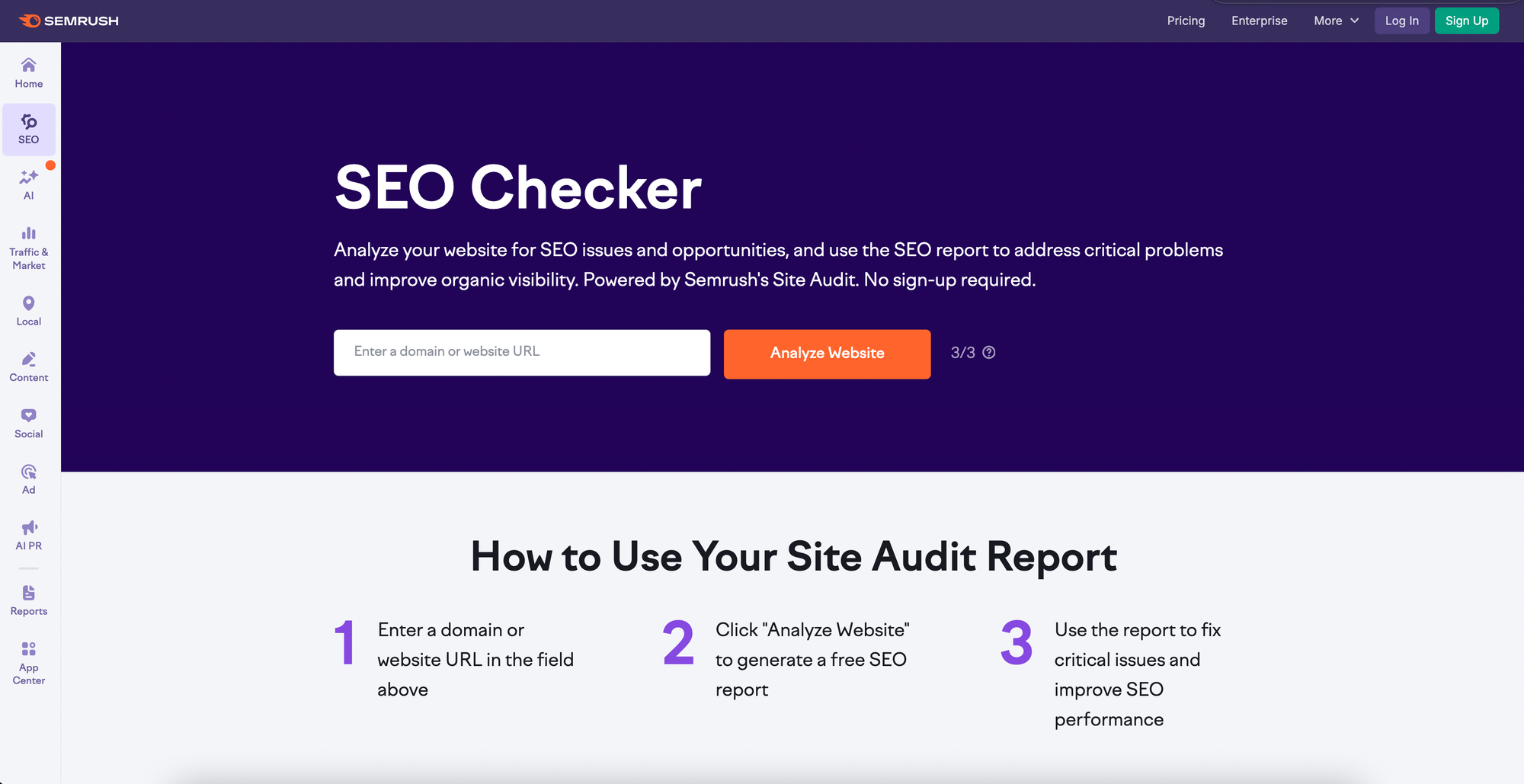
Semrush's free Site Audit crawls a small batch of your pages and uses AI-driven logic to find technical errors, then hands you prioritized fixes.
Technical SEO gets intimidating fast, and an AI-powered audit takes the edge off. This one is the tool for confirming your site is crawlable and indexable.
It flags the serious stuff: broken internal links, slow loads, wrong canonical tags, and HTTPS problems. It also points out pages blocked by robots.txt or stuck on other indexing issues, which matters because Google's crawlers have to see your content before anything else happens.
9. Google's structured data markup helper: Schema generation
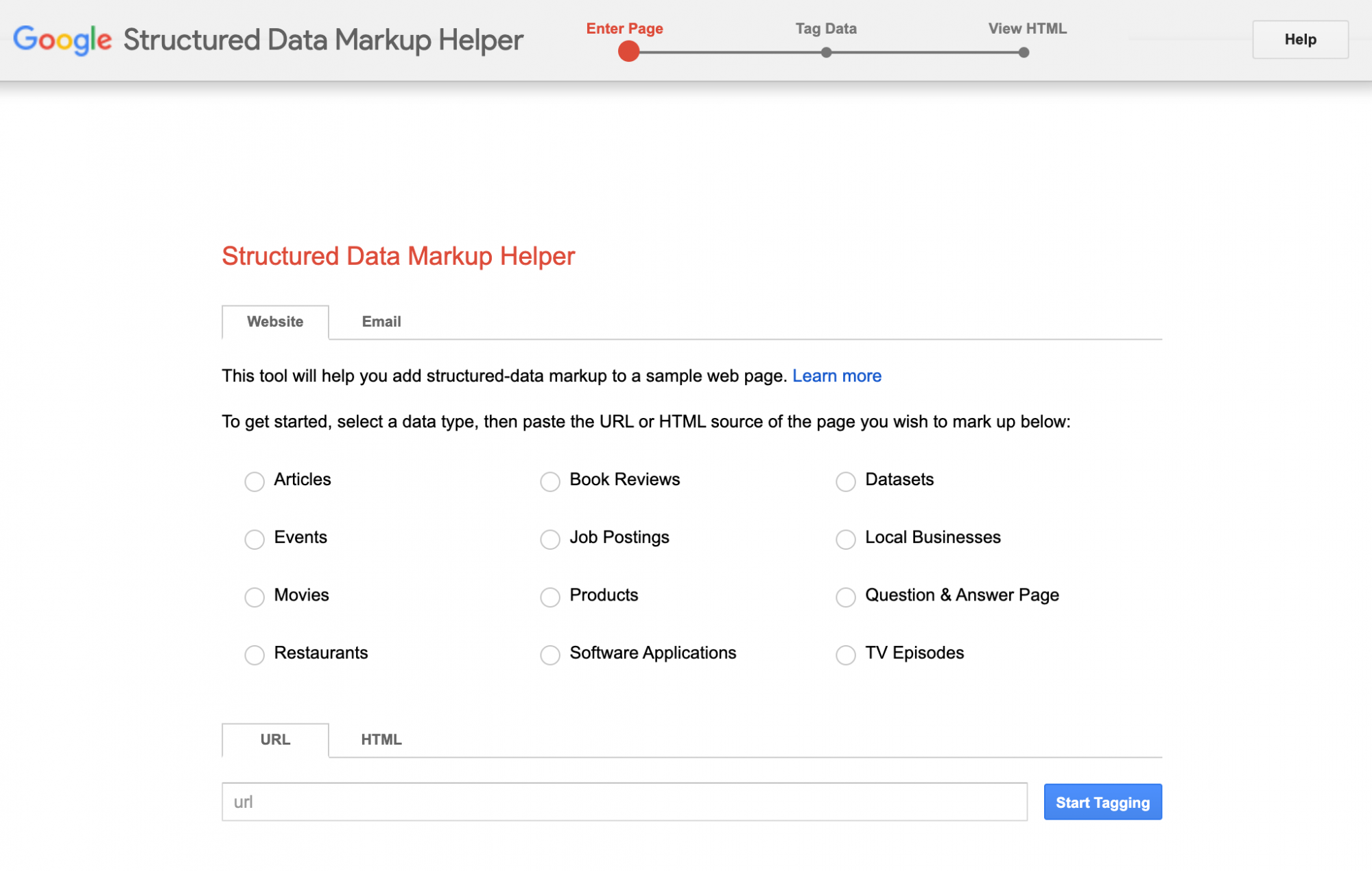
Google's Structured Data Markup Helper
Google's free tool takes the pain out of writing structured data (schema markup), which is what earns rich results and gives AI-driven search a clean read on what your content is for.
Schema markup is the machine-readable layer that helps both search engines and generative AI understand your content's context. Get it right and your odds of showing up in rich snippets and AI Overviews go up.
The helper lets you tag elements on your page visually, author name, publish date, product price, then generates the JSON-LD for you to copy in. Done properly, schema drives rich results like star ratings, FAQ accordions, and how-to steps, which lift click-through rates and feed AI models clean information to summarize.
10. Copy.ai (free plan): AI-driven content generation and repurposing
Copy.ai
Copy.ai's free tier is a content generator that's good at repurposing what you already have and producing solid short-form copy, which speeds up your output without dropping quality.
Many platforms lock content generation behind a paywall, but Copy.ai's free version gives you enough credits for the essential, time-saving jobs, mostly on-page copy and micro-copy.
It spins up multiple versions of meta descriptions, ad copy, and social posts for quick A/B testing. And it can rewrite an existing paragraph in a different tone or focus, which is handy for on-page work: it keeps your target keywords in place and varies the language so the page doesn't read as repetitive.
Strategic integration: Building your AI SEO workflow
These tools pay off most when they feed each other. Run them in a connected workflow and give each one the job it's best at.
- Phase 1, research and strategy (ChatGPT, Semrush, Perplexity): Brainstorm and outline with ChatGPT. Tighten the topics in Semrush's Keyword Magic Tool for semantic clustering and intent. Then run a GEO citation check in Perplexity on your top 5 target keywords to see who's already getting cited.
- Phase 2, technical foundation (AWT, Google Suite, Semrush Site Audit): Run Ahrefs Webmaster Tools and Semrush Site Audit and fix whatever critical issues they flag. Use Google Search Console and PageSpeed Insights to set your baseline for organic traffic and speed.
- Phase 3, content and optimization (ChatGPT, Copy.ai, Schema Helper): Build the content you outlined in Phase 1, drafting and refining with ChatGPT and Copy.ai. Then generate and add your schema markup with the Structured Data Markup Helper so you capture rich results.
This covers modern SEO end to end, from the technical backend to the generative front end, at basically no cost. It's a working path to ranking and citation in AI search.
The tools are free. The barrier now is execution.
Is AI recommending your store? Check free.
FAQ
Are free AI SEO tools truly effective for scaling a business?
Yes. Paid plans give you unlimited capacity, but the free tiers of tools like Semrush and Ahrefs deliver the high-value data that startups and small teams actually need, technical audits, keyword clustering, and enough depth for focused strategic work.
What is generative engine optimization (GEO)?
GEO is the practice of shaping your content so large language models find, summarize, and cite it, the models behind AI Overviews in search and chatbots like ChatGPT and Perplexity.
Should I rely solely on AI for content creation?
No. ChatGPT and Copy.ai are strong for research, outlining, drafting, and editing, but human expertise is what supplies original insight, an authentic voice, and the Experience and Trustworthiness that E-E-A-T rewards.
How often should I run a technical SEO audit using a free tool?
Run one monthly as routine, and again right after any big change like a platform migration or template update, so you catch serious issues before they hit your rankings.