
90-day roadmap: Growing AI visibility through AI search
A practical 90-day roadmap for growing AI visibility through AI search: from technical foundations and schema markup to answer-first content, E-E-A-T authority, and the AEO metrics that matter.

The landscape of search has fundamentally shifted. Today, with the rise of Large Language Models (LLMs) powering tools like Google's AI Overviews (AIO), ChatGPT, and Perplexity, the goal is citation. Your content must be the authoritative source that an AI engine chooses to synthesize and present directly to the user.
This 90-day roadmap pivots your digital strategy from chasing links to earning AI citations. The future of organic traffic belongs to the authoritative source.
Key Takeaways: The 90-Day Mandate
- Mindset Shift: Citation Over Clicks: The primary goal is to be the source that AI platforms cite, mention, or recommend, as this new form of visibility (often called "AI Share of Voice") is rapidly replacing traditional SERP clicks.
- The Content Mandate: Clarity is King: AI models prioritize content that is highly structured, conversational, and direct. Adopt an "answer-first" methodology, leading with a concise response before diving into depth.
- Technical Non-Negotiables: Schema & Speed: Implement entity-aligned Schema Markup (especially FAQPage, HowTo, and Article) to help AI crawlers understand your content's context and purpose.
- Authority is Foundational: E-E-A-T Redefined: AI systems are intensely focused on the source. You must proactively build expertise, experience, authority, and trustworthiness (E-E-A-T) signals, including detailed author bylines and original data.
- Prompt-Centric Content: Move beyond optimizing for short keywords. Create content that answers the conversational questions users are asking AI assistants (e.g., "What is the best CRM for remote B2B sales teams?").
What you'll learn:
- The core difference: AI search vs traditional SEO
- Days 1-30: Technical foundation and content audit
- Days 31-60: Content transformation and authority building
- Days 61-90: Monitoring, iteration, and future-proofing
The core difference: AI search vs traditional SEO
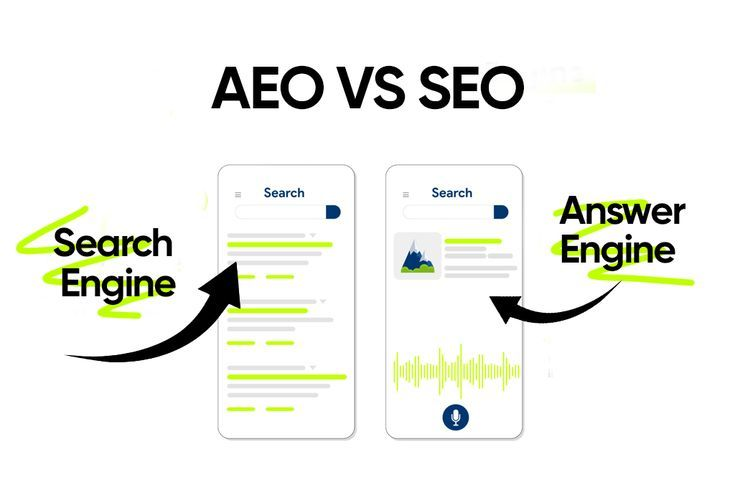
AI Search vs Traditional SEO.
Traditional SEO aims for a high rank in a list of links, AI search (or AEO) aims for direct inclusion, mention, or citation within a synthesized answer.
The foundation of the digital marketing profession was built on the 10-blue-links model. We optimized title tags, meta descriptions, and backlink profiles to climb a ranking ladder. AI search, driven by Large Language Models (LLMs), has shattered this model. When a user asks an AI assistant a question, the LLM processes data from millions of sources, synthesizes a single, authoritative answer, and often presents it in a rich format like a paragraph, a list, or an AI Overview (AIO).
Why it matters: The zero-click funnel
In this new environment, your visibility is defined by your AI Share of Voice (ASoV): how often your brand is cited compared to your competitors. If an AI provides a complete, satisfactory answer without the user needing to click a link, that’s a zero-click event for a competitor, but a massive visibility win for your brand if you were the primary source. This fundamentally changes the marketer's job from traffic acquisition to narrative control and trust-building.
| Feature | Traditional SEO (Last Decade) | AI Search Optimization (AEO/GEO) |
|---|---|---|
| Primary Goal | Top 10 rank on a keyword SERP. | Citation, mention, or recommendation within a synthesized answer. |
| Target Query Type | Short-tail, transactional, or informational keywords. | Conversational, long-tail, and complex multi-part questions (prompts). |
| Content Structure | Hierarchical, topic-focused pages. | Modular, answer-first sections designed for extraction. |
| Key Metric | Organic Clicks, Impressions, Rank Position. | AI Impression Share, Citation Frequency, Brand Sentiment. |
| Technical Focus | Core Web Vitals, Crawl Budget. | Schema Markup, Data Quality, Entity Alignment. |
The key takeaway for developers and marketers alike: you are optimizing for an intelligent system to trust and quote a specific passage.
Read more: A Deep Dive into SEO for LLMs and the AI-First Search Economy
Days 1-30: Technical foundation and content audit

Days 1-30.
The first month is dedicated to establishing the technical scaffolding (Schema, Indexing) and auditing existing content to identify your most potent assets for AI citation.
The shift to AI search is as much a technical challenge as a content one. LLMs ingest and interpret web data differently than previous-generation algorithms. Your immediate priority must be to speak the LLMs' language through structured data and a clean, accessible site architecture.
Establish the technical foundation
Your technical SEO stack is the bedrock of your AI visibility.
- Schema Markup Implementation: This is non-negotiable. Schema.org markup is the primary tool to communicate the context and meaning of your content directly to AI models. Action: Prioritize the use of FAQPage on your Q&A content, HowTo on your guides and tutorials, and complete Article schema across all long-form posts, including a detailed author and publisher object to support E-E-A-T.
- Developer Task: Validate all new JSON-LD implementations using Google's Rich Results Test and Schema Markup Validator.
- Crawlability and Indexing: Ensure AI-specific crawlers have access to your best content.
Action: Review your robots.txt file. While you may want to block general scraping bots, verify that you are not inadvertently blocking key AI search crawlers like Google-Extended (for AI Overview), ChatGPT-User, or PerplexityBot.
- Core Web Vitals: Page speed and stability remain a critical baseline. AI systems which prioritize user experience will favor fast, accessible pages. Learn more: What is AI Visibility? And Why It Matters in 2025
The conversational content audit
Not all content is created equal in the age of AI search. Identify high-potential pages and retrofit them for AI citation.
- Identify "Citation Gravity" Pages: Use your analytics to find the pages that already rank for informational or "how-to" keywords, or that appear in Featured Snippets. These pages are already favored by algorithms and are the easiest wins for AI Overviews visibility.
- Adopt the Answer-First Methodology: For your top 10 high-potential pages, rewrite the opening. Instead of a long, flowery introduction, start with a direct, concise 2–3 sentence answer to the H2 question. The LLM can lift this answer cleanly.
Example (Bad): “In the ever-evolving world of digital marketing, understanding the core components of AI search is crucial...”
- Example (Good): “AI search fundamentally differs from traditional SEO by aiming to generate a direct, synthesized answer rather than a list of links, making the goal citation.”
- Use Scannable Formats: Convert dense paragraphs into bulleted lists and numbered steps. LLMs are trained on this structured data and are significantly more likely to extract and cite clear, modular information like tables, definitions, and lists.
Days 31-60: Content transformation and authority building

Days 31-60.
The second month is about creating net-new, highly authoritative content tailored to long-tail, conversational user prompts and embedding strong E-E-A-T signals.
This phase moves beyond technical fixes into strategy, focusing on what content the LLMs will actually trust. Trust in AI search is synonymous with E-E-A-T, which is why original data and demonstrable expertise are more important than ever.
Strategy 1: Prompt-centric content creation
Users interact with AI assistants by asking full, complex questions. Your content strategy must evolve to address these long-tail "prompts."
- Mining for Prompts: Go beyond traditional keyword research. Analyze your support tickets and customer service logs for the exact questions your users are asking.
- Use "People Also Ask" (PAA) sections and forum questions (Reddit, Quora, industry forums) to capture natural, conversational phrasing.
- Action: Restructure your content outline using these actual user questions as your H2 and H3 headings. An H2 like "How does AI search affect my e-commerce conversion rate?" is superior to "E-Commerce Impact."
- The Depth-Authority Loop: Content for AI search must be both broad (answering the prompt) and deep (establishing authority).
Action: Create comprehensive pillar pages that fully cover a core topic. Include internal links to related content clusters. This signals to the AI that you are the central, authoritative hub on that subject.
Strategy 2: Building unquestionable E-E-A-T
AI models use external signals to gauge the credibility of a source. You must give the AI every reason to cite you as the expert.
- Original Data as Citation Bait: Nothing establishes authority faster than proprietary, unique information. Action: Publish a new, original research report, survey, or case study. Even a small, defensible statistic (e.g., "Our analysis shows B2B tech companies that deployed FAQPage schema saw a 15% jump in AI Impression Share") becomes highly quotable by an LLM.
- Author and Brand Signals: Humans and AI look for the same signs of credibility.
Action: Ensure every piece of content has a detailed author byline that links to a professional profile (LinkedIn, industry site) and uses Person and Author schema. For corporate sites, link back to an "About Us" page that highlights company credentials and mission.
- Citation Engineering (Off-Page): The web-wide narrative matters.
Action: Systematically pursue mentions from authoritative, third-party sites in your niche. A favorable mention or citation on a high-DA site is a powerful E-E-A-T signal that LLMs are trained to respect.
Days 61-90: Monitoring, iteration, and future-proofing

Days 61-90
The final month is dedicated to measuring your new AI visibility metrics, iterating based on real-world performance, and establishing a continuous optimization workflow.
In the world of AI search, there is no "set it and forget it." Performance must be monitored using AEO-specific metrics that replace the outdated keyword ranking tracker.
Track the right metrics
Traditional SEO reports are incomplete without an AEO overlay.
| Metric | What it Measures | Why it Matters |
|---|---|---|
| AI Impression Share (AIS) | How often your content is included or cited across major AI Overviews and chat results. | This is your true AI visibility. Low AIS means you're invisible where decisions are made. |
| Citation Frequency | The number of times your domain is linked/mentioned in AI-generated responses. | Direct measure of your content's authority and quotability. |
| Brand Sentiment Score | The positive/negative tone when your brand is mentioned in an AI answer. | Directly shapes customer perception before they click or convert. |
| Conversion Rate (AI Traffic) | Conversion rate from users who clicked through from an AI-cited answer. | Users clicking from an AI summary are highly qualified and often convert at a higher rate. |
Action: Use dedicated AEO tools (or manual monitoring) to establish a baseline in week 9 and track changes in these four metrics through week 12.
Iteration and the update workflow
AI loves fresh, accurate information. A core component of your 90-day win is establishing a workflow for continuous content refinement.
- The Quarterly Content Refresh: AI search algorithms heavily favor content that is current. Action: Implement a mandatory quarterly review for all high-value content. Update statistics, links, product screenshots, and most importantly, the year/date in the title/body (e.g., "Best Strategies for 2026").
- The AI Citation Feedback Loop:
If you see a competitor cited in an AI Overviews where you aren't: Immediately analyze their content structure, add any missing facts, and make your answer more concise and structured.
- If your content is cited: Study the structure and phrasing that the LLM lifted. Replicate that clarity and structure on other high-potential pages.
Future-proofing for the multimodal web
The end of the 90 days is merely the beginning of your journey into AI search. The next frontier is multimodal content.
- Action: Ensure all images, charts, and videos have descriptive alt text and captions that are rich in context and align with your target entities. AI Overviews and other generative results are increasingly featuring non-text assets. Optimizing your media for context is key to long-term AI visibility.
Start now. Your invisibility is your competitor’s citation.
Is AI recommending your store? Check free.
FAQ
What is the main difference between traditional SEO and AI Search Optimization (AEO)?
Traditional SEO aims for a high rank in a list of links. AEO aims for a direct citation or mention within a synthesized AI-generated answer, like Google's AI Overview or a ChatGPT response.
Does technical SEO still matter for AI search?
Yes, more than ever. AI models rely heavily on clean site architecture, fast load times, and especially Schema Markup that describes your content in detail, to understand its context and trust it as a source.
What is the single most effective thing I can do right now?
Implement the answer-first methodology: start your content sections with a clear, concise, 2-3 sentence answer to the question posed in the heading. This makes your content instantly quotable by an LLM.
Will AI search entirely eliminate clicks to my website?
No, but it may reduce clicks for purely informational queries. Clicks that do come through, often from users seeking greater depth or a specific solution, are generally higher-quality and convert at better rates.