
Cited, not ranked: AI visibility tools playbook
A practical playbook for AI visibility tools: track citations instead of rankings, strengthen E-E-A-T signals, compare platforms, and measure the ROI of AI-first content.

Shoppers now ask ChatGPT and Google AI Overviews a question and get one synthesized answer back. No ten blue links to scroll. If that answer names your brand, you win the sale. If it doesn't, you're invisible, and your rank on page one won't save you.
So the metric changed. You're not chasing position anymore; you're chasing citations. AI visibility tools exist to measure that: how often models cite you, which questions surface you, and how your authority stacks up against competitors.
Key takeaways for digital leaders
- Citations replace rankings. These tools track how often models extract and cite your content, which is the signal that tells you AEO actually moved.
- Trust and experience have to be yours. A model can synthesize generic copy; it can't fake first-hand experience or data that only you hold, so that's where you compete.
- You can finally tie content spend to revenue. High-intent, question-shaped queries connect visibility to sales in a way old SEO reporting rarely did.
- Long-tail questions are the currency. AI tools surface the specific, conversational queries shoppers actually type, and those are the ones that convert.
- One dashboard beats five open tabs. Leading platforms fold rank and traffic together with mentions and citations across LLMs.
- Humans still do quality control. Automation handles volume; a person checks accuracy and brand fit, and that matters most in niche or local markets.
What you'll learn:
- Decoding the AI visibility metric: Citation over rank
- The E-E-A-T engine: Using AI tools for trustworthiness
- The toolkit of extraction: Tracking mentions across answer engines
- Geo-targeting in the AI lens: Hyper-local visibility strategies
- The economics of automation: Measuring AI content ROI
- FAQ about AI visibility tools
1. Decoding the AI visibility metric: Citation over rank
The goal is easy to state: get mentioned and quoted so your brand earns a seat inside the answer.
AI visibility tools measure Answer Engine Optimization (AEO) by counting how often generative AI cites and extracts your content. That count replaces organic rank as the number that matters.
Search went from a list of ten sources to a single AI Overview. So your position on the first page means a little less every quarter. These tools track the new scoreboard instead, the one built for a conversational web.
They measure visibility three ways:
- Citation tracking watches for your brand inside the generated answer itself, across Google AI Overview, ChatGPT, and other LLMs. A mention there is the clearest proof of authority we have right now.
- Intent analysis reads the question behind the citation. Once you know exactly what a shopper asked and how the model used your page to answer, you know what to write next.
- Domain analysis shows which sites and URLs the models lean on most. That's your competitive map: see who the AI trusts, then work out why.
Why it matters for developers and marketers
For developers, this is a feedback loop. Structure a page with clean headings, watch whether models start extracting it, and you know your architecture is right.
For marketers, it moves the conversation past raw traffic to intent. Every page you publish aims at one thing: becoming the source the answer quotes.
2. The E-E-A-T engine: Using AI tools for trustworthiness
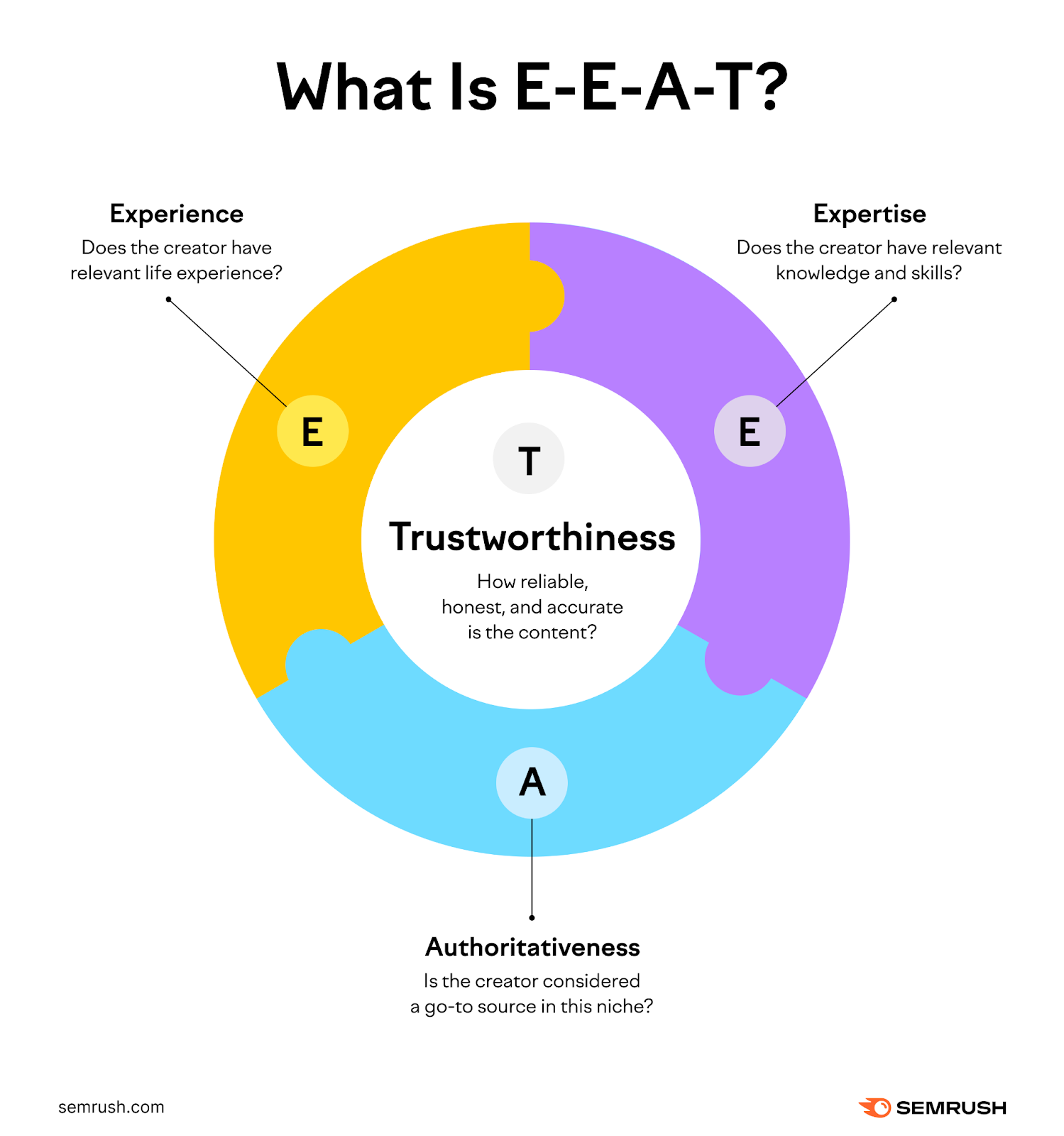
The E-E-A-T Framework. Source: Semrush
AI can produce a competent draft in seconds, which means competent stopped being the bar. E-E-A-T is the bar now, and its two hardest letters are Experience and Trustworthiness. Good AI SEO tools help you prove both.
A model writes fluent, consistent copy all day. It can't test your product, walk your warehouse, or know why customers return the thing they return. That first-hand knowledge is yours, and it's what makes a page worth citing. Visibility tools help you find where those signals are thin and where to add them.
The role of AI tools in establishing E-E-A-T
- Audit your pages against what AI answers currently reward, then get a read on the spots where your expertise comes across as generic. Citing an author's own published work is one honest fix, and platforms can track whether it earns citations.
- Keep a person in the loop on accuracy and brand fit, so nothing ships biased, wrong, or off-voice. That check matters most in niche and local categories where the model has little to compare against.
- Mention Network checks how AI describes your store, flags the product pages models skip, and drafts the fix so you can preview and approve it inside your store admin.
For founders and category experts, the job is concrete: document real credentials, tie bylines to a track record, and bake in the experience that turns a generic article into a source AI quotes.
Read more: What is Mention Network? A Complete Guide to AI Visibility and GEO
3. The toolkit of extraction: Tracking mentions across answer engines
The search surface is fragmented now. Your brand can show up in a Google AI Overview, a ChatGPT answer, and a Gemini reply, each pulling from different sources. Specialized platforms track your mentions across all of them, so you see the whole picture instead of one slice.
The unified dashboard is the standard buyers expect. Traditional SEO suites and AI-first newcomers are converging on the same promise: rank and citation, tracked side by side.
Key tools and their strategic features
| Tool Category | Example Platforms | Key AI Visibility Feature | Strategic Advantage |
|---|---|---|---|
| Unified SEO/AI Tracking | SE Ranking, Ubersuggest | AI Overviews Tracker, ChatGPT/AI Mode Tracker. | One dashboard to tune content for both rank (SEO) and citation (AEO) at once, so your team spends effort in one place. |
| Deep Citation Analytics | xFunnel, Profound | Deep-dive citation analytics, competitor visibility dashboard, response analysis. | Best for enterprises and large teams, analyzes citation context and identifies the specific domains driving AI answers, helping benchmark against true leaders. |
| Content Optimization | Frase, Surfer SEO | SERP analyzer, AI-guided content brief generation, content auditing. | Streamlines the creation and optimization of content for AEO structure and topic depth, increasing the likelihood of AI extraction. |
| Keyword Generation | Optimo, Embarque | AI Long-Tail Keyword Generators. | Uses advanced language models to generate highly specific, low-competition long-tail keywords that align with conversational user intent. |
Why bother covering several environments? Because a page that wins Google's factual summary can need a different structure or tone to get pulled into a third-party model's answer. These tools give you the granularity to tune for each one instead of guessing.
4. Geo-targeting in the AI lens: Hyper-local visibility strategies
Local businesses need visibility tools tuned to conversational, location-based questions. When someone asks their phone "where's the best digital service provider near me," they expect one answer, and it's either you or a competitor.
Local Search Engine Optimization (Local SEO) has turned hyper-local, pushed by mobile devices and voice search. Winning that single answer comes down to a few specific moves.
Optimizing local AEO with visibility tools
- Capture conversational intent. AI keyword generators surface the long-tail queries people actually speak, neighborhood names and service types included, so you write for the exact question instead of a broad head term.
- Get your local data clean. Models lean on your Google Business Profile (GBP) and consistent NAP (Name, Address, Phone) as trust signals, so fix those first and keep collecting reviews.
- Verify local facts with a human. Regional accuracy and context are where a person earns their keep, and that human-checked layer is what makes an answer trustworthy enough for AI to repeat.
Get those right and your store shows up for the searches happening a mile away. Mobile results ride on your location targeting, and AI search only raises the stakes.
Learn more: How to Measure Your Brand's AI Visibility: Key Metrics and Tools
5. The economics of automation: Measuring AI content ROI
Every tool has to earn its budget, and visibility tools hand founders the number SEO often couldn't produce: a line from content spend to revenue.
That line comes from focusing on high-intent, long-tail queries and citation earned through real E-E-A-T. Both connect visibility to sales directly, which is why the return holds up under scrutiny.
Picture a hypothetical B2B company that rebuilds its content for AI search. Citations across the major models compound into organic user growth, market share, and revenue over months, not days. That's the shape of the payoff.
It comes from a formula these tools make repeatable:
- Fix the technical foundations (AI auditing tools handle most of this).
- Build topical authority (AI content research points the way).
- Tune your content for AI search platforms (visibility trackers measure it).
- Tie all of it back to revenue and ROI (the dashboards close the loop).
Do that and visibility becomes an asset that keeps compounding on its own.
FAQ about AI visibility tools
How do these tools find citations inside closed models like ChatGPT?
They read the source links a model shows inside its answer, and they pull aggregated, anonymized data through APIs on which domains get referenced across different models. Put together, that gives you a reliable read on who the AI is citing.
Which E-E-A-T factor matters most to track?
Trustworthiness and Experience. AI visibility comes largely from content that offers specific, first-hand detail a model treats as reliable, and human review is what verifies it.
Can a small business actually afford AI visibility tools?
Yes. Plenty of platforms offer free or low-cost tiers that pair full SEO features with AI citation tracking, so serious analysis isn't gated behind an enterprise budget.