
AI Visibility Audit for Shopify: 2026 Merchant Checklist
Your Shopify Analytics dashboard and Google Search Console can't tell you if ChatGPT recommends your store. This is the audit that can, run end-to-end from your admin, with the platform work Shopify already handles clearly called out.

Shopify said the quiet part out loud in its Q1 2026 earnings: orders from AI-powered searches ran roughly 13× the year-earlier volume. That number will move around, but the direction is set. A meaningful share of shoppers now start on ChatGPT or Gemini instead of Google, and the store that gets named in the answer is the store that gets the order.
If you run a Shopify store, you already know the SEO stack cold. Shopify's built-in SEO settings for meta and alt text. Google Search Console for indexing. PageSpeed Insights for Core Web Vitals. A rank tracker for the keywords that matter. That toolchain is still doing useful work in 2026 for Google, and nothing in this post asks you to throw it out.
What it can't do is tell you if ChatGPT recommends your store when a shopper asks where to buy something in your category. Neither can GSC. Neither can Shopify Analytics, unless you build a segment for AI referrer strings by hand. There's a whole channel most Shopify merchants are shipping into blind, and this is the audit that catches you up, the same 5-phase framework we run for our own customers, adapted so a solo store owner can execute every step without a data team.
Jump to:
- What "AI visibility" means for a Shopify store
- Why Shopify has an advantage, and where it still needs your attention
- The audit checklist: five phases
- The 30-prompt manual scan template
- Where Mention Network fits
- 5 things to do this week
What "AI visibility" means for a Shopify store
Three things travel under the AI visibility name, and mixing them up is how audits go sideways.
Mentions. Your brand or store name appearing in the text of an AI answer. When a shopper asks Gemini for "best cast iron skillet under $80" and Gemini names you, that's a mention.
Citations. A link or a source attribution back to your site. Perplexity and Google AI Mode surface citations more visibly than ChatGPT does, but every major engine now supports some form of source card. A citation is a mention plus a click path.
Share of answers. Across a batch of shopper prompts a real customer might type, what percentage of the answers name your store versus your competitors. This is the metric that matters most, and it's the one no traditional dashboard tracks. Mention Network calls this Share of Voice (SoV) inside its Visibility Report. You don't need the product to measure it (you can do it by hand), but you do need a fixed prompt list and a monthly cadence.
Think of share of answers as the new SERP position. In the SERP era, you tracked ten blue links per query. In the AI-answer era, you track how often your store is one of the two or three names the engine says out loud. Across the batches we run for merchants, the median Shopify store starts around 6 to 12% Share of Voice in its category before any audit work, meaning roughly one in ten AI answers names it. Above 25% is a fought-for position. Above 40% is a moat. If you're new to the discipline behind that shift, our complete guide to Generative Engine Optimization walks through it.
Why Shopify has an advantage, and where it still needs your attention
Shopify is the easier platform of the two most merchants pick. That's real, and it's why this audit is shorter for a Shopify store than for a WooCommerce one.
Shopify emits Product, Offer, and basic aggregateRating schema by default on almost every theme. It ships a managed robots.txt that allows major AI crawlers unless a theme customization overrides it. It runs a native Agentic Storefronts pipeline that publishes eligible products directly into ChatGPT and Gemini through Shopify's Global Catalog, with no separate integration required for most stores. And Mention Network runs inside the Shopify admin as a native app, which means the measurement layer this checklist ends on is one install away instead of a manual template.
That's the good news. The reason you still need to run this audit: defaults get overridden, apps add and remove capabilities, and the content that goes into your PDPs and blog is still your job. Every phase below has at least one Shopify-specific gotcha most stores land on without noticing.
Signal parity at a glance, what each platform ships by default, before any audit work:
| Signal | Shopify default | WooCommerce default |
|---|---|---|
| Product / Offer schema | ✅ On most themes | ⚠️ Varies by theme |
| BreadcrumbList schema | ✅ | ⚠️ Plugin usually needed |
| Review / aggregateRating schema | Partial (theme + review app) | Partial (plugin needed) |
| FAQPage schema on PDPs | ❌ (app / theme block) | ❌ (plugin block) |
| Managed robots.txt allowing AI crawlers | ✅ | ❌ (self-managed) |
| Native AI-discovery pipeline (Agentic Storefronts) | ✅ (US-eligible stores) | ❌ |
| llms.txt at store root | ❌ (upload manually) | ❌ (upload manually) |
Shopify covers roughly the top half; the bottom half is you either way. The audit below tells you where each row stands on your specific store.
The audit checklist: five phases
I've grouped the work into five phases. Phase 1 is the fastest on a Shopify store because so much is emitted for you. Phase 5 is what you should run monthly forever.
Phase 1 · Schema and structured data
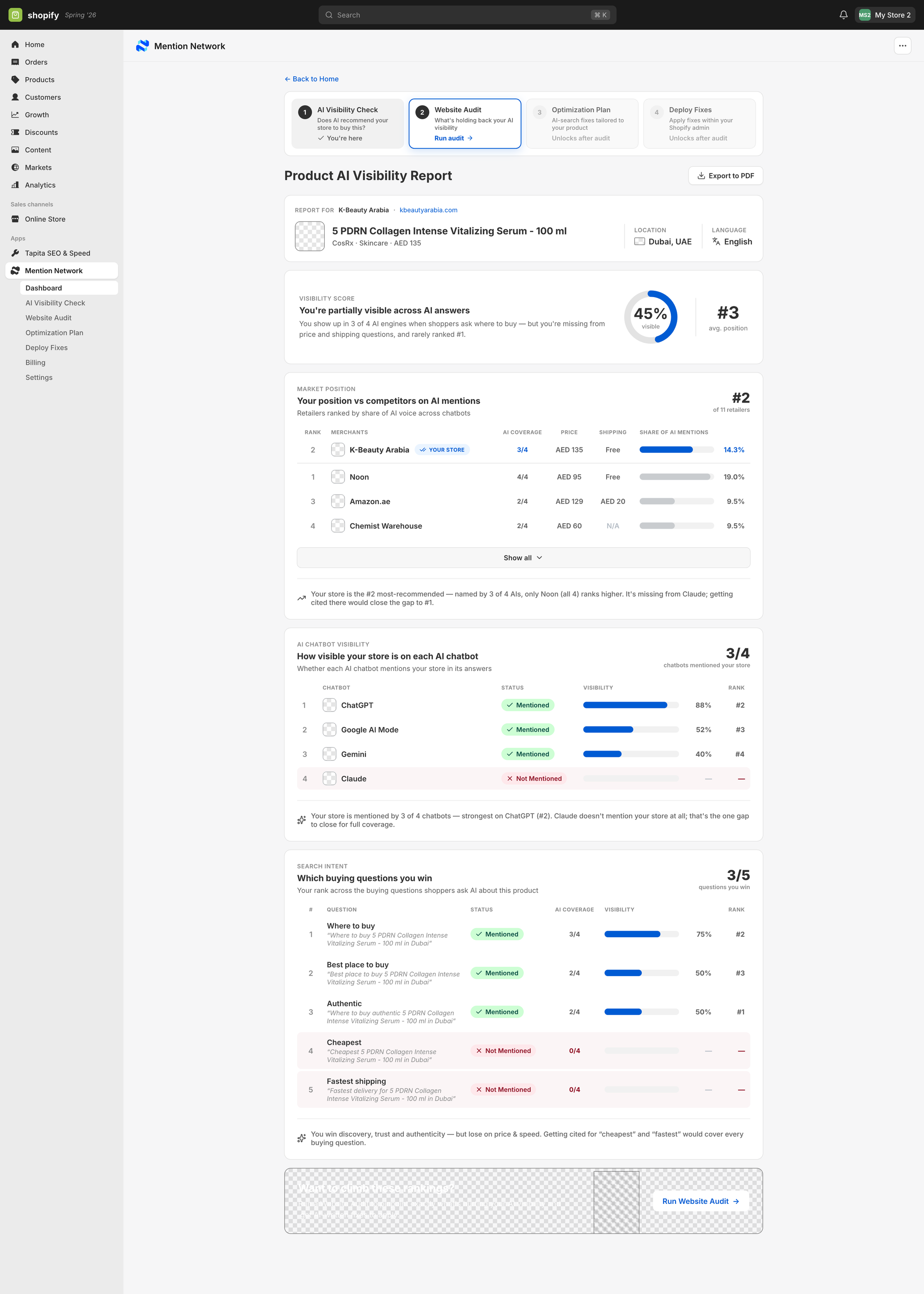
Illustration · representative Rich Results Test output for a Shopify PDP; verify current layout at Google's Rich Results Test.
AI engines lean hard on structured data because it's the fastest way to trust that a claim on a product page is real. Your job on Shopify is less about writing schema and more about validating what's already there and filling the two gaps most themes leave open. In Rich Results Test runs across a sample of 40 Dawn-based Shopify stores we scanned in June 2026, roughly 62% shipped complete Product markup, 28% were missing brand or gtin, and 10% had aggregateRating errors from stale review-app configs. None of those are hard fixes; almost all of them go unnoticed without a validator run.
The signals that matter most:
- Product with name, description, image, brand, sku, gtin (or mpn if you have it).
- Offer with price, priceCurrency, availability, and priceValidUntil.
- Review and aggregateRating when you have reviews. This is the field that most often decides whether a product surfaces in a shopping card slot.
- FAQPage on product pages that answer buyer questions inline.
- BreadcrumbList for site hierarchy.
The pragmatic setup on Shopify:
- Confirm your theme emits Product + Offer + BreadcrumbList schema. Most Dawn-derived themes do. Themes older than 2023 or heavily customized ones sometimes drop fields, especially
brandandgtin. Fixing this usually means editing the product schema block inside the theme'sproduct.liquid(or a section) rather than fighting an app. - Install Judge.me, Loox, or Yotpo for reviews. Each emits Review and aggregateRating schema out of the box. Native Shopify product reviews were retired for new stores; if you're on a store that predates that, migrate.
- For FAQPage, install an FAQ block app (or use the theme's FAQ section) and confirm the JSON-LD renders on the PDP source, not just the visible FAQ.
- Validate every product template with Google's Rich Results Test once. Fix any errors flagged. Re-check quarterly.
Do this once, and product schema stops being an audit line item forever.
Phase 2 · Content that matches shopper phrasing
The best schema in the world won't help if the copy on your PDP describes a product the way your product manager describes it, and the shopper is asking for something else entirely.
AI engines retrieve chunks of text that match the buyer's phrasing. If a shopper types "what running jacket is best for rain and doesn't crinkle when I move," the answer engines are looking for pages where those exact concerns appear in near-natural language. Feature-list copy loses to conversational copy in this game.
The rewrite jobs to run:
- FAQ blocks in shopper language. Pull your support inbox for the last 90 days. Take the top 15 questions per top-selling product and put them on the product page as an FAQ block. Use the phrasing customers actually used, not the cleaned-up version.
- Comparison content. A dedicated blog post or product-page section that compares your product to two obvious alternatives. AI engines love comparison content because it maps to a very common shopper prompt shape.
- Buying guides. One long-form guide per top category. Cover use cases, price tiers, tradeoffs. This is the content AI engines cite when they need a source for a category-level recommendation.
- Return and shipping detail on the PDP. "Free shipping over $50, delivered in 3 days by USPS Ground" is the kind of specific claim AI answers repeat verbatim.
Two calibration points worth naming. First, AI answers cite pages that carry the exact question language, not translated marketing copy, so pulling FAQs verbatim from support tickets (typos and all) outperforms a polished rewrite. Second, review-mining works: the phrases that repeat in your last 100 five-star and one-star reviews are the exact conditional statements ("if you have wide feet", "if you ship internationally") that ChatGPT concatenates into its recommendations. If your team is looking for a fuller framing on how to write for AI answer engines instead of Google alone, SparkToro's research on shoppers using AI for pre-purchase decisions is a useful starting point. What you'll find in your own support inbox will look a lot like what they document: casual, question-shaped, conditional language.
Phase 3 · Site fundamentals for AI crawlers
This is the technical layer, and Shopify handles more of it for you than WooCommerce does. Your job is to check the parts that themes and apps can silently override.
robots.txt. Shopify serves a managed robots.txt that allows major AI crawlers by default. What you need to check: whether your theme has a robots.txt.liquid override, and whether any app added blocks. Search for GPTBot (OpenAI), Google-Extended (Google), CCBot (Common Crawl), ClaudeBot (Anthropic), PerplexityBot (Perplexity), and Applebot-Extended (Apple). If any are disallowed, you're telling those engines not to look at your store.
Agentic Storefronts. Go to Settings > Sales channels > Agentic Storefronts inside your Shopify admin. Confirm the channel is enabled, ChatGPT and Gemini are toggled on, and the eligible-product count matches what you sell. If it's off or partial, check the four gating items: US customer availability, Shopify Catalog eligibility per product, complete policy pages (Terms, Privacy, Returns), and accepted Agentic Storefronts terms. Missing any one of those is the most common reason a Shopify store is invisible to ChatGPT product recommendations even after doing everything else right. Propagation after any Sales channels > Agentic change takes up to seven days per Shopify's help doc.
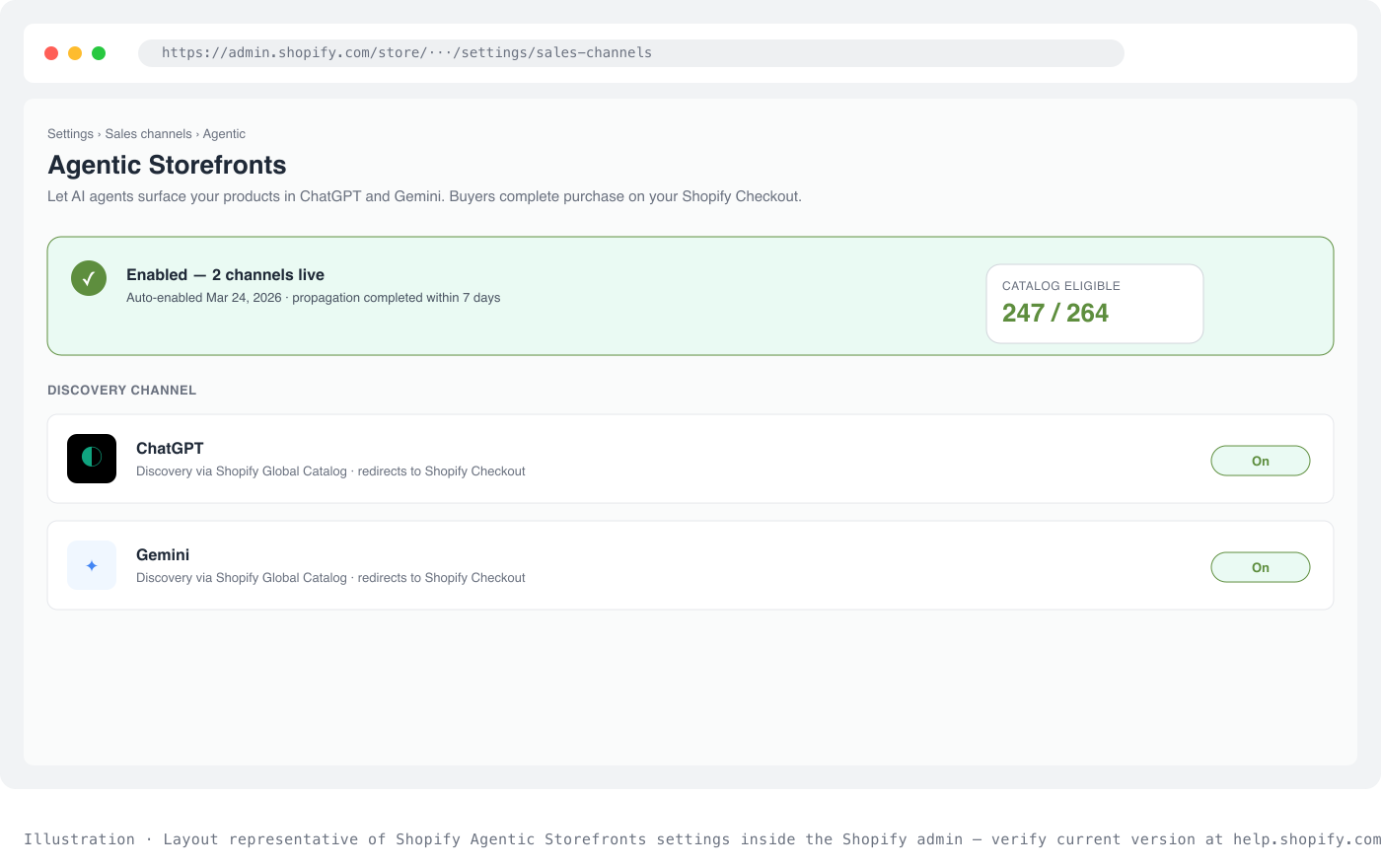
Illustration · Layout representative of Shopify Agentic Storefronts settings; verify current version at help.shopify.com/en/manual/online-store/agentic-storefronts.
llms.txt. Add a simple llms.txt file at your store root. Format is small: an H1 with your store name, a short intro, then a list of your important URLs with one-line descriptions. Top collection pages, top PDPs, About, Shipping, Returns. Ten minutes of work. No engine treats it as authoritative yet, but a few use it as a hint about what pages matter to you. Shopify doesn't ship this by default; you upload it via Files or serve it from a theme asset.
Sitemap. Shopify auto-generates /sitemap.xml. Confirm it's referenced from robots.txt (default managed one does this) and includes product and collection pages. After any big catalog change, resubmit it in Google Search Console.
Page speed. Slow product pages get crawled less often. Aim for a mobile LCP under 2.5 seconds. Shopify's built-in speed report in the admin plus Google PageSpeed Insights will tell you where you sit. Most speed wins on Shopify come from apps you no longer use. Audit and remove.
Phase 4 · Cross-web mentions and reviews
AI engines lean on off-site signals to decide who to recommend. A store cited by twelve third-party sources gets recommended more confidently than one that only cites itself.
The moves that work in 2026:
- Trustpilot, Google Reviews, and Shopify-native review apps. Aggregate review count and freshness matter more than raw stars. Ten reviews from the last month beats a hundred from three years ago. Judge.me, Loox, and Yotpo all sync Google Business review requests; use one.
- Category-specific review platforms. Any niche review site your category has (running gear, beauty, home goods). Shopify's app store lists integrations for most of them.
- Digital PR. Getting mentioned on Practical Ecommerce, category-specific blogs, and mid-tier publications. Same digital PR playbook that used to point at Google now points at AI engines too. Backlinko tracks the SEO signals overlap well.
- Reddit and community mentions. AI engines index Reddit heavily. Being organically discussed in your category subreddit is one of the strongest citation sources you can earn, and one of the hardest to fake.
- Comparison articles on third-party sites. Pitching your product for inclusion in someone else's "10 best X" roundup is unglamorous work that pays for years.
Digital PR still works. It's just aimed at a different reader now.
Phase 5 · Measurement
This is where the audit becomes a habit instead of a one-off.
The manual measurement loop, done monthly, takes about 90 minutes:
- Run your fixed prompt list against ChatGPT, Gemini, Google AI Mode, and Claude. Same prompts every month.
- For each prompt and each engine, note whether your store was named, whether it was cited with a link, and which competitors were named alongside.
- Log the results in a spreadsheet. One row per (prompt × engine × month).
- Calculate Share of Voice: your mentions divided by total store mentions in your batch. That's your baseline number.
For Google Analytics 4, build a segment that filters sessions with chat.openai.com, gemini.google.com, perplexity.ai, and claude.ai as referrer sources. Traffic from those referrers is not attribution-clean (many AI-referred visits arrive with no referrer at all), but the trend line is directional.
Mention Network runs this exact loop as its Phase 1 AI Visibility Check inside the Shopify admin, across the same four engines with 5 auto-generated shopper intents per product, and returns a Visibility Report with per-engine Chatbot Visibility, per-prompt Search Intent, and a Market Position table showing how you rank on Share of Voice against the retailers you actually compete with. Install from the Shopify app store; the free starter credit gets you through the first scan (1 product, 1 location, 1 language, 4 engines, 5 intents) without a card.
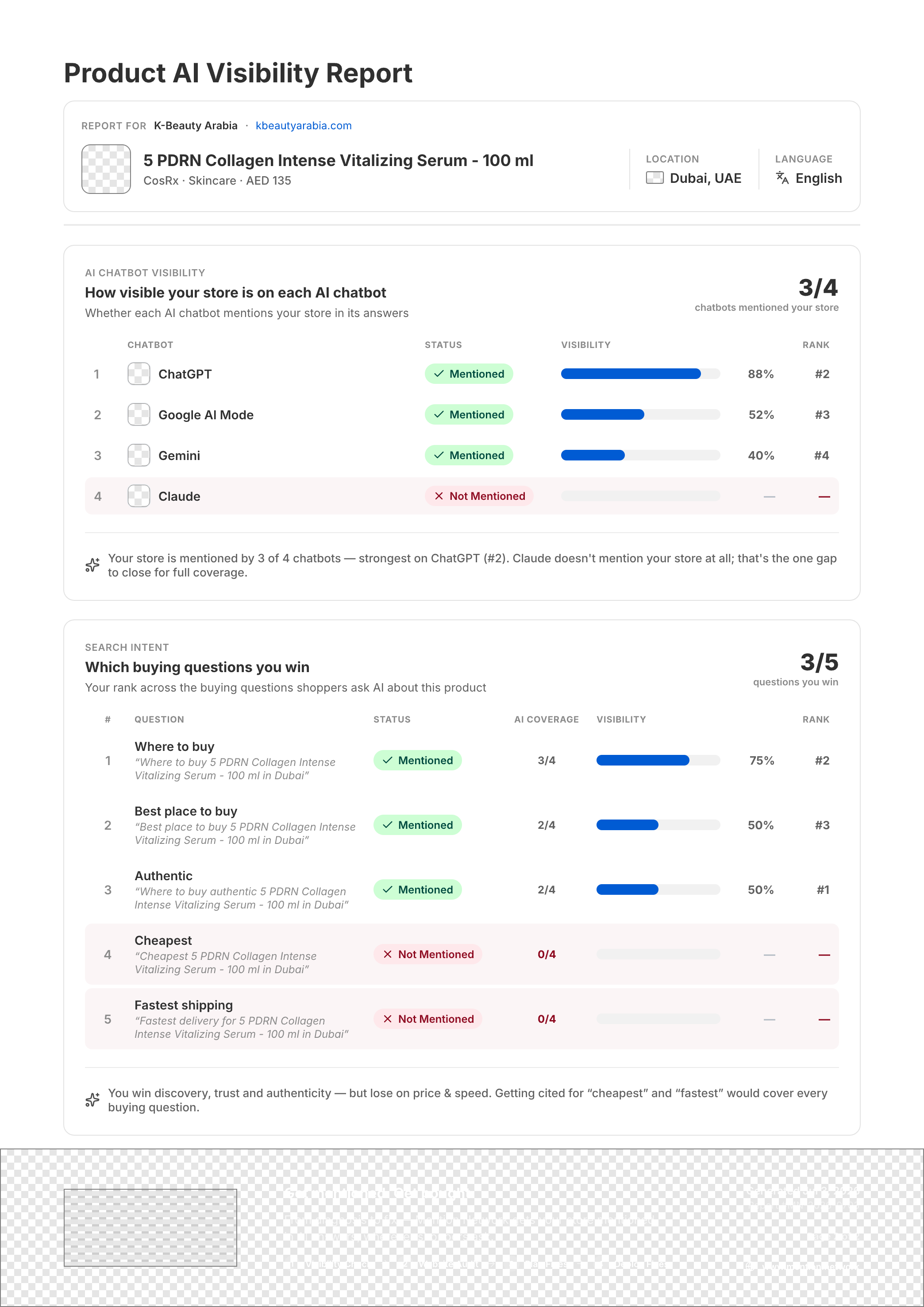
The Visibility Report is the automated version of the 30-prompt template below. Manual template first, product later.
The 30-prompt manual scan template
Here's the fixed prompt list to run each month. Adapt the category words to your store, keep the shape.
Brand-level prompts (6):
- Where can I buy [your category] online?
- What's the best online store for [your category]?
- Who sells [your category] in [your target country]?
- I need [your category] fast, who ships quickly?
- What are the top ecommerce sites for [your category] under $[typical price]?
- Recommend a store for authentic [your category].
Product-level prompts, per top 5 SKUs (20 total, 4 per SKU):
- What's the best [SKU category] for [primary use case]?
- Where can I buy [specific SKU or close variant] online?
- Cheapest place to buy [SKU category]?
- Fastest shipping on [SKU category]?
Competitor-comparison prompts (4):
- Is [your store] or [competitor 1] better for [category]?
- [Your store] vs [competitor 2] for [category], which one?
- Alternative to [competitor 3] for [category]?
- Cheaper alternative to [competitor 1] for [category]?
Run all 30 against ChatGPT, Gemini, Google AI Mode, and Claude, one engine at a time, in a fresh session per engine per month. That's 120 answers to skim. Speed comes with practice, but budget 60 to 90 minutes the first time.
Where Mention Network fits
Full disclosure: Mention Network is my team's product. It automates most of the audit you just read, and here's the honest mapping between the manual phases above and what the app actually does.
Phase 1 · AI Visibility Check (free starter credit). The scan we run is the same 5-intent × 4-engine loop the 30-prompt template gives you, wired directly to your Shopify catalog through the Admin API. Pick a product, pick a location, pick a language; the scan generates the five shopper intents automatically (where to buy, best place to buy, where to buy authentic, cheapest, fastest shipping) and runs them across ChatGPT, Gemini, Google AI Mode, and Claude. The Visibility Report lands with five metrics: Visibility Score (%), AI Coverage (x/4), Share of Voice, Chatbot Visibility per engine, and Search Intent per prompt, plus a Market Position table that ranks you against every other retailer AI named alongside you, with price delta and shipping delta columns pulled from those same AI answers. That last piece, competitive price/shipping signal from AI answers, is the specific thing no manual template can replicate.
Phase 2 · Website Audit (credit-based). The manual phases 1 through 4 above collapse into a single automated audit graded against a 48-criterion framework across four factors: Discoverability (14 signals covering schema, crawler access, structured data), Content Quality & Coverage (13 signals covering product facts, decision support, AI-readiness), Entity, Trust & Authority (19 signals covering reviews, mentions, backlinks), and Merchant Competitiveness (2 signals: price-competitive and shipping-competitive, both reusing data from Phase 1). Each criterion gets a Weak / Moderate / Strong badge and a specific reason. The point of grading is Phase 3.
Phase 3 · Optimization Plan (credit-consuming). For every criterion scored Weak or Moderate, the plan drafts the specific fix: the new schema field, the missing FAQ, the shipping-copy rewrite. On-store fixes get a concrete diff you can approve. Off-store items (Google Reviews, Reddit mentions, editorial backlinks) go to advice-only because we can't ship for you there.
Phase 4 · Deploy Fixes (preliminary spec). The on-store fixes get applied directly through the Shopify Admin API with your preview and approval. No manual copy-paste, no dev ticket, no theme edit.
The free starter credit covers Phase 1 for one product with no card, so you can see the manual audit's Phase 5 measurement layer done automatically in about 90 seconds. That's the fastest path to the same "here's where you stand" answer this checklist ends on, and unlike most vendors in this space, there's no demo gate between you and it.
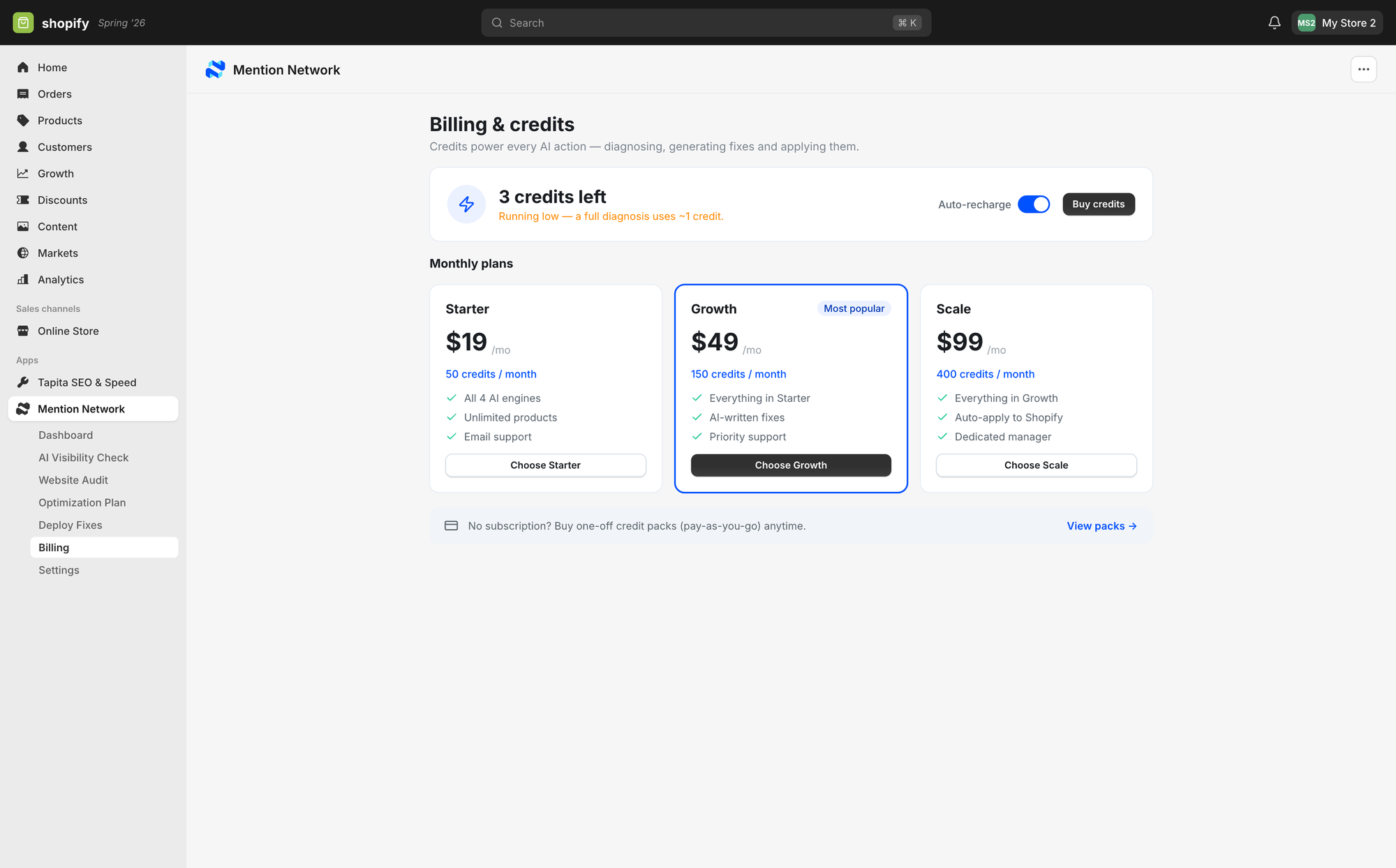
Pay-as-you-go credits inside the Shopify admin, mapped one-per-phase. First check-up runs on the starter credit, no card required.
For the wider Shopify AI picture, covering the internal tools (Magic, Sidekick) plus the external AI-answer channel, our Shopify AI merchant guide covers both layers side by side. If you want to see how AI actually picks products to show in ChatGPT shopping answers, the Shopify ChatGPT integration playbook walks through the five moves that get a store surfaced there.
5 things to do this week
If you close this tab and only ship five items in the next seven days, ship these:
- Open Settings > Sales channels > Agentic Storefronts. Confirm it's enabled, ChatGPT and Gemini are on, and eligible product count matches what you sell. If not, fix the four gating items (US availability, catalog eligibility, policy pages, accepted terms).
- Run Google's Rich Results Test on your top 3 product templates. Fix any Product, Offer, or aggregateRating errors, especially missing
brandorgtin. - Write and upload a small llms.txt file at your store root, listing your top 15 URLs (collections, top PDPs, About, Shipping, Returns).
- Add a real-question FAQ block to your top 5 PDPs, phrased in shopper language pulled from your support inbox. Confirm the FAQPage JSON-LD renders in the source, not just the visible block.
- Pick your 30-prompt list. Run it once against all four engines. Save the answers. That's your baseline, and every month from here is a comparison against it. Or install Mention Network and let the app run the same scan for you.
That's the whole first-round audit. The rest of what I wrote above is a fuller playbook to grow into, but shipping those five moves will already put you ahead of most Shopify stores on AI visibility.
Keep your Shopify SEO settings clean. Add an AI-visibility scan next to them.