
Shopify ChatGPT Integration: The 2026 Merchant Playbook
Instant Checkout is dead. Agentic Storefronts is what actually works. Here is how Shopify products show up in ChatGPT today, why the checkout flow changed in March 2026, and the five moves a merchant needs to make.

If you Googled "shopify chatgpt integration" any time in the last nine months, you got a moving target. September 2025 brought Instant Checkout, the demo that let shoppers buy from Shopify merchants without leaving the chat. March 2026 quietly killed it. Then Shopify shipped Agentic Storefronts, and the whole flow rewired again.
For merchants, the practical question is small and specific: what do you do this quarter to show up in ChatGPT shopping answers?
This is that playbook, written after the dust settled.
Jump to:
- What the Shopify ChatGPT integration actually is in 2026
- How Instant Checkout worked, and why it stopped
- Availability and eligibility today
- How ChatGPT picks a product to name
- Five moves to make this quarter
- Where ACP is heading, and what to watch
- What this means next to your existing SEO stack
What the Shopify ChatGPT integration actually is in 2026
Two things share the name, and they do different jobs. Both matter.
Agentic Storefronts is the Shopify side. It is a discovery channel that publishes eligible Shopify products into ChatGPT and Gemini via Shopify's Global Catalog. Shoppers see products in the chat, click through, and complete checkout on the merchant's own store, either in the ChatGPT in-app browser on mobile or a new tab on web. Shopify's own page says it plainly: sales run through Shopify Checkout, powering 14% of US ecommerce.
Agentic Commerce Protocol (ACP) is the OpenAI side. It is an open protocol co-created with Stripe that describes how AI agents talk to retailers about product discovery and, eventually, purchase. ACP is what ChatGPT uses to fetch structured product data. Named ACP retail partners on OpenAI's side are Target, Sephora, and The Home Depot, per OpenAI's May 2026 update. Shopify is not on that partner list. What Shopify offers instead is the Agentic Storefronts pipeline, which produces a similar end result for shoppers without needing merchants to integrate with ACP directly.
The short version: your Shopify store can already surface in ChatGPT today, without you signing anything with OpenAI, because Shopify Catalog is doing the plumbing for you.
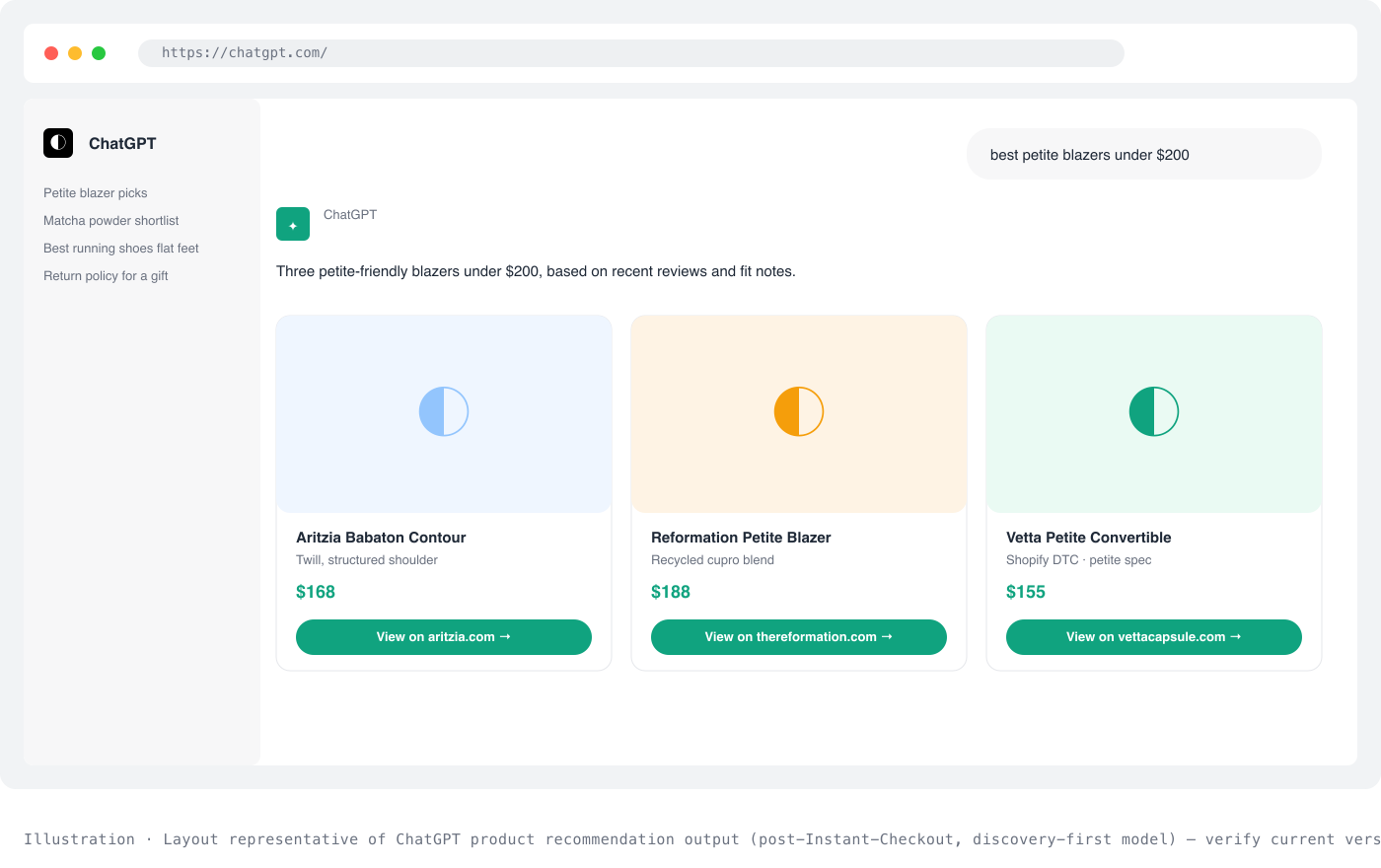
Illustration · Layout representative of ChatGPT product recommendation output (post-Instant-Checkout, discovery-first model), verify current version at chatgpt.com/merchants.
How Instant Checkout worked, and why it stopped
Instant Checkout launched September 29, 2025. The promise was straight from OpenAI's blog: "with over a million Shopify merchants, like Glossier, Skims, Spanx, Vuori, and more," shoppers could buy in-chat.
In March 2026, six months later, OpenAI shelved it. Their own statement, quoted in Exploding Topics' post-mortem on the Agentic Commerce Protocol: the initial version "did not offer the level of flexibility we aspire to provide."
Two things happened underneath. First, ACP research showed trust caps that hurt in-chat conversion: 41% of shoppers described themselves as skeptical of autonomous AI purchases, 33% called it suspicious, and the median trust threshold for an autonomous AI spend capped at about $50. Second, Shopify's own March 2026 announcement of Agentic Storefronts reframed the flow: discover in ChatGPT, buy on the merchant store. Merchants keep the customer relationship. Shopify keeps Shopify Checkout in the loop. Shoppers get a checkout they already trust.
If you were writing a merchant strategy in October 2025 around Instant Checkout, the plan aged badly. If you write one today around Agentic Storefronts and AI visibility, the plan holds.
Availability and eligibility today
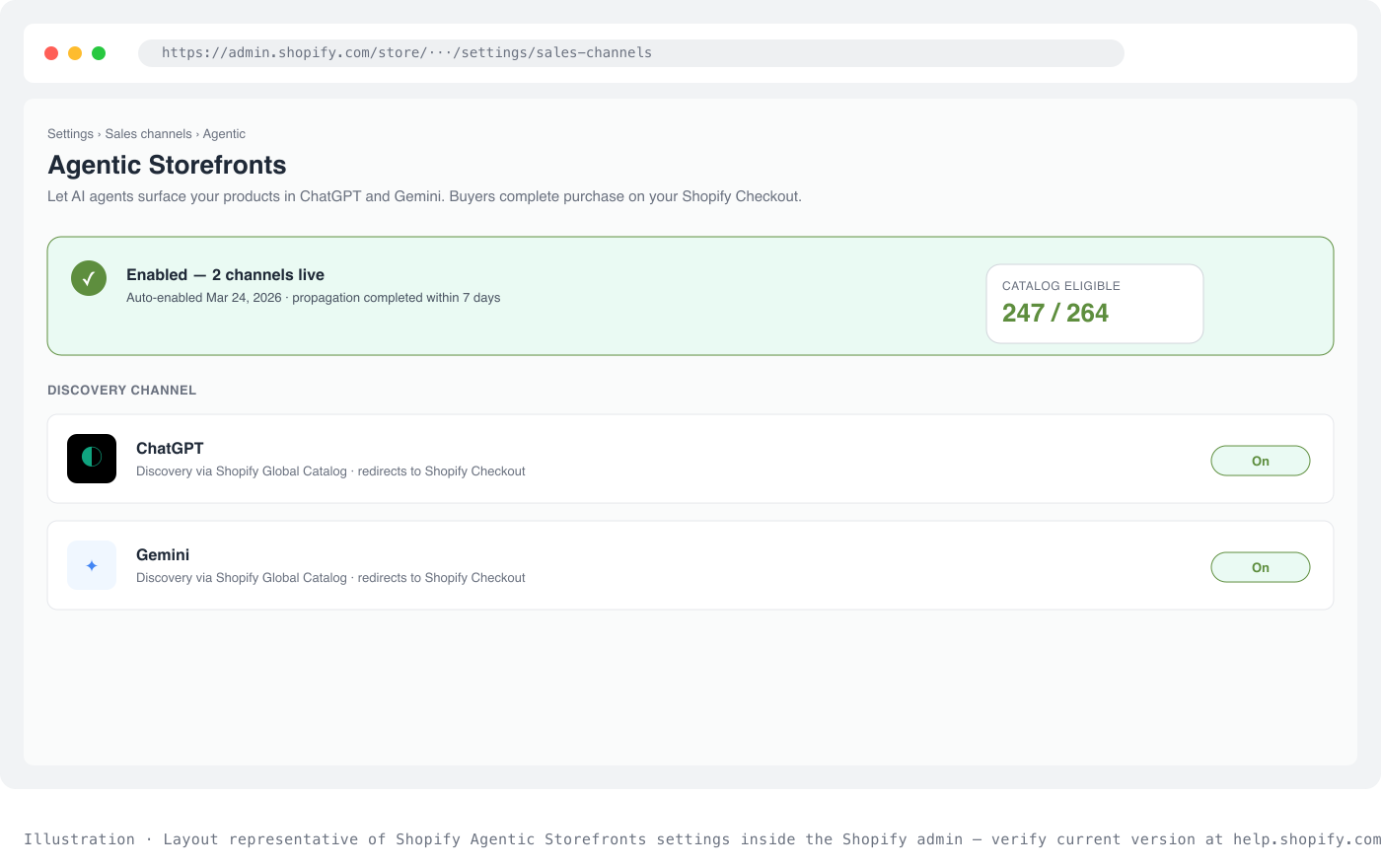
Illustration · Layout representative of Shopify Agentic Storefronts settings inside the Shopify admin, verify current version at help.shopify.com/en/manual/online-store/agentic-storefronts.
For most Shopify merchants, Agentic Storefronts is on by default. Shopify's help doc is direct about this: "you don't need to do anything for your products to be discovered by the ChatGPT agentic storefront."
Eligibility rules:
- The store sells to US customers (store location can be elsewhere).
- Products qualify for Shopify Catalog.
- Terms of Service, Privacy Policy, and Return / Refund Policy are complete in Settings.
- The store accepts Shopify's Agentic Storefronts terms.
If any of those are missing, that is your first fix. Go to Settings, complete the policy pages, save. Processing propagation takes up to seven days after any Sales channels, Agentic change.
Merchants outside the US, or in categories Shopify Catalog does not cover yet, are on the outside of Agentic Storefronts for now. The visibility levers below still apply, because ChatGPT retrieves the open web too, not just structured retail catalogs.
How ChatGPT picks a product to name
Zoom in one level. When a shopper asks ChatGPT "best running shoes for flat feet under $150," the model does four things in sequence, and merchant work influences each one.
Retrieval. ChatGPT queries its search-and-web-browsing subsystem for products, reviews, and category context matching the intent. Sources include indexed pages crawled by GPTBot, real-time web search when the query is fresh, and structured catalog feeds like Shopify's Global Catalog for eligible stores.
Ranking. From the retrieved pool, candidates get scored against buyer intent. Product schema (Product, Offer, Review, aggregateRating) does heavy lifting here. A page with clean schema is easier to reason over than an HTML wall.
Presentation. Two to five products survive scoring and get formatted into shopping cards, name, one-line positioning, price, and, for Agentic Storefronts merchants, a link that opens the merchant store checkout.
Handoff. ChatGPT opens the store's checkout page in the in-app browser or new tab. The shopper completes on Shopify Checkout. The merchant gets a normal Shopify order in the admin.
That handoff step is the one that changed in March 2026. In the Instant Checkout world, the transaction completed inside ChatGPT. In the Agentic Storefronts world, ChatGPT is a shop window, and the merchant store is the register.
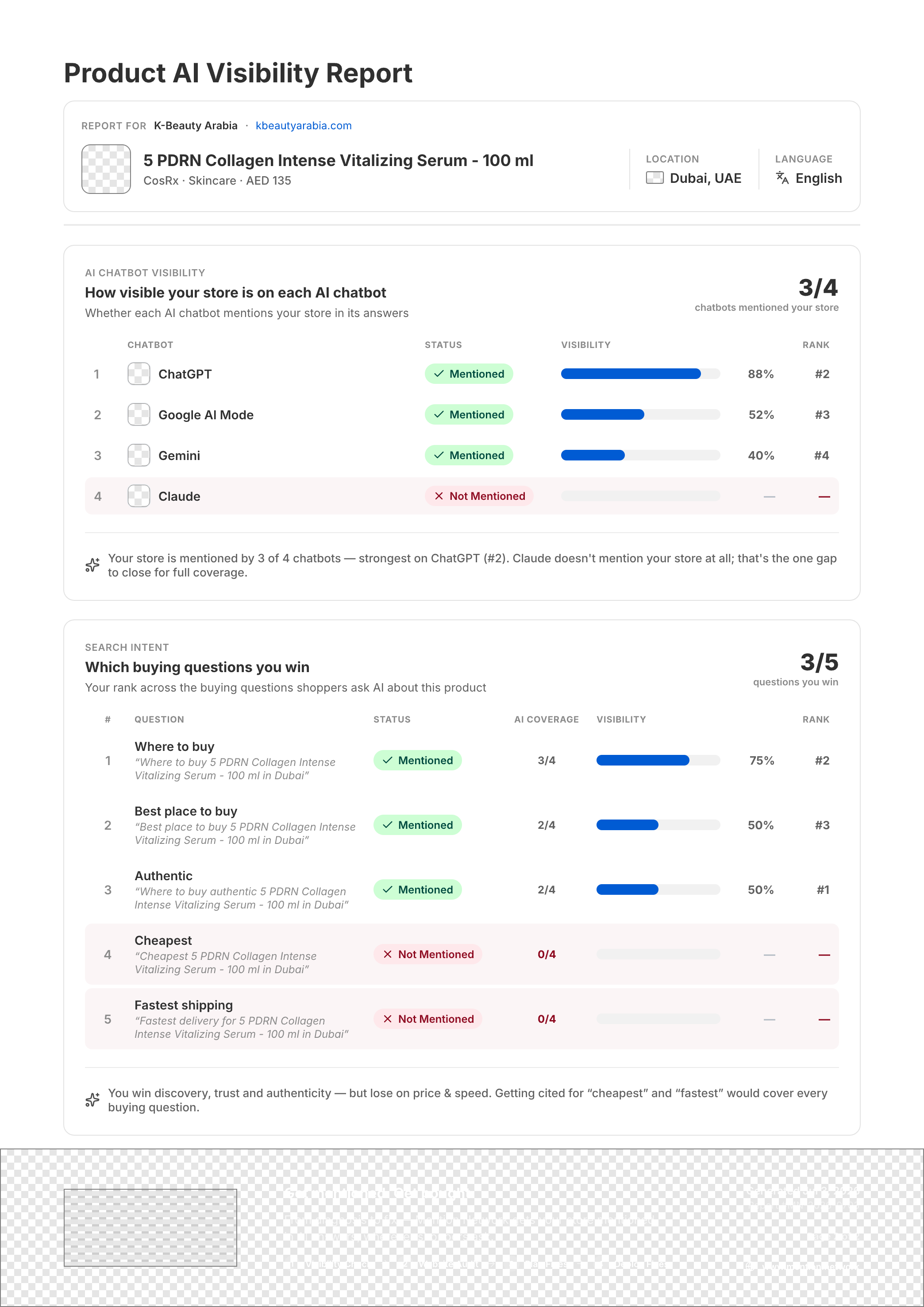
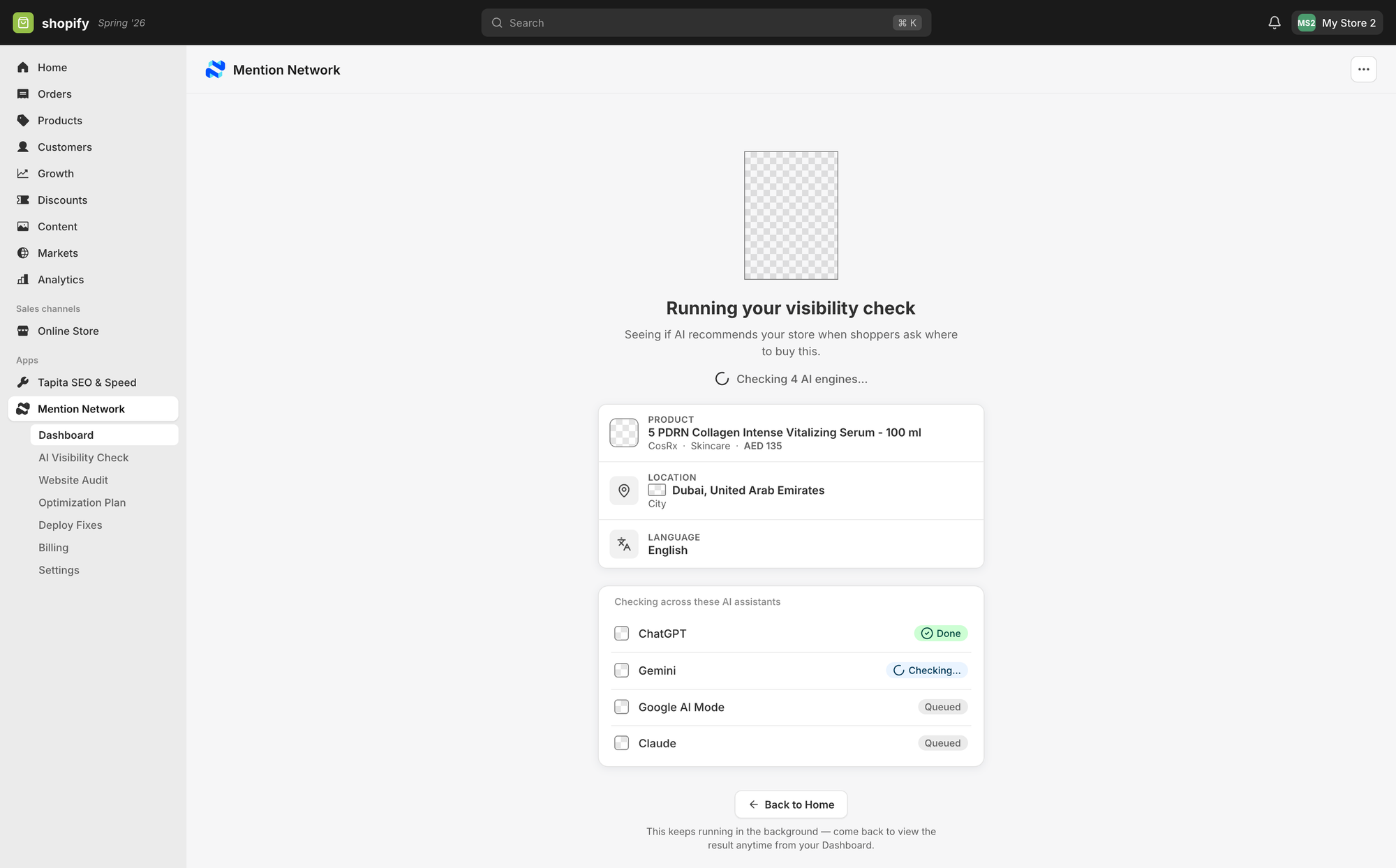
Per-model visibility breakdown inside the Shopify admin. The gap between "brand visible" and "specific product visible" is where most stores lose ChatGPT-driven sales.
Five moves to make this quarter
Not everything you do on the store matters. Five moves cover 80% of the work.
1. Confirm Agentic Storefronts is on, and your policies are complete
Log into Shopify admin, open Sales channels, look for Agentic. If it's there, confirm ChatGPT is active. If it isn't, work your way through the eligibility checklist above. This is a settings task, not a code task, and it's the closest thing to a free lever a Shopify merchant has this year.
2. Ship Product schema depth on your top SKUs
Shopify emits basic Product schema by default on most themes. Depth varies. Open Google's Rich Results Test on your best-margin product pages and check for Offer, availability, price, brand, and aggregateRating. Missing aggregateRating alone can knock a product out of the shopping cards. Fix at the theme level, or install a schema plugin like Yotpo, Judge.me, or Loox that syndicates review data into the right shape.
3. Rewrite FAQ blocks in the buyer's own words
ChatGPT weighs text that matches the buyer's phrasing. FAQ blocks are the highest-yield place to plant that phrasing. Pull the last 20 customer support tickets on your best-margin product. The questions your buyers actually ask, in the words they use, belong on the product page as FAQ items. This is old-school on-page SEO, applied to a new ranking layer.
4. Earn third-party mentions on trusted category sites
ChatGPT weights mentions on Reddit, niche category blogs, Practical Ecommerce, and category authorities as trust signals. A store cited on 12 external sites gets recommended with more confidence than one only mentioned on its own domain. Plan two guest posts or two Reddit contributions per month in your category. Digital PR, applied to the AI-answer era.
5. Baseline, then measure monthly
You can't improve what you don't measure. Run an AI visibility scan across ChatGPT, Perplexity, Gemini, and Google AI on the 10 buying questions your shoppers actually ask. Note share of answers per engine and which competitors get named. Rerun in 30 days. Iterate on the signal that moved least.
Where ACP is heading, and what to watch
Instant Checkout is off, but ACP is very much on. As of mid-2026:
- Named ACP retail partners on OpenAI's side: Target, Sephora, The Home Depot.
- Protocol adopters on the payments side: Google's Agent Payments Protocol (AP2), Visa Intelligent Commerce, Stripe's Machine Payments Protocol.
- On the AI side: Perplexity has shifted its Shop Like A Pro flow toward discovery-focused features that overlap with ACP's shape.
The likely 2026 to 2027 endpoint is a resurrected in-chat purchase, gated by category and dollar amount, with better trust affordances (delivery ETA visible, price locked, cancellation clear). Merchants who invest in Product schema and third-party mentions now inherit the AI visibility that flows through whatever protocol wins.
If Agentic Storefronts is a car, ACP is the road. Both are being built at the same time. Merchant work sits on the car.
What this means next to your existing SEO stack
The full stack for a Shopify merchant in 2026 keeps three tracks in parallel.
Google SEO (Semrush or Ahrefs, GA4, Search Console) stays. Zero-click has grown, not gone, and Google still sends the largest chunk of ecommerce traffic. AI visibility (Mention Network or a monthly manual scan) sits alongside it, tracking share of answers across ChatGPT, Perplexity, Gemini, and Google AI. Retail media (Shopify Catalog, Google Merchant Center, Amazon if you're on it) is the third track, feeding structured product data into every discovery surface.
Merchants who add the AI visibility track this quarter compound the advantage against merchants who wait for the category to force it. In the SERP era, the win came from ranking on page one. In the AI-answer era, the win is being one of the three products ChatGPT names when a shopper asks. Same discipline, different surface.
Curious how ChatGPT sees your Shopify store today? Run a free Mention Network AI visibility check and get a per-engine report inside your Shopify admin.
Related reading:
- What Is AI Visibility for Ecommerce? A 2026 Merchant's Guide, the foundation guide this playbook builds on.
- SimilarWeb Alternative for Ecommerce: Mention Network vs SimilarWeb, how AI visibility differs from traffic analytics.
- Mention Network vs Semrush AI Visibility Toolkit, the AI visibility layer inside the SEO tool you already use.
- Shopify AI in 2026: A Merchant Guide, the wider picture of internal Shopify AI tools plus external AI-answer visibility.
- How to optimize your store for ChatGPT shopping, the store-level fixes that make ChatGPT surface your products.
- Connecting Shopify and Amazon data to ChatGPT shopping, how your product feed reaches AI buying answers.
Sources we cited or built on:
- Shopify's Agentic Storefronts help doc is the authoritative source on eligibility and merchant settings.
- Digital Commerce 360 on the March 2026 integration change documents the pivot from Instant Checkout to discovery-and-redirect.
- Exploding Topics on the Agentic Commerce Protocol covers ACP's timeline, retail partners, and the consumer-trust research behind the shift.
- Shopify's own Agentic Storefronts landing page shows the ChatGPT + Gemini + more positioning and the Shopify Catalog mechanic.