Semrush AI Visibility Toolkit vs Mention Network: Which Fits E-commerce Merchants (2026)
Semrush AI Visibility Toolkit ships as a feature inside a large SEO suite. Mention Network is purpose-built for e-commerce merchants who need product-level AI visibility. Here's how they compare on the jobs that actually move store revenue.

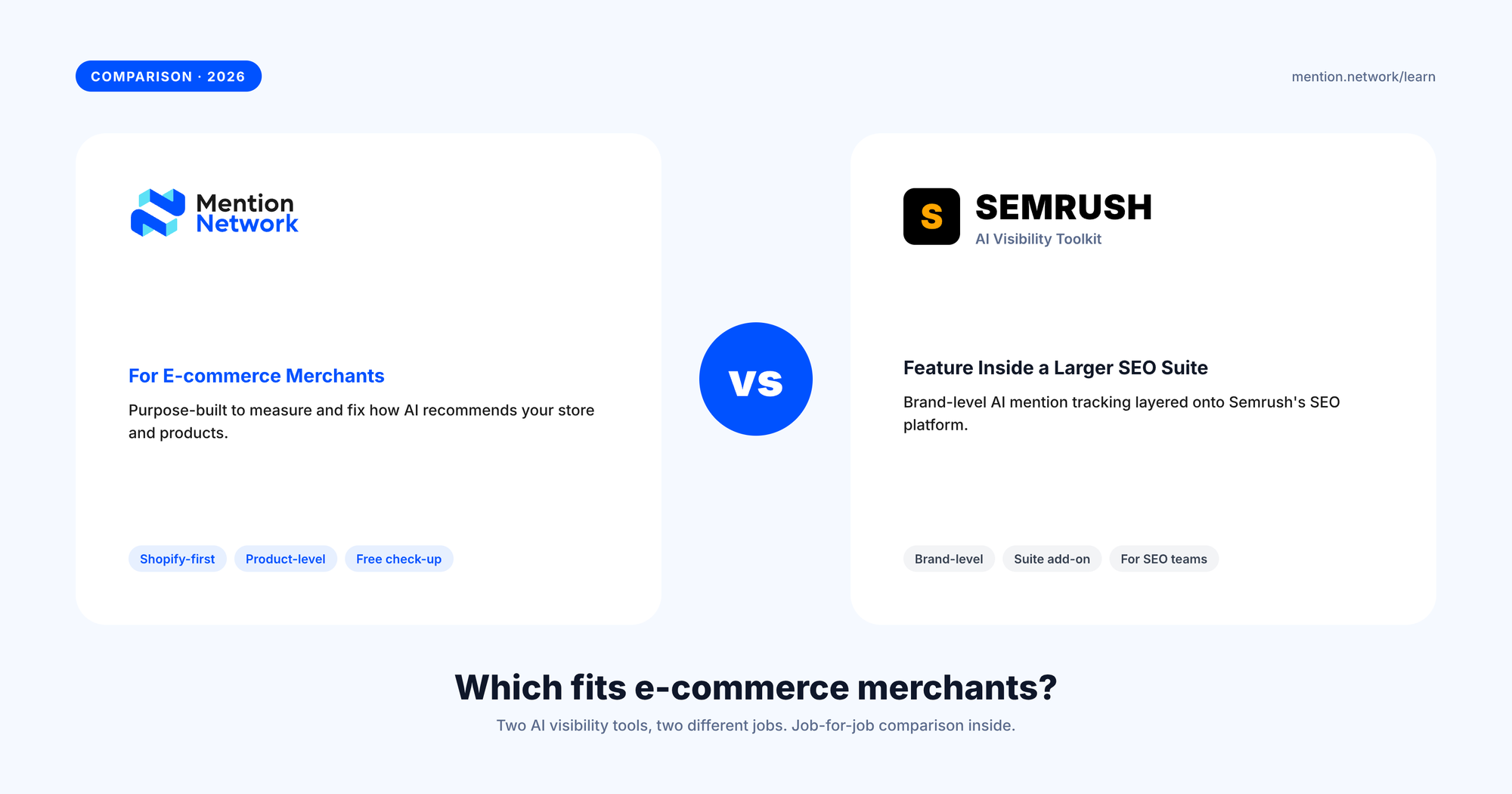
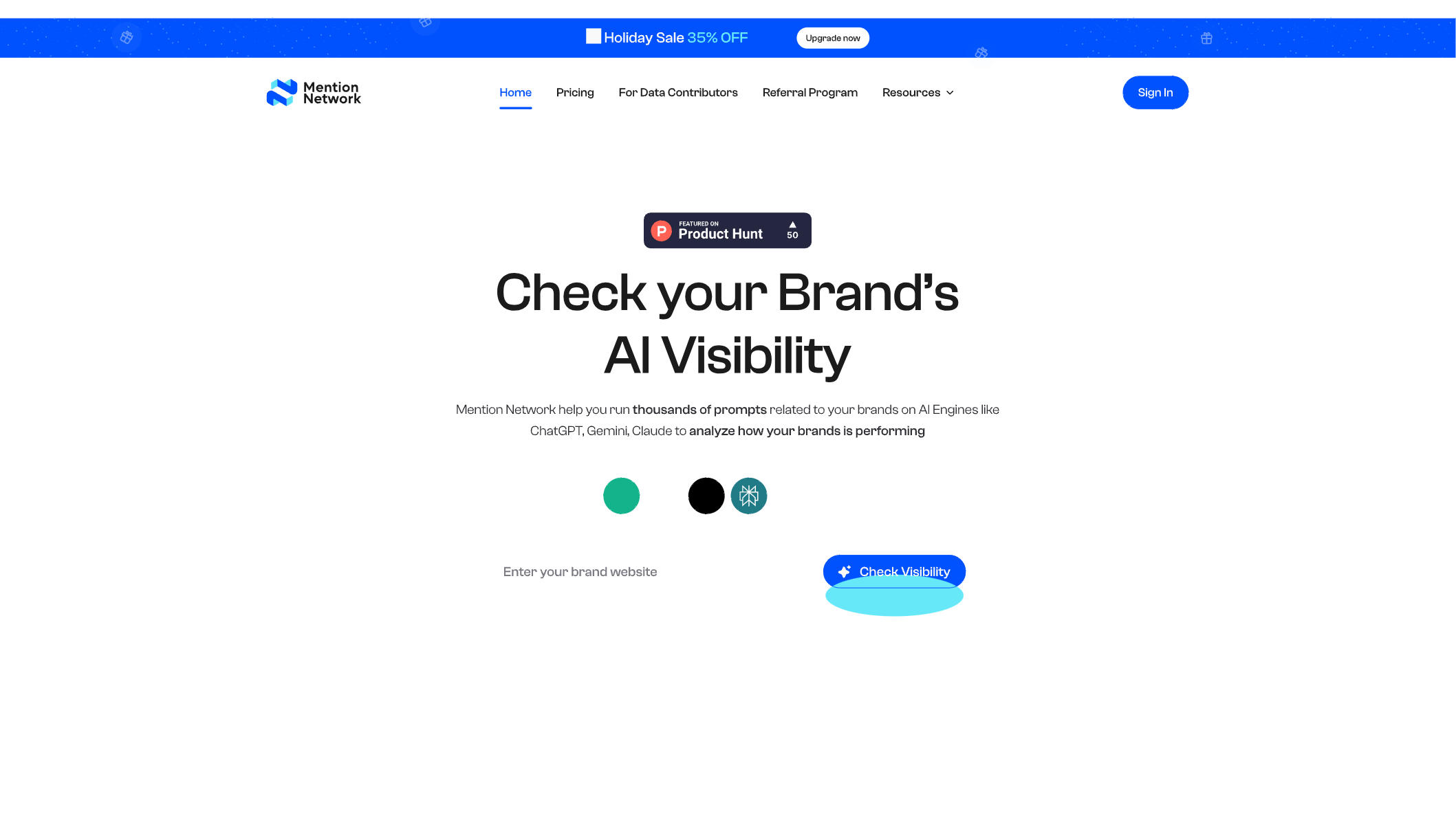
Semrush AI Visibility Toolkit landed inside a mature SEO suite you probably already pay for. Mention Network is a merchant-first platform that measures whether AI recommends your store and helps you fix the answer. Both address the AI-visibility question. They're built for different buyers, and they measure different things.
If you're an e-commerce merchant weighing the Semrush AI Visibility Toolkit against a specialized tool, the honest comparison is job-for-job rather than feature-for-feature. Does the Toolkit answer "is AI recommending my specific products?" Or does it stop at brand-level signals shaped for content marketers?
That's the question this article walks through. Concession up front: Semrush's full suite is a genuinely strong platform. Nothing here argues you should drop it. This comparison is narrower, and it's about one job the Toolkit was bolted onto rather than built around: when a shopper asks ChatGPT, Gemini, or Google AI what to buy or where to buy it, does the answer include your store and your products?
TL;DR: Semrush AI Visibility Toolkit tracks brand-level AI signals inside a full SEO suite. Mention Network adds the layer Semrush skips: product-level visibility, a store audit that explains why AI passes you over, and fixes you approve inside your store admin.
Short answer for the impatient: stack them. Keep Semrush for your blog and site SEO. Add Mention Network when your revenue depends on AI recommending your specific products.
How they stack up:
- Key Summary
- What Is Semrush AI Visibility Toolkit?
- What Is Mention Network?
- The Broader Semrush Suite (Context You Already Know)
- Does AI Recommend Your Store When Shoppers Ask Where to Buy?
- Product-Level vs Brand-Level Tracking
- From Tracking to Fixing
- How AI Picks Which Stores to Recommend
Key Summary
- Semrush wins the full-SEO-suite comparison outright, conceded up front. The only ring compared here is AI-visibility jobs for e-commerce merchants.
- Semrush AI Visibility Toolkit is a feature inside a larger platform. It tracks brand-level presence in AI answers, useful for content marketers watching share of voice.
- Mention Network works at two layers: Brand AI Visibility (is your brand named when shoppers ask AI about your category) and Product AI Visibility (does AI suggest your specific products and SKUs, including where-to-buy answers).
- Mention Network goes past tracking: measure, diagnose (a store audit built to explain why AI isn't picking you), fix (AI drafts the fix for your product page; you preview and approve it inside your store admin).
- Merchant-specific AI jobs like SKU-level recommendation tracking aren't documented Semrush Toolkit capabilities at the time of writing.
- The recommended setup for most stores is both: Semrush defends your Google visibility; Mention Network covers the AI-recommendation channel. Minimal overlap, minimal wasted spend.
At-a-glance job comparison
* n/a: not a documented Semrush AI Visibility Toolkit capability for this specific job at the time of writing. Semrush adds features regularly; verify against its current feature pages before deciding.
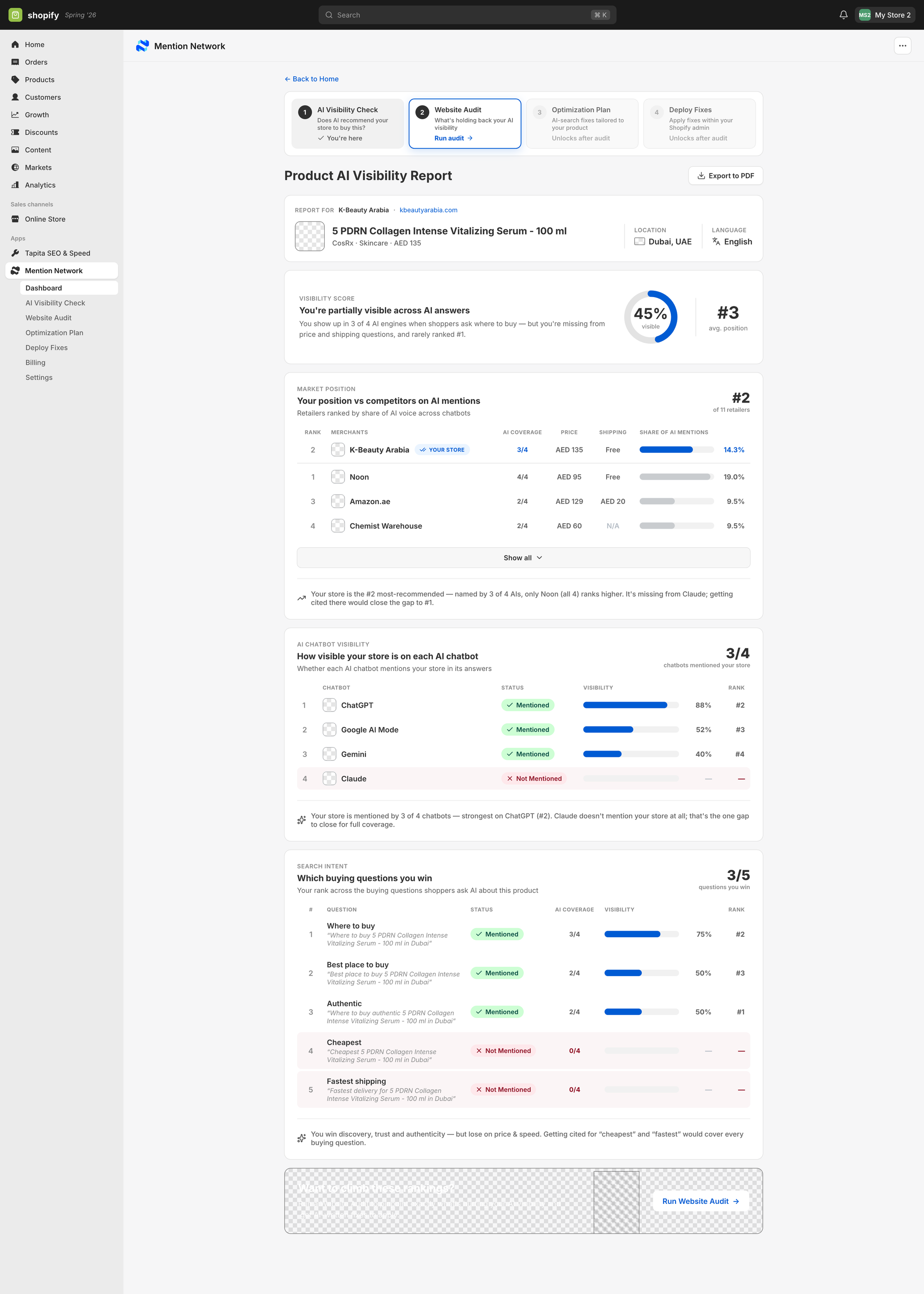
Mention Network AI Visibility Report inside the Shopify admin. Product-level rows (per-SKU passing/failing) are the layer Semrush's Toolkit does not document.
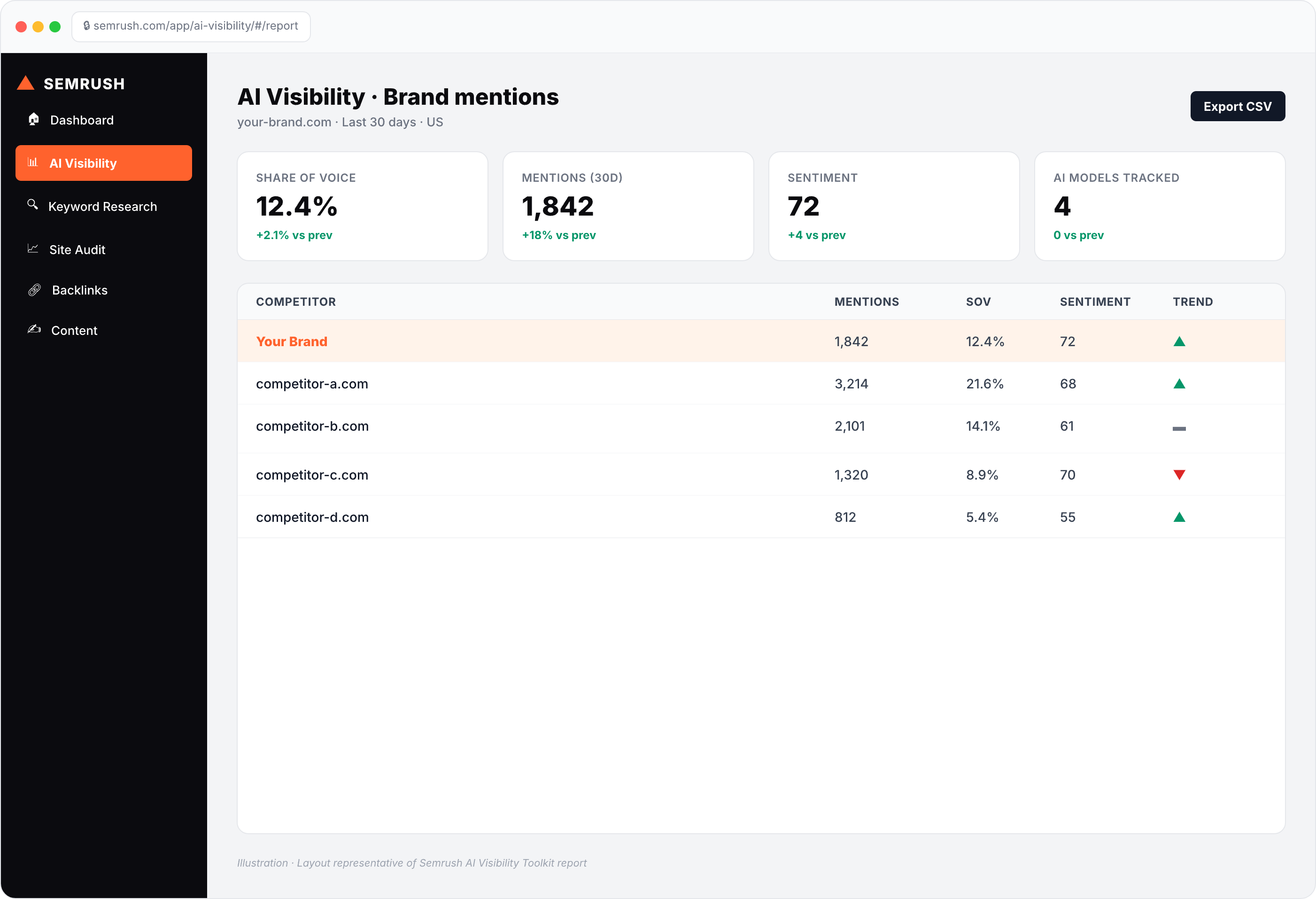
Semrush AI Visibility Toolkit reports similar KPIs at the brand and competitor level. Illustration based on the Toolkit's public framing; verify current layout on Semrush.
What Is Semrush AI Visibility Toolkit?
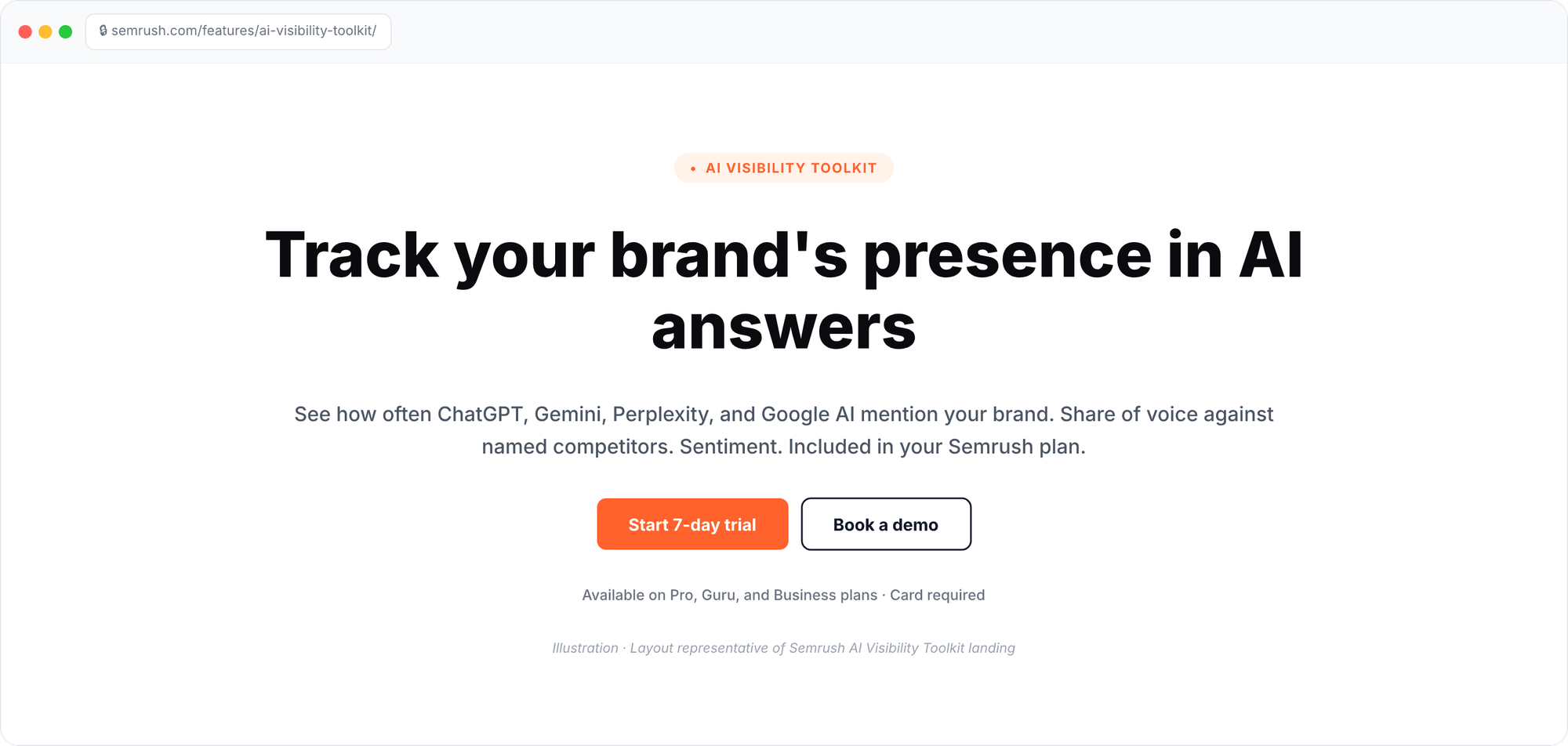
The Toolkit's landing pitch: brand-level tracking across the major AI answer engines, included in Pro/Guru/Business plans. Illustration based on public materials.
Semrush shipped its AI Visibility Toolkit as a module inside the broader Semrush platform. The Toolkit measures how your brand shows up in AI-generated answers across engines like ChatGPT, Google AI Overviews, and Perplexity, with the same reporting DNA the rest of the suite uses: charts, filters, competitor benchmarking, share-of-voice trends.
For a marketing team that already lives inside Semrush's dashboards, the appeal is obvious. You get an AI-visibility signal without adding a new vendor to the stack, a new login for the team, or a new invoice for finance. The Toolkit inherits Semrush's UX, its permissions, its data export patterns.
The framing is brand-first. You track how often your brand name appears in AI answers, which competitors appear alongside you, and what topics or prompts trigger those mentions. Content marketers watching share of voice will recognize the shape of it. It's Semrush's brand-monitoring lens re-tuned for the AI channel.
What the public materials don't document, at least at the time of writing, is a merchant-specific view: whether AI recommends your specific SKUs when a shopper describes a need, whether your store appears in where-to-buy answers, or whether the Toolkit understands your product catalog as the thing being measured. Those are the questions Mention Network was built to answer.
What Is Mention Network?
Mention Network is the AI-visibility platform built for e-commerce: measure, diagnose, and fix how ChatGPT, Gemini & Google AI surface your brand and products. The starting question is simple: is AI recommending your store and products? A free check-up answers it.
It looks at your AI visibility on two layers:
- Brand AI Visibility: when shoppers ask AI about your category, is your brand named or recommended? And when they ask about you directly, what does AI actually say?
- Product AI Visibility: does AI suggest your specific products and SKUs when a shopper describes a need, including where-to-buy answers?
Where most tools stop at tracking, Mention Network's workflow is designed around three steps: measure your visibility across ChatGPT, Gemini, Google AI, and other AI engines; diagnose with a store audit built to explain why you're not being picked; and fix: AI drafts the fix for your product page, and you apply it inside your store admin with a preview and your approval. Everything is grounded in real data from your store, contrasted with what AI claims.
It's built for merchants rather than enterprise marketing teams: non-technical, self-serve, free check-up entry, pay-as-you-go credits, no demo gate, no contract. It ships as a Shopify app first, with WooCommerce and custom storefronts planned via API. New to the discipline? Start with our guide on what AI visibility is and why it matters.
The Broader Semrush Suite (Context You Already Know)
The AI Visibility Toolkit sits inside a much larger platform. If you're evaluating it, you probably use pieces of that platform already:
- Keyword research and tracking: extensive data on what people search for and how you rank
- SEO auditing and optimization: technical site health checks and on-page recommendations
- PPC campaign management: paid search planning alongside organic work
- Content marketing tools: content strategy, briefs, and optimization
- Backlink analysis: deep visibility into link profiles for you and competitors (if you want the deep-end version of that discipline, Backlinko's link-building guide is the canonical starting point)
- Brand monitoring and competitor analysis: through the lens of search rankings, backlinks, and share of search visibility
For an online store, that suite maps to real jobs: ranking your blog content, keeping your site technically healthy, understanding competitors' search strategies. Semrush has been shipping AI-related features on top of that foundation for a while. The AI Visibility Toolkit is the most direct product in that lineup. The rest of this comparison focuses on it.
Does AI Recommend Your Store When Shoppers Ask Where to Buy?
A shopper who asks ChatGPT "what's a good ceramic pour-over set under $50, and where should I buy it?" gets one synthesized answer naming a handful of brands, products, and stores. You're either in that answer or you're invisible: there is no page two. It's a different question from "do I rank?"
Mention Network is built around exactly this: whether your brand gets named when shoppers ask AI about your category, whether your store shows up in where-to-buy answers, and what AI says when someone asks about you directly. That last part matters: AI engines will happily describe your store whether or not the description is accurate, which is why Mention Network contrasts what AI claims with real data from your store.
Semrush's AI Visibility Toolkit does capture some of this at the brand level: if ChatGPT names "Your Brand" in response to a category query, the Toolkit will register it. Where the gap opens is the product layer and the where-to-buy layer. Neither is a documented Toolkit capability at the time of writing. HubSpot's rundown of AEO optimization tools is a decent map of the AI-answer surface if you want a category-level walk-through. To go deeper on what to measure in this channel, see our breakdown of key metrics and tools for measuring your brand's AI visibility.
Feature comparison: brand vs product tracking
Who leads in this ring: Mention Network. It's the job the product exists for. Semrush AI Visibility Toolkit covers the brand row honorably, and skips the rest.
Product-Level vs Brand-Level Tracking
Most AI-visibility discussion happens at the brand level: is your company mentioned, who else gets named. Necessary, but for a merchant it's not sufficient. Shoppers buy a specific product, and AI recommends specific products.
Mention Network tracks both layers separately:
- Brand level: whether AI names or recommends your brand for category questions, and what it says when asked about you.
- Product level: whether AI suggests your specific products and SKUs when a shopper describes a need, including whether your store appears as the place to buy them.
The product-level layer is what makes the data actionable. "Your brand has weak AI visibility" is a diagnosis you can't act on; "AI recommends your category but never surfaces this product" points at a specific page in your catalog.
Semrush's tracking granularity is built around keywords, URLs, and domains, the right units for SEO work. Product- and SKU-level AI recommendation tracking is not a documented Semrush capability at the time of writing; verify against its current pages, but as of now this is a ring Semrush isn't fighting in.
Who leads in this ring: Mention Network, on the strength of the product/SKU layer.
From Tracking to Fixing
Here's the honest problem with visibility dashboards of every kind: knowing your number went down doesn't tell you what to change on Tuesday morning.
Mention Network's differentiating bet is that the workflow is the product. After measuring your brand and product visibility, it runs a store audit designed to explain why AI isn't picking your store or a given product. Then, instead of handing you a PDF of recommendations, the workflow is built so AI drafts the fix for the affected product page and you apply it inside your store admin, with a preview and your approval before anything changes. See the problem, see the proposed fix, approve it: a loop built for non-technical merchants.
To be fair inside Semrush's own territory: Semrush absolutely does actionability for SEO; its site audits and on-page recommendations are among the most mature in the industry. The distinction is where the fix lands. Semrush's recommendations target your website's SEO; Mention Network's workflow targets your product pages and store data, aimed at how AI engines describe and recommend them. If you're building out that discipline, our complete guide to generative engine optimization covers why store and product content shapes AI answers.
Who leads in this ring: Mention Network for on-store, AI-visibility fixes; Semrush for site-wide SEO fixes. They're different fixes to different problems.
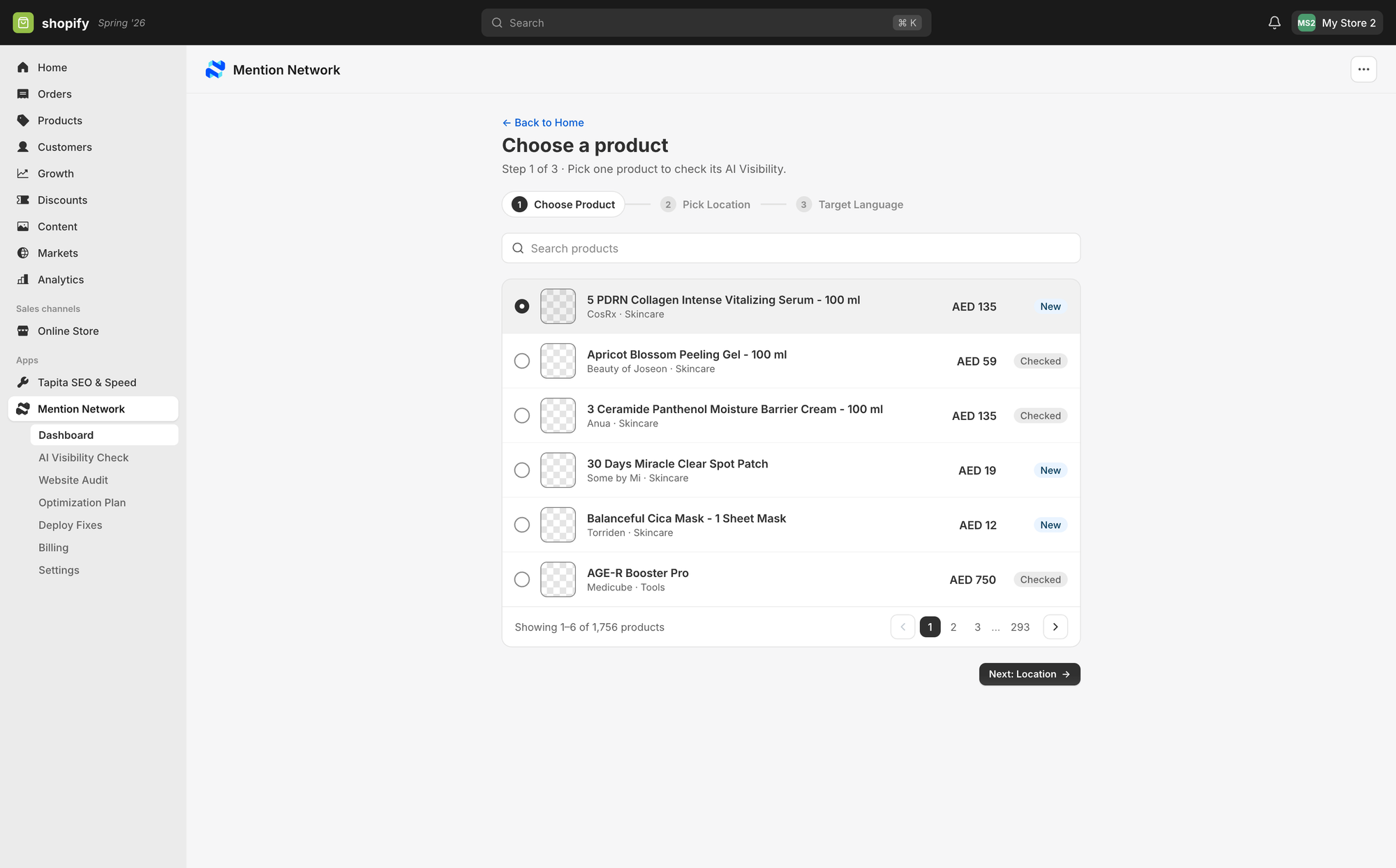
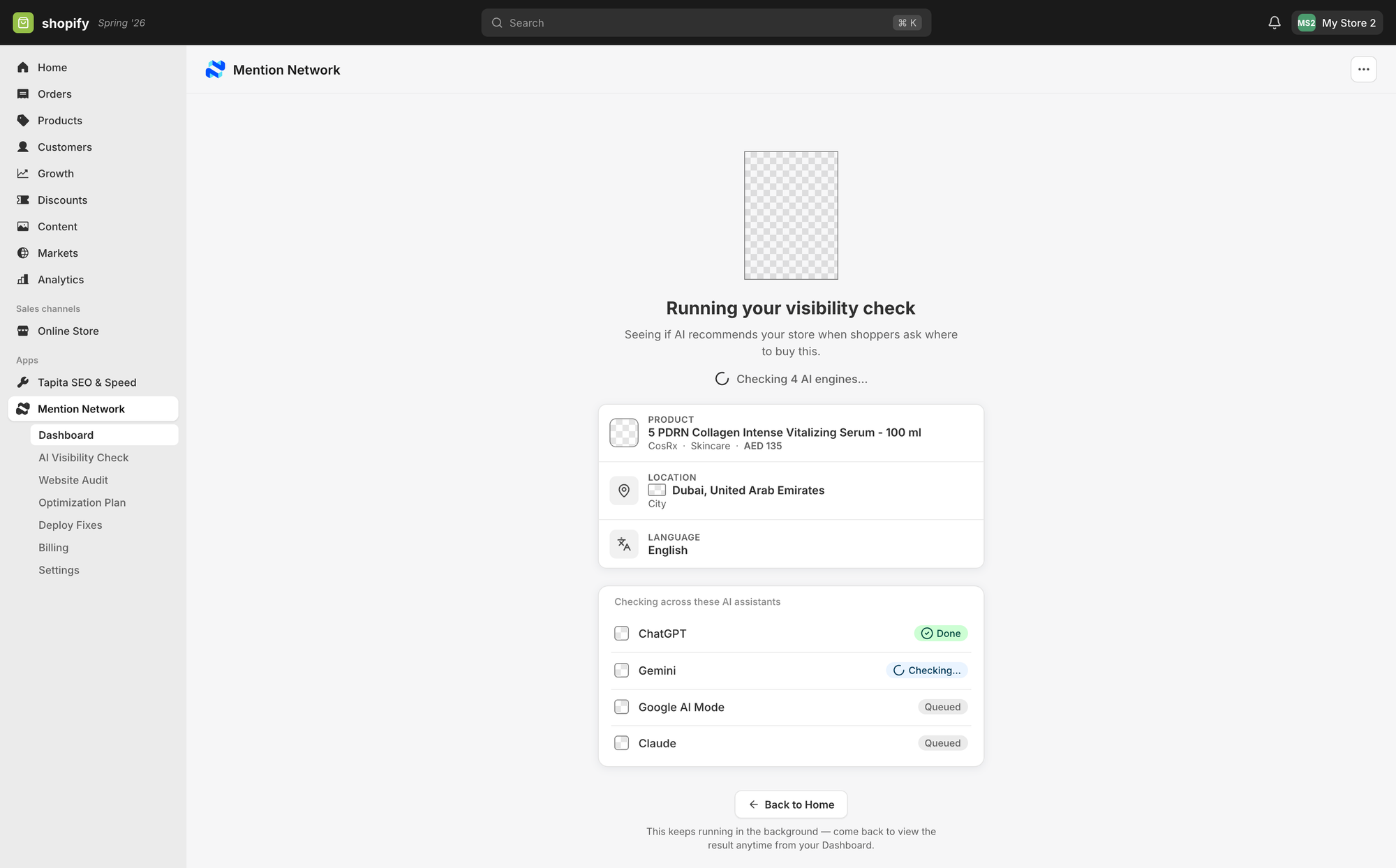
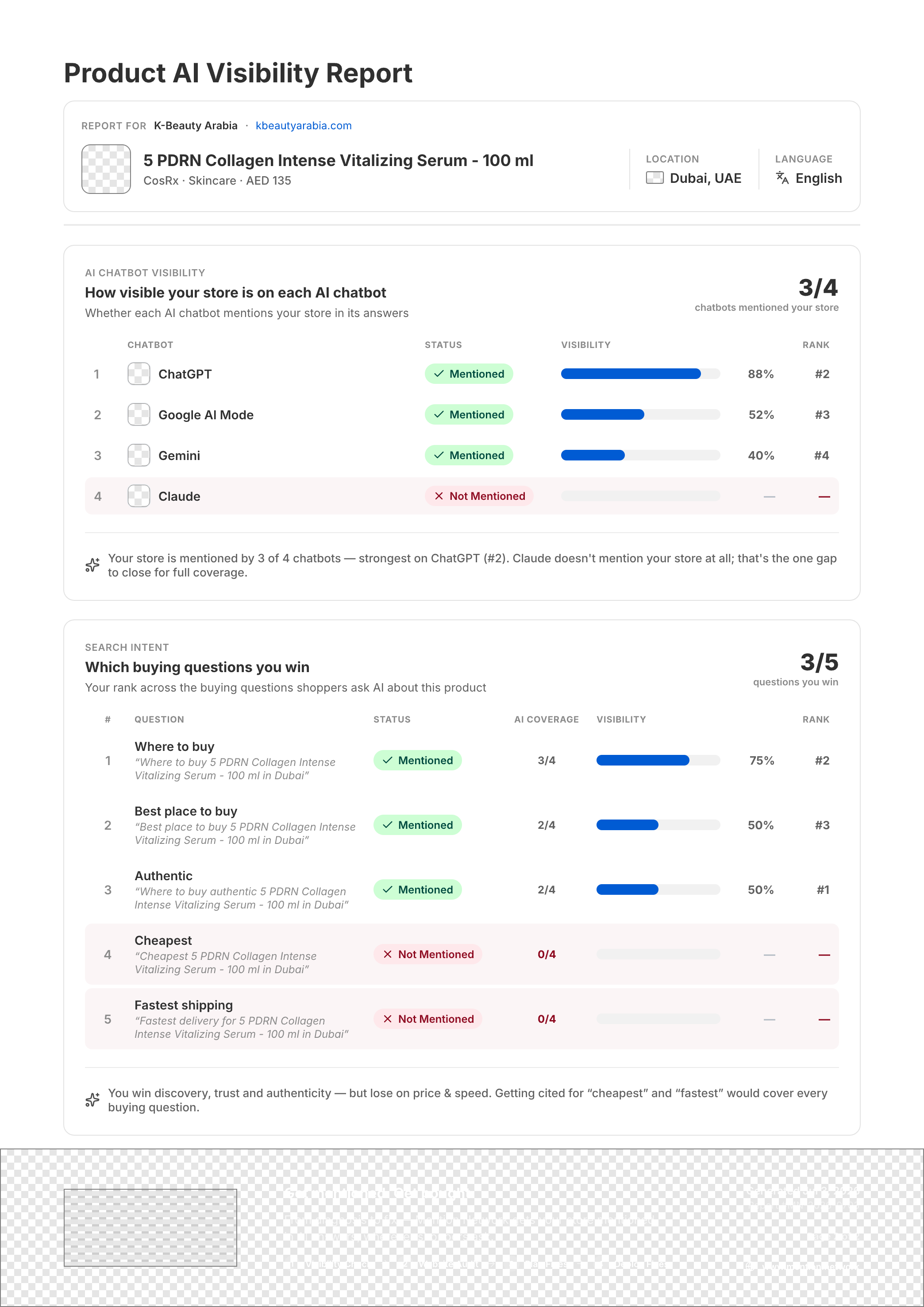
The check-up loop inside your Shopify admin: pick a product, run the scan, read the report, approve the fix. None of it requires a demo or a contract.
How AI Picks Which Stores to Recommend
Skip this section if you're already fluent in generative-engine mechanics. If you're not, here's the short version of what's happening on the other side of the query.
When a shopper asks ChatGPT for a product recommendation, the model pulls from three overlapping signals. First, its training data: which brands and products were mentioned often enough during pretraining to be "known." Second, retrieval-augmented content: sources the model can fetch in real time, like Bing results, cited reviews, or brand-provided answers. Third, structured data: schema markup, product feeds, and any llms.txt-style guidance a site publishes for AI crawlers.
Your visibility, then, is the compound of these signals working (or not working) together, never a single number. A brand can be well-known in training data but invisible in retrieval if its product pages don't render clean structured data. A specific SKU can rank well organically but never surface in ChatGPT's shopping suggestions because your product feed is missing a key attribute.
That's why product-level tracking matters. A brand-only signal averages all of this together and leaves you to guess where the gap is. A product-level tool tells you which pages are winning and which are being skipped, which is the level at which you can actually fix things. The Semrush AI Visibility Toolkit measures the outcome (brand mentions). Mention Network measures the outcome and connects it to the specific product page that generated it.
If the mechanics of what shapes AI answers are new to you, our complete guide to generative engine optimization covers the signals in more depth.
How the Two Layers Fit Together
By now the shape of this comparison should be clear: these tools barely compete. A sensible stack for an online store in 2026 has two layers:
- Semrush handles the search layer: keyword research, content briefs, technical site health, backlinks, competitor SEO intelligence.
- Mention Network handles the AI-recommendation layer: whether ChatGPT, Gemini & Google AI name your brand, suggest your products, and point shoppers at your store, plus a workflow to improve those answers.
The overlap is so thin that running both doesn't mean paying twice for the same job. And since Mention Network starts with a free check-up, finding out whether you even have an AI-visibility problem costs nothing.
Pricing Considerations
No numbers here: both vendors change plans over time, and any figure printed would go stale. Check the current pricing pages at mention.network and semrush.com.
Qualitatively, the models differ in ways that matter for merchants:
- Entry path. Mention Network is self-serve: a free AI-visibility check-up, then pay-as-you-go credits, with no demo gate or contract. Semrush follows a conventional SaaS subscription model across its suite tiers.
- What you're paying for. Semrush is a broad suite: great value if you use its breadth, less so if you only need one narrow job done. With Mention Network, the spend maps to one job: AI visibility for your store and products.
- Budgeting for the stack. If you need both the search layer and the AI layer (most growing stores eventually will), plan for two focused line items rather than expecting either tool to absorb the other's job.
Pricing structure at a glance
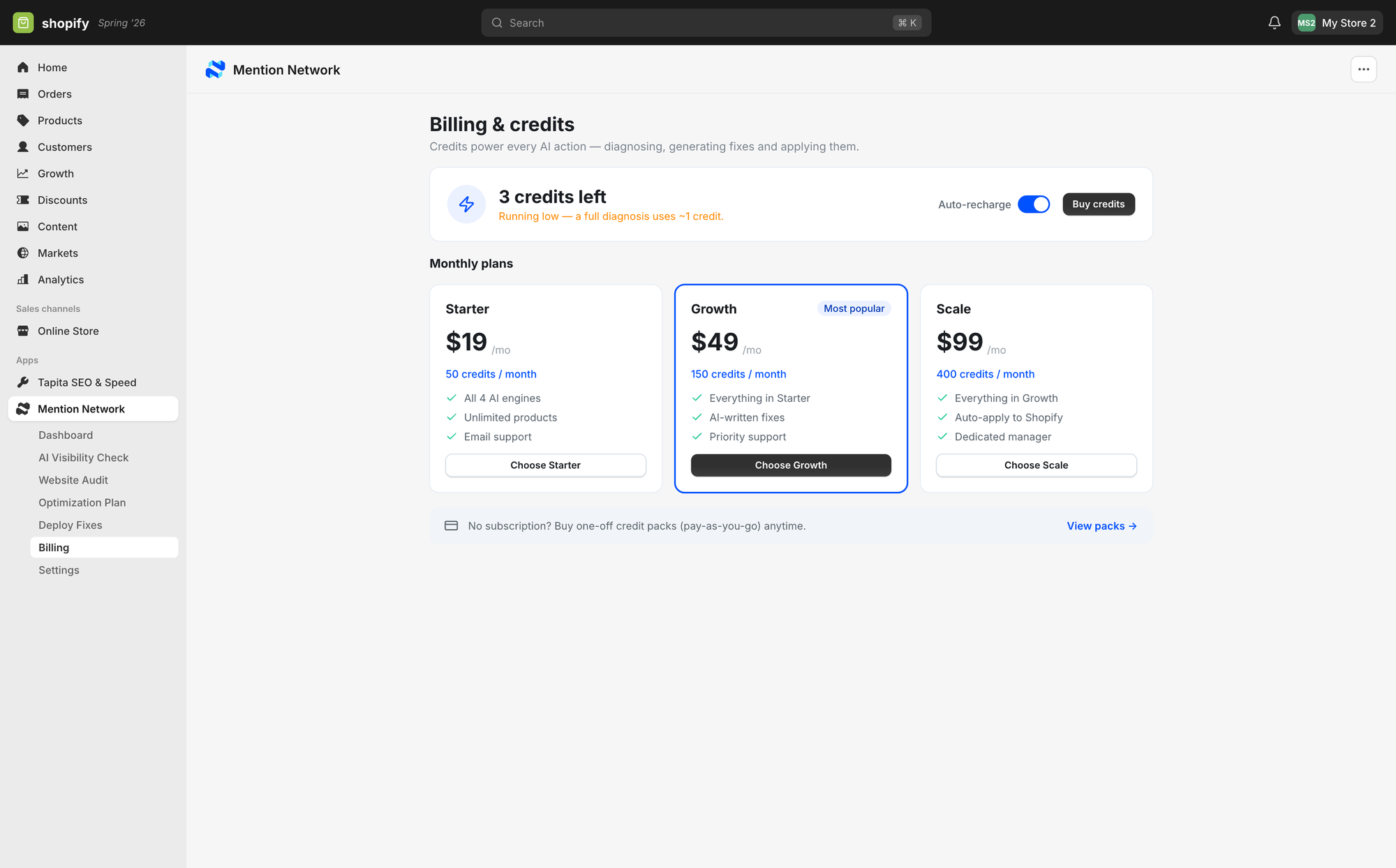
Mention Network billing inside the Shopify admin: pay-as-you-go credits, no card for the first check-up.
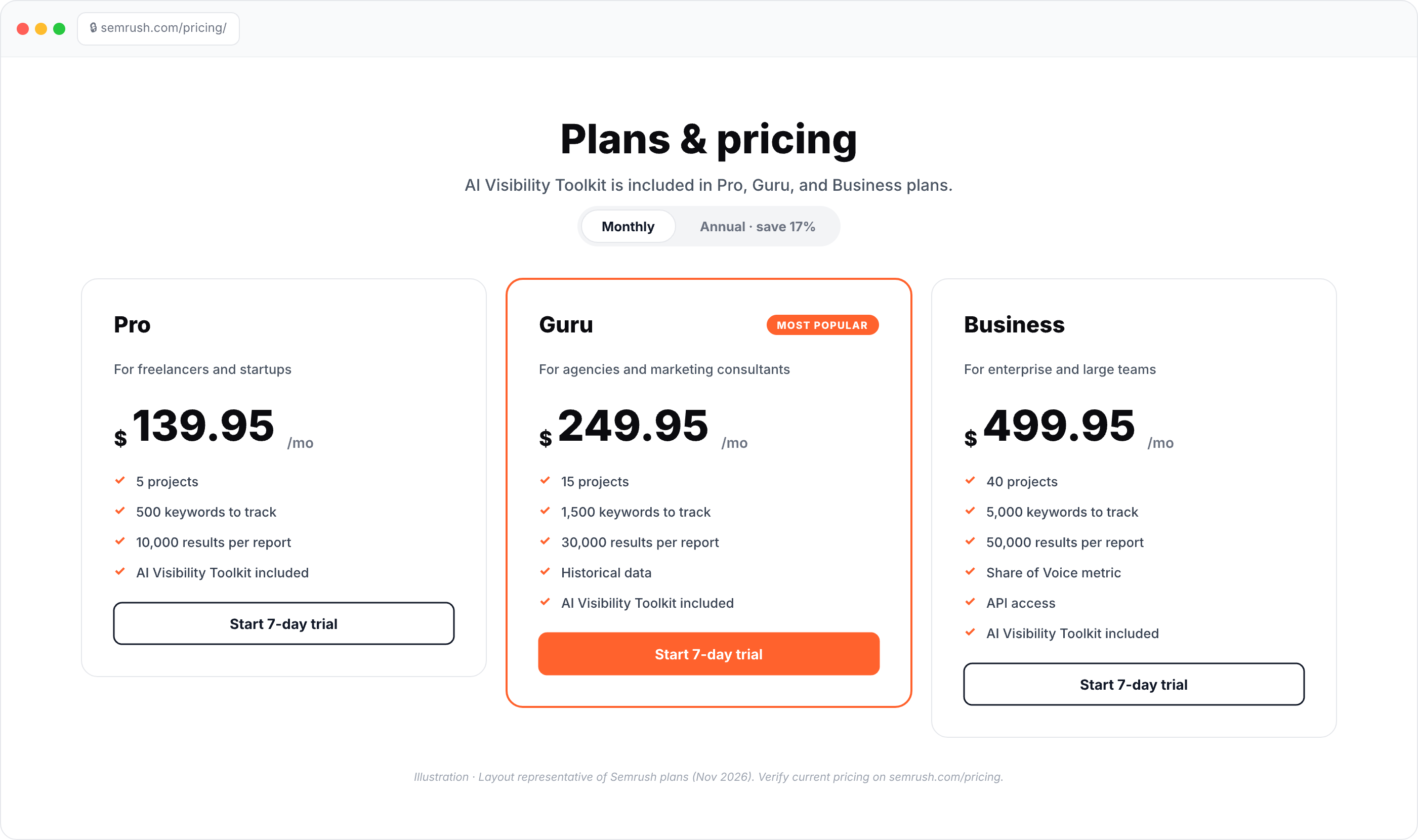
Semrush's plans and pricing structure: three suite tiers, AI Visibility Toolkit included on each. Illustration; verify current pricing on semrush.com/pricing.
Choose Semrush if… / Choose Mention Network if…
Choose Semrush if your growth still runs through Google
If your traffic and revenue come primarily from organic rankings and paid search, Semrush is the better fit: keyword research, technical audits, and backlink analysis are exactly what that job requires, and Mention Network doesn't offer them.
Choose Semrush if you run content marketing or PPC at scale
Stores with an active blog and content calendar benefit from Semrush's integrated pipeline: keyword data feeding briefs, briefs feeding optimized content, the same data powering paid search. That combined workflow is a genuine, durable Semrush win.
Choose Mention Network if shoppers in your category ask AI what to buy
If your customers ask ChatGPT or Gemini for product recommendations, comparisons, or where-to-buy advice, you need to know whether those answers include you, and how to change them when they don't. That's Mention Network's entire job, and it's outside the ring Semrush fights in.
Choose Mention Network if you want answers at the product level
Resellers and store owners who need to know which products AI surfaces (and which it skips) need the SKU-level layer that brand-only monitoring can't provide.
Choose Mention Network if you want fixes you can approve in your store admin
Non-technical merchants who want a measure → diagnose → fix loop inside their store admin (with preview and approval) rather than a report to hand to an agency, will find Mention Network built around exactly that.
Limitations of Both Tools
No honest comparison skips this section.
Mention Network's limitations:
- A newer, specialized platform, without Semrush's years of accumulated tooling, integrations, and community resources.
- Not an SEO suite, on purpose. No keyword research, backlink analysis, PPC tools, or technical site auditing. If you drop Semrush expecting Mention Network to absorb those jobs, you'll be disappointed.
- Channel coverage is staged: Shopify first, WooCommerce and custom storefronts planned via API. If you're not on Shopify today, check current availability first.
- AI visibility is a young discipline. AI engines change quickly and answers shift with model updates, so results need ongoing attention rather than a one-time fix.
Semrush's limitations (inside this comparison's ring only):
- Its center of gravity is search engine optimization for websites; merchant-specific AI jobs like SKU-level recommendation tracking and on-store fix workflows aren't documented capabilities at the time of writing.
- Breadth cuts both ways: a store that only needs one narrow job done may find itself paying for a large suite it mostly doesn't open.
Semrush remains great at its own job; this comparison simply happens in a different ring.
Final Verdict
Mention Network vs Semrush is a stack. Semrush is a great SEO platform, and if your store's growth runs through Google, keep it.
But when a shopper asks ChatGPT, Gemini, or Google AI what to buy and where to buy it, that answer is a channel your SEO suite wasn't built to measure, let alone fix. Mention Network is purpose-built for exactly that: brand- and product-level AI visibility for e-commerce, with a measure → diagnose → fix workflow that lands inside your store admin instead of in another dashboard.
The recommendation: keep Semrush for your blog and site SEO; add Mention Network for how AI recommends your store and products.
Is AI recommending your store? Check free at mention.network.
Frequently Asked Questions
Should I replace Semrush with Mention Network?
No. They do different jobs. Semrush is a full SEO and digital marketing suite for your blog, site health, keywords, and backlinks. Mention Network is a purpose-built e-commerce AI visibility tool that measures and helps improve how ChatGPT, Gemini & Google AI recommend your store and products. Most merchants who use Semrush should keep it and layer Mention Network on top.
Does Semrush track how AI recommends my specific products?
Semrush has been adding AI-related features to its SEO suite, but product- and SKU-level AI recommendation tracking for e-commerce (including where-to-buy answers) is not a documented Semrush capability at the time of writing. Check Semrush's current feature pages, as its toolkit evolves. That product-level view is the specific job Mention Network is built for.
What does Mention Network do that Semrush doesn't?
Mention Network works at the level of your store and individual products. It measures whether AI names your brand and suggests your specific products, runs a store audit designed to explain why AI isn't picking you, and its workflow is built so AI drafts the fix for your product page, which you preview and approve inside your store admin. Semrush's suite is oriented around search engine optimization for websites rather than merchant-level fixes inside a storefront.
Can I use Mention Network and Semrush together?
Yes: that's the setup this comparison recommends for most stores. Keep Semrush for your blog and site SEO, and add Mention Network for how AI recommends your store and products. The two tools cover different channels, so there's very little overlap in what you'd be paying for.
Which e-commerce platforms does Mention Network work with?
Mention Network ships as a Shopify app first, with WooCommerce and custom storefronts planned via API. It starts with a free check-up of your AI visibility and uses pay-as-you-go credits, with no demo gate or contract.
Does the Semrush AI Visibility Toolkit track individual product recommendations?
Not as a documented capability at the time of writing. The Toolkit's public framing is brand-level: how often your brand name shows up in AI answers, share of voice against named competitors, sentiment. Product- and SKU-level recommendation tracking, and where-to-buy answers pointing at a specific storefront, aren't advertised. Semrush ships new features often, so verify against the current Toolkit page before deciding.
Is Mention Network cheaper than adding the Semrush AI Visibility Toolkit?
Depends entirely on your situation. If you're already a Semrush customer and the AI Visibility Toolkit is included in your tier, the marginal cost of using it is zero. Mention Network isn't cheaper than "already paid for." What Mention Network changes is the job coverage: for a merchant who needs product-level visibility and an on-store fix workflow, the Semrush Toolkit doesn't cover those jobs at any price. Compare them on fit for your job instead.
Can I run Mention Network on a Shopify store without technical setup?
Yes. It's built as a merchant tool: install the app, connect your catalog through Shopify's standard OAuth, and run the free check-up. No dev handoff, no API keys for the merchant to manage. WooCommerce and custom storefronts are handled through a similar low-friction flow via API, planned for the phased rollout after Shopify.
What if my brand is already well-known in AI answers? Do I still need product-level tracking?
If AI answers reliably surface your brand for the categories that matter, you're winning at the brand layer. The question that stays open is which products carry that visibility, and which don't. Product-level tracking is how you catch a specific SKU that's invisible in AI recommendations even when the brand around it does fine. Whether that matters to your revenue is a business call, and the free check-up will tell you the honest answer for your catalog.