SimilarWeb Alternative for E-commerce: Mention Network vs SimilarWeb (2026)
Looking for a SimilarWeb alternative built around AI visibility instead of traffic analytics? Mention Network measures, diagnoses, and helps fix how ChatGPT, Gemini & Google AI recommend your store and products.

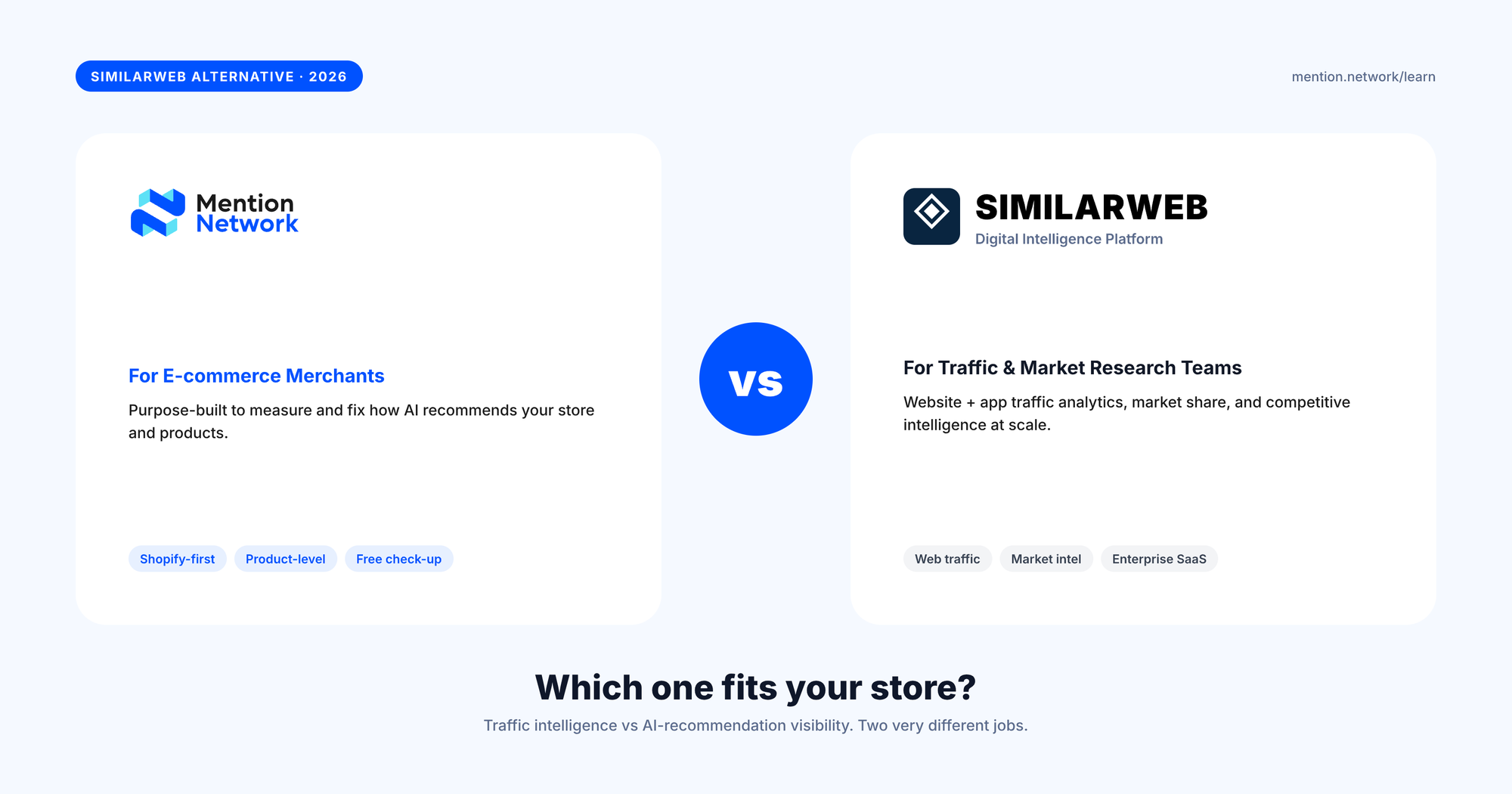
More shopping journeys now start with a question typed into ChatGPT or Gemini instead of a search bar ("what's the best running jacket under $100?", "where can I buy it?"), and the answer either includes your store or it doesn't. If you've searched for a SimilarWeb alternative built for that question rather than for traffic analytics, this comparison is for you. It's a cross-category one, and it's worth saying so upfront. SimilarWeb is a digital intelligence platform that analyzes website and app traffic, one of the most established names in competitive web research. Mention Network is the AI-visibility platform built for e-commerce: it measures, diagnoses, and helps fix how ChatGPT, Gemini & Google AI surface your brand and products.
TL;DR: SimilarWeb handles traffic analytics, market intelligence, and traditional SEO. Mention Network is the SimilarWeb alternative for e-commerce merchants who need to know whether ChatGPT, Gemini, and Google AI recommend their store and products, and how to fix it when they don't.
Let's be honest before the table: if your question is "where does my traffic come from, and how do I stack up against competitors on the web?", SimilarWeb is excellent at that job, and Mention Network doesn't try to do it. Teams use SimilarWeb to track website traffic and user behavior, benchmark against competitors, and inform SEO and market strategy; that reputation is earned. This comparison exists because store owners and resellers are now asking a different question: is AI recommending my store and my products? That question needs a different kind of tool.
How they stack up:
- Key Summary
- What Is Mention Network?
- What Is SimilarWeb?
- Traffic Intelligence vs E-commerce AI Visibility: Two Different Jobs
- Does AI Recommend Your Store When Shoppers Ask Where to Buy?
- Product-Level vs Brand-Level Tracking
- From Tracking to Fixing
- Pricing Considerations
Key Summary
- Different core jobs. SimilarWeb measures website/app traffic, user behavior, and market intelligence. Mention Network measures whether AI assistants recommend your store and products, and helps you fix it when they don't.
- SimilarWeb does cover some AI visibility ground, including geographic and topic-level views, competitor analysis, and prompt-level breakdowns, aimed at marketing and research teams working at market level.
- Mention Network works at two layers merchants care about: Brand AI Visibility (is your brand named when shoppers ask AI about your category?) and Product AI Visibility (does AI suggest your specific products, including where-to-buy answers?).
- Tracking vs fixing. Mention Network's workflow is built to go from measurement to a store audit that explains why you're not being picked, to AI-drafted fixes you can review and apply inside your store admin. SimilarWeb is an intelligence platform: it informs strategy rather than editing your product pages.
- They're complementary. A team can run SimilarWeb for traffic and market intelligence and Mention Network for AI-answer visibility on their store.
Here's the short version, framed as merchant jobs:
* "n/a" means this isn't advertised as a core capability on the vendor's public site at the time of writing; check SimilarWeb's current feature list before deciding.
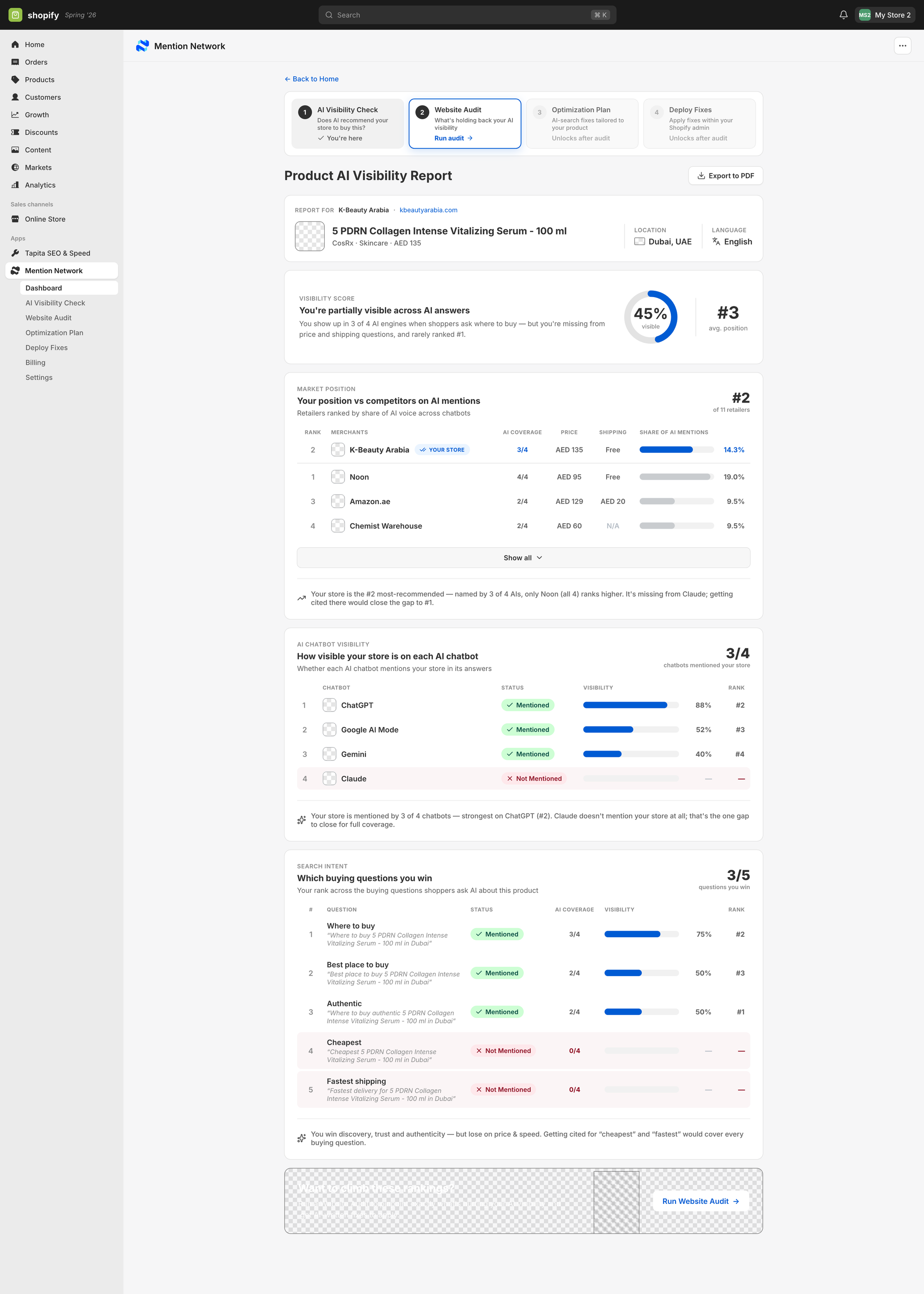
Mention Network AI Visibility Report inside the Shopify admin. Product-level rows are the layer SimilarWeb's AI features don't document.
What Is Mention Network?
Mention Network is the AI-visibility platform built for e-commerce. It exists to answer one question and act on it: is AI recommending your store and products?
It works at two layers:
- Brand AI Visibility: whether your brand is named and recommended when shoppers ask ChatGPT, Gemini, Google AI, and other AI engines about your category, and what AI actually says when asked about you.
- Product AI Visibility: whether AI suggests your specific products for a shopper's need, including where-to-buy answers that send buyers to a store.
The bigger difference is what happens after measurement. Most tools stop at tracking: a dashboard that tells you your rank or mention count. Mention Network's workflow is designed around measure → diagnose → fix: a store audit explains why AI isn't picking you, AI drafts the fix for your product page, and you apply it inside your store admin with preview and approval. The trust principle behind it: real data from your store, contrasted with what AI claims.
It's built for merchants rather than enterprise marketing teams: non-technical, self-serve, with a free check-up as the entry point and pay-as-you-go credits instead of a demo gate or contract. It ships as a Shopify app first, with WooCommerce and custom storefronts planned via API. If you're new to the category, our complete guide to Generative Engine Optimization explains why it exists at all.
What Is SimilarWeb?
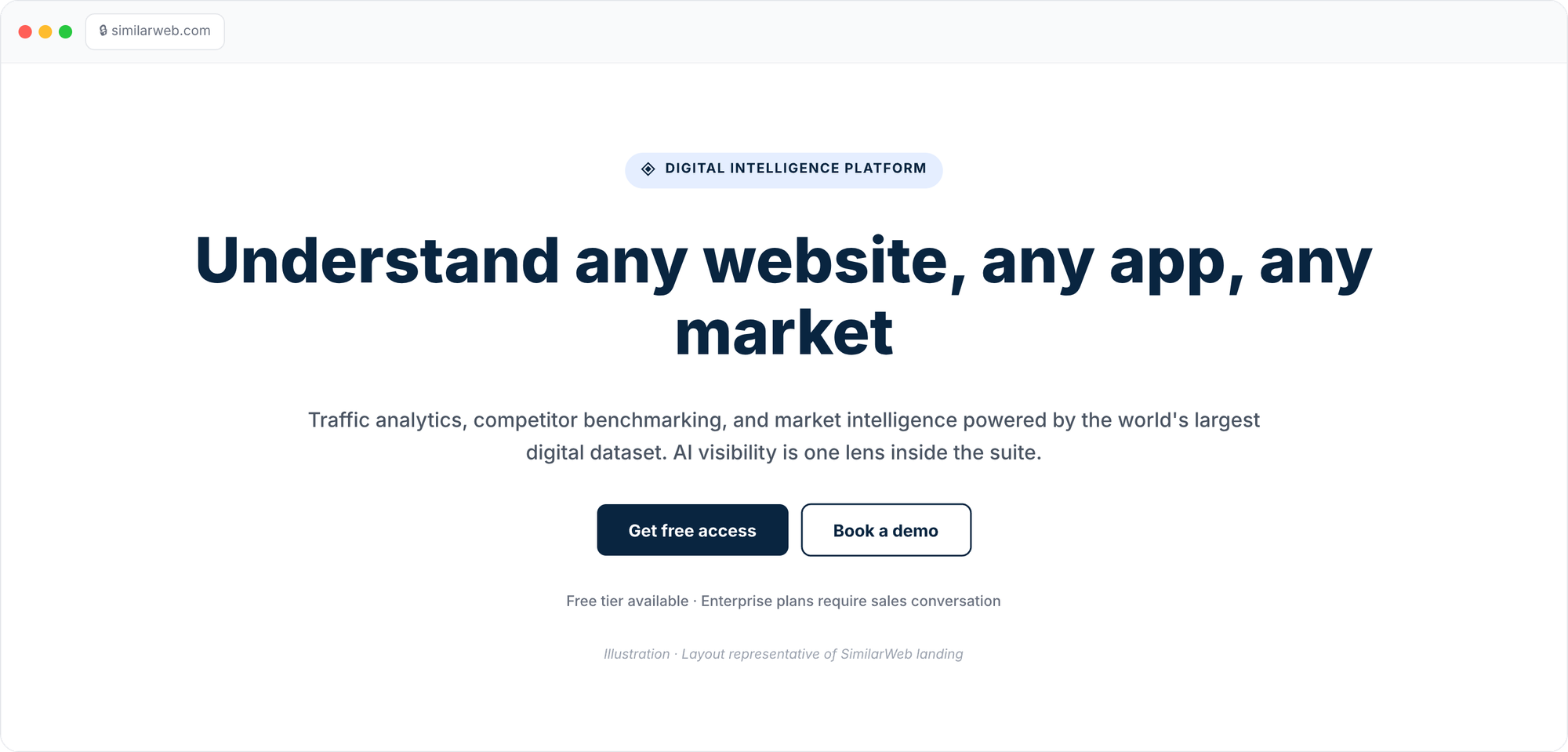
SimilarWeb's public framing: a digital intelligence platform for traffic analytics, competitive research, and market share. Illustration based on their public materials.
SimilarWeb is a digital intelligence platform that analyzes website and app traffic. It's one of the most established names in competitive web research: teams use it to track website traffic and user behavior, benchmark against competitors, and inform SEO and market strategy.
SimilarWeb also offers AI visibility capabilities, including geographic and topic-level views, competitor analysis, and prompt-level breakdowns. But its center of gravity remains traditional web analytics: it is stronger in classic SEO and market intelligence than in Generative Engine Optimization. If your primary question is "where does my traffic come from and how do I compare to rivals on the web?", SimilarWeb is squarely in its element.
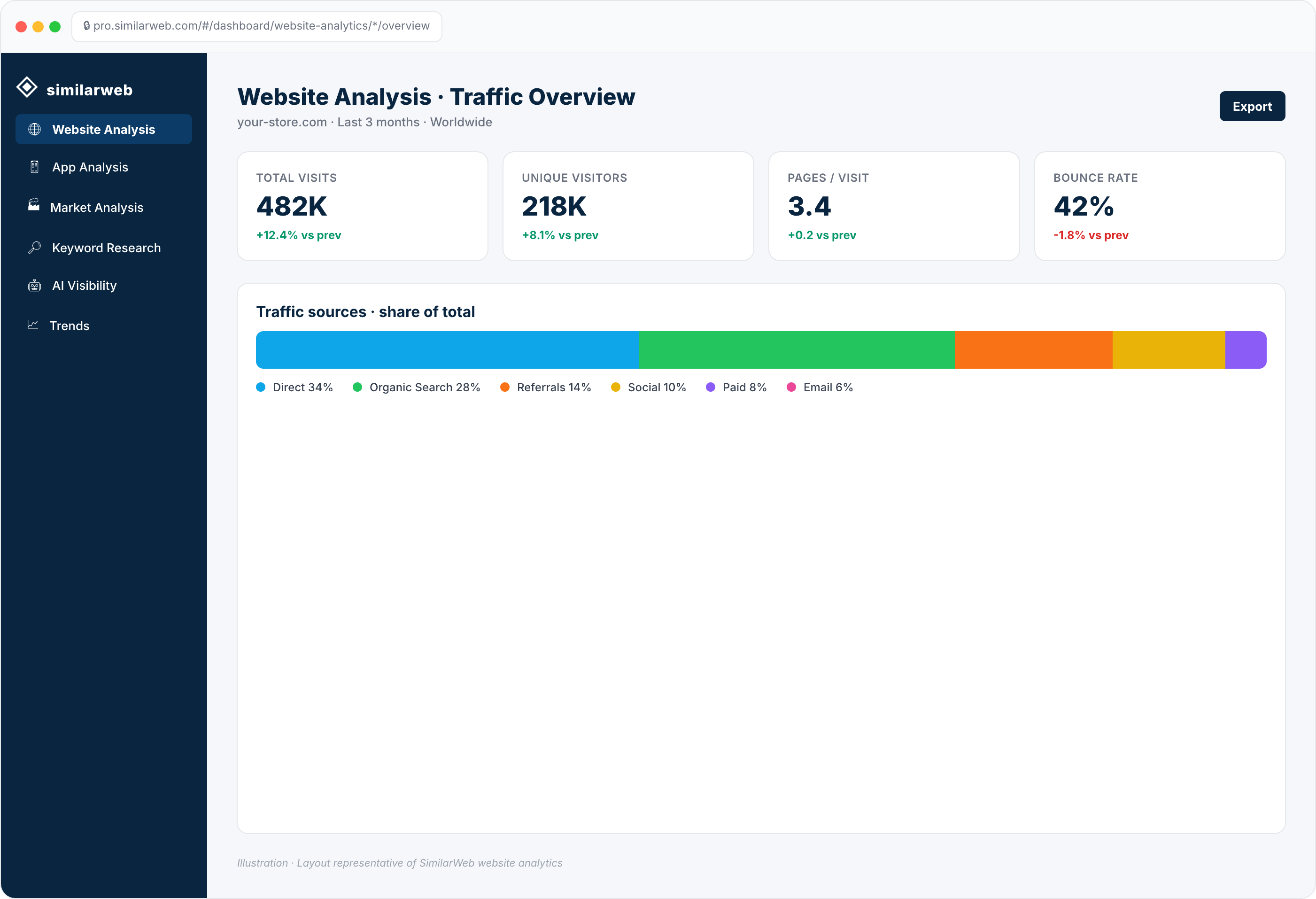
SimilarWeb's core report: traffic analytics and source mix at market and site level. Illustration; verify current layout on similarweb.com.
Traffic Intelligence vs E-commerce AI Visibility: Two Different Jobs
The cleanest way to understand this comparison is by the question each platform answers.
SimilarWeb answers market questions. How much traffic does a site get, from which channels and geographies? How does your share compare to competitors? Which keywords and categories are moving? These are the questions of marketing, research, and strategy teams, and SimilarWeb's traffic and market intelligence is the standard toolkit for them.
Mention Network answers a merchant question. When a shopper asks an AI assistant what to buy and where to buy it, does your store show up, and if not, what specifically about your store and product pages is causing AI to pass you over? It's a your-store question, and it ends in an action on your product page rather than a slide in a strategy deck.
Neither platform is a substitute for the other. Traffic intelligence tells you how the web is treating you; AI visibility tells you how AI assistants are treating you. In 2026, both are real acquisition surfaces; see what AI visibility is and why it matters for how the second surface emerged.
Does AI Recommend Your Store When Shoppers Ask Where to Buy?
This is the question that separates e-commerce AI visibility from general AI-answer tracking.
When a shopper asks ChatGPT or Gemini "best ceramic pour-over set under $50" and follows up with "where should I buy it?", there are two chances to win: your brand being named in the recommendation, and your store being named in the where-to-buy answer. Mention Network tracks both, because for a merchant the second one is where revenue actually happens.
SimilarWeb's AI visibility features (topic and geographic views, prompt-level breakdowns, competitor analysis) give marketing teams a genuine read on AI-answer presence at market level. If you're new to how AI answers get shaped, Google's Product structured data reference is a useful primer on the signals AI engines actually see. Whether it covers store-specific, where-to-buy-level answers for your individual shop isn't something its public pages spell out, so verify with the vendor if that's your use case. What's clear is the orientation: SimilarWeb's AI features live inside a digital intelligence suite; Mention Network's exist to drive a merchant workflow that ends in a fix.
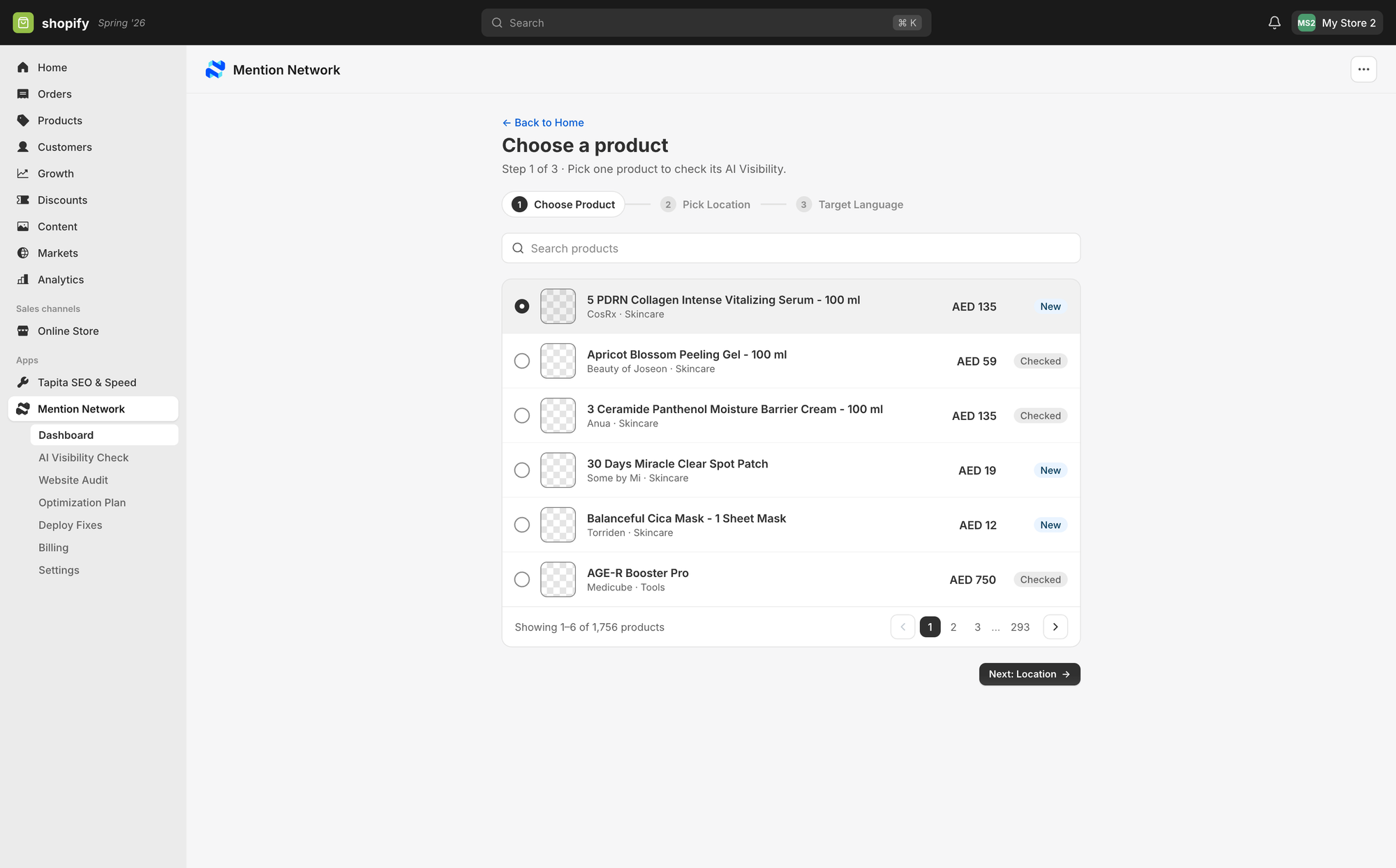
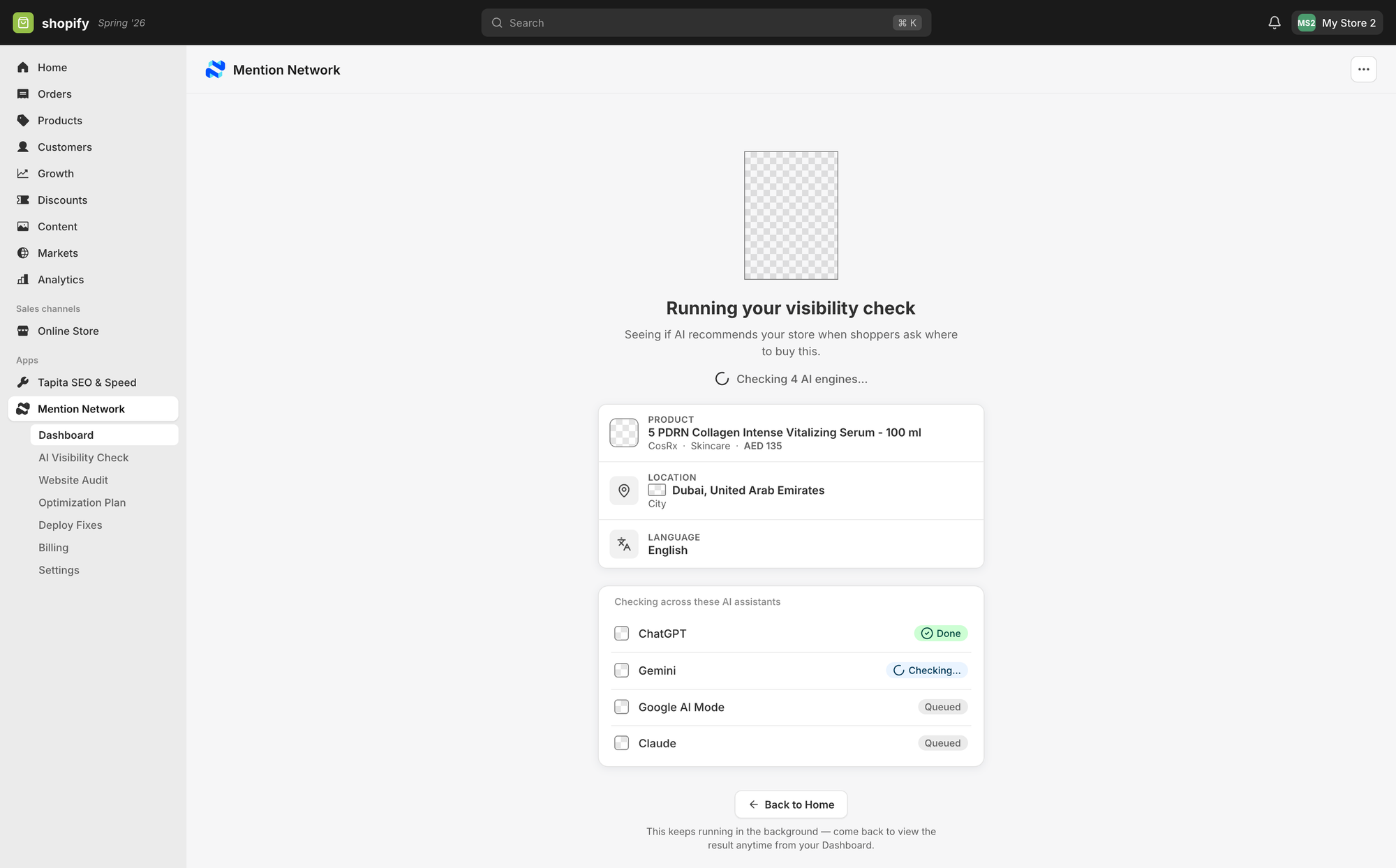
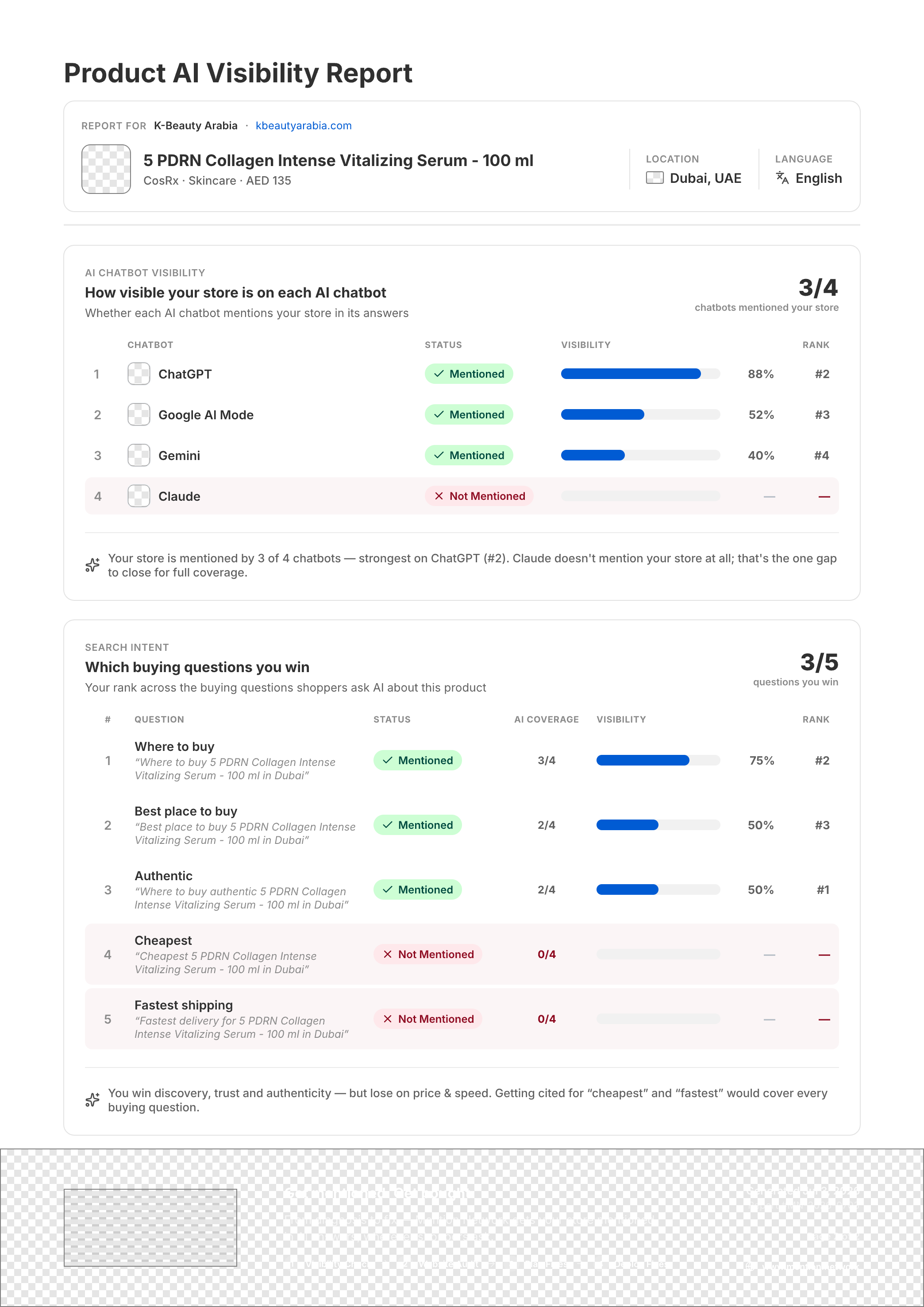
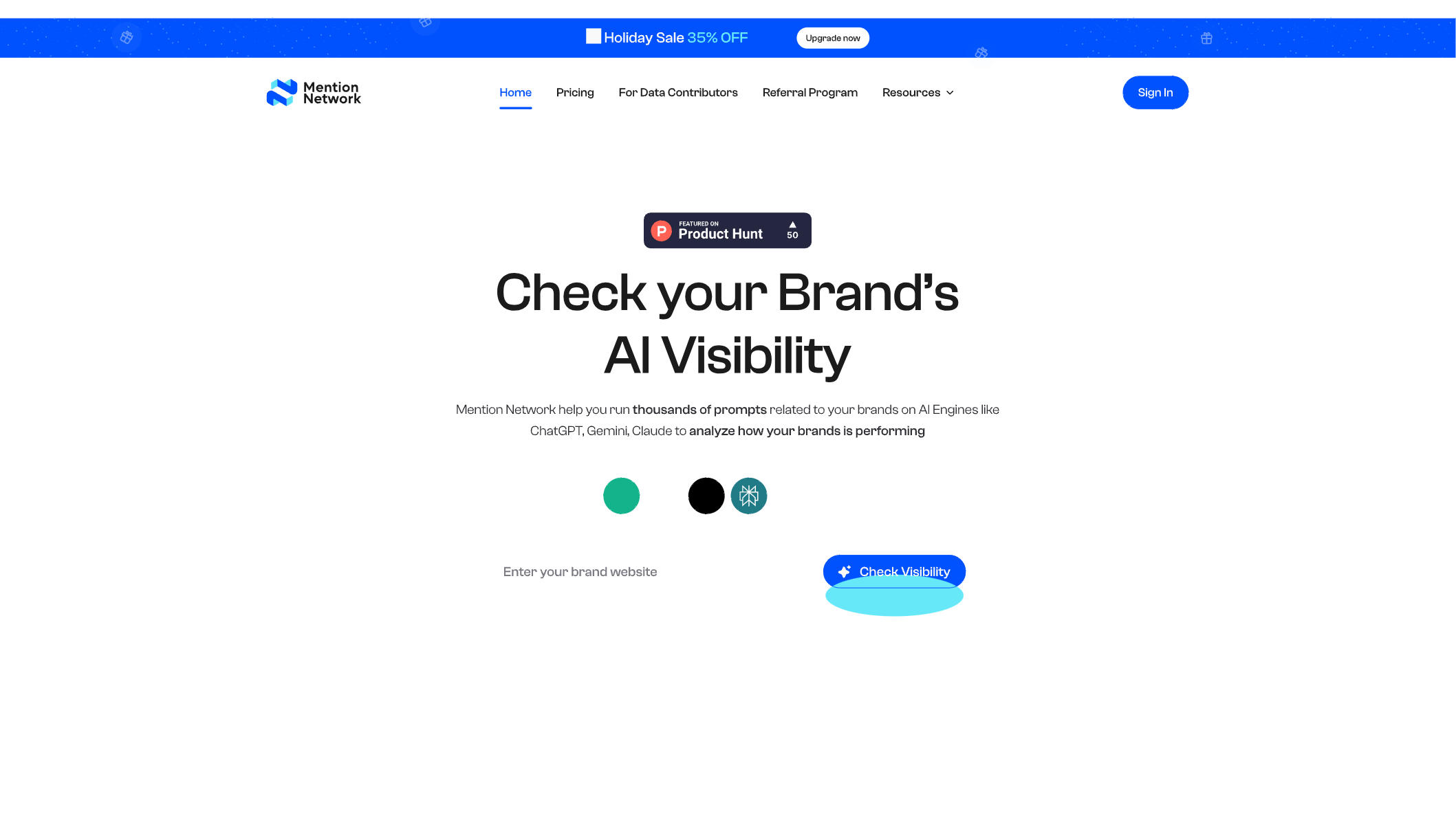
The measure → diagnose → fix loop inside your Shopify admin. Free entry, no demo, no contract.
Product-Level vs Brand-Level Tracking
Most AI visibility tools track brands. Merchants sell products.
That distinction matters more than it sounds. Your brand can be reasonably visible in AI answers while your best-margin product never gets suggested for the need it solves, or the reverse. Mention Network's Product AI Visibility layer tracks whether AI suggests your specific products for a shopper's need, so a store owner or reseller can see visibility at the level they actually merchandise: the product.
SimilarWeb's analytics are organized around sites, apps, and markets, the right altitude for its job. If you want to know which product categories drive a competitor's traffic, that's SimilarWeb territory. If you want to know whether Gemini recommends your waterproof hiking boots when someone asks for waterproof hiking boots, that's product-level AI visibility, and it's the layer Mention Network is built around. For a framework on which visibility metrics to prioritize, see how to measure your brand's AI visibility.
From Tracking to Fixing
Knowing your visibility score is not the same as improving it.
Mention Network's differentiating claim is the workflow after the number: a store audit that diagnoses why AI isn't picking your store or products, and a fix step where AI drafts the change for your product page and you apply it inside your store admin, with preview and approval, so nothing ships to your storefront without you signing off. The workflow is designed to be non-technical: a store owner can run it without a data team.
To be fair to SimilarWeb, "fixing your product pages" was never its promise. It's an intelligence platform: its insights inform SEO, content, and market strategy, and implementation happens in whatever tools your team already uses. That's a reasonable division of labor for an enterprise marketing org. It's just a different shape of product than a merchant tool where measurement, diagnosis, and the fix live in one loop.
Pricing Considerations
We're deliberately not quoting prices: both vendors update plans and packaging, so check their current pricing pages directly. A few qualitative points:
- Match cost to the job. A full digital intelligence suite and a focused e-commerce AI visibility tool are priced for different scopes and different buyers. Paying for market-intelligence breadth when your question is "does AI recommend my store?" (or vice versa) is the easiest way to overspend.
- Note the entry model. Mention Network starts with a free check-up and uses pay-as-you-go credits, with no demo gate or contract: you can see your own data before spending anything. For SimilarWeb, review its current plans and trial options on its pricing page.
- Consider the "both tools" scenario. Because the platforms answer different questions, the real comparison for some teams is the combined cost of both versus the cost of leaving one question unanswered.
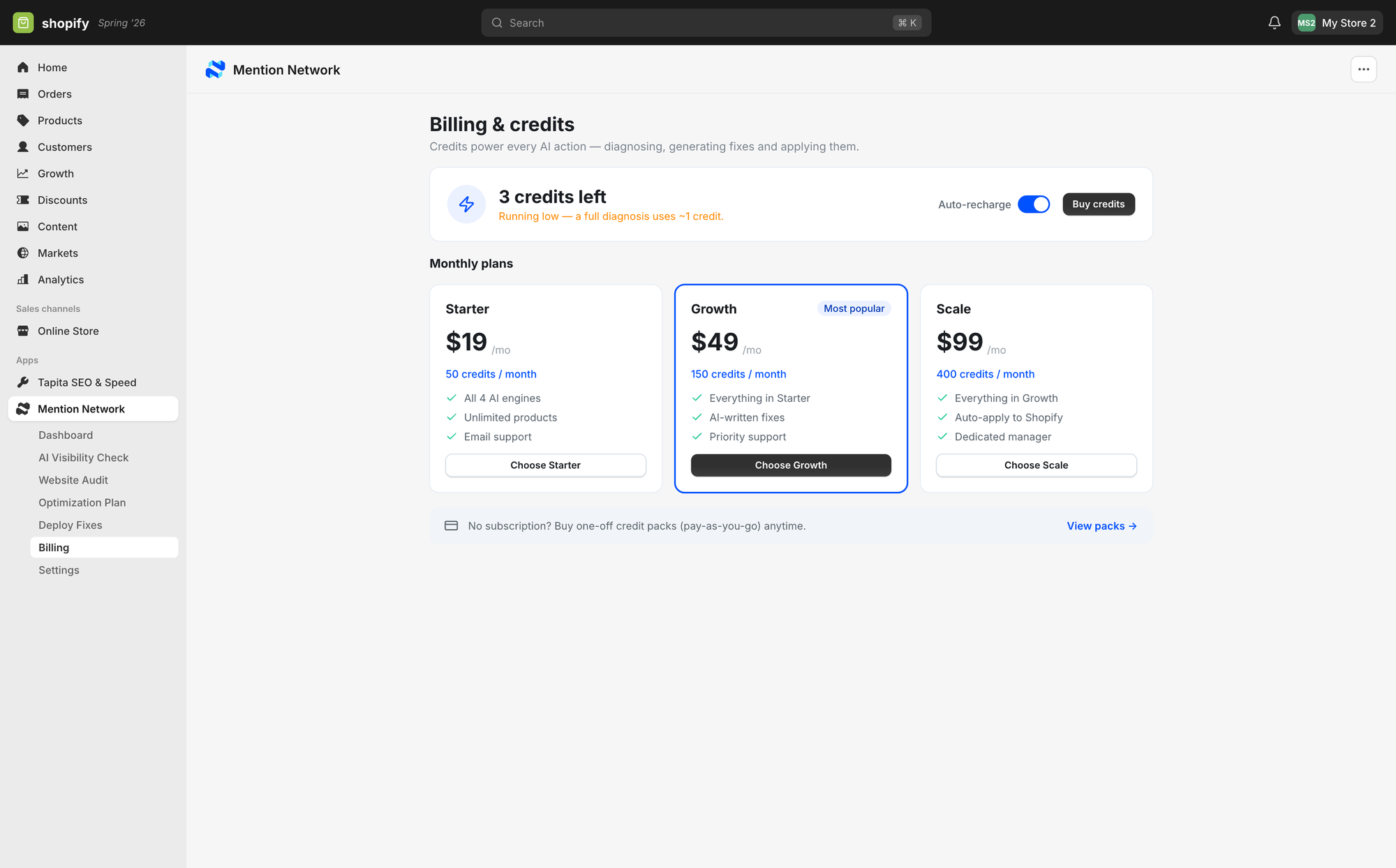
Mention Network billing inside the Shopify admin: pay-as-you-go credits, no card for the first check-up.
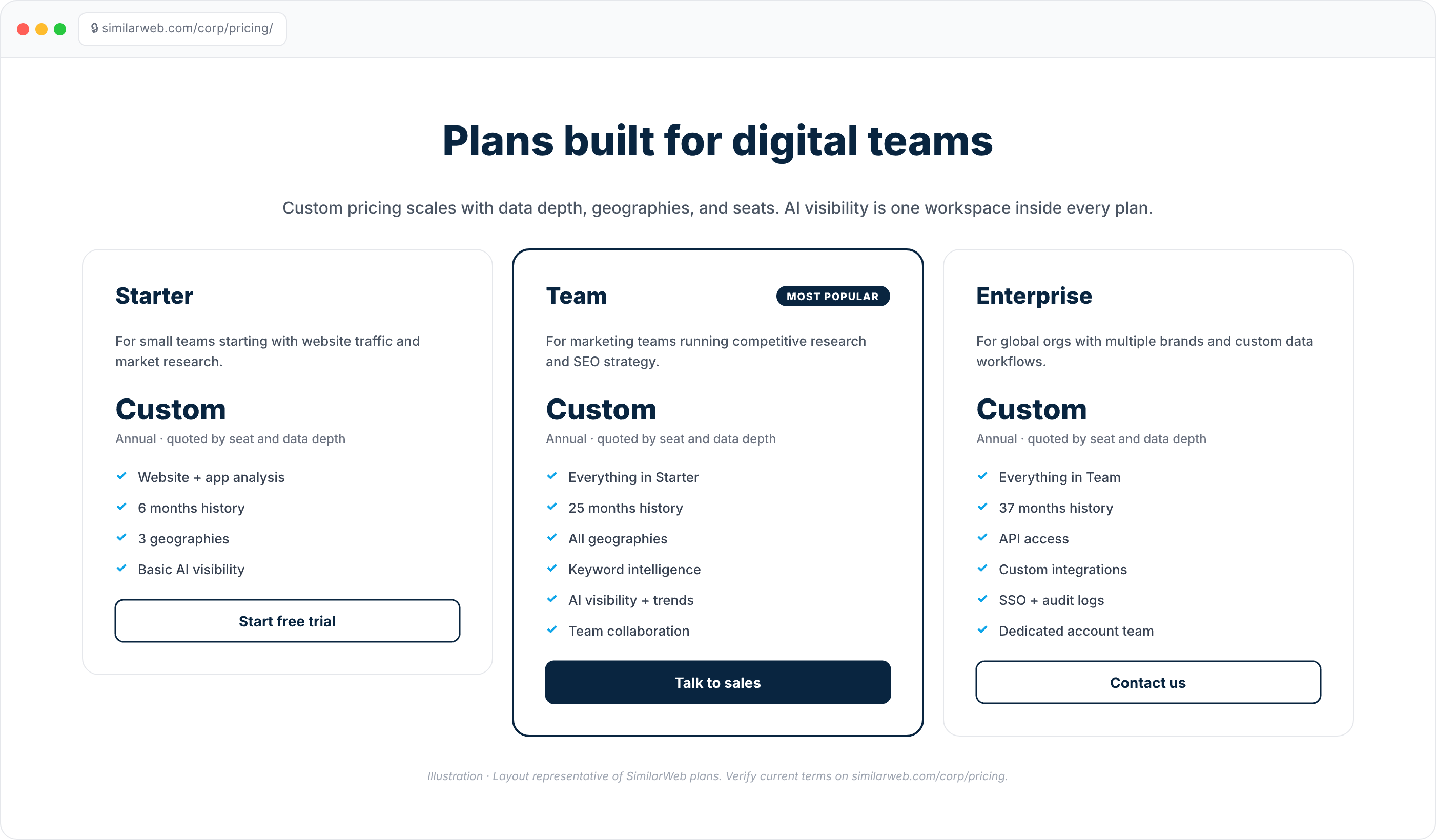
SimilarWeb's suite pricing model: seat and data-depth based, annual contract. Illustration; verify current terms on similarweb.com/corp/pricing.
Choose SimilarWeb if… / Choose Mention Network if…
Choose SimilarWeb if you're a traffic-driven marketing or research team
If your core workflow is website and app traffic analysis, competitive traffic benchmarking, and market research, SimilarWeb is the better fit. That's its specialty, and Mention Network doesn't try to replicate it.
Choose SimilarWeb if traditional SEO and market intelligence are your main channels
SimilarWeb is stronger in classic SEO and digital market intelligence than in GEO. Teams whose growth still primarily runs through search and market analysis (keyword performance, category rankings, traffic sources, competitor market share) will get more day-to-day value from SimilarWeb. Moz's SEO learning centre is a useful primer if you're staffing up a team around that classic SEO surface.
Choose Mention Network if you run a store and want to know whether AI recommends it
If shoppers are finding (or missing) your store in ChatGPT, Gemini, and Google AI answers, you need visibility at both brand and product level, including where-to-buy answers. Mention Network is purpose-built for exactly this, starting with a free check-up.
Choose Mention Network if the goal is fixing your AI visibility
Mention Network's measure → diagnose → fix workflow ends in an audited reason and an AI-drafted change you can preview and apply in your store admin. If your goal is action on your own product pages, without a data team or an agency retainer, that's the job it's built for.
Use both if you run marketing across web traffic and AI answers
The platforms answer different questions. It's entirely coherent to keep SimilarWeb for traffic and market intelligence while adding Mention Network for how AI recommends your store and products.
Limitations of Both Tools
No honest comparison skips this section.
Mention Network limitations:
- It's a newer, specialized platform: it doesn't have SimilarWeb's long track record or its breadth as a general digital intelligence suite.
- It is focused on e-commerce AI visibility rather than analytics. You won't get website traffic estimates, user behavior data, keyword research, or app intelligence; if you need those, you'll still want a tool like SimilarWeb alongside it.
- Channel coverage starts with Shopify; WooCommerce and custom storefronts are planned via API, so merchants on other platforms should check current availability first.
SimilarWeb limitations (for a merchant's AI visibility job specifically):
- Its AI visibility features sit inside a digital intelligence suite aimed at marketing and research teams rather than a merchant workflow for a single store's product pages.
- It doesn't position itself as a diagnose-and-fix tool for AI recommendations: insights end in strategy, and implementation on your storefront is on you.
- Its strength remains traffic analytics, market intelligence, and traditional SEO; e-commerce GEO is not its core competency.
Final Verdict
Mention Network vs SimilarWeb comes down to two different jobs. For website traffic analysis, market research, and traditional SEO intelligence, SimilarWeb remains the stronger, more established platform, and nothing here changes that. If you're building the merchant side of the stack too, BigCommerce's e-commerce SEO guide covers the platform-level fundamentals that shape whether AI even reaches your product pages. The merchant job is different: knowing whether ChatGPT, Gemini & Google AI recommend your store and products, understanding why they don't, and fixing it on your product pages. Mention Network is the purpose-built choice for that job: brand and product-level visibility, where-to-buy tracking, a store audit that explains the why, and an apply-in-admin fix workflow, all behind a free, self-serve entry.
Is AI recommending your store? Check free with Mention Network.
Frequently Asked Questions
Which is better: Mention Network or SimilarWeb?
They do different jobs. SimilarWeb is a digital intelligence platform for website and app traffic, market research, and SEO intelligence. Mention Network is an AI-visibility platform built for e-commerce: it measures, diagnoses, and helps fix how ChatGPT, Gemini & Google AI recommend your store and products. Pick based on the question you need answered.
Does Mention Network replace SimilarWeb?
No. SimilarWeb answers questions about web and app traffic, market share, and competitive benchmarking. Mention Network answers whether AI assistants recommend your store and products, why they don't, and how to fix it. Many e-commerce teams will find room for both.
What does Mention Network measure that SimilarWeb doesn't?
Mention Network tracks two layers for merchants: Brand AI Visibility (whether AI names and recommends your brand when shoppers ask about your category, and what AI says about you) and Product AI Visibility (whether AI suggests your specific products for a need, including where-to-buy answers). It then runs a store audit to explain why you're not being picked and helps you apply fixes inside your store admin.
Does SimilarWeb track AI visibility at all?
Yes. SimilarWeb offers AI visibility capabilities, including geographic and topic-level views, competitor analysis, and prompt-level breakdowns. Its center of gravity remains web and app traffic intelligence, though, and it is not built as a merchant workflow for diagnosing and fixing product pages.
Do I need to be on Shopify to use Mention Network?
Mention Network ships as a Shopify app first, with WooCommerce and custom storefronts planned via API. The entry point is a free check-up that shows whether AI is recommending your store and products.