What is Google AI Mode? How to earn a spot in the AI answer
Google AI Mode replaces blue links with synthesized AI Answers and a small set of citations. Learn how it differs from AI Overviews and how to earn a spot in the answer.

Google AI Mode changes what visibility means in search. Instead of a page of blue links, you get an AI Answer that stitches information together and points to a handful of sources. So the game shifts. Rank still matters, but now you're also competing to land inside the response itself, and to be one of the few citations the interface bothers to show.
Here's the gap that creates. You can rank well and still be missing from the AI Answer. That's what AI Visibility measures: whether your brand shows up, how it gets described, and which sources Google's system trusts enough to lean on. If your content is hard to summarize, hard to verify, or cut off from trusted ecosystems, your AI Visibility can sit low even when your SEO looks fine on paper.
What you'll learn:
- What Google AI Mode is?
- How Google AI Mode differs from other LLMs
- What Google AI Mode cites and why rankings are not enough
- How to optimize for Google AI Mode without chasing myths
- Where Mention Network fits in a Google AI Mode workflow
- FAQs
What Google AI Mode is?
Google AI Mode is a search experience that uses generative AI to build answers from multiple trusted sources instead of just ranking pages. Instead of a list of links, you get a contextual, conversational response. That changes how content gets found and cited.
A separate AI-first search experience
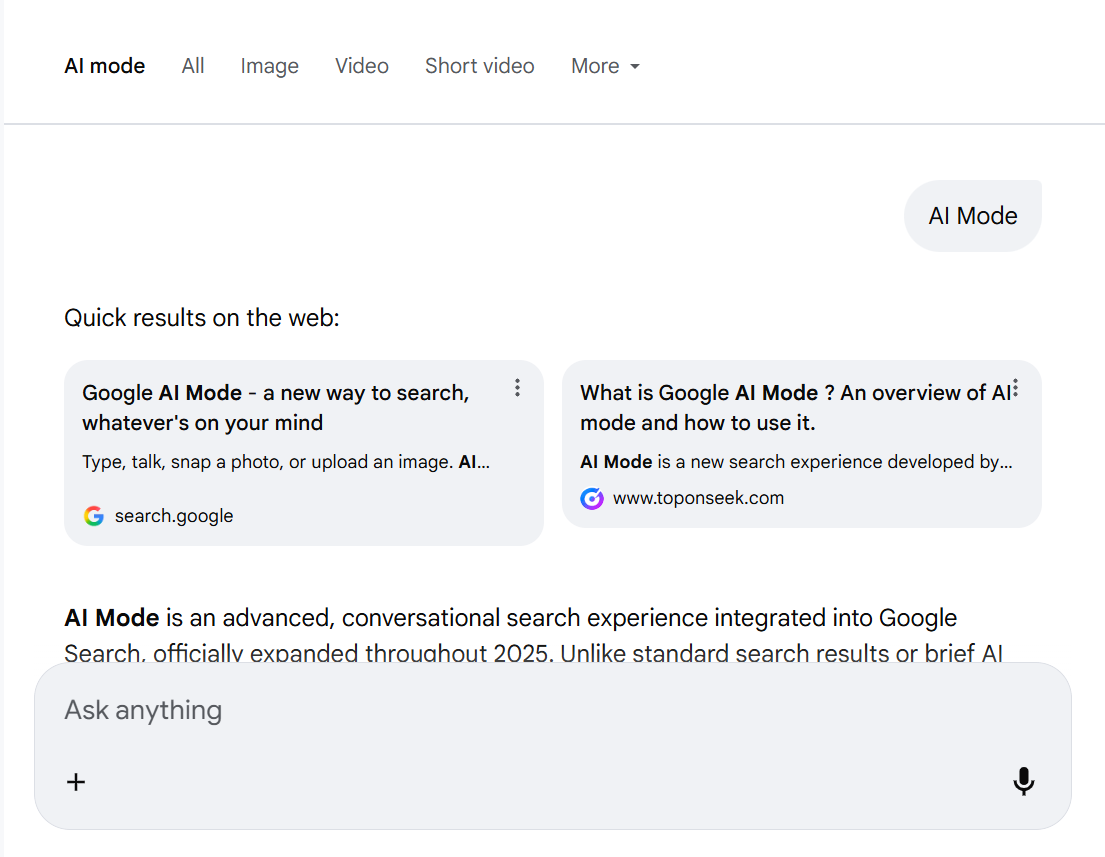
Google AI Mode is an opt-in version of Google Search with an AI-first layout. It shows up as its own tab in Search, and you can go to it directly. It's built for deeper exploration, follow-up questions, and comparisons rather than one static snippet. A Gemini-based system powers it from inside Google's search environment, which is why it behaves differently from standalone chat tools.
What the interface rewards
AI Mode rewards sources it can pull from cleanly and corroborate. The output pairs a summary with a curated set of citations, often shown in a sidebar that spans several domains.
One answer, a bundle of sources. Google picks which of those sources feel trustworthy enough to hold up the final narrative.
Why marketers should care about AI answers
AI Answers compress the decision journey. A user can jump from question to conclusion without scrolling or clicking much at all. So two things become true at once: your content can shape the outcome without earning a click, and you can lose influence while still sitting near the top of classic rankings. That's why AI Visibility is a metric worth tracking on its own.
How Google AI Mode differs from other LLMs
Google AI Mode sits deep inside Google's search ecosystem. It combines real-time indexing, ranking signals, and source attribution with generative responses, so it can favor freshness, authority, and web-wide consensus instead of leaning only on pre-trained knowledge.
Source: Semrush
Google AI Mode vs AI Overviews
AI Overviews show up inside standard Google results when Google thinks they help. AI Mode is a separate, opt-in experience for deeper, multi-turn exploration. AI Overviews tend to be one-and-done. AI Mode is built for follow-ups, comparisons, and planning.
Google AI Mode vs ChatGPT and Perplexity
Standalone tools like ChatGPT and Perplexity can feel more conversational, but they don't sit inside Google's ranking ecosystem the same way. AI Mode is wired tightly into Google's systems, so it can mirror Google's preferences in sourcing, trust signals, and link presentation. That's why the same query can crown different winners across systems.
What makes AI Mode uniquely “search-native”
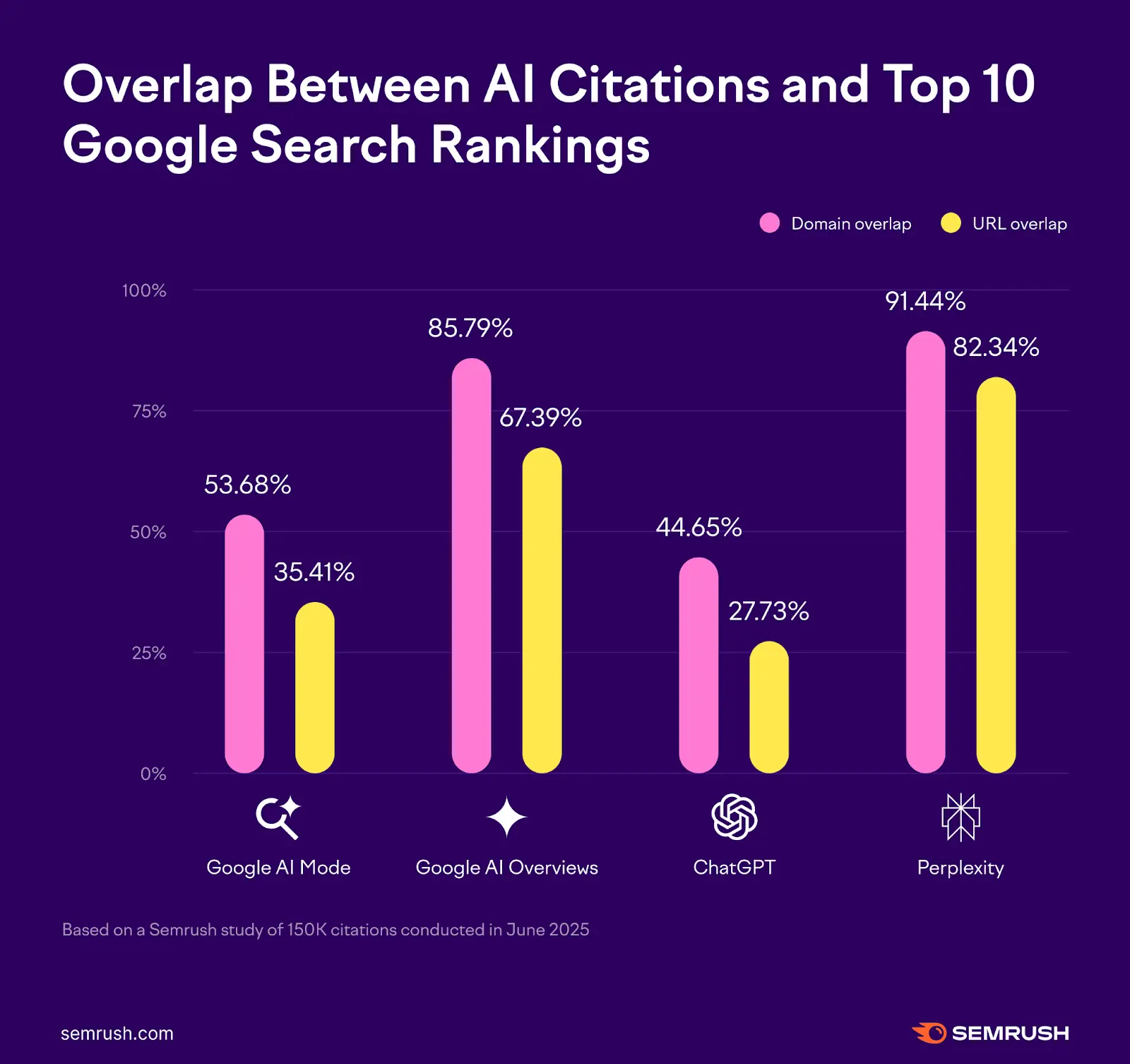
AI Mode pulls from a wider range of domains and tends to present several at once, usually in a sidebar. Those cited domains often overlap only partly with the classic top 10, and exact URL overlap is thinner still. So there's risk and opportunity in the same move: you might get cited without ranking top 10, and you might get skipped even when you do rank.
Comparison table: AI Mode vs other systems
| Dimension | Google AI Mode | Google AI Overviews | ChatGPT / Perplexity (typical behavior) |
|---|---|---|---|
| Access | Separate tab / opt-in AI-first experience | Appears inside standard results when triggered | Separate AI interfaces |
| Interaction style | Multi-turn exploration with follow-ups | Usually single response with links | Multi-turn chat; citation transparency varies |
| Source behavior | Curated multi-source citations, often sidebar | Supporting links inside SERP context | Often fewer sources; varies by product and mode |
| SEO relationship | Strongly tied to Google ecosystem signals | Tied to Google SERP environment | Less directly tied to Google ranking signals |
| Key marketer risk | Ranking does not guarantee inclusion | Same risk, but more limited contexts | Winners vary by model and retrieval approach |
💡Related topic: LLMs Optimization - Why ChatGPT, Gemini, Claude and Perplexity Produce Different Winners
What Google AI Mode cites and why rankings are not enough
Google AI Mode cites content that shows authority, consensus, and real-world relevance. A strong SEO position on its own no longer carries you. AI Mode leans toward sources that explain concepts clearly, get referenced across the web, and match what the user actually wants when it builds an answer.
The overlap problem: Domain vs URL
Here's the practical part. AI Mode doesn't just echo the top 10 organic results. Domain overlap between its citations and classic results is only partial, and exact URL overlap is lower still. So "we rank" and "we get used" are two different things. The selection logic looks closer to trust plus extractability than raw position.
Why clicks can drop even when you “win”
AI-enhanced search can cut clicks because users get what they need straight from the AI Answer. Pew Research has reported that AI-enhanced SERPs can drop click-through rates significantly. Track clicks alone and you'll misread the story. You might be shaping the answer while traffic looks flat, or missing from it entirely while traffic looks fine.
A simple mental model for AI visibility in AI Mode
Think of AI Mode as a filter with three gates:
- Trust gate: is the source credible, corroborated, and consistent?
- Extractability gate: can the system pull clean statements, definitions, and structured facts?
- Relevance gate: does the content match the query intent and the follow-up paths?
Fail any gate and rankings won't save you. Pass all three and you can show up even without perfect classic SEO positions.
How to optimize for Google AI Mode without chasing myths
Getting picked by Google AI Mode comes down to clear, credible content an AI system can quote with confidence. Skip the myth-chasing. Focus on explainability, a consistent topical presence, and getting cited across trusted sources, and inclusion tends to follow.
Build content that an AI answer can safely reuse
AI systems prefer language that's scoped, factual, and easy to paraphrase without warping the meaning. Write in clear units the model can lift:
- A direct definition near the top of the section
- A short answer before the longer explanation
- Explicit constraints (who this is for, when it applies, when it does not)
Bury your best insight in marketing phrasing and the model will skip it, because it can't reuse it safely.
Structure for multi-turn exploration
AI Mode invites follow-ups, so content that supports branching questions tends to do better. Design for the next question:
- “What is it?” then “How does it work?” then “What should I choose?”
- “Pros and cons” then “pricing” then “who it fits”
- “Common mistakes” then “best practices” then “examples”
The practical version: a clean heading hierarchy, short lead answers up top, deeper context below.
Earn “distributed trust” across the web
AI Mode citations can reach well beyond your own site, so showing up across trusted platforms matters: directories, communities, reputable publishers. For a lot of marketers, that means moving effort from "publish more blog posts" to "build more credible footprints."
A checklist for distributed trust:
- Keep profiles consistent (name, category, description) across major directories
- Contribute expertise in communities where people ask real questions
- Secure mentions from reputable industry publications (even unlinked mentions can help)
Call it reputation building for AI reuse.
Publish content that is citation-worthy, not just lengthy
Original research, clear statistics, and expert commentary carry more weight per word. In AI Mode, dense fluff is a liability. A page with a clean framework, a real data point, and a sharp conclusion gets cited more often than a long page that says almost nothing.
A quick scoring approach you can apply internally:
| Element | Question | Signal of strength |
|---|---|---|
| Originality | Does this add something not found everywhere? | Unique data, unique framework, unique examples |
| Clarity | Can the key point be quoted in one sentence? | Strong lead answer + scoped definitions |
| Verifiability | Is the claim supported by sources or evidence? | Credible citations, transparent methodology |
| Usefulness | Does it solve a real decision problem? | Comparisons, tradeoffs, constraints, next steps |
💡Read more: Understanding Power of AI Search Engine
Where Mention Network fits in a Google AI Mode workflow
Mention Network fits a Google AI Mode workflow by showing e-commerce brands exactly where and how AI surfaces them, then helping them fix it. It closes the gap between publishing content and actually earning AI visibility: measure how ChatGPT, Gemini, and Google AI describe your store, find the authority gaps, and strengthen the signals AI Mode leans on when it picks sources.

Why you need measurement beyond classic SEO dashboards
Traditional tools can't isolate AI-driven visibility. Rankings, clicks, and Search Console reports don't show how your brand reads inside an AI Answer. That's the gap a dedicated AI Visibility layer fills.
What Mention Network helps you see
Mention Network works as an AI Visibility layer built for e-commerce, and it measures outcomes inside AI answers on two levels. Brand AI Visibility asks whether AI names and recommends your store when shoppers ask about your category. Product AI Visibility asks whether AI suggests your specific products and points shoppers to where they can buy them. In day-to-day terms, it helps your team answer:
- Does AI name us when shoppers ask about our category, and how accurately?
- Which of our products get suggested, and which get skipped?
- Which competitors get cited instead, and in what contexts?
Once you can see the pattern, the work becomes evidence-driven instead of guesswork.
How to operationalize it
A simple operating rhythm:
- Measure: capture AI Visibility signals across your priority categories and products
- Diagnose: run a store audit that explains why AI isn't picking a given page or product
- Fix: apply the drafted improvements to your product pages, with preview and approval, from your store admin
- Re-check: watch whether inclusion and citations move over time
That keeps your Google AI Mode strategy anchored to measurable shifts instead of opinions about what should work.
You can run a free AI Visibility check at mention.network to see how your brand shows up in AI answers.
Got questions? Email us at [email protected], or book a quick call with our team for free support.
FAQs
What is the biggest misconception about Google AI Mode?
That ranking in the top results guarantees a spot in the AI Answer. AI Mode cites sources outside the top 10, and it skips pages that are hard to summarize or verify.
How do I know if my brand’s AI visibility is improving?
Watch how often you get mentioned or cited in AI Answers across your target topics, and whether the descriptions of your brand get more accurate and more positive over time. Monitoring tools make that trackable.
Should I optimize differently for AI Mode vs AI Overviews?
The fundamentals overlap: trust, clarity, extractable structure, and distributed presence. The difference is that AI Mode runs more multi-turn and comparison-heavy, so content built for follow-ups and decision frameworks tends to perform better.
If clicks drop, is that always bad?
Not always. AI-driven answers can pull clicks down even while your content shapes the AI Answer. Measure presence and citations, not only traffic.