Agentic AI vs generative AI: Key differences and what they change for AI visibility
Generative AI answers questions; Agentic AI pursues goals and selects brands through constraint checks. Learn what each system rewards and how to stay visible in both.

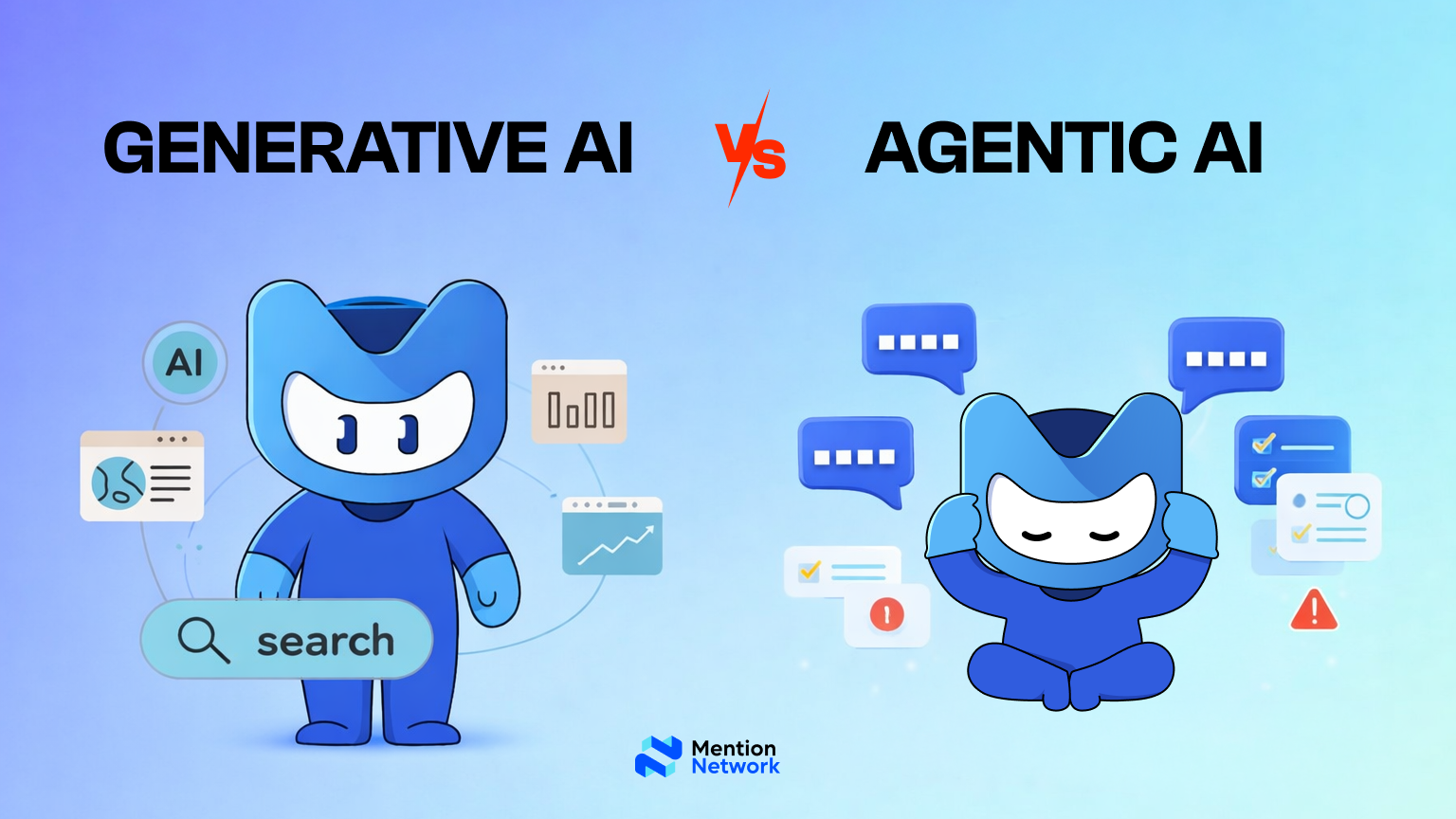
Agentic AI vs generative AI is a real split, and it decides how products get discovered, compared, and chosen. A generative system answers your question. An agentic system chases a goal. That gap shapes how brands surface, how they get judged, and why getting mentioned counts for less than getting selected.
Here's what the split means in practice for AI Visibility, AI SEO, and AI SEO Optimization.
What you'll learn:
About agentic AI
Agentic AI runs a task from start to finish. Rather than write one response, it plans the steps, calls tools, checks the results, and loops until it hits the outcome. The point is a finished job.
What is it?
An agentic AI decides what to do next and takes the steps to do it. It runs a loop: plan, act, verify, refine. So the system gets judged on one question. Did it reach the goal?
You see it in workflows like "book the best option," "launch a campaign," "audit competitors," or "fix the errors," where the model coordinates a chain of steps.

Key components
Several layers work together here. Look only at the model and you'll miss why the behavior changes.
- Planning and task decomposition. The agent splits a big goal into smaller tasks, then picks an order to run them. Brands get filtered out early when the plan sets a constraint like "must have SOC2" or "must support EU billing."
- Tool use and integrations. Agents call external tools: search, CRM, spreadsheets, APIs, internal docs. That shifts the source of truth to what those tools return, not what a brand claims on its homepage.
- Memory and state tracking. Many agents remember what they tried and what worked. A brand can lose visibility because earlier steps returned inconsistent info, even when the brand itself is well known. That's why AI SEO Optimization now leans hard on consistency and structured attributes.
- Evaluation and self checking. Agents validate their outputs against the requirements. When the system can't verify a claim, it drops its confidence and holds back the recommendation. That rewards evidence over persuasion.
💡Read more: Why Visibility in Business Is the Real Growth Advantage
How agentic AI evaluates brands across a decision chain
An agent doesn't judge you once. It judges you again at every stage. That's the core reason Agentic AI vs Generative AI creates different “winners.”
A typical selection chain runs like this:
- Eligibility screening. The agent applies constraints: price, region, integrations, compliance, category fit. If your brand data is fuzzy, you drop out before the comparison even starts.
- Comparative reasoning. It lines up the shortlist across decision dimensions. A product without clear, comparable attributes loses here, reputation and all.
- Risk and trust validation. The agent hunts for confirmation from neutral sources or consistent coverage across the web. This is where AI Visibility meets authority signals.
- Final selection. The agent picks the option that satisfies the goal with the least risk. By then a mention counts for little. Getting chosen is the whole game.
For AI Visibility, agentic AI raises the bar. Your clarity has to survive repeated evaluation.
About generative AI
Generative AI produces content: answers, summaries, drafts, code, explanations. It's tuned for fluent, helpful output inside a single exchange.
What is it?
Generative AI takes your prompt and writes a response. It might retrieve, cite, or browse, but it stays in answer mode: give the best response for the prompt and context in front of it.
This is the system most marketers picture when they think of AI Search. You ask, the model answers, the session ends.

Key components
The structure is simpler, even when the model underneath is not.
- Prompt to response generation. The model turns your instruction into text. For AI Visibility, this is where most brand mentions happen, because the model is composing a story.
- Retrieval and citation behavior. Some systems pull sources and cite them. That shapes AI SEO, since extractable facts and reputable sources are the easiest material to reuse.
- Summarization and compression. Generative AI squeezes information into short outputs. Complex or inconsistent positioning gets you misread or dropped.
- Safety and risk avoidance. Models steer clear of shaky claims. That matters for AI SEO Optimization, because a statement the model can't verify rarely makes it into an AI answer.
How generative AI drives brand inclusion
Generative AI names a brand when it can do so safely and clearly. It reaches for brands that are:
- easy to categorize
- described the same way across sources
- tightly tied to a use case
- backed by trusted third party references
That's why AI Visibility in generative systems tends to reward "mentionability" and "quotability." Clear definitions, structured comparisons, and stable attributes get you named more often.
Run a free check-up at mention.network to see how ChatGPT, Gemini, and Google AI surface your store and products when shoppers ask.
If you have any questions, email us at [email protected], or book a quick call for free support with our team here
                    [
                        Book a call for free support
                    ](https://cal.com/mentionnetwork)
Agentic AI vs generative AI: The key differences
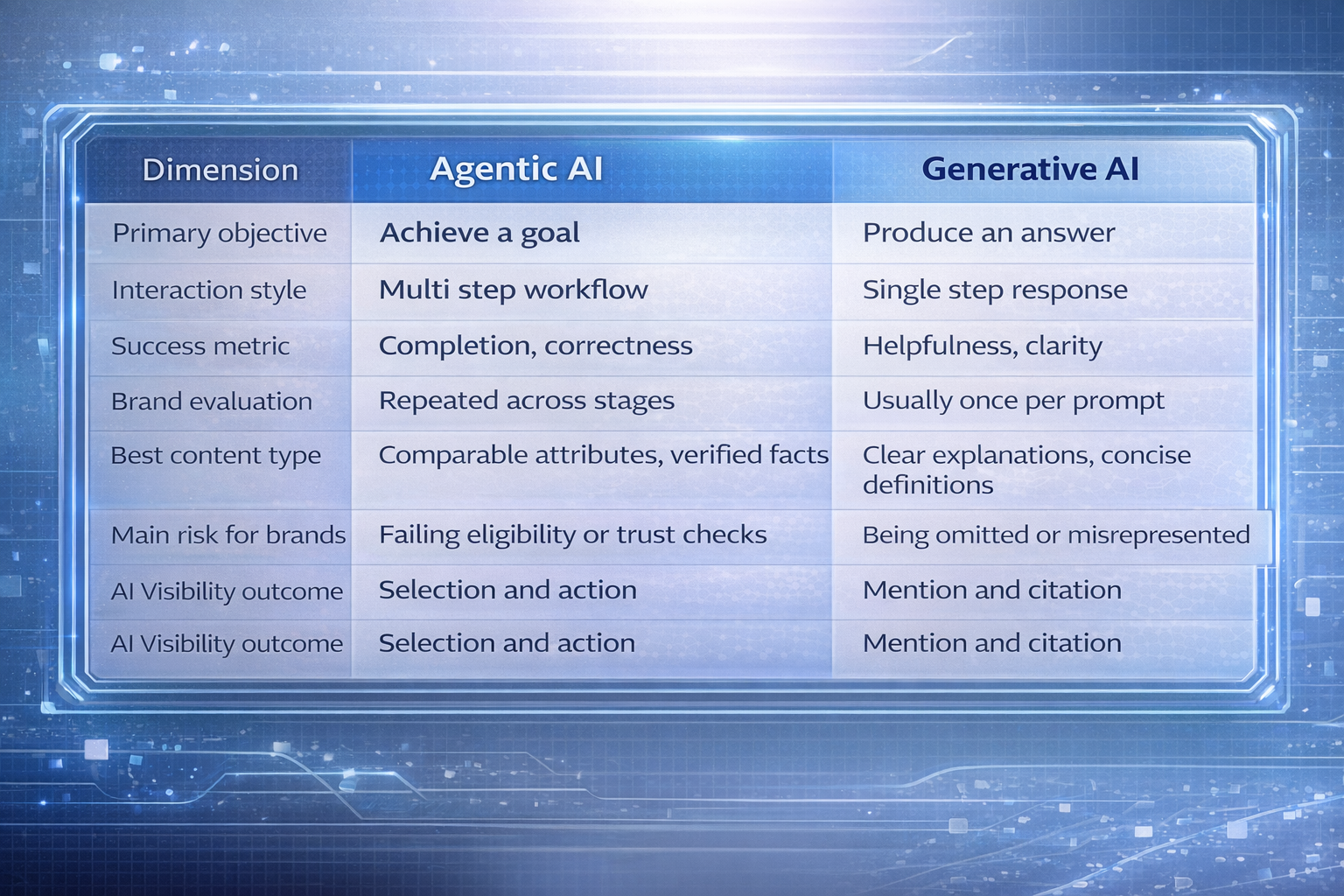
Here's an overview table you can share internally.
1. Selection vs position
Generative systems feel like ranking. Your brand lands in the answer or it doesn't. Agentic systems behave like procurement, where your brand moves through stages or gets cut.
That's the strategic shift for marketers. Build your whole strategy around getting mentioned and you'll come up short in agentic settings, where the win is getting selected.
It reshapes AI SEO too. Approaches that lean only on narrative content struggle in the selection pipeline once product attributes have to be decision ready.
2. Data needs and verification pressure
Agentic systems want actionable data: pricing rules, integrations, limits, compliance, availability. Generative systems still name you off softer signals like "often used for teams."
The practical move is to build a decision ready source of truth page that reads cleanly for both:
- a precise product definition
- an attribute table (pricing model, target users, integrations, regions)
- fresh change logs (what changed, when)
- neutral validation links (docs, reviews, community references)
Here, AI SEO Optimization shifts away from keyword coverage and toward verifiable structure.
3. What “AI visibility” actually means in each world
In generative systems, AI Visibility reads as frequency: how often a brand gets mentioned or cited in AI answers.
In agentic systems, it reads as outcomes: how often a brand clears the constraints, makes the shortlist, and gets picked for execution.
Think of it this way:
- Generative: "Did the model talk about us?"
- Agentic: "Did the system choose us?"
Both matter. They measure different layers of discovery.
4. Implications for AI SEO and AI SEO optimization
Want durable visibility across both? Your playbook has to cover two surfaces.
On the Generative AI answer surface, you prioritize:
- extractable definitions
- FAQ style questions that match intent
- comparison pages that teach the category logic
- content that summarizes cleanly without distortion
On the Agentic AI decision surface, you prioritize:
- decision attributes and constraints
- structured product facts that stay consistent across channels
- validation signals from third party sources
- clear documentation that lowers risk
This is the heart of AI SEO: lining up what you publish with how systems select and reuse information. Skip the decision surface and you'll be visible yet passed over. Skip the answer surface and agents may pick you while humans never hear your name.
💡Learn more: How to Quantify Your Brand’s Presence in the Age of AI Visibility
Real world examples you can map to your work
Here are deployments you'll recognize, minus the hype.
- Customer support automation. A model reads a ticket, decides the action (refund, escalate, route), and drafts a response. The generative layer writes; the agentic layer decides. Brands with clear policy docs and decision rules get chosen more reliably.
- Developer productivity workflows. Generative tools draft the code. Agentic tools run the tests, open PRs, and iterate. In those flows the tools and repos become the source of truth, so consistent docs beat blog marketing.
- B2B software evaluation. A buyer asks an AI answer engine for recommendations, then hands an agentic assistant the shortlist to filter on integrations and compliance. You need mentionability and decision readiness to win.
If you track AI Visibility, your measurement should show both layers.
Generative AI moves perception through AI answers. Agentic AI moves outcomes through selection and execution. Treat both as real distribution channels, and build content that reuses easily alongside product facts that verify easily.
FAQs
Is agentic AI just “generative AI with tools”?
Not quite. An agentic system can run on a generative model, but its defining feature is the control loop: plan, act, verify across steps. That loop changes how brands get evaluated, which is why AI Visibility behaves differently.
Does agentic AI reduce the value of traditional marketing content?
It devalues vague marketing claims and raises the value of clear positioning, comparable attributes, and documentation you can trust. Those assets help you on the answer surface and inside agent decision systems.
How should teams measure AI visibility across both types?
Track two signals: mention and citation frequency in AI answers, plus shortlist and selection patterns in goal driven workflows. Track citations alone and you'll miss the moments where agentic systems quietly hand the win to a competitor.
Where do AI SEO and SEO AI fit into this shift?
AI SEO is about inclusion inside AI mediated discovery. SEO AI usually means using AI to do SEO tasks faster. The two overlap, but their priorities split. AI SEO Optimization is the practical bridge that turns your content into decision ready, reusable information.