Best AI SEO Tools for Ecommerce in 2026
The best AI SEO tools for ecommerce cover product feeds, schema, crawl checks, product copy, AI-answer monitoring, and store-level where-to-buy measurement.

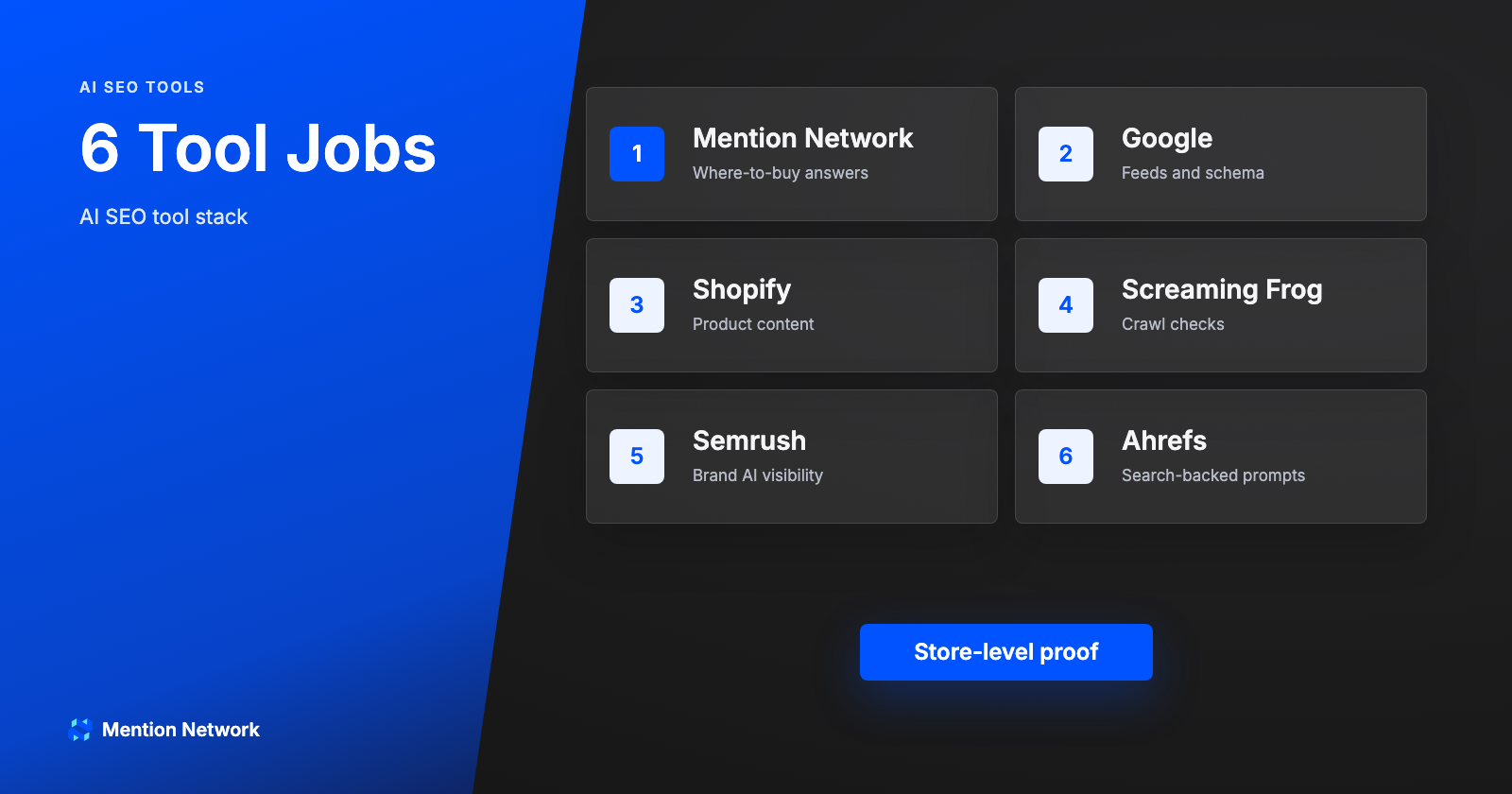
TL;DR The best AI SEO tools for ecommerce do six jobs. They make product data eligible, validate Product and Offer schema, crawl pages, draft product copy, monitor brand visibility in AI answers, and measure where-to-buy answers. Brand dashboards cover one of those six jobs. Pricing and features below were checked against official vendor sources in mid-July 2026.
An ecommerce AI SEO stack needs a different checklist from general AI SEO software. A store has product feeds, variant data, price, availability, shipping, returns, reviews, and merchant trust signals. A content team has articles.
That is why a generic writing tool is a poor center of gravity for a store stack. Start with the systems AI shopping surfaces can read. Then add monitoring.
Full disclosure: Mention Network is our product, and it appears in this comparison. I am using the same rule for every tool here: official docs or vendor pages only.
What this stack covers:
- Which AI SEO tools matter for ecommerce?
- Which tools handle product data and schema?
- Which tools monitor your brand in AI answers?
- Which tool measures where-to-buy visibility?
- What should you buy first?
- Six-tool comparison table
Which AI SEO tools matter for ecommerce?
An ecommerce AI SEO stack makes product, store, and trust data readable enough for AI systems to cite or recommend. The useful stack has six layers:
- Product-feed eligibility.
- Product and Offer schema.
- Crawl validation.
- Product copy and page clarity.
- AI-answer monitoring.
- Store-level where-to-buy measurement.
The split matters because official commerce guidance is already product-data first. OpenAI's Product Feed Spec says merchants should provide structured product feeds so ChatGPT can index and display products with current price and availability. Google's Product structured data docs name price, availability, review ratings, and shipping information as product facts that can appear in Search experiences.
Vendors put it in the same terms. On OpenAI's product-discovery page, Shopify's VP of Product, Mani Fazeli, says: "When buyers look for products, the Shopify Catalog offers the most relevant options from the brands that people love" (OpenAI, "Powering Product Discovery in ChatGPT"). The structured catalog, not a blog post, is what an AI shopping surface pulls from.
So the first question is boring and useful: can AI read the store's product truth? Tools that cannot inspect that layer are support tools, not the core stack.
Which tools handle product data and schema?
Google Merchant Center and Product structured data are the eligibility layer. Use them before buying another dashboard. Google's Merchant Center product data specification treats price and availability as product attributes that need to stay fresh when they change often. Google's merchant listing structured data docs also include shipping and return information.
For Shopify stores, the official help center is now explicit about AI search. Shopify's AI optimization guide says AI-powered search engines and shopping assistants can help customers discover and compare products. Its product AI optimization page adds the caveat stores need. Products that meet Shopify Catalog requirements are included by default, and best practices only improve the chance that AI platforms match your products to customer searches.
Use Google and Shopify as the source-of-truth tools. Use paid tools to find the gaps.
Which tools catch crawl and page-level defects?
Screaming Frog is still the practical crawler in this stack because ecommerce AI SEO has ordinary crawl problems underneath it. The official SEO Spider page says it audits more than 300 SEO issues, crawls 500 URLs for free, and removes that limit with a £199 per year licence, verified July 19, 2026.
Use it to check whether product pages expose the basics in HTML: title, canonical, indexability, structured data, status codes, internal links, duplicate templates, and broken links. Those are not AI-specific labels, but they decide whether downstream systems can find and trust the page.
For Shopify copy, Shopify Magic can generate product descriptions, email subject lines, headings, and other store copy. Treat it as a draft helper. It does not tell you whether AI recommends the store.
Which tools monitor your brand in AI answers?
Semrush, Ahrefs, Profound, and Peec AI are the brand and category monitoring layer. They answer questions like: how often does AI mention a brand, which competitors appear, and which pages get cited? That is useful, especially when a store owns its brand or sells private-label products.
Semrush AI Visibility Toolkit pricing lists the Base plan at $99 per month per domain when billed annually, verified as of July 16, 2026. Ahrefs Brand Radar says it draws on a search-backed database of 401M+ total monthly prompts; Ahrefs pricing lists custom prompt packages from $50 per month for 2,500 checks, verified July 19, 2026.
Profound tracks AI visibility, brand mentions, responses, and citations. Peec AI positions itself for marketing teams analyzing brand performance across ChatGPT, Perplexity, and Gemini. Strong tools. Different unit.
Which tool measures where-to-buy visibility?
Mention Network is our product, so read this section with that disclosure in mind. The reason it belongs in an ecommerce AI SEO stack is the unit of measurement: whether AI names your store when a shopper asks where to buy a product.
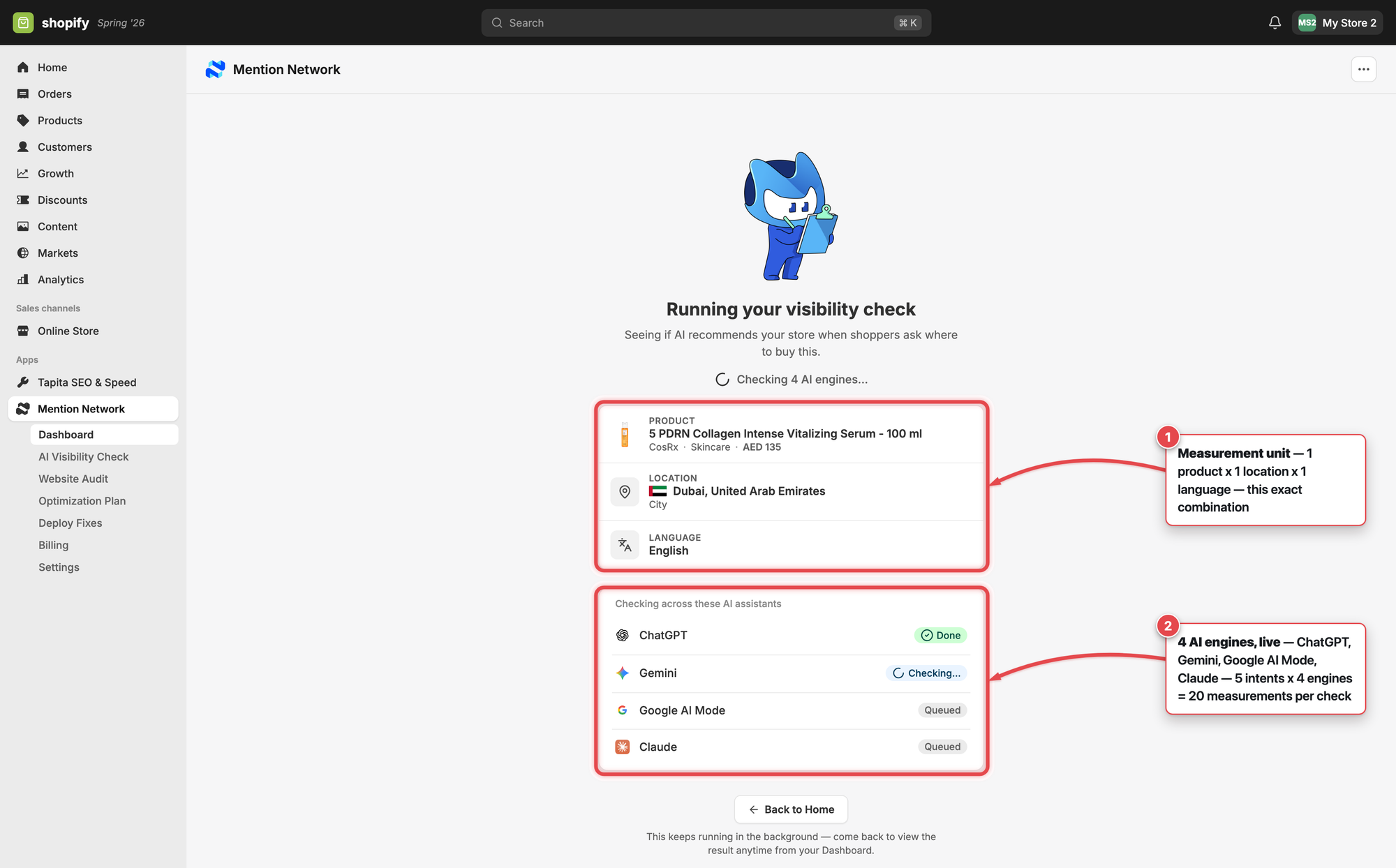
The shipped AI Visibility Check is verified in our fact inventory as of July 11, 2026. It currently runs five buyer intents across four engines: ChatGPT, Gemini, Google AI Mode, and Claude. That creates 20 answer receipts for one product, one location, and one language, with the raw AI answers saved as proof.
Use a brand monitor when the question is share of voice. Use store-level measurement when the question is whether shoppers get sent to you. However, store-level measurement has one limitation: it is deliberately narrow, so it will not report your category-wide share of voice, and a brand team that needs that number should keep a monitor alongside it.
What should you buy first?
Buy in this order: free official tools, crawler, product-copy helper, AI visibility monitor, then store-level answer measurement. The order keeps you from paying to monitor broken inputs.
For a Shopify store with limited budget, start with Merchant Center, Product structured data, Shopify's AI product guidance, and a 500-URL Screaming Frog crawl. Then improve product titles and descriptions. Once the inputs are readable, monitor AI answers.
For a brand team, Semrush, Ahrefs, Profound, or Peec AI may come earlier because brand share of voice is the business metric. For a reseller or multi-brand retailer, that order can mislead you. Brand visibility can rise while your store stays absent from the actual where-to-buy answer.
Use the broader AI SEO pillar for definitions, the ecommerce AI SEO playbook for store fixes, and the AI visibility tools guide for a wider category list.
Six-tool comparison table
Bottom line: ecommerce AI SEO needs six tool jobs; brand dashboards cover one of them, and store-level where-to-buy measurement covers the buying answer they miss.
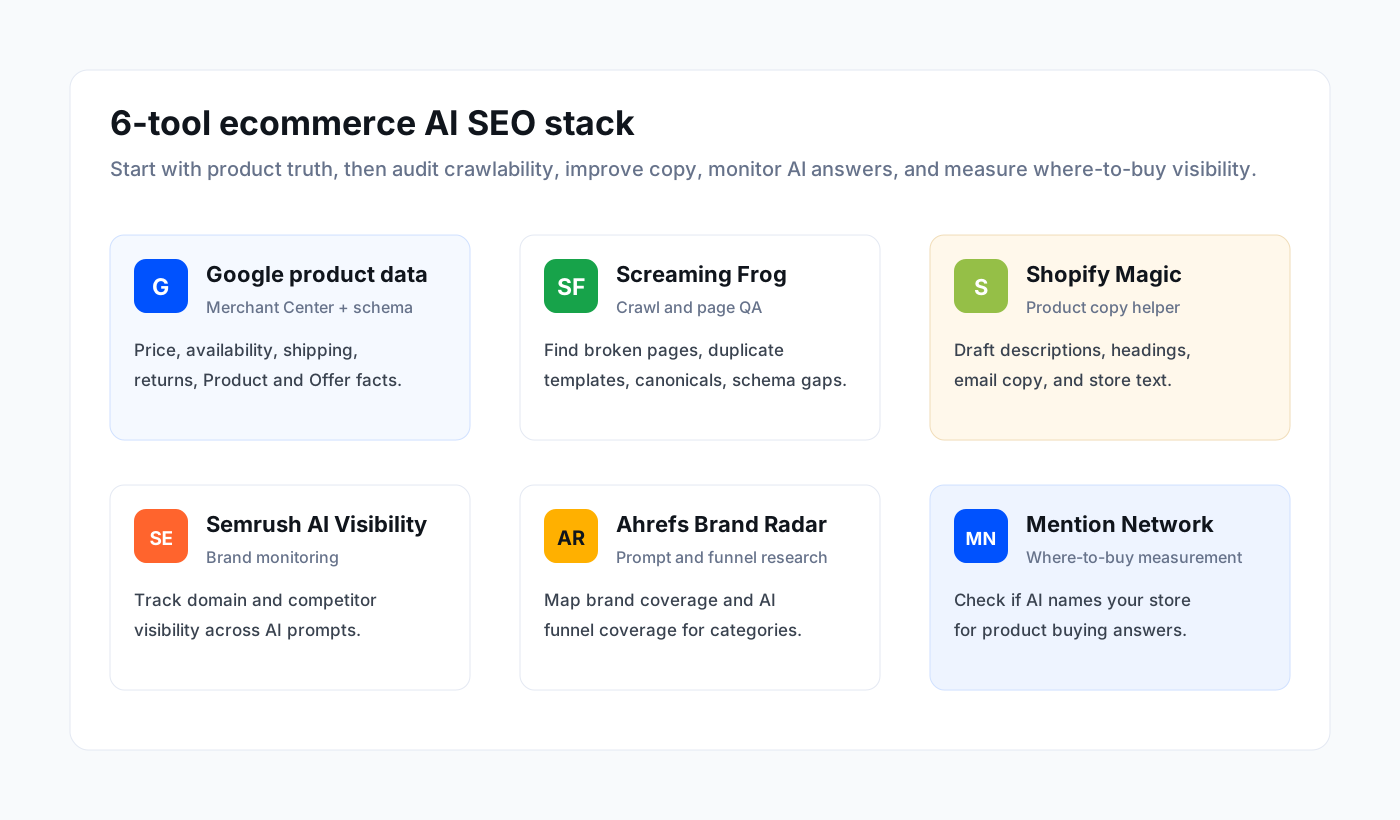
For broader brand-monitoring alternatives, use the AI visibility tools guide and the free AI search visibility tools list as satellite reading. Keep this ecommerce table narrower: these are the 6 jobs a store has to cover before a where-to-buy answer can be trusted.
Frequently asked questions
What are the best AI SEO tools for ecommerce?
For eligibility, use Google Merchant Center with Product structured data. Then add Screaming Frog for crawl checks, Shopify Magic for product copy, Semrush or Ahrefs for brand monitoring, and Mention Network for store-level where-to-buy measurement. Together they cover the six jobs a store stack needs: feeds, schema, crawl checks, copy, AI-answer monitoring, and where-to-buy measurement.
Is Mention Network an AI SEO tool?
Mention Network is our ecommerce AI visibility product. It measures whether AI names your store in where-to-buy answers for a product, location, and language.
Do ecommerce stores need both SEO tools and AI visibility tools?
Yes. SEO tools check crawlability, schema, feeds, and content quality. AI visibility tools check whether AI systems cite, mention, or recommend the store after those inputs are live.
Can AI SEO tools get my products into ChatGPT?
Not directly, but they prepare the inputs ChatGPT reads. OpenAI's Product Feed Spec says merchants should provide a structured product feed so ChatGPT can index and display products with current price and availability. Feed and schema tools raise your chance of inclusion, but each engine still decides what to show.
How much do AI SEO tools for ecommerce cost?
AI SEO tools for ecommerce range from free to enterprise. Google Merchant Center and Product structured data are free, and Screaming Frog crawls 500 URLs free before its £199 per year licence. On the paid monitors, Semrush's AI Visibility Toolkit starts at $99 per month per domain billed annually, and Ahrefs custom prompt packages start at $50 per month, both checked on official vendor pages in July 2026.
Which AI SEO tools work with Shopify?
Shopify stores pair Shopify's built-in tools with general AI SEO software. Shopify Magic drafts product copy inside the admin and Shopify publishes AI optimization guidance for product visibility, while Google Merchant Center, Product structured data, and a Screaming Frog crawl handle feed eligibility and technical checks.
Are free AI SEO tools enough for an ecommerce store?
Free tools cover the eligibility base layer but not measurement. Google Merchant Center, Product structured data, and a 500-URL Screaming Frog crawl make product data readable for AI systems. But confirming whether AI actually names your store in where-to-buy answers needs a monitoring or store-level measurement tool on top.
After your product data is readable, run a free check to see whether AI recommends your store in buying answers.