
GEO for Shopify: Product Data Truth Across AI Shopping
GEO for Shopify starts with product data truth across your product pages, Product structured data, feeds, Shopify Catalog, and off-store trust signals.

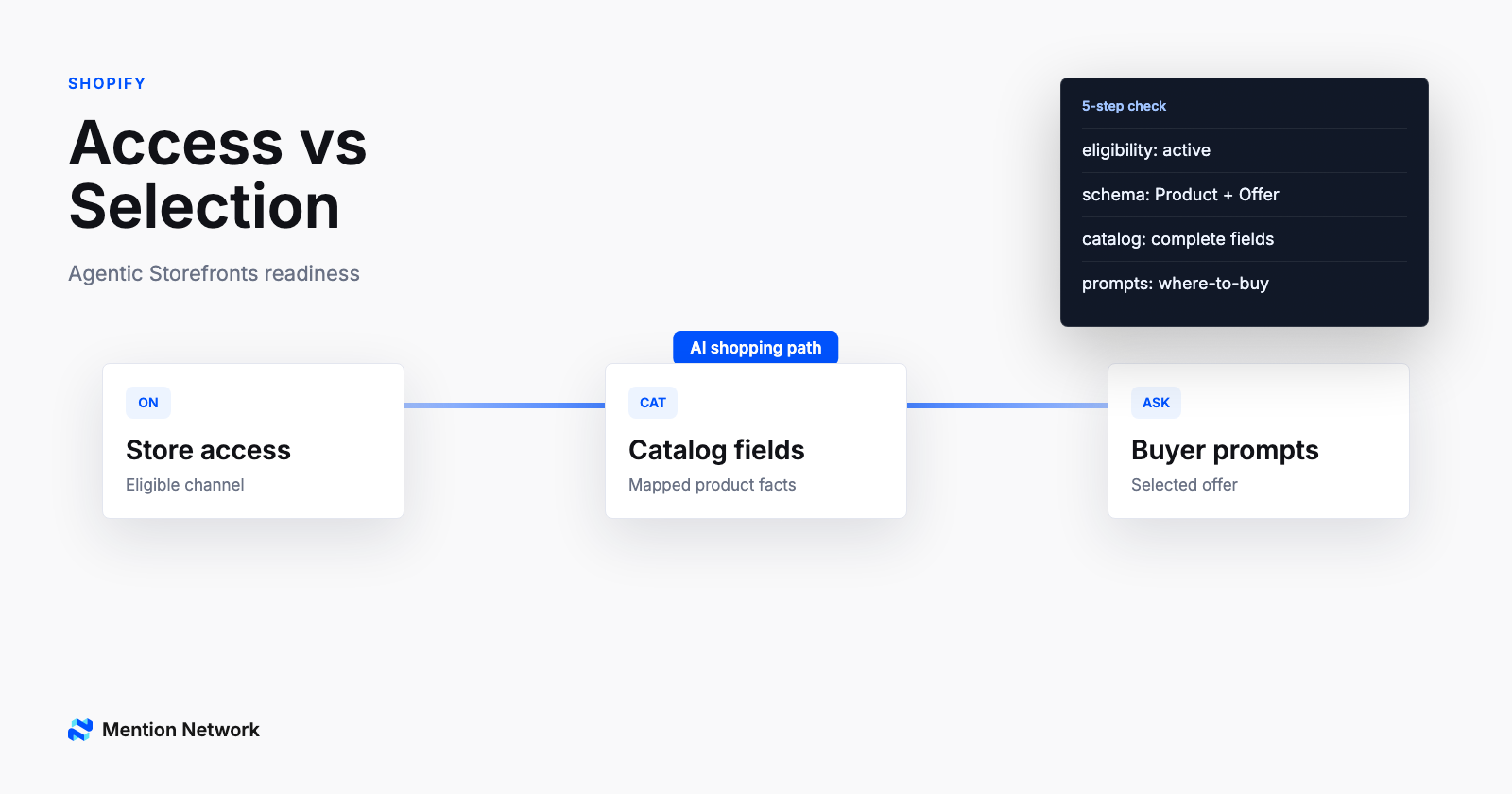
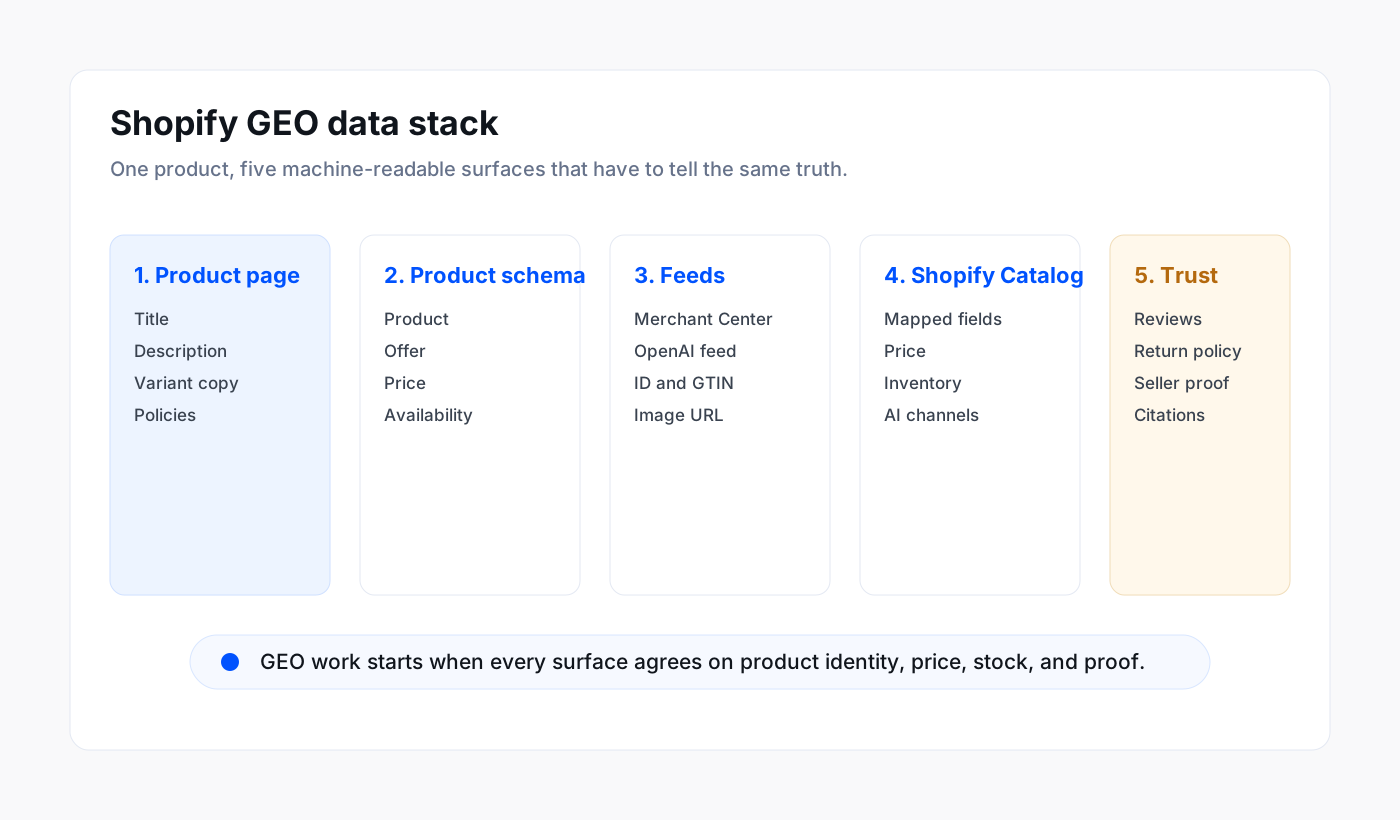
TL;DR GEO for Shopify is a product-data truth job. As of 2026-07-16, Shopify Catalog, OpenAI product feeds, Google Product structured data, and Merchant Center all ask for machine-readable product facts. The first pass is 5 of 5 surfaces agreeing: product page, schema, feeds, Catalog, and off-store trust.
A Shopify merchant can have a polished product page and still hand AI 5 versions of the same product. The page title says one thing, Product structured data says another, Merchant Center has stale availability, Shopify Catalog maps a custom metafield, and reviews live somewhere AI may or may not trust.
That is the job of GEO for a Shopify store. It is not a generic checklist. GEO for Shopify is the discipline of making your product data consistent enough for AI shopping engines to parse, compare, and recommend.
GEO for Shopify is product data truth
GEO for Shopify is the work of making each product legible across the machine-readable surfaces that AI shopping uses. The important word is product. Broad GEO advice usually talks about brand pages, FAQs, and topical authority. A Shopify store has a more concrete problem: one SKU has to carry the same identity, price, availability, shipping promise, and seller proof everywhere a machine reads it.
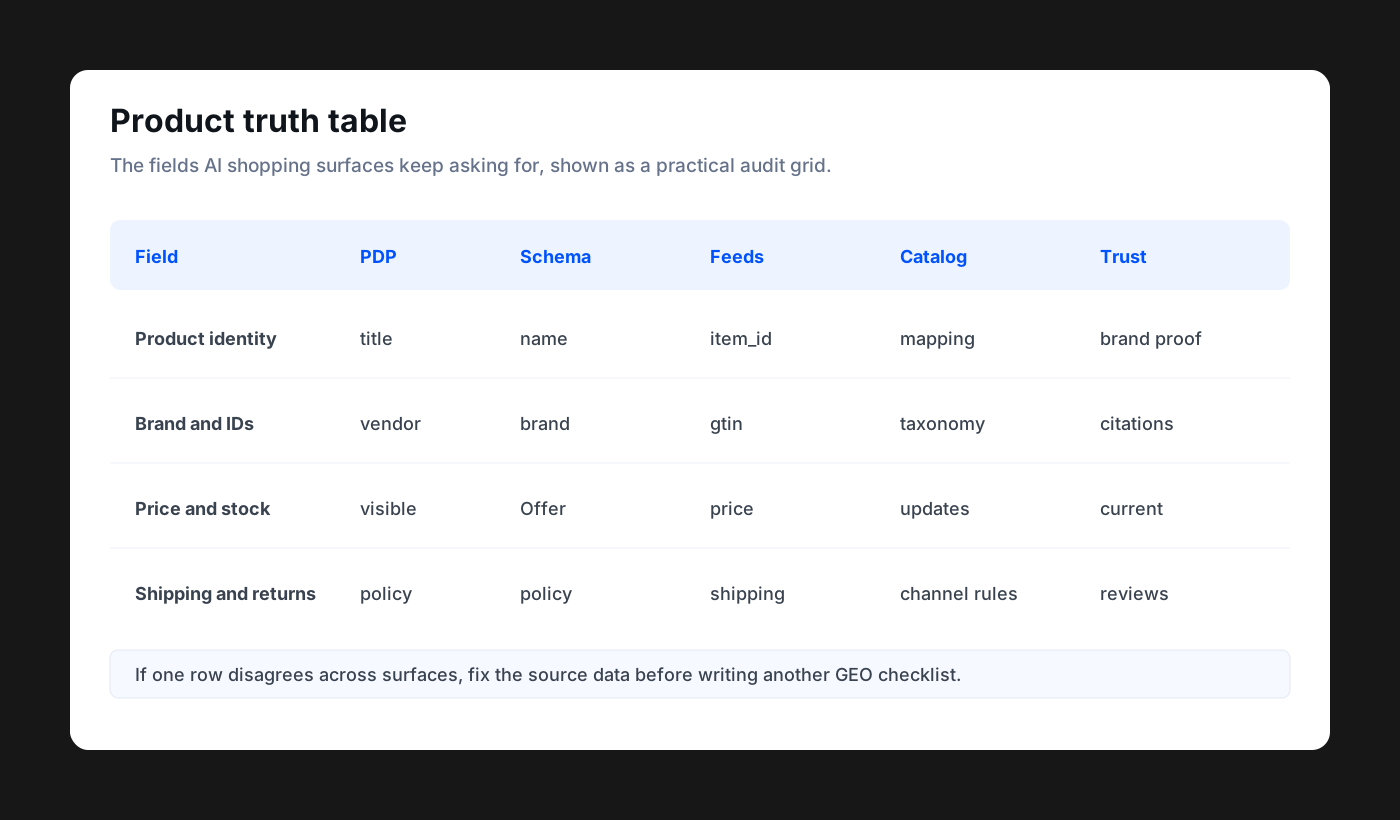
That is why GEO vs SEO for ecommerce is a real split. SEO can still care about titles, crawl paths, and category pages. Shopify GEO cares about whether an AI answer can tell that the product on the PDP, the Product schema, the Merchant Center feed, and Shopify Catalog are the same sellable item. If those records disagree, better copy will not fix the trust gap.
Shopify Catalog is now part of the surface
Shopify Catalog is a first-class AI-shopping surface, verified as of 2026-07-16. Shopify says eligible products are automatically discoverable by AI channels through Shopify Catalog, plus other methods such as web crawling, indexing, and merchant-owned feeds. The same Shopify page says Catalog syndicates title, description, options, images, price, availability, and other key attributes in a structure AI agents can parse.
This changes the Shopify GEO audit. Your theme is one source. Catalog mapping is another. If product data lives in metafields, metaobjects, tag prefixes, or custom title separators, Shopify says Catalog Mapping may be needed to source the right data for agentic storefronts. That is a practical instruction, not a ranking theory.
The current Shopify Agentic Storefronts page also says agentic storefronts are active by default for eligible stores, while Google AI Mode and Gemini remain early access. Treat that as a dated platform fact, not evergreen advice.
Product schema and feeds verify each other
Product structured data is one ledger. Product feeds are another. Google Search Central, last updated 2025-12-10 and rechecked 2026-07-16, says merchants can add Product structured data, upload Merchant Center feeds, or do both. Google also says using both helps it understand and verify product data, and that some experiences combine the two.
That is the correct claim to make about schema. Product structured data can make a product page clearer to Google and eligible for rich product experiences. It is not a magic citation lever for AI answers. The stronger Shopify GEO move is consistency: Product, Offer, price, availability, shipping, and return policy on the page should match the feed Google reads through Merchant Center.
This is where the companion guides matter. Use Shopify structured data for AI for the page layer. Use Shopify to Google Merchant Center for the feed layer. Then compare the two records row by row.
ChatGPT needs its own product record
OpenAI's product feed spec is now explicit commerce infrastructure, verified as of 2026-07-16. The OpenAI Developers page says a structured product feed helps ChatGPT index and display products with current price and availability. Its required fields include stable product identity, title, description, URL, image URL, price, and availability.
For Shopify merchants, the lesson is simple: AI shopping systems prefer structured product records. A product title written for humans may be charming, but the feed still needs a stable item ID, clean brand field, current availability, and a URL that resolves. If the product comes in variants, variant grouping matters too.
Shopify's ChatGPT help page adds another boundary. ChatGPT is described as a discovery-focused referrer for eligible stores, with customers completing checkout through the online store checkout. So your Shopify GEO work for ChatGPT starts with discovery data and the destination page, not an assumption that every channel has the same checkout behavior.
Off-store trust is the last consistency check
Product visibility is not only a catalog problem. The AI product visibility frame separates store recommendations from brand mentions: the shopper asks where to buy, and the answer names a small set of sellers. Product data gets you parsed. Trust helps decide whether you belong in that set.
Start with the fields official docs can verify: return policy, shipping cost, availability, ratings, seller identity, and current price. Google's Product structured data docs name ratings, shipping, availability, returns, and price-related enhancements. Merchant Center warns that inaccurate or missing product information can cause disapprovals, limited eligibility, or incorrect displays.
Then check the off-store layer. Are reviews, marketplace profiles, Reddit mentions, and merchant policies telling the same story as the product page? Keep the claim grounded: off-store trust can support product visibility, but it does not rescue a feed that says the item is out of stock.
A 5-step Shopify GEO audit
Use one high-margin product first. Shopify GEO gets vague when you audit the whole store at once, and AI shopping answers are product-specific.
- Match the product page to the feed: title, brand, variant, price, availability, image, shipping, and return policy.
- Validate Product structured data against the visible page. The
ProductandOfferfields should describe the same item a shopper sees. - Open Merchant Center diagnostics and fix product-data issues before content rewrites.
- Review Shopify Catalog mapping if key product data lives in custom fields or naming conventions.
- Measure AI answers after the cleanup. One product in one location and one language is the smallest honest unit.
Mention Network's current check, verified in the product fact inventory on 2026-07-11, runs 5 buyer intents across 4 engines: ChatGPT, Gemini, Google AI Mode, and Claude. That is 20 measurements for one product, with raw answers as receipts.
Frequently asked questions
What is GEO for Shopify?
GEO for Shopify is the work of making a Shopify product understandable to AI shopping engines across the product page, Product structured data, product feeds, Shopify Catalog, and off-store proof.
Does Product structured data alone make Shopify products appear in AI answers?
No. Product structured data helps machines understand a product page, but Google also uses Merchant Center feeds, Shopify uses Catalog for AI channels, and OpenAI defines product feeds for ChatGPT.
What should a Shopify merchant check first for AI shopping visibility?
Check whether the same product identity, brand, price, availability, shipping, and return data agree across the product page, Product structured data, Merchant Center, OpenAI-style feeds, and Shopify Catalog.
For a practical next step, pick one important SKU and run a free check to see whether AI shopping answers can already find your store.