
GEO for WordPress WooCommerce: Product Data Guide
GEO for WordPress WooCommerce starts with product data plumbing: schema, feeds, merchant policies, reviews, and proof that AI shopping engines can read your store.

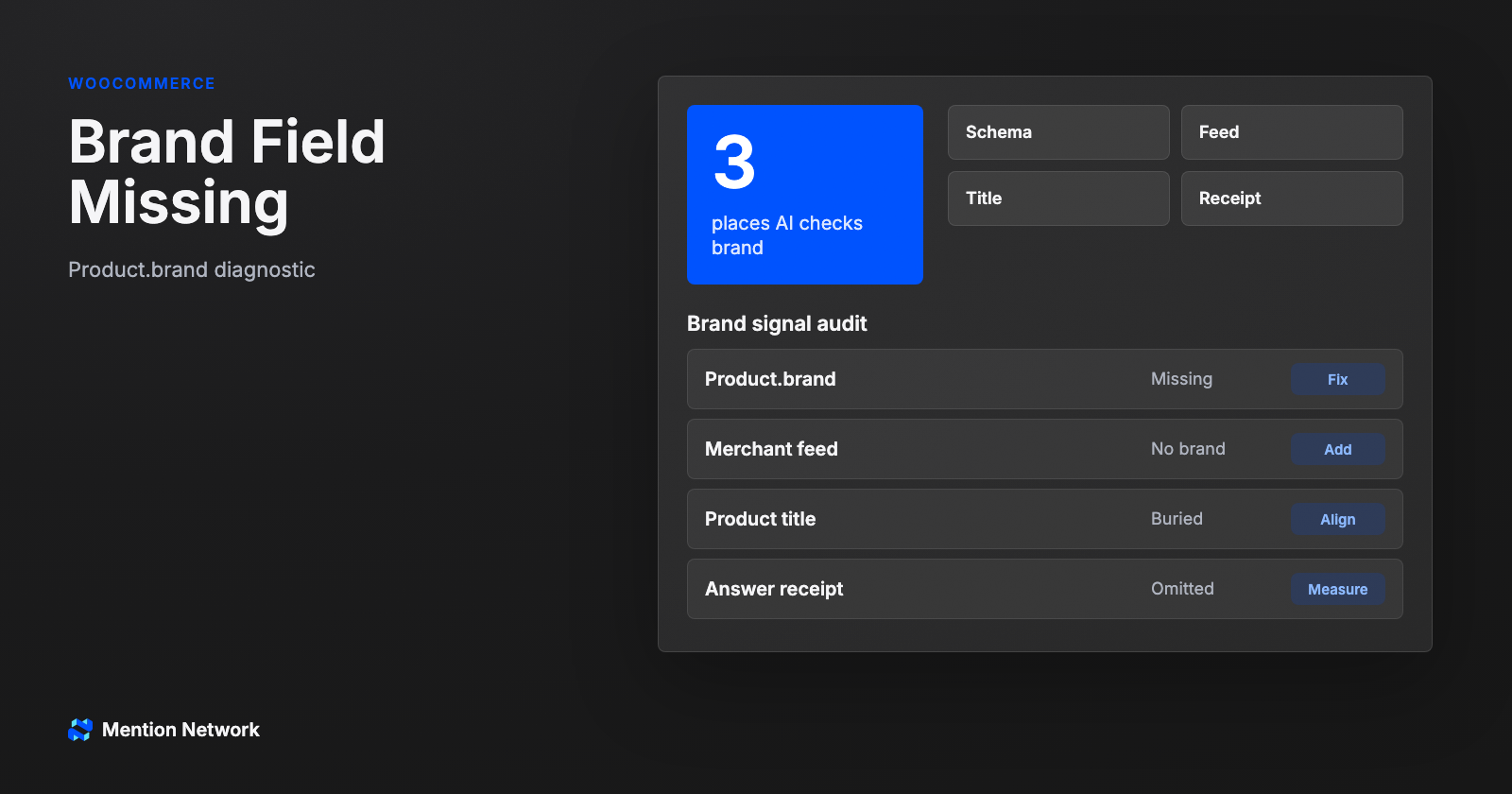
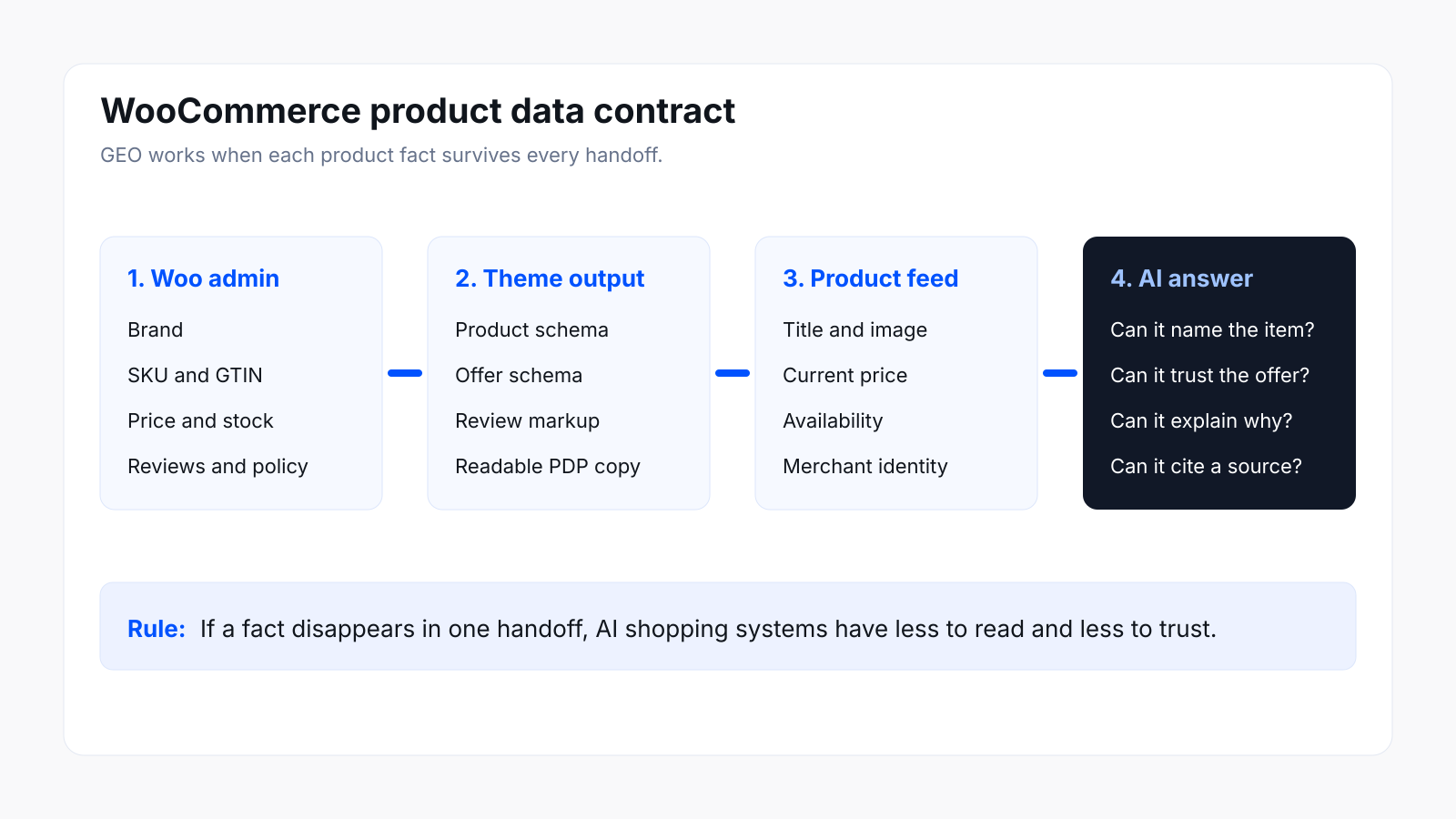
GEO for WordPress WooCommerce starts in a place most merchants already know too well: the product edit screen. You can see brand, price, reviews, stock, shipping rules, and return policy across WooCommerce, a theme, and 3 or 4 plugins. The buyer's AI assistant cannot see your admin.
It reads the version of those facts that survives into the product page, schema, feed, and trusted sources around your store.
TL;DR: Verified as of July 16, 2026, WooCommerce's code reference lists 5 native structured-data types, and Mention Network's shipped Shopify check preserves 20 of 20 raw answer receipts per product run. GEO for WooCommerce depends on whether product identity, offer data, merchant policy, reviews, and answer receipts stay readable outside the WordPress dashboard.
Jump to:
- What GEO means for a WooCommerce store
- Where WooCommerce product data breaks
- What to make explicit first
- How schema and feeds fit together
- How to measure whether AI can read it
- What to ship this week
What GEO means for a WooCommerce store
GEO for WooCommerce is the work of making product and merchant facts readable to generative search systems, shopping assistants, and answer engines. Google still treats this as part of search quality: its AI optimization guide, verified as of July 16, 2026, says Search's generative features rely on core ranking and quality systems. Keep your SEO foundation.
The WooCommerce-specific layer is product data plumbing. A normal SEO audit asks whether the page can rank. A GEO pass asks whether an AI system can identify the product, trust the seller, read the offer, compare availability, and explain the recommendation. That means product schema, merchant listings, feeds, reviews, policies, and real answer measurement belong in the same workflow.
Where WooCommerce product data breaks
WooCommerce is flexible, and flexibility creates handoff risk. Verified as of July 16, 2026, the official WC_Structured_Data code reference lists Product, Review, BreadcrumbList, WebSite, and Order structured-data generators. So the claim is not that WooCommerce has no schema. The practical question is whether your store's actual facts reach the output.
A brand might live in an attribute plugin. Reviews might live in a separate review app. Shipping rules might sit in an extension that never writes OfferShippingDetails. Return policy might exist on a page but never connect to the offer. A third-party Woo gap analysis from Seresa flags missing GTIN, dimensions, materials, ratings, and feed attributes as common risks. Treat that as third-party diagnosis, then verify your own store against official docs.
What to make explicit first
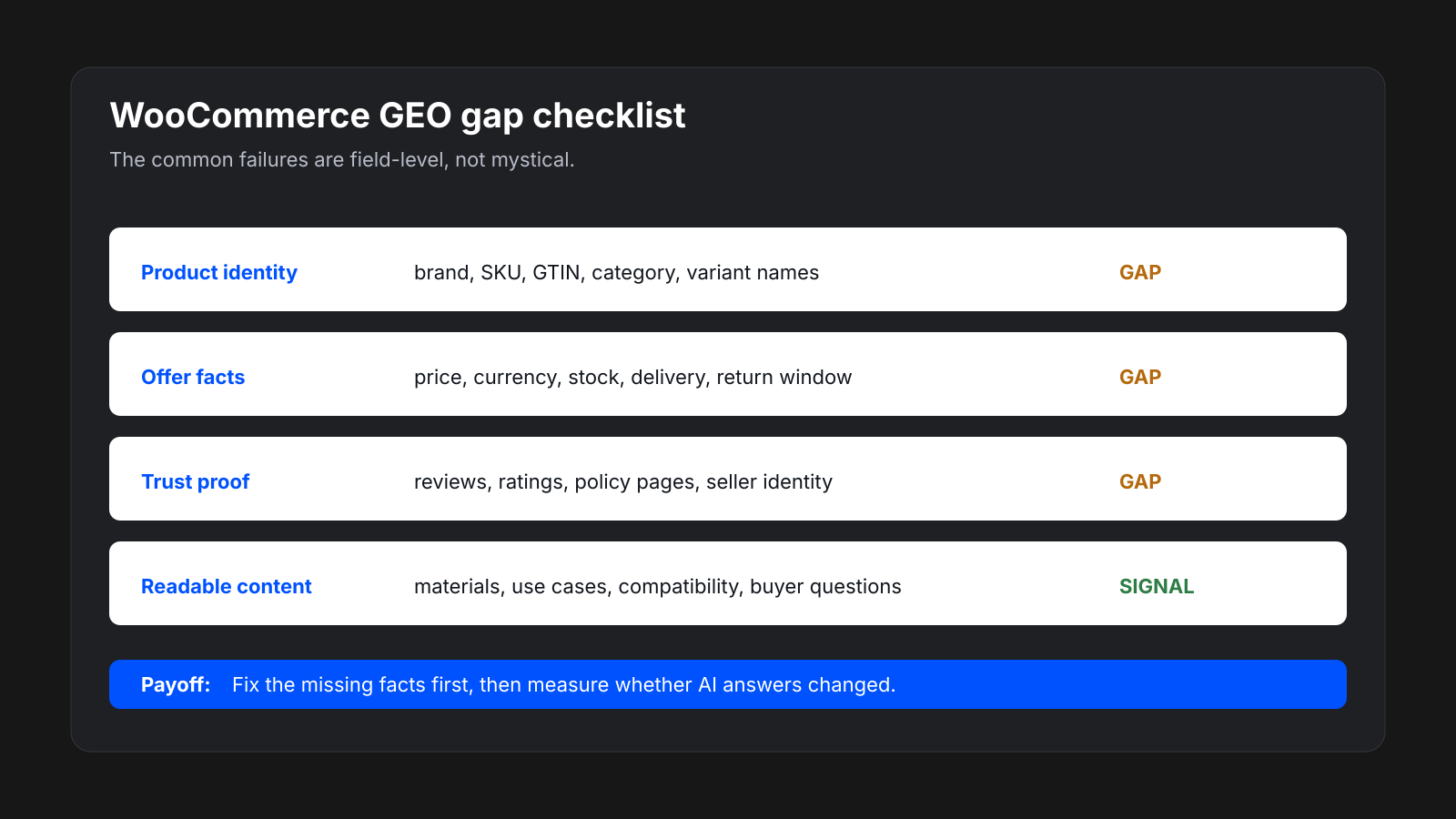
The first pass is boring in the best SEO sense: make the facts unmissable. Start with product identity: product name, brand, SKU, GTIN or MPN, variant names, category, material, size, compatibility, and use case. Schema.org Product, verified as of July 16, 2026, defines identifiers such as GTIN as product properties, and Google uses product identifiers in shopping surfaces.
Then move to offer and merchant facts. Google's Product structured data documentation, verified as of July 16, 2026, names price, availability, review ratings, shipping information, and related shopping details as product data that can appear in richer Search experiences. For WooCommerce, that usually means checking the rendered page source, not just the plugin settings. If a fact matters to a buyer, it needs a readable home.
| Layer | WooCommerce fact to verify |
|---|---|
| Product identity | brand, SKU, GTIN or MPN, category, variant name |
| Offer data | price, currency, stock status, shipping, return window |
| Trust proof | reviews, rating text, seller identity, policy pages |
How schema and feeds fit together
Schema is the on-page contract. Feeds are the catalog contract. Google says merchants can provide product data through structured data, Merchant Center feeds, or both, while OpenAI's Agentic Commerce product feed reference, verified as of July 16, 2026, says a structured feed helps ChatGPT index and display products with current price and availability.
That is why schema alone is the wrong finish line. It helps systems read product and offer facts on the page. A feed gives shopping systems a cleaner catalog layer. Merchant policy markup adds shipping and return context; Google's merchant listing docs, verified as of July 16, 2026, define OfferShippingDetails and MerchantReturnPolicy for exactly those facts. Your job is consistency: page, schema, feed, and policy should agree.
How to measure whether AI can read it
WooCommerce's own AI shopping agents guidance, published June 29, 2026 and verified July 16, 2026, recommends monthly manual tests in ChatGPT or Perplexity and regular schema validation with Google's Rich Results Test. That is the right instinct: measure the answer, then fix the data.
Use a fixed prompt set for your top products. Ask where to buy, best place to buy, authentic product, cheapest place, and free-shipping style questions across the same engines each month. Mention Network's shipped AI Visibility Check does this for the Shopify channel today: 5 buyer intents across ChatGPT, Gemini, Google AI Mode, and Claude, which creates 20 raw answer receipts for 1 product, 1 location, and 1 language. WooCommerce support is on the roadmap, so Woo merchants can use the same measurement pattern manually for now.
What to ship this week
Ship 5 fixes before you buy another plugin.
- Validate 3 top product pages in Google's Rich Results Test and save the errors.
- Inspect the rendered JSON-LD for brand, SKU, GTIN or MPN, price, currency, availability, reviews, shipping, and returns.
- Export or audit your product feed and compare the same fields against the page.
- Rewrite the top product pages so buyer facts appear in visible copy: material, sizing, compatibility, use case, delivery, and return terms.
- Run 10 manual shopping prompts and record whether the answer names your store, cites your page, or names a competitor instead.
If you already run Shopify alongside WooCommerce, you can run a free check to get product-level answer receipts from Mention Network while the Woo channel is still in the roadmap stage.
The bigger architecture sits in the broader GEO cluster. Use GEO vs SEO for ecommerce to keep the SEO and answer-engine work straight, the WooCommerce AI visibility checklist for a deeper platform audit, the Product Visibility pillar for store-level measurement, and the GEO pillar for the full framework.
Frequently asked questions
What is GEO for WordPress WooCommerce?
GEO for WordPress WooCommerce is the work of making WooCommerce product pages, structured data, feeds, merchant policies, reviews, and proof readable enough for AI shopping and generative search systems to use.
Does WooCommerce include product schema?
Yes. WooCommerce has native structured data generation for Product, Review, BreadcrumbList, WebSite, and Order data types, but merchants still need to check whether their theme, plugins, feed, and custom fields expose the facts shoppers and AI systems need.
Does schema alone improve AI citations?
Schema is hygiene, not a citation guarantee. It helps systems read product and offer facts, while citations still depend on crawlability, feed eligibility, page usefulness, merchant trust, and whether AI answers actually name the store.