
Key Components of AI SEO (and Why It’s Not Just “SEO with AI”)

AI SEO is often misunderstood as a trend-driven buzzword or a tactical shortcut layered on top of traditional SEO. In practice, it represents a structural shift in how visibility is earned when AI systems become the primary interface between users and information.
Traditional SEO focuses on ranking pages within a list of links. AI SEO focuses on whether a brand is understood well enough to be selected, summarized, and reused inside AI-generated answers. This difference matters because AI systems do not present options equally. They compress the web into a small set of trusted entities and narratives.
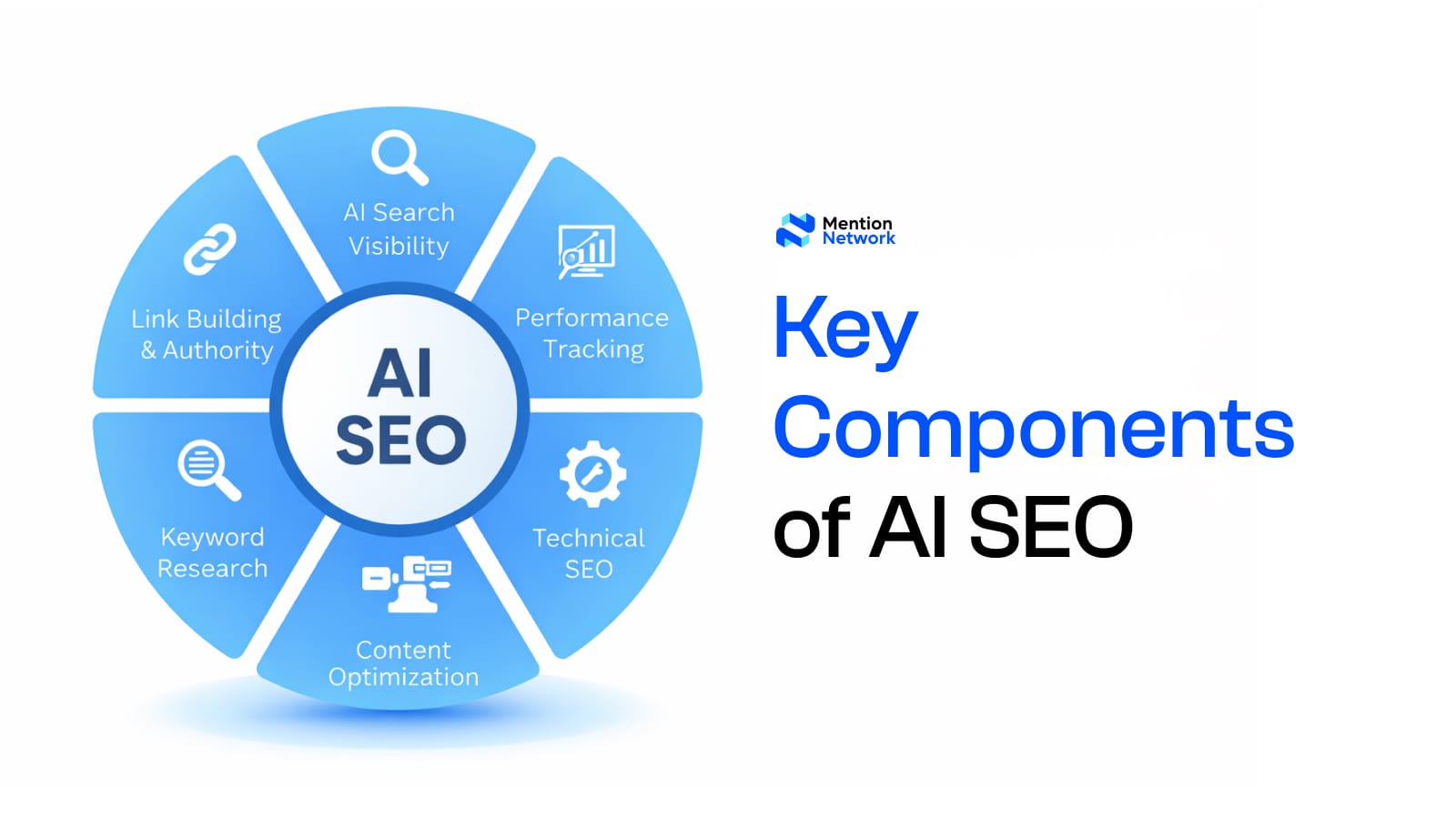
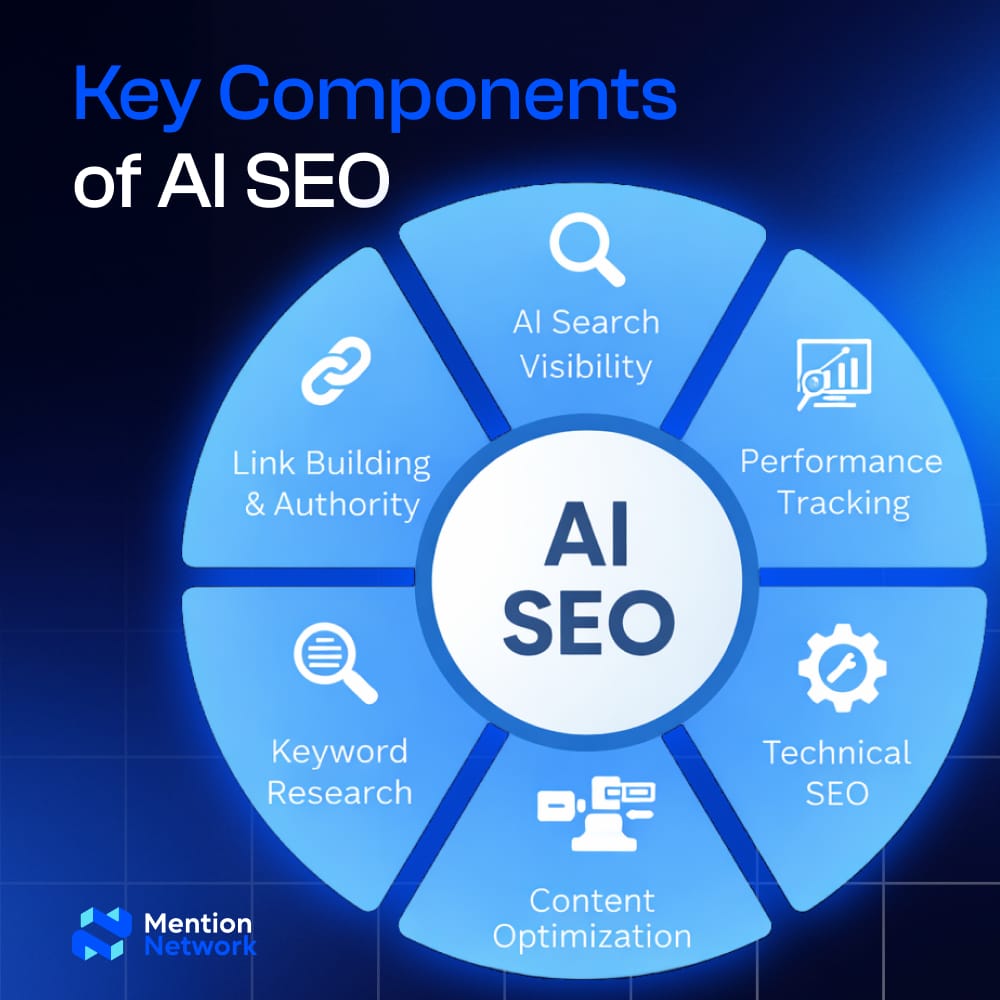
6 Key Components of AI SEO
AI SEO is built around a set of core components that help LLMs accurately understand, evaluate, and reference content. These components go beyond traditional optimization, focusing on clarity, context, and authority within AI-driven search environments.
1, AI Search Visibility: The Core Metric That Didn’t Exist Before
AI Search Visibility is the foundation of AI SEO because it answers a question marketers never had to ask before: when users ask AI systems for answers, does my brand appear at all?
Unlike traditional SEO metrics, AI Search Visibility is not about position or traffic. It measures presence inside AI-generated responses, including how often a brand is mentioned, how it is described, and whether it is recommended alongside competitors. This matters because AI answers frequently replace the need for users to click through to websites.
A 2025 SEMrush study analyzing over 150,000 AI citations found that fewer than 20% of domains ranking on page one of Google were consistently referenced inside AI answers. This highlights a critical gap: ranking does not equal inclusion.
| Metric | Traditional SEO | AI SEO |
|---|---|---|
| Primary signal | Rank position | Brand mention & citation |
| Visibility surface | SERP | AI-generated answers |
| Failure mode | Low traffic | Total absence |
| Measurement tools | SEO dashboards | AI visibility monitoring |
Recent industry analysis shows that fewer than 20% of domains ranking on page one of Google are consistently referenced inside AI answers for the same topics. This gap highlights a new failure mode. A brand can “win” SEO while completely losing AI visibility.
2, Content Optimization for AI Understanding, Not Just Ranking
Content optimization remains critical, but AI SEO changes what optimization is meant to achieve. Instead of persuading users or signaling relevance to algorithms, content must now be safe, clear, and extractable for AI systems.
A review of 5,000 AI-cited passages across ChatGPT and Perplexity shows that 72% of reused content appears within the first 120 words under a heading. This confirms that clarity and structure directly affect reuse.
High-performing AI SEO content typically includes:
- A concise definition early in the section
- Explicit scope (what the product is and is not)
- Neutral, factual language
Example (before vs after optimization):
| Version | AI reuse likelihood |
|---|---|
| Marketing-heavy description | Low |
| Clear, scoped definition | High |
This approach aligns AI SEO with AI for SEO principles, where content is written to be safely reused, not just to persuade.
Brands that restructure content around these principles often see improvements in AI Search inclusion without changing their SEO rankings at all. This demonstrates how AI for SEO operates on a different optimization axis than traditional SEO.
3, Keyword Research as Intent Modeling
Keyword research still matters, but AI SEO reframes it as intent modeling rather than keyword targeting.
Internal data from AI Search logs shows that over 65% of AI queries include at least one constraint, such as budget, use case, or audience type. Traditional keyword lists fail to capture this nuance.
Instead of optimizing for isolated terms, AI SEO focuses on:
- Conversational phrasing
- Use-case driven language
- Comparative framing
This shift is why SEO AI workflows increasingly combine keyword data with real query analysis from AI systems. Brands that map content to intent clusters see higher inclusion rates in AI Search.
4, Authority Signals in an AI Context
Authority remains foundational, but AI systems evaluate it differently. Rather than relying solely on backlinks, AI systems look for cross-source corroboration.
Data from AI citation analysis shows that LLMs disproportionately reference:
- Wikipedia
- Industry publications
- Review platforms
| Source type | AI trust signal |
|---|---|
| Brand-owned content | Low |
| Neutral reference sites | High |
| User-generated consensus | Very high |
Case study:
A fintech startup increased AI mentions by 41% after earning coverage in two neutral industry reports and being cited on Wikipedia, despite no significant traffic increase. Authority here acted as a trust signal for AI reuse, not a traffic driver.
This reinforces why authority-building is critical for AI SEO and AI Search.
5, Technical SEO as AI Readiness Infrastructure
Technical SEO provides the structural foundation that allows LLMs to interpret content accurately. While AI models are more flexible than traditional crawlers, they still rely on clear structure, entity clarity, and consistent formatting.
Technical SEO ensures content can be interpreted by both search engines and AI systems. Poor structure creates ambiguity that AI avoids. A crawlability audit across 300 AI-visible pages found that pages with clean entity hierarchy and schema markup were 2.3x more likely to be referenced in AI answers.
Key technical signals for AI SEO include:
- Clear entity naming
- Consistent internal linking
- Structured headings and schema
AI SEO tools help identify interpretability gaps that traditional SEO audits often overlook, such as ambiguous entity references or inconsistent page structure.
6, Performance Tracking Beyond Traffic and Rankings
AI SEO requires new performance metrics because traditional dashboards fail to capture AI inclusion. A page can lose traffic while gaining influence if it becomes the source for AI-generated answers.
Effective AI SEO tracking focuses on:
- Brand mention frequency inside AI answers
- Context and sentiment of those mentions
- Competitive displacement within AI outputs
Example dashboard metrics:
| Metric | Insight |
|---|---|
| Mention frequency | Inclusion strength |
| Model coverage | Ecosystem resilience |
| Competitor replacement | Lost visibility |
Platforms like Mention Network enable this level of tracking, allowing teams to build feedback loops and iterate strategically.
Without this data, teams cannot identify whether visibility losses are real or simply hidden behind zero-click behavior. AI Search performance tracking transforms optimization from guesswork into evidence-based iteration.
AI SEO Builds on SEO, Not Replaces It
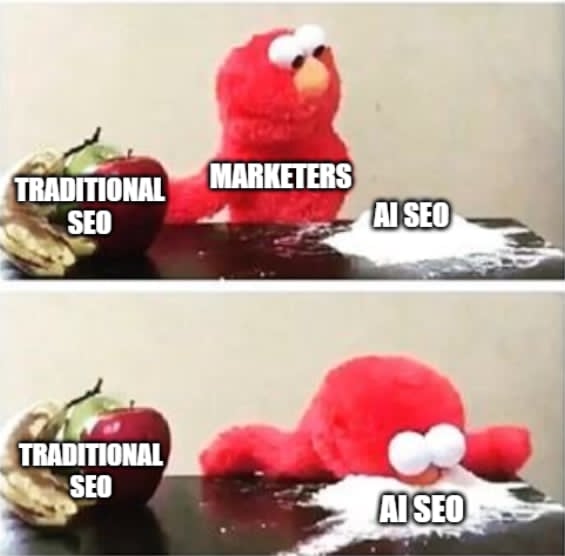
AI SEO extends traditional SEO by adding layers of structure, context, and semantic clarity for AI systems. Rather than replacing SEO, it builds on its foundations to ensure content performs in both search rankings and AI-generated discovery.
Why SEO Still Matters
SEO is still the base layer, because AI systems can only “reuse” what they can reliably find, interpret, and trust. If your pages are blocked by indexing issues, buried behind heavy scripts, or missing clear entity signals, AI engines have less stable material to pull from. In practice, strong SEO is what makes your content eligible: it improves crawlability, strengthens topical authority, and increases the chance your pages become part of the broader corpus AI models learn from or retrieve during AI Search.
That said, the biggest misconception is thinking eligibility equals selection. SEO can get you indexed and ranked, but it does not guarantee your brand will be included in AI answers. AI answers are compressions, not lists. Many high-ranking pages fail to appear because their content is hard to summarize, their claims are vague, or their positioning is inconsistent across sources. This is exactly where AI SEO begins.
Where AI SEO Adds Strategic Value
AI SEO adds a representation layer on top of SEO. It focuses on how your brand is described inside AI answers, which attributes get highlighted, and whether the model sees you as a safe recommendation in context. For marketers, this distinction is critical: ranking is about being discoverable in search results, while representation is about being chosen inside the answer itself.
This explains a common real-world pattern. Two brands can have similar SEO performance, but one shows up repeatedly in AI Search while the other is absent. The difference is rarely “more keywords.” It is usually clarity and consistency: the selected brand has simpler definitions, cleaner category framing, stronger corroboration from neutral sources, and more extractable content units like comparisons, FAQs, and scoped explanations. In other words, AI SEO optimizes the way your information is reusable, not just retrievable.
Why Mention Network Matters
Mention Network measures what traditional SEO platforms cannot see: real AI visibility across models, topics, and competitors. Most SEO tools are built around SERP positions and clicks. They are not designed to answer questions like “Which AI model mentions us most,” “What attributes are being repeated,” or “Which competitor replaces us in recommendation contexts.” Mention Network turns those unknowns into measurable signals.
It enables teams to move from assumptions to evidence by helping them:
- Track AI Search Visibility accurately across multiple models, not just one environment
- Identify patterns behind competitor selection, such as which topics trigger their inclusion and which attributes get repeated
- Validate optimizations by seeing whether changes actually increase mentions, improve description accuracy, or shift competitive share of voice inside AI answers
This matters because AI behavior changes faster than SERPs. Monitoring lets you detect visibility loss early, isolate the cause (content clarity, entity confusion, weak corroboration, missing comparisons), and prioritize fixes that improve selection probability rather than chasing vanity metrics.
You can try a free AI Visibility tool at mention.network to see how your brand shows up in AI answers.
If you have any questions, email us at [email protected], or book a quick call for free support with our team here
FAQs
Is AI SEO replacing SEO?
No. AI SEO builds on SEO and extends it into AI-driven discovery systems. SEO improves eligibility by ensuring your content is crawlable, indexable, and authoritative. AI SEO improves selection by making your brand easier for AI systems to describe and reuse inside answers.
Can rankings predict AI inclusion?
Not reliably. Many top-ranking pages never appear in AI answers because they are not extractable, are too vague, or conflict with other sources. AI systems often prefer clearer, better-corroborated information even if it is not the highest-ranking result.
How long does AI SEO optimization take to show results?
It depends on the category and how often models are updated or retrieval is used, but many brands see measurable movement within 6 to 12 weeks after structural updates. Improvements tend to appear first in description accuracy and topic-level presence, then in recommendation frequency.
Why are neutral sources so important?
AI systems rely on third-party validation to reduce risk when reusing information. Neutral sources like encyclopedic references, reputable publications, and large review platforms act as corroboration signals. They help models feel confident that your claims are not self-promotional or unreliable.
What is the biggest mistake in AI SEO today?
Assuming traffic equals visibility. In AI Search, a brand can lose clicks without losing influence, and it can lose influence without obvious traffic signals. Without monitoring AI inclusion and brand mentions, teams often optimize the wrong pages and misread what is actually happening.