
Shopify AI Visibility: What Agentic Storefronts Fix and What They Miss
Shopify Agentic Storefronts make eligible products available to AI shopping channels. The next job is checking whether AI actually recommends your store in buyer answers.

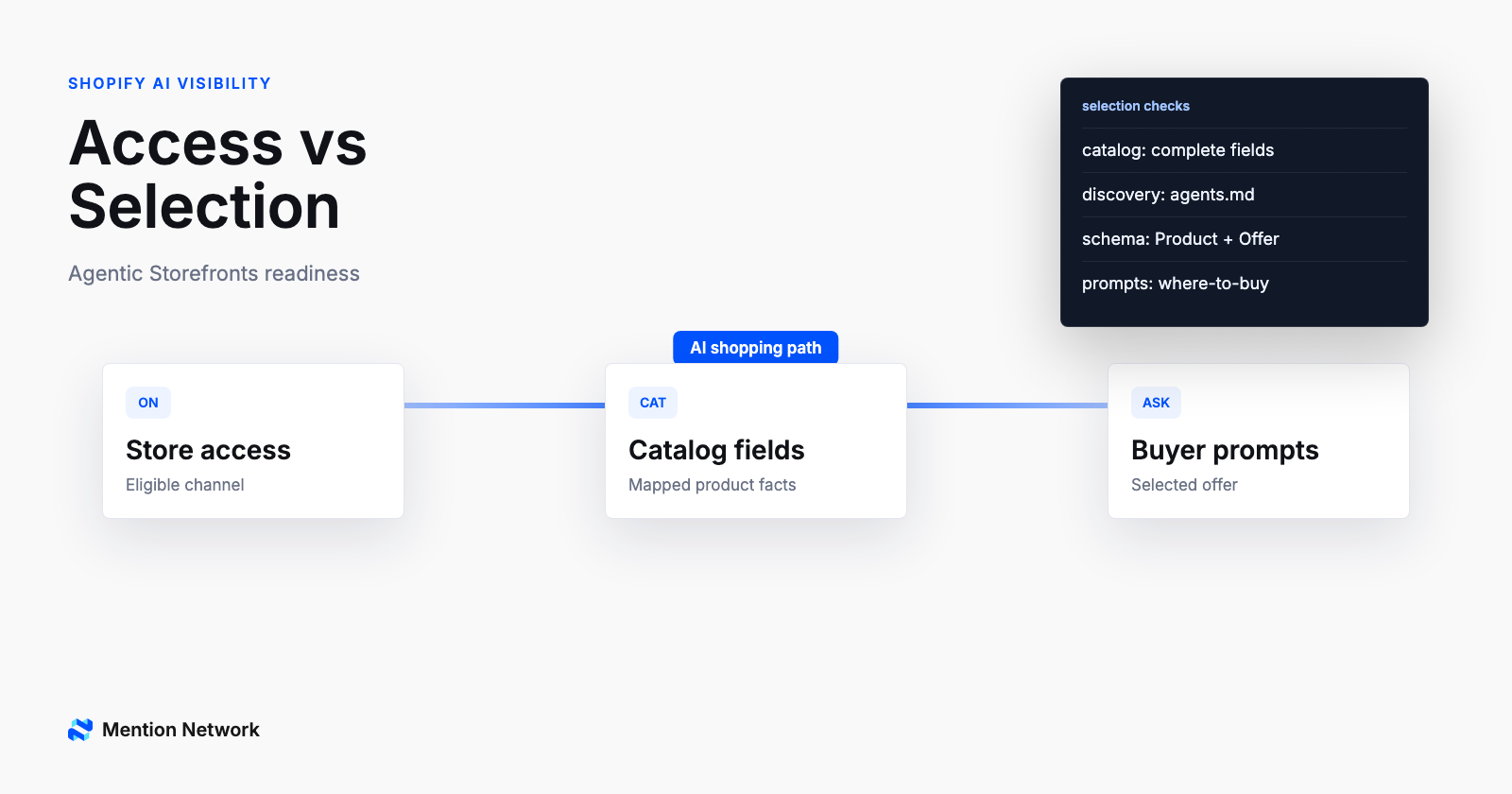
TL;DR Shopify Agentic Storefronts solve the access layer for eligible stores. Shopify Catalog gives AI channels structured product data. ChatGPT can find products as a discovery channel. UCP and MCP create paths toward agent-led carts and checkout. The open question is selection: when a shopper asks AI where to buy, does the answer pick your store? That has to be measured product by product.
What you'll learn:
- How I checked Shopify AI visibility
- What Shopify Agentic Storefronts fix
- What Shopify Catalog sends to AI channels
- What agents.md and llms.txt do
- What Agentic Storefronts still leave open
- Shopify SEO still matters, but the checklist changed
- The simple Shopify AI visibility workflow
- Where Mention Network fits
Platform facts in this guide were checked against Shopify Help Center, Shopify Dev, and OpenAI Developers on July 22, 2026. These pages change fast, so treat this as a dated working map.
How I checked Shopify AI visibility
I used these source groups:
- Shopify Help Center pages for Agentic Storefronts, Selling on ChatGPT, and Shopify Catalog product discovery.
- Shopify Dev docs for UCP, MCP, carts, and checkout.
- OpenAI's Product Feed Spec, which defines structured feeds for product discovery, pricing, availability, and seller context.
- Mention Network's product fact inventory for what the current AI Visibility Check can and cannot claim.
The split matters because Shopify, OpenAI, and Mention Network each cover a different layer. Shopify helps your product data reach AI channels. OpenAI's feed spec shows the shape of product data ChatGPT can ingest. Mention Network checks whether AI answers actually name your store.
What Shopify Agentic Storefronts fix
Shopify's Agentic Storefronts make eligible products available to AI channels such as ChatGPT, Google AI Mode and Gemini, Microsoft Copilot, and Meta. Shopify says the feature is active by default for eligible stores, and products are made available through Shopify Catalog or the relevant platform sales channels.
That fixes a real distribution problem. Before agentic commerce, a store mostly depended on pages, feeds, search engines, and marketplaces. Now Shopify has a first-party path for structured product data to flow into AI shopping surfaces.
For ChatGPT specifically, Shopify describes the channel as a discovery-focused referrer. Customers discover products through ChatGPT, then complete the purchase on the merchant's online store checkout inside the ChatGPT app browser or a web tab. Other channels can support Shopify-powered direct checkout when activated.
Channel availability and default-on behavior per Shopify Help Center, checked July 22, 2026.
That means the first win is eligibility and structured access. Your products can be presented to the systems that answer shopping questions.
What Shopify Catalog sends to AI channels
Shopify Catalog is the main pipe. Shopify says Catalog syndicates product title, description, options, images, price, availability, and other key attributes in a structure AI agents can parse and understand.
That field list is the practical checklist for Shopify AI readiness.
Catalog mapping also matters when your product data lives in metafields, metaobjects, tag prefixes, or custom grouping logic. A key attribute can sit outside the fields Catalog reads cleanly. In that case, an AI channel can get a thinner version of the product than a human sees in the admin. Clean Shopify structured data for AI reduces that gap.
What agents.md and llms.txt do
Shopify now serves /agents.md, /llms.txt, and /llms-full.txt automatically for stores. Shopify describes /agents.md as the canonical agent discovery URL, while the llms files support older crawler conventions.
Treat those files as store-level context. Shopify's own docs say these discovery files are separate from Shopify Catalog and do not replace Catalog capabilities.
Think of them as store-level context. They can tell an agent about your store name, policies, sitemap, and discovery endpoints. Catalog is still the product-data feed for agentic channels.
What Agentic Storefronts still leave open
Access is the first gate. Selection is the money question.
A product can be available through Catalog and still lose the answer. Take a shopper asking, "where can I buy waterproof trail shoes in Austin?" The AI answer may prefer another store. Maybe that store has clearer product data, stronger review signals, a better price and shipping profile, cleaner policies, or more corroboration across the open web.
Shopify gives the channel product data. The AI channel still ranks, filters, and presents options for a buyer's prompt.
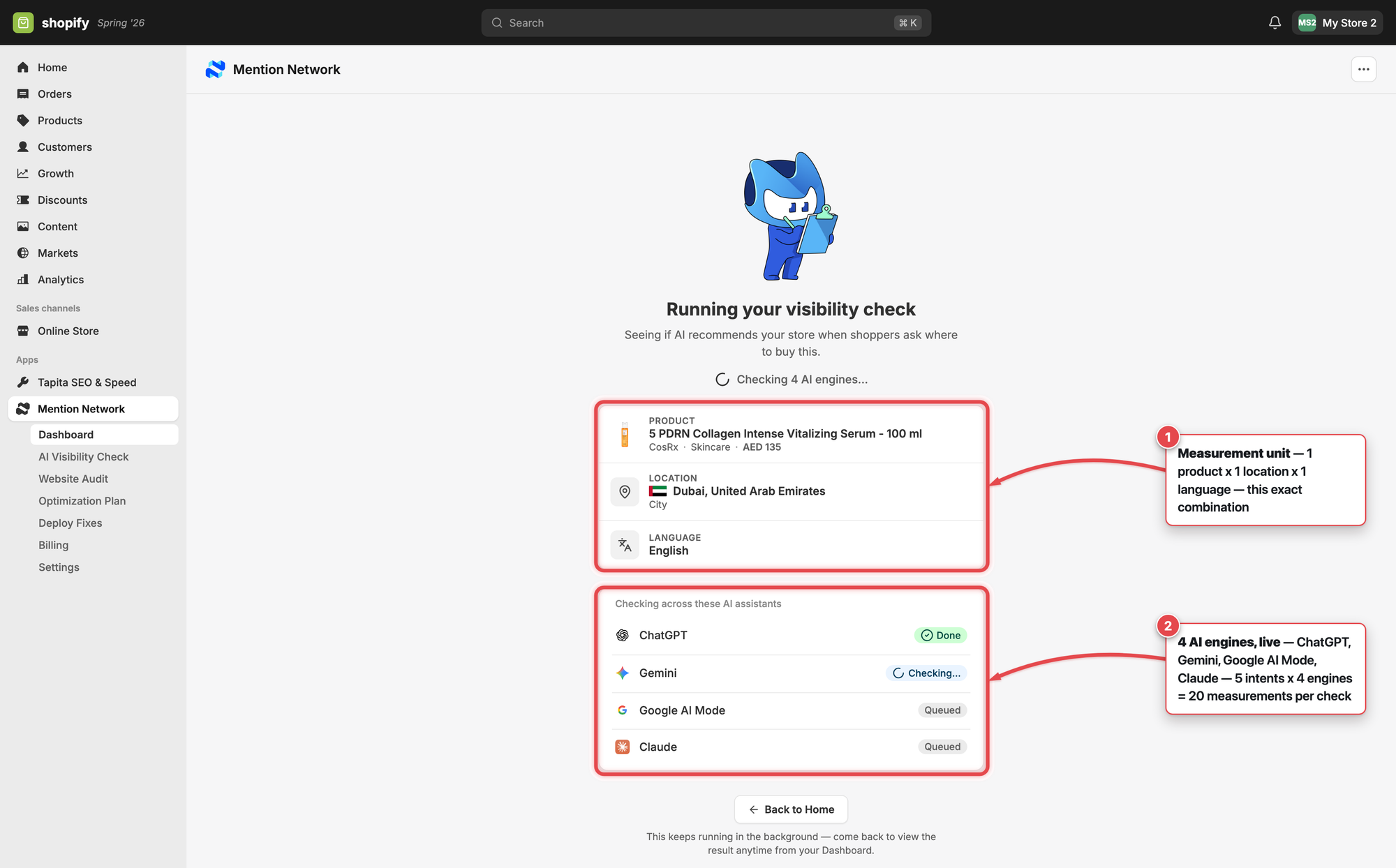
That is why a Shopify AI visibility check has to ask buyer questions and inspect setup. This is the AI product visibility layer. It measures selection, not access. Mention Network's current AI Visibility Check measures 1 product, 1 location, and 1 language at a time. Every 1 of 5 buyer intents runs against all 4 engines: ChatGPT, Gemini, Google AI Mode, and Claude. One product produces 20 answers with raw response evidence. You can see whether your store was named, where it ranked, and what the answer said.
Shopify SEO still matters, but the checklist changed
Classic Shopify SEO focused on pages: title tags, collection structure, schema, internal links, page speed, and indexing. Keep that work. AI channels still use the open web, search indexes, feeds, and structured data.
The new checklist adds product-level questions:
- Does Shopify Catalog have the right product facts?
- Do AI channels see the same price, availability, variant, and seller context across surfaces?
- Does the answer actually name your store for buyer prompts?
The third question is the one most setup guides skip. A setup guide can tell you that a product is eligible. It cannot tell you that ChatGPT, Gemini, or Google AI Mode selected your store for the shopper's question this week.
The simple Shopify AI visibility workflow
Run this in order.
Check Catalog fields
Open your best-selling product and inspect the fields that AI channels need: title, description, variants, images, price, and availability. If the brand or model is buried in custom fields, map it into Catalog properly.
Check discovery files
Open /agents.md, /llms.txt, and /llms-full.txt on your store. They should describe the store cleanly and point agents to the right discovery paths. Treat this as store context, not product optimization.
Check channel eligibility
In Shopify admin, review Sales channels > Agentic. Confirm which channels are active for your store and products. For ChatGPT, Shopify says eligible stores are active by default, but requirements still apply, including United States selling eligibility, Catalog eligibility, accepted supplemental terms, and completed policies.
Run buyer prompts
Pick a few products that matter commercially. For each one, test these where-to-buy questions in the market you care about:
- where to buy [product] in [location].
- best place to buy [product] online in [location].
- where to buy authentic [product].
- cheapest place to buy [product].
- where to buy [product] with free shipping in [location].
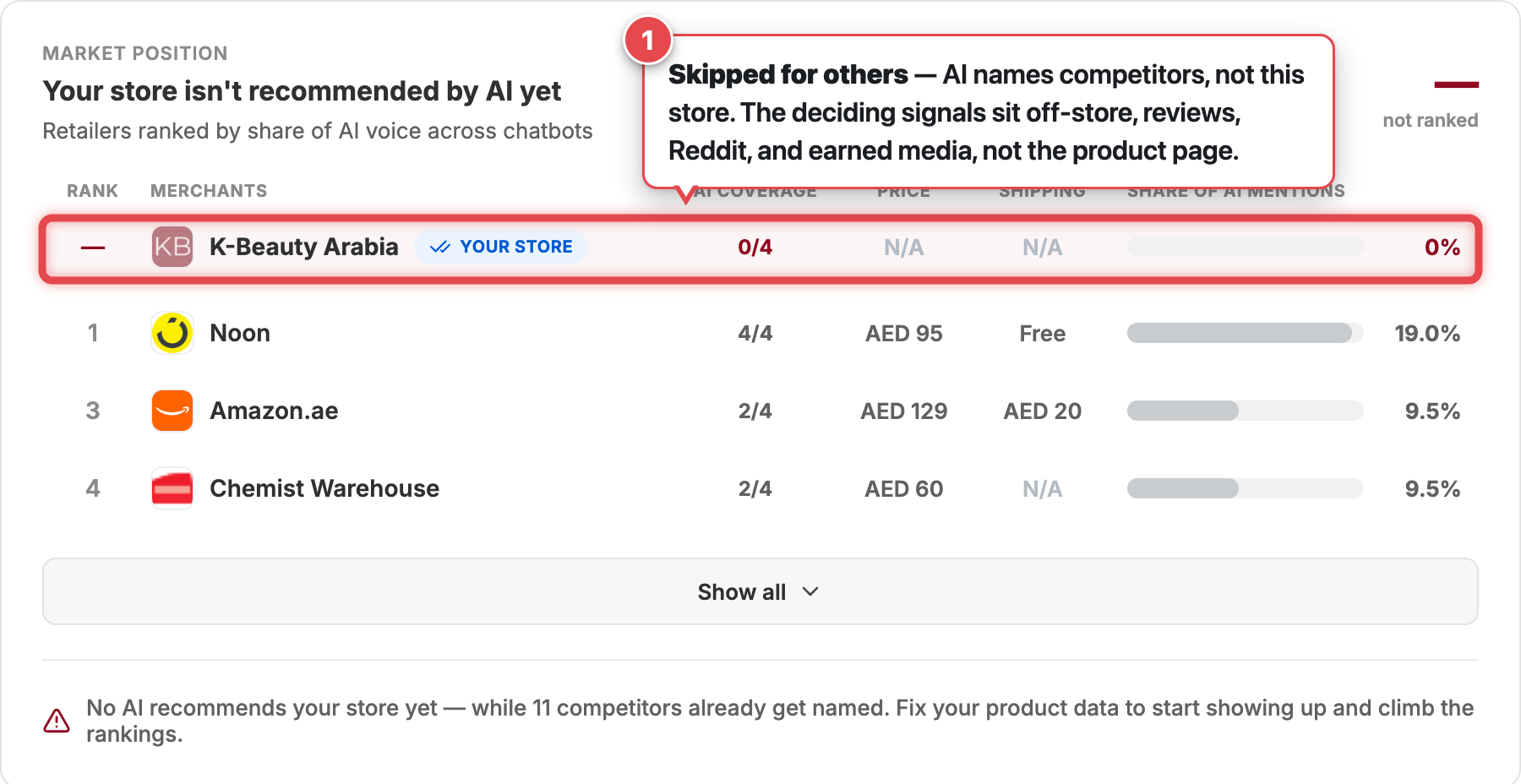
If your store is absent, the next job is diagnosis. Catalog access did its part. Something about the answer's selection criteria still points elsewhere.
Compare the raw answers
Do not average the problem away too early. Read the raw answers. Which competitors appear? Which sources does the assistant cite? Does the answer trust your store's price, shipping, policies, and availability? Does it confuse your product with another brand?
That is where Shopify AI visibility becomes operational. You move from "are we connected?" to "why did this answer choose them?"
One limitation: this is a platform-docs snapshot, not a live ranking study. Shopify can change eligibility and channel behavior. AI answers can change by product, market, language, and week. The method still holds: verify access, then measure selection.
Where Mention Network fits
Mention Network is built for the measurement layer after Shopify setup. The current product does not claim to make a store transactable through UCP, run agent checkout, or deploy Shopify fixes automatically today.
It answers the narrower question a merchant needs first.
Does AI recommend your store and products in purchase-intent answers?
The current AI Visibility Check runs 20 measurements for a single product, location, and language, then shows the raw answers. The roadmap loop after that is Audit, Plan, and Deploy, but the shipped starting point is the check.
Start here:
- Use Shopify Catalog and Agentic Storefronts to get eligible product data into AI channels.
- Use clean product data, policies, feeds, and schema to reduce ambiguity.
- Run a free check to see whether AI actually names your store.
That last step is the one that turns Shopify AI from setup work into a revenue signal.
Frequently asked questions
Do Shopify Agentic Storefronts guarantee AI visibility?
No. They make eligible products available to AI channels through Shopify Catalog and related sales channels. Availability is different from selection. A merchant still has to check whether the AI answer names the store for real buyer prompts.
What does Shopify Catalog fix for AI shopping?
Shopify Catalog gives AI channels structured product data. Shopify names title, description, options, images, price, availability, and other key attributes as fields that can be structured for AI agents to parse.
Is ChatGPT direct checkout available through Shopify?
Shopify's ChatGPT help page describes ChatGPT as a discovery-focused referrer. Customers complete purchases through the merchant's online store checkout inside the ChatGPT app browser or in a web tab. Shopify direct checkout settings apply to other AI channels when activated.
What should I measure after enabling Agentic Storefronts?
Measure whether AI names your store for purchase-intent questions around specific products, locations, and languages. The useful unit is not "is my Shopify setup active?" It is "does AI pick my store when a shopper asks where to buy?"