Profound Alternatives for E-commerce (2026): 6 Tools Compared
Profound built its reputation on enterprise AI-visibility monitoring. That fit doesn't match every merchant, and priced-for-enterprise wasn't every team's plan. Six alternatives worth evaluating, ranked by the job you actually need done.

Profound built a real category around enterprise AI-visibility monitoring, and it deserves credit for that. Its Series A of $35M in mid-2025 (per the widely-reported TechCrunch coverage) put a floor under the enterprise-AI-search category and pulled a wave of alternatives up alongside it. For a Fortune 500 marketing team with a GEO practice and procurement processes, it's a credible pick.
Everyone else runs into the friction. Sales-led evaluations. Annual contracts that start in the mid-four-figures monthly and climb. Reporting breadth tuned for people who report up, not people who fix things. G2's own alternatives page for Profound (July 2026) lists Semrush, Scrunch AI, and BrightEdge as the three top-of-mind competitors, a signal that the buyers making the switch skew enterprise rather than merchant. The six alternatives below are grouped by the specific job you're trying to do: merchant-first store visibility, mid-market brand tracking, budget entry, or AI signals bundled into a suite you already pay for. Same table at the bottom for scan-reading.
How they stack up:
- Why teams look for a Profound alternative
- What to look for in a Profound alternative
- The 6 alternatives, ranked
- At-a-glance comparison
- Which alternative fits your team
- Where Mention Network fits (honest disclosure)
Why teams look for a Profound alternative
The switch pattern shows up in the same five places, over and over.
1. Pricing floor. Third-party reviews put Profound's self-serve entry around $99/mo and its highest self-serve tier around $499/mo before you hit an enterprise custom quote. For a mid-market brand tracking one category, that's fine. For a Shopify store checking whether AI recommends 200 SKUs, the numbers don't square with the value returned.
2. Sales-led evaluation. Larger commitments route through demos and quotes even at the self-serve end. Most merchants who searched "profound alternative" hit that friction and bounced. If your decision cycle is "let me see the tool this afternoon," Profound's motion isn't built for it.
3. Brand-level, not product-level. Profound tracks whether AI mentions your BRAND across engines, the metric enterprise reputation teams care about. Merchants sell products. A brand-level number averaged across 200 SKUs hides which specific product is losing the recommendation, and the product page is the layer you can actually fix on a Tuesday morning.
4. Report-out, not fix-in. Profound is a measurement and reporting platform. The path from "you have a visibility gap" to "here's the change on the product page" is your team's project. For a merchant without an in-house SEO or content team, that gap between insight and action is where the tool stops delivering.
5. Enterprise engine coverage vs shopping intent. Profound covers a wide surface including Microsoft Copilot and non-shopping AI answer engines. Right shape for enterprise brand monitoring. For an e-commerce merchant, shopping-answer intent concentrates in four engines (ChatGPT, Gemini, Google AI Mode, Claude), and paying for coverage of the rest is often paying for a signal your revenue doesn't feel.
None of these are Profound doing something wrong. They're the shape of a tool purpose-built for enterprise buyers landing in a market of merchants who have a different job to be done. That mismatch is what the six alternatives below are built to close.
What to look for in a Profound alternative
Before ranking anything, it helps to be honest about what changes between a Profound-sized problem and a merchant-sized one. Four questions do most of the sorting.
1. Is the unit of measurement your brand, your products, or both? Enterprise tools like Profound track brand-level presence across AI answer engines. If you sell 200 SKUs, that layer is only half the picture. You also need to know whether AI recommends the specific product a shopper asks for, including where-to-buy answers.
2. Does the tool explain why you're not being picked? Measurement without diagnosis is a dashboard, not a repair kit. If your visibility number falls but the tool can't tell you which product page, schema field, or catalog attribute is causing it, you'll spend the fix time reverse-engineering.
3. Where does the fix land? Some tools export recommendations to a report you hand off to an SEO team. Others draft the fix inline and apply it to your live store admin with your approval. The second shape is faster for merchants without in-house SEO capacity.
4. What's the entry motion, and what's the total cost? A free check-up de-risks trial. A demo-gated enterprise tool assumes intent before evidence. When you also account for the SEO subscription you already run, the total AI-visibility layer cost changes whether you're stacking or replacing.
These four criteria apply to every tool below. The ranking follows them.
The 6 alternatives, ranked
1. Mention Network: Best for e-commerce merchants
Mention Network is the AI-visibility platform purpose-built for e-commerce. It runs inside the Shopify admin as an embedded app (Polaris), not a separate dashboard you switch tabs to. The differentiating shape is a four-phase workflow: measure the gap, diagnose it, draft the fix, deploy it. Every phase is designed to end on your product pages, not in a strategy deck.
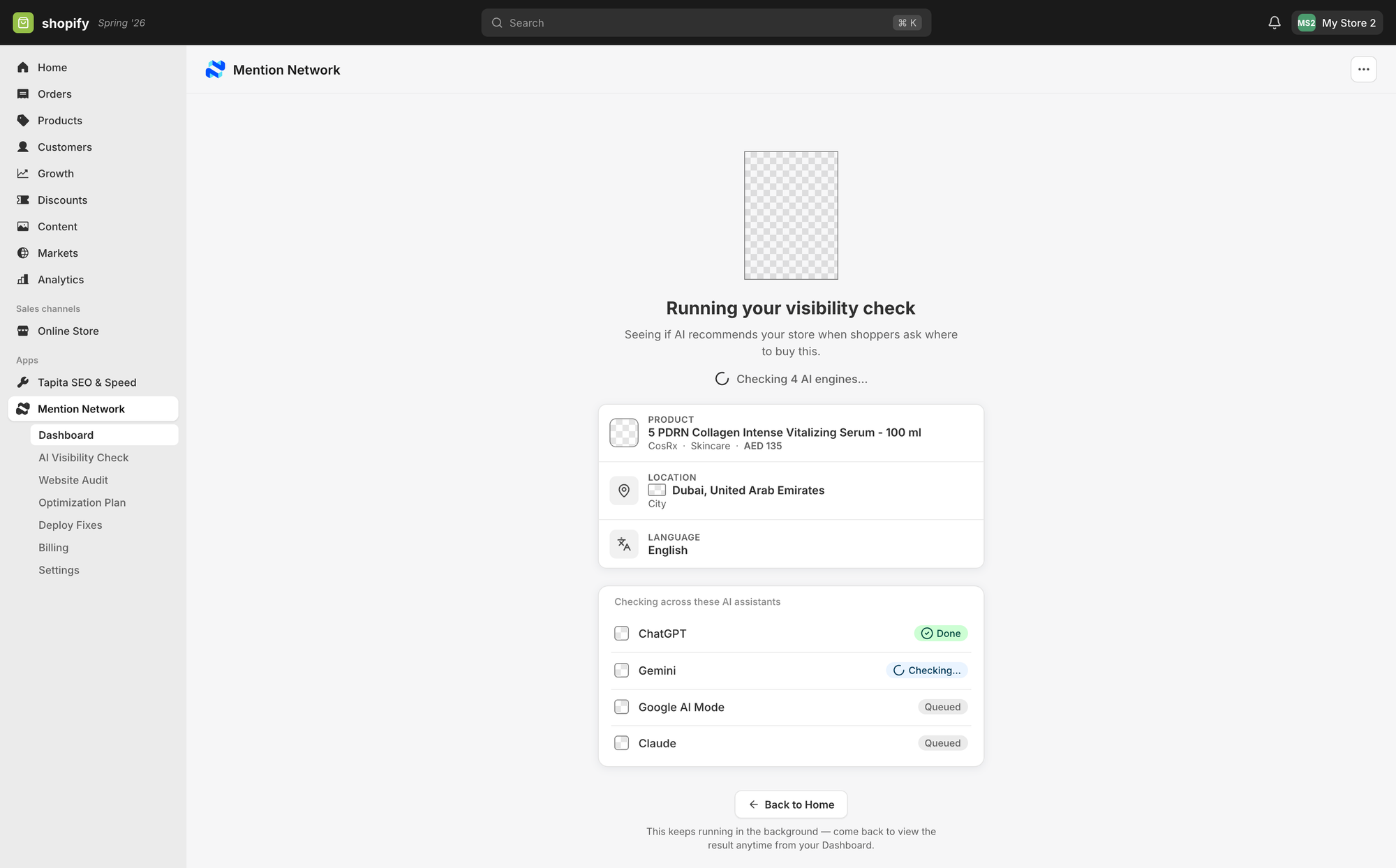
How each scan actually works. Pick a product from your live Shopify catalog (Admin API integration, no CSV import). Pick a single location (city or country, single-select) and language. The scanner then generates five shopper intents automatically for that product and runs each against ChatGPT, Gemini, Google AI Mode, and Claude: 20 LLM calls per product per scan. The five intents mirror how shoppers actually ask AI: where to buy [product] in [location], best place to buy [product] online, where to buy authentic [product], cheapest place to buy [product], and fastest shipping for [product]. That's the specific mechanism, not a marketing abstraction.
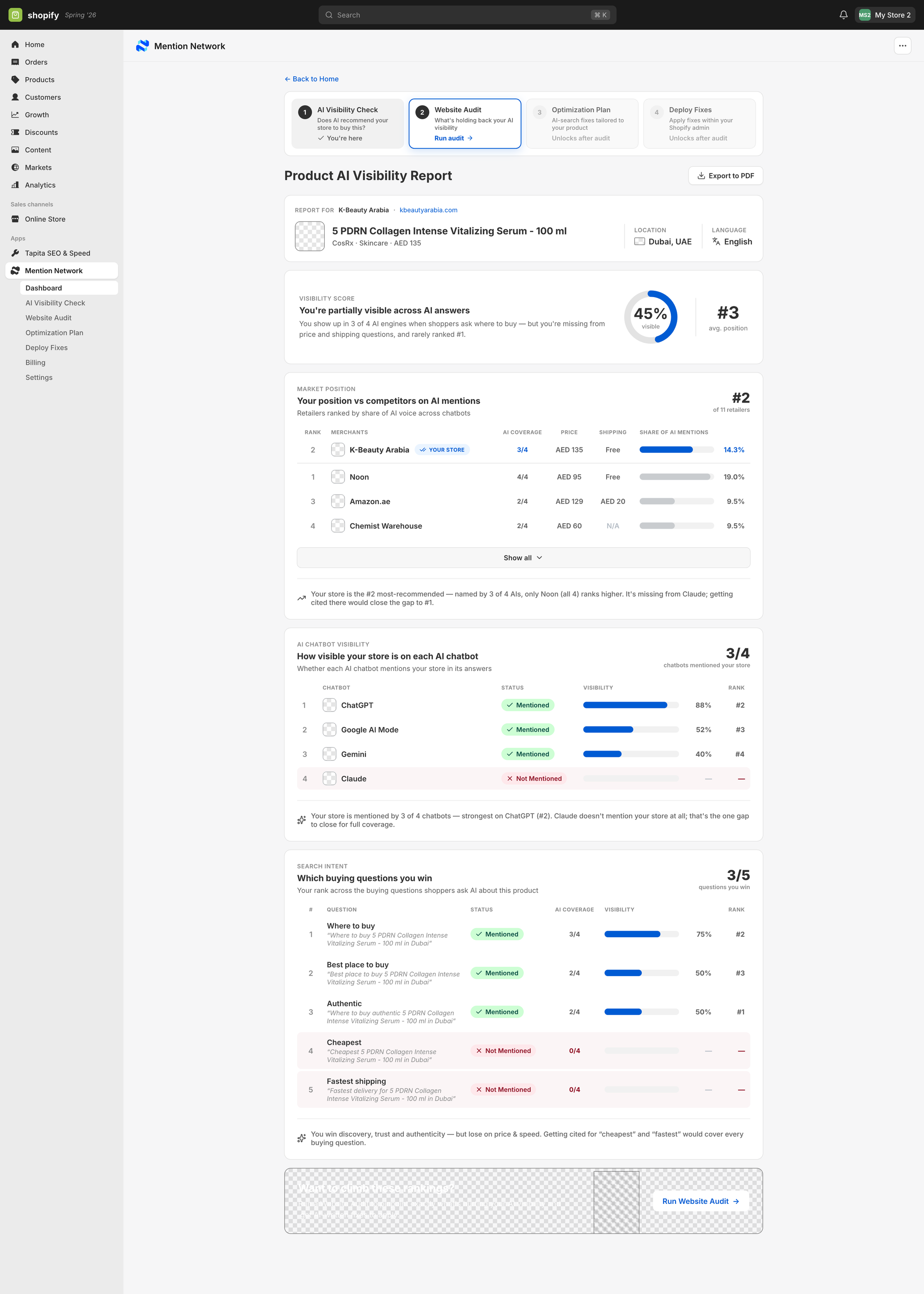
What the Visibility Report contains. Five metrics with specific names: Visibility Score (%): how many of the (5 intents × 4 engines) combos mentioned your store, with a tier verdict (Not Visible / Partially / Visible / Highly Visible). AI Coverage (x/4): how many engines named you at all. Share of Voice (SoV): your percentage of total store mentions in that category across all retailers. Chatbot Visibility: per-engine breakdown row. Search Intent: per-prompt breakdown row. And the piece none of the other tools ship: a Market Position table that ranks you and every retailer AI named alongside you by SoV, with price delta and shipping delta columns pulled from the same AI answers. You see who is beating you AND on what: cheaper, faster, or just more mentioned.
The audit is a 48-criterion framework. Phase 2 (Website Audit) grades your store against four factors: Discoverability (14 signals: schema, crawler access, structured data), Content Quality & Coverage (13 signals: product facts, decision support, AI-readiness), Entity, Trust & Authority (19 signals: reviews, mentions, backlinks), and Merchant Competitiveness (2 signals: price-competitive, shipping-competitive). That fourth factor is uniquely e-commerce. No other tool on this list checks whether your prices and shipping are within striking distance of the competitors AI is naming alongside you.
Best for. Shopify merchants (WooCommerce on the roadmap) who need product-level visibility, a store audit that explains why AI isn't picking you, and fix drafts they can approve inside the Shopify admin. Non-technical by design.
Pricing. Free starter credit covers the first check-up (1 product × 1 location × 1 language × 4 engines × 5 intents = 20 LLM calls). No card, no demo, no contract. Paid scaling runs on pay-as-you-go credits across the four phases.
Engine coverage. ChatGPT, Gemini, Google AI Mode, Claude, four fixed engines aligned to shopping intent. Perplexity, Copilot, and non-shopping surfaces are deliberately out of scope; the trade-off is depth-of-workflow over breadth-of-coverage.
Where it wins vs Profound. Product-level (SKU-level) tracking, not just brand-level. Store audit with 48 named criteria across 4 factors, including Merchant Competitiveness that no brand-level tool measures. On-store fix workflow inside the Shopify admin, no report handoff. Free entry with no card. Shopify Admin API integration for automatic product picking. Market Position table with price and shipping deltas.
Where Profound still wins. Enterprise reporting breadth for large marketing teams. Compliance posture for procurement. Broader engine coverage including Copilot and non-shopping AI surfaces. Non-Shopify channel coverage today. See our full Mention Network vs Profound writeup for the buyer split.
The measure → diagnose → fix loop inside your Shopify admin. Free starter credit, no demo, no contract.
2. Peec AI: Best mid-market brand tracker
Peec AI sits between Profound's enterprise posture and the budget tier. It ships daily tracking, competitor benchmarking, and multi-engine coverage aimed at mid-market brand teams, companies that outgrew the $29/mo entry tools but don't need enterprise procurement.
Best for. Mid-market brand teams tracking share of voice across ChatGPT, Gemini, and Perplexity, without a Shopify or e-commerce dependency.
Pricing. From around $99/mo for the entry plan, with higher tiers for larger prompt limits and daily-cadence tracking.
Where it wins vs Profound. Faster onboarding, more accessible pricing, self-serve trial. Solid stack integration story if you already run other marketing tools.
Where Profound still wins. Deeper enterprise features, wider engine coverage, more mature account management for large orgs.
3. Scrunch AI: Best structured enterprise alternative
Scrunch is often the sitepoint-style "if not Profound, then Scrunch" pick. It's structured, enterprise-grade AI monitoring built specifically as a dedicated AI-visibility tool rather than a module bolted onto an SEO suite.
Best for. Enterprise teams who want dedicated AI-visibility monitoring without merging it into a general SEO platform, but don't fit Profound's specific sales motion or price point.
Pricing. Enterprise contract, published pricing is limited; expect a demo cycle similar to Profound's.
Where it wins vs Profound. Optimization recommendations closer to the actionable end of the spectrum (rather than pure measurement).
Where Profound still wins. Longer market presence and reporting depth for the largest enterprise buyers.
4. Otterly AI: Best budget entry
Otterly is the low-cost multi-engine tracker most teams evaluate when Profound's price is a non-starter. Coverage is narrower than the enterprise tools, but for a solo founder or a small brand starting AI-visibility work from zero, it's the cheapest way to establish a baseline.
Best for. Solo founders, small brands, agencies running client pilots, anyone who needs a "does AI mention us at all" answer without a real budget.
Pricing. From around $29/mo, positioned explicitly as the budget entry point.
Where it wins vs Profound. Price. Fast setup. No procurement.
Where Profound still wins. Depth, reporting sophistication, engine breadth, and account support for teams that need those things.
5. SE Ranking (AEO mode): Best if you already pay for an SEO suite
SE Ranking added AEO tracking as a module inside its broader SEO platform. If your team already runs SE Ranking for keyword tracking, backlink audits, and site health, the AI-visibility layer is one more tab in the same dashboard.
Best for. SEO agencies and mid-market brands running SE Ranking today, who want a first AI-visibility signal without adding a new vendor to the stack.
Pricing. Bundled inside SE Ranking plans (starting around $65/mo for the SEO suite; AEO limits depend on tier).
Where it wins vs Profound. No new vendor, no new login, no new invoice. Traditional SEO plus AI visibility under one contract.
Where Profound still wins. Depth. A module inside a broader suite is rarely as sharp as a purpose-built platform.
6. Writesonic: Best if you want content generation bundled
Writesonic positioned itself as a Profound alternative by bundling AI-visibility tracking with content creation tools and an "Action Layer" that drafts content responses. If your team's real bottleneck is content velocity rather than measurement, the packaging can make sense.
Best for. Content-marketing teams who see AI-visibility measurement as the input to a content workflow they'd run anyway.
Pricing. From around $199/mo for plans that include AI-visibility features.
Where it wins vs Profound. Content generation bundled. Broader marketing utility if you're a small team that would otherwise buy separate tools for each job.
Where Profound still wins. Depth of pure measurement. Enterprise reporting. Focus (Writesonic's breadth is either an asset or a distraction depending on what you actually need).
At-a-glance comparison
| Tool | Best for | Pricing (Jul 2026) | Product-level tracking | On-store fix workflow | Entry motion |
|---|---|---|---|---|---|
| Mention Network | E-commerce merchants | Free check-up + pay-as-you-go | ✅ (SKU-level) | ✅ (Shopify admin) | Self-serve, no demo |
| Peec AI | Mid-market brand teams | From ~$99/mo | ❌ (brand-level) | ❌ | Self-serve trial |
| Scrunch AI | Enterprise-adjacent | Enterprise contract | ❌ | Partial (recommendations) | Sales-led |
| Otterly AI | Budget / solo | From ~$29/mo | ❌ | ❌ | Self-serve |
| SE Ranking (AEO) | SEO agencies | From ~$65/mo (suite) | ❌ | ❌ (report handoff) | Self-serve |
| Writesonic | Content teams | From ~$199/mo | ❌ | Partial (content draft) | Self-serve |
Numbers verified from vendor pages and third-party review sites on July 9, 2026; check current pricing before deciding. Profound itself lists pricing on request but published tiers referenced by third-party reviews sit in the ~$99 to $499/mo self-serve range with enterprise custom quotes above that.
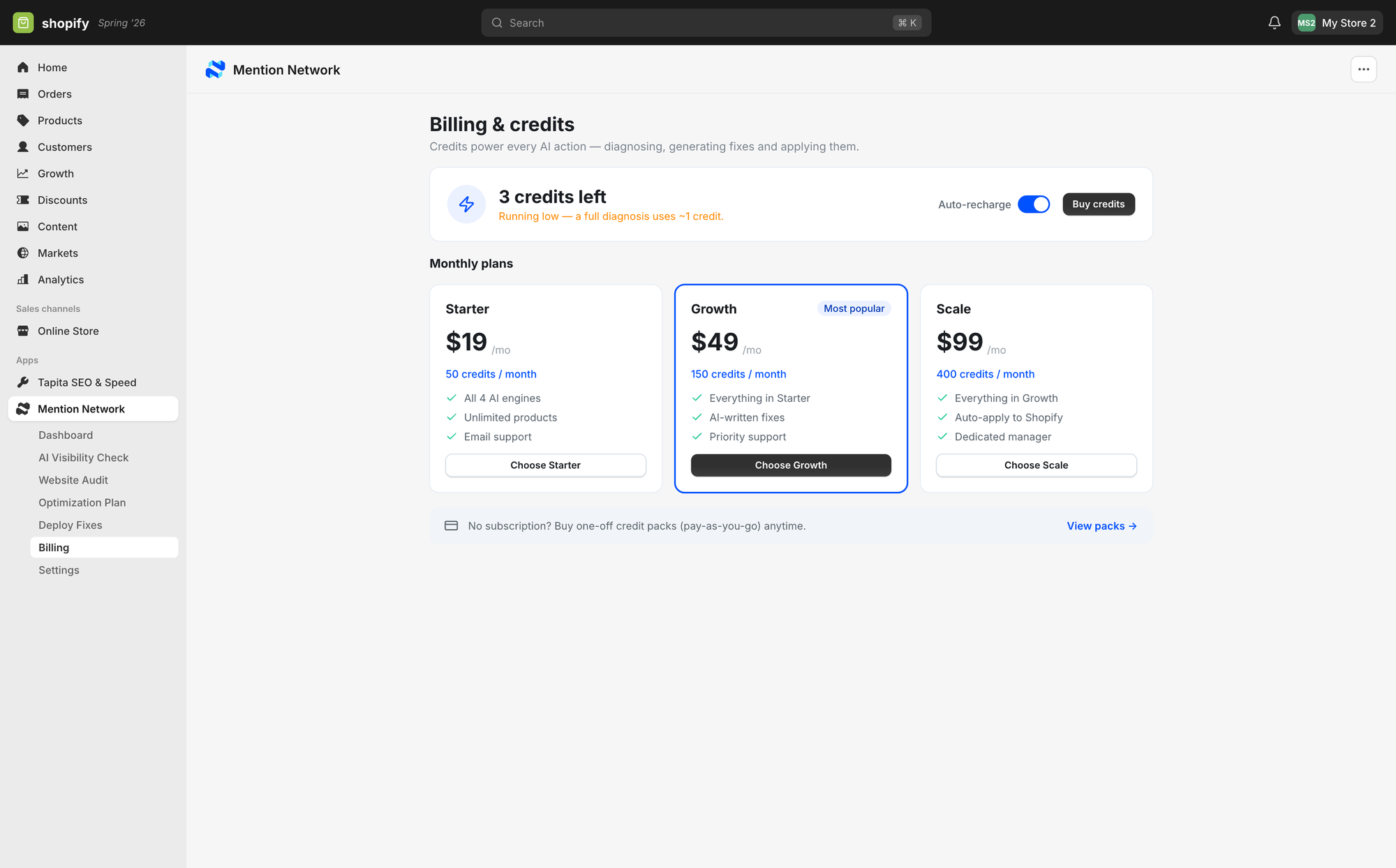
Pay-as-you-go inside the Shopify admin. First check-up runs on the starter credit, no card required, the shape of pricing you get when the buyer is a store owner instead of a procurement team.
Which alternative fits your team
The four evaluation questions from the top translate into a quick decision rule:
- You sell products through a Shopify store, and the problem is that AI isn't recommending them. Mention Network. This is the specific job it was built for, and it's the only tool on the list that runs the fix workflow inside the Shopify admin.
- You're a mid-market brand team tracking share of voice at brand level, and Profound's price is the friction. Peec AI. Similar shape at accessible pricing.
- You have enterprise buying process and Profound just doesn't click. Scrunch AI. Same enterprise posture, different execution.
- You want to establish a baseline for under $50/mo. Otterly AI. Not the deepest tool, cheapest way to start.
- You already pay for SE Ranking (or a similar SEO suite that added AEO). Add the module. Don't add a vendor if you don't need one.
- Content velocity is your bottleneck and you'd buy a content tool anyway. Writesonic. The bundled tracking is a bonus.
If more than one of these fits, the tiebreaker is usually the fix workflow: how much of the "now what?" happens inside the tool versus in a doc your team has to hand off.
Where Mention Network fits (honest disclosure)
Mention Network is my team's product, so treat the ranking above as informed but not neutral. What I'll stand by: the merchant-first fit is real. There isn't another tool on this list that runs measure → diagnose → fix inside the Shopify admin at the SKU level, and there isn't another one with a free entry-point check-up that doesn't require a card. If those are the shapes you need, we're the natural choice.
If you want a broader landscape read across other well-known tools, our head-to-head comparisons cover Mention Network vs Semrush (SEO suite with AI Visibility Toolkit) and Mention Network vs SimilarWeb (traffic intelligence). For the wider "what is AI visibility even" background, our complete guide to Generative Engine Optimization sets the frame.
Is AI recommending your store? The fastest way to find out is Mention Network's free check-up, no card, no demo.